The process of obtaining a GREEN CARD through a job is among the most established routes to obtaining a permanent residency in America.
If you are a professional with skills, an academic researcher, an executive of a multinational corporation or an investor there is most likely an employment-based category suited for you.
Still, the whole process is quite complicated & includes MANY different government agencies, various types of documentation & strict timelines.
If you are considering moving forward with your application, this will provide you with all the information you need to know!!
A foreign worker can reside & work in an indefinite capacity in the US, by virtue of his/her job skills, education or professional experience, via an Employment-Based Green Card. A US employer generally sponsors the worker by submitting a petition to the appropriate US governmental agency. When approved, the foreign employee obtains permanent residency status.
The US government divides employment-based Green Cards into five preference categories, commonly referred to as EB-1 through EB-5. Each has its own set of requirements & is designed for a different type of worker or investor.
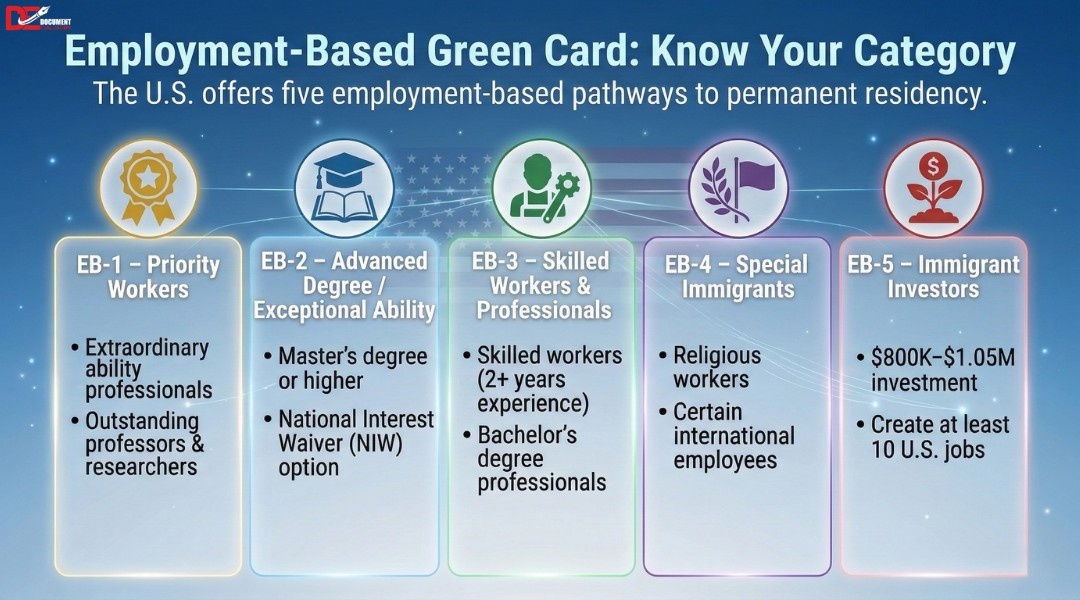
EB-1 (Priority Workers)
The top tier of the EB section is also generally the fastest.
Except for professors & researchers with international recognition, this category is reserved for individuals with extraordinary ability in their fields (science, arts, education, business, athletics) & multinationals.
One significant advantage to applying using EB-1 is that, in many cases, there is no job offer requirement & no Labor Certification is required.
Interested in applying under the EB-1 Extraordinary Ability category? Explore our complete guide to understand eligibility criteria, USCIS requirements, and how professionals qualify for the EB-1A Green Card.
EB-2 Professionals with Advanced Degrees or Exceptional Ability
The Master’s (or higher) degree holder & the person with exceptional ability in this category must qualify as either a Master’s or higher degree holder & an extraordinary ability to do the work performed. Additionally, the National Interest Waiver (NIW) is available for this classification to permit individuals who meet certain criteria to avoid the Labor Certification process, if their work is deemed to be in the national interest of the US.
Planning to apply under EB-2 or the National Interest Waiver (NIW)? Read our detailed guide explaining EB-2 eligibility, NIW requirements, and how professionals can apply without labor certification.
EB-3 Skilled Workers, Professionals, and Other Workers
This broadest type of employment-based immigration category encompasses skilled workers (those whose jobs require at least two years of training or experience), professionals (those whose jobs require a bachelor’s degree), & other (or unskilled) workers (those whose positions require less than 2 years of training). Almost always a job offer & labor certification are required for all employment based categories in the United States.
EB-4 Special Immigrants
EB-4 is a general classification that includes a number of different groups of individuals who qualify based on their unique circumstances. Examples include religious workers, employees of the US foreign service stationed abroad, some broadcasters, Iraqi or Afghan nationals who have worked for the US government & many others. Each subgroup falls under different eligibility criteria.
EB-5 Immigrant Investors
Foreign nationals can use the EB-5 Program to obtain Permanent Resident status (Green Card) in the US through an investment of at least $800,000 in targeted employment areas (TEA) or $1,050,000 in non-targeted employment areas through a new commercial enterprise that creates at least 10 full-time jobs directly or indirectly in the US.
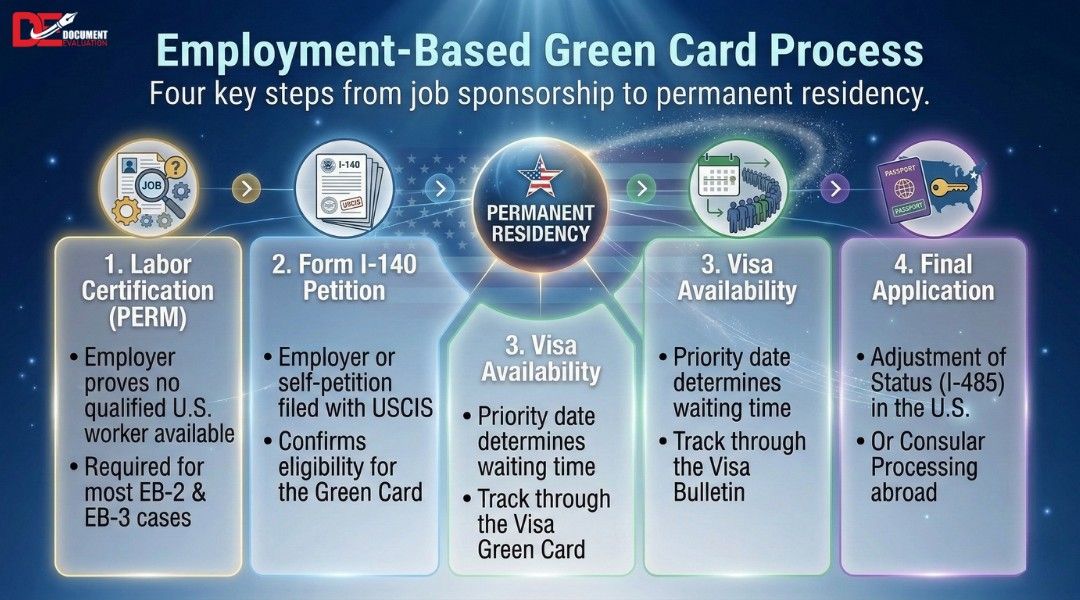
The path to an employment-based Green Card generally involves three main stages. Here is what each step looks like in practice.
1.Labor Certification (PERM)
In the majority of EB-2 & EB-3 requests, the initial part of the application is for the employer to get a PERM (Program Electronic Review Management) Labor Certification from the United States Department of Labor (DOL), which will indicate whether or not there are no qualified United States workers available for the job opportunity being offered to the applicant.
In order to obtain the PERM Labor Certification, the employer needs to do a formal recruitment process with job postings, job applications & show that there was an unsuccessful recruitment of any qualified United States applicant. This recruitment process can take several months or more than one year. Once the PERM Labor Certification has been obtained from the DOL, it will be valid for 180 days, during this 180-day period the employer must file the next step.
NOTE – EB-1 & some EB-2 NIW applicants do not require Labor Certification. Additionally, EB-5 Investors will skip this step as well.
2.Filing Form I-140 (Immigrant Petition for Alien Workers)
After PERM approval (or if not applicable) your employer or you (self-petition) files Form I-140 with USCIS.
3.Waiting for a Visa Number to Become Available
Each country has a cap on how many employment-based green cards are issued in a given year. Therefore, applicants from countries with such huge demand for employment-based green cards (like India & China) because it takes so long for applicants from these countries to receive their green cards due to the backlog that has developed in the employment-based green card program.
You can track the availability of visas each month through the Visa Bulletin published by the US Department of State. Once your priority date is reported as having become available in the Visa Bulletin, proceed to Step 3 of the process for obtaining your green card.
4.Adjustment of Status (Form I-485) or Consular Processing
The last step of this process is to apply for residency using either Consular Processing or Adjustment of Status (Form I-485).
If you are already in the United States, then you will use the Adjustment of Status form to become a resident without leaving the United States. You will also submit your work authorization application (Form I-765) & your travel document application (Form I-131).
If you are outside of the United States, then your case will be sent to the National Visa Center & then to the US Consulate (or Embassy) in your country of residence for your immigrant visa interview.
Both options will provide you with a Green Card, but the timing & the process are different. An immigration attorney or document evaluation service can assist you in determining which option is available to you.
The exact documentation required varies by Green Card category, but most applicants will need to gather the following:
Diplomas, transcripts & certificates – You will need to include all diplomas, transcripts & certificates from all schools/universities/institutions you attended. If you are applying from outside of the USA, you must get your foreign credential evaluated by a credential evaluation service to determine their equivalence in the USA.
Letters of Employment – You will need a letter of current employment & letters from past employees confirming position held, responsibilities, & dates of employment.
Evidence of Extraordinary ability (for EB-1 applicants) – This will consist of items such as awards, publications, citations, media coverage, peer review activity, high salary, & membership in a professional association which requires a proven track record of high achievement.
PERM Labor Certification – For EB-2 & EB-3 categories, individuals must provide evidence of an approved PERM Labor Certification.
I-140 approval notice – The notice received when USHIS approves your petition (Form I-140) for the EB-1, EB-2 or EB-3 category. Valid Passport & Visa Documentation – Current & previous passport copies, US visa stamps, & entry records.
Medical Exam Results – Results of the medical examination completed by either a civil surgeon designated by USCIS (for applicants filing I-485) or by a physician who is part of the panel of physicians designated by the US Government.
Police Clearances and Background Check Documentation – Needed if you lived in specific countries for extended periods.
Financial Documents (for EB-5 investors) – Proof of lawful source of investment funds, supporting documents regarding formation of your business & evidence of job creation.
Affidavit of Support – This is necessary to prove that you will not become a public charge.
So why go through all this effort? Here are the key benefits of obtaining an employment-based Green Card.
Permanent Residency – A Green Card gives you the right to live & work in the United States indefinitely. You are no longer restricted by visa expiration dates or tied to a specific employer.
Path to US Citizenship – After holding a Green Card for five years (or three years if married to a US citizen), you may be eligible to apply for naturalization & become a US citizen.
Freedom to Change Jobs – While you must complete the Green Card process with your sponsoring employer in most cases, once approved, you generally have the flexibility to pursue other opportunities.
Access to Social Services and Benefits – Green Card holders are eligible for many of the same public services as U.S. citizens, including access to public education, certain healthcare programs, and Social Security benefits after meeting work requirements.
Travel Flexibility – With a Green Card, you can travel in & out of the US more freely, though extended absences may affect your permanent resident status.
Educational Opportunities – Many universities offer in-state tuition rates to Green Card holders & Green Card holders are eligible for federal student aid.
Family Benefits – You can petition for your spouse & unmarried children under 21 to also receive Green Cards.
While the benefits are clear, the road to an employment based Green Card is not always smooth. Here are some of the most common obstacles applicants face:
Long Wait Times – There will be wait times of long duration for applicants from China & India in the employment-based EB-2 & EB-3 categories because there are per country cap limits. It is important to plan ahead & know what your visa priority dates are.
Requests for Evidence (RFEs) – If USCIS requires additional information or documentation to adjudicate your petition, they will issue you a Request for Evidence (RFE). It is very important that you respond to your RFE accurately & on time otherwise, you risk being denied.
PERM Audits – Your employer’s PERM application may be subject to an audit by the Department of Labor.
Credential Recognition Issues – Proper evaluation & acknowledgment of foreign certifications & degrees is critical. Incorrectly evaluated credentials may delay or prevent an application from being accepted.
Employer Sponsorship Dependency – In most employment-based categories, an individual must have a USA employer in order to receive sponsorship. Changing employers before receiving your Green Card could put your application at risk (however, there are certain exceptions to this under the job portability provisions established by USC 1244).
The employment-based Green Card application process can be very complicated, so it often helps to get some professional assistance. Document Evaluation LLC can help you with all your documentation requirements.
Credential Evaluation – Our certified evaluators will evaluate foreign education credentials, & generate evaluation reports that are compliant with USCIS Standards.
Expert Opinion Letters – For cases in EB-1 & EB-2, we will create strong expert opinion letters detailing your achievements & qualifications for evaluation by USCIS.
RFE Response Support – In the event you receive a Request for Evidence from USCIS (RFE) our staff will help you prepare a clear & documented response that will help to satisfy any issues of concern to USCIS.
Document Translation – We offer accurate, certified translations from foreign language documents into English to secure compliance with USCIS requirements.
Obtaining a Green Card based on employment takes time & includes several detailed & complex steps. However, if you know what is required & how to follow the process, it becomes easier to manage.
Planning is helpful when selecting the correct employment category, preparing the necessary documents needed for each step of the application process & achieving a successful outcome with the application.
If the individual receives the proper documents & appropriate guidance, individuals with professional skills can take proactive steps to establish their long-term residency in the US.


 |
|