





The H-1B visa remains the most popular and most competitive pathway for foreign workers in specialty occupations. But here’s the reality for 2026: the rules have changed. The lottery is no longer purely random. New fees have appeared. RFEs are more common than ever.
If you’re applying this year, you cannot afford to guess your way through the process.
This complete 2026 guide tells you everything that matters: eligibility requirements, the new wage-weighted lottery system, and the complete USCIS filing process.
Let’s get started. To safeguard your petition against strict adjudications and validate your specialty occupation claims, you can secure professional assistance and an H-1B expert opinion letter from a specialized agency.
So, What Exactly Is the H-1B Visa?
Let’s start with the basics.
The H-1B visa is a non-immigrant, employment-based visa. That’s a fancy way of saying it lets US companies bring in skilled professionals from other countries to fill jobs that need specialized knowledge.
The visa is employer-sponsored. That means you can’t just apply for it yourself. Your US employer has to file the petition on your behalf. They’re the ones inviting you, so to speak.
What kind of jobs qualify? USCIS calls them “specialty occupations.” In simple words, that means a role where
- You need theoretical and practical knowledge in a specific field.
- The job normally requires at least a US bachelor's degree (or its foreign equivalent).
- Your degree field directly matches what you'll be doing day to day.
Software engineers, data scientists, mechanical engineers, financial analysts, research scientists, or university professors. Those are classic H-1B roles.
One more thing, and this is a big advantage compared to many other visa types. The H-1B allows dual intent. What does that mean? You can apply for a Green Card while working in the US on an H-1B without risking your current visa status. That’s a game changer for people who ultimately want permanent residence in the USA.
Why Would You Want One? The Benefits of H-1B Visa
People pursue the H-1B for many good reasons. Here’s what you get:
| Benefit | What Does It Actually Mean for You? |
|---|---|
| Legal Work Authorization | You Can Work for a U.S. Employer for Up to 6 Years (3 Years Initially, Then a 3-Year Extension). |
| Dual Intent | You Can Start the Green Card Process While on H-1B Without Affecting Your Temporary Status. |
| Employer Mobility | You Can Change Employers Through an H-1B Transfer Without Re-Entering the Lottery. |
| Family Accompaniment | Your Spouse and Unmarried Children Under 21 Can Accompany You on H-4 Visas. |
| Work Authorization for Some Spouses | If the H-1B Holder Has an Approved I-140, the Spouse May Apply for an H-4 EAD and Work Legally in the U.S. |
Who Qualifies for an H1B Visa? Breaking Down Eligibility (Employer + Employee)
Eligibility isn’t just about you. It’s about both you and your employer meeting USCIS standards.
1. The Job Must Be a “Specialty Occupation”
Here’s what USCIS looks for:
| Requirement | What That Means in Practice |
|---|---|
| Specialized Knowledge | The Job Requires Theoretical Knowledge and Cannot Be Learned Through Basic On-the-Job Training Alone. |
| Bachelor's Degree Minimum | The Position Normally Requires at Least a Bachelor's Degree, Not Just a Preferred Qualification. |
| Degree-to-Job Match | Your Degree Should Closely Align with the Job Duties to Demonstrate Specialty Occupation Eligibility. |
2. Your Educational Background
You need to show you have the education. That means one of these three things:
- A US bachelor's or higher degree (clear and simple).
- A foreign degree that's equivalent to a US bachelor's. But here's the catch: USCIS won't just take your word for it. You'll need a credential evaluation from a reputable service.
- A combination of education and work experience. USCIS allows you to substitute experience for education using this formula: 3 years of relevant work experience = 1 year of college education. But again, you can't just claim this. You need a work experience evaluation that maps your professional background to academic credit.
If you hold a foreign degree, do not skip the credential evaluation. We’ve seen too many otherwise strong petitions get an RFE or denial simply because the applicant assumed USCIS would recognize their university. They won’t. You need proof.
3. The Employer-Employee Relationship
This one trips up a lot of people, mainly consultants or remote workers.
USCIS wants to see that your employer has actual control over you. That means they can:
- Hire you
- Pay you
- Supervise your work
- Fire you if needed
If you’re placed at a third-party client site (common in IT staffing), you’ll need extra documentation showing who supervises you day to day.
The Paper Trail: Every Document You'll Need for Your H1B Visa Process
Missing documents are the #1 reason for delays. Don’t be that person.
What Your Employer Must Provide
- Labor Condition Application (LCA) - certified by the Department of Labor. You cannot file without this
- Company registration documents - Think EIN, business license, and proof of active operations.
- Employer support letter - This is your employer's chance to explain why they need you and how you fit the role.
- Detailed job description - Not generic. We're talking specific daily duties, required tools, and reporting structure.
- Evidence of business operations - leases, tax returns, client contracts, and payroll records.
What Do You (the Employee) Must Provide?
- Valid passport and recent utility bill to show residence address
- Professional resume or CV customized according to the job
- Degree certificates, every post-secondary degree you've earned
- Official transcripts or grade reports
- Employment experience letters from every relevant employer. These need to be on company letterhead and include dates, job titles, and detailed duties.
- Credential evaluation, if your degree is from outside the US
- Work experience evaluation, if you're using experience to make up for missing education
A note from Document Evaluation: We’ve reviewed many H-1B packages. The ones that get approved fastest are the ones where every document is in place before filing. No scrambling. No “We’ll send that later.” Just a complete, organized packet.
The 2026 Cap and Lottery: It's Not Random Anymore
This is where things have changed significantly in 2026.
| Cap Type | Number of Visas Available |
|---|---|
| Regular Cap | 65,000 |
| U.S. Master's Degree or Higher (Additional) | 20,000 |
| Total | 85,000 |
Every year, USCIS gets far more registrations than available visas. That’s why there’s a lottery.
The Old Way vs. The 2026 Way
Before 2026: Pure random lottery. Every registration had the same chance, regardless of the job or salary.
Starting February 27, 2026: Wage-weighted lottery. The higher your offered wage relative to the Department of Labor’s prevailing wage levels, the more lottery entries your registration receives.
Here’s the breakdown:
| DOL Wage Level | What It Means | Lottery Entries per Registration |
|---|---|---|
| Level 1 | Entry-Level, Basic Duties | 1 Entry |
| Level 2 | Qualified, Some Independent Judgment | 2 Entries |
| Level 3 | Experienced, Significant Judgment | 3 Entries |
| Level 4 | Fully Competent, Highest Complexity | 4 Entries |
What this means for you: Higher wages don’t just mean more money; they mean statistically better odds of being selected. Employers are now encouraged to offer competitive wages, not just the minimum.
Cap-Exempt Employers (No Lottery Required)
Some employers don’t have to go through the lottery at all:
- Universities & affiliated nonprofits
- Nonprofit research organizations
- Governmental research organizations
If you get a job offer from one of these, you can file anytime. No March rush. No lottery anxiety.
The H1B $100,000 Fee You Need to Know About
The H-1B 100K visa fee is new, and it’s caught a lot of people off guard.
A Presidential Proclamation issued in September 2025 imposes a $100,000 fee for certain H-1B applicants. Specifically, it applies if:
- You're applying for an initial H-1B visa, and
- You're applying from outside the United States, or
- Your case needs consular processing (getting the visa stamp at a US embassy abroad).
Here’s the good news: The fee does NOT apply if you’re already in the US in valid legal status and your petition requests a “change of status” rather than consular processing.
Advice: If you’re already in the US, avoid international travel during the H-1B petition process. That one decision could save you or your employer $100,000.
Step by Step: How the USCIS Process Actually Works
It’s longer and more detailed than most people realize.
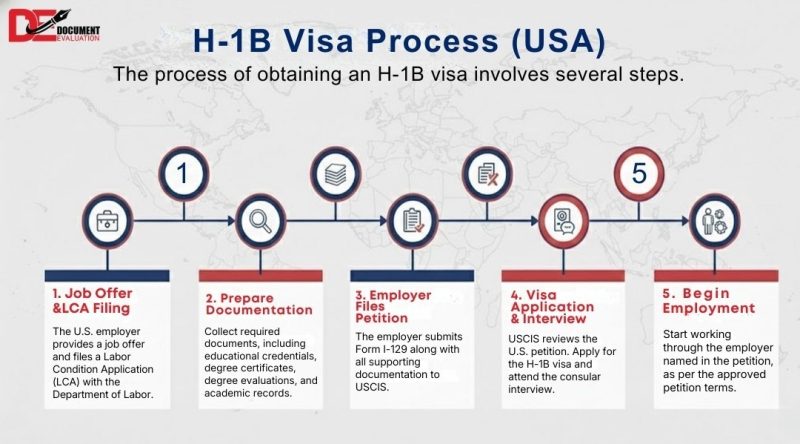
Step 1: H-1B Registration (March)
Your employer creates a USCIS online account and registers you as a beneficiary. They’ll need basic info: your name, passport number, country of birth, and offered wage level. That’s it for now.
Step 2: The Wage-Weighted Lottery (Early April)
USCIS runs the lottery. Each registration gets 1, 2, 3, or 4 entries based on wage level. USCIS randomly selects registrations until the caps are reached.
When you’ll know: USCIS notifies employers of selection results on the given date. If you’re selected, congratulations – you can now file the full petition. If not, you’ll have to try again next year.
Step 3: Labor Condition Application (LCA) with DOL (April-June)
Once selected, your employer files an LCA with the Department of Labor. This document verifies:
- The job's prevailing wage (what similar jobs pay in that geographic area)
- Work locations
- Working conditions (no strikes, no adverse effects on US workers)
Processing time: About 7 days if everything is clean. Longer if DOL has questions.
Step 4: Form I-129 Filing (Within 90 Days of Selection)
After LCA approval, your employer files Form I-129 (Petition for a Nonimmigrant Worker) with USCIS. This is where you include all those documents from the checklist earlier.
Deadline: You must file within 90 days of receiving the lottery selection notice. Miss this window, and you lose your spot.
Step 5: USCIS Review (2-6 Months, or 15 Days with Premium Processing)
USCIS reviews your case. They can:
- If approved, great. Move to step 6.
- If they issue an RFE (Request for Evidence) - not a denial, but you'll need to respond with more information.
- Deny - the case is closed. You can appeal or refile with stronger evidence.
Premium Processing option: For an additional $2,805, your employer can file Form I-907. USCIS then guarantees a response within 15 calendar days. The clock resets if you get an RFE and need to respond.
Step 6: Visa Stamping or Change of Status
If approved, you have two paths:
- If you're outside the US: Schedule visa stamping at a US consulate. Attend the interview. Get the stamp in your passport.
- If you're already in the US in valid status, USCIS will change your status automatically. No consulate visit needed.
Step 7: Employment Start Date
The earliest you can start working on a new fiscal year H-1B is October 1. You cannot start before that date, even if you’re approved earlier.
H-1B RFEs: What Triggers Them, How Much Time You Have, and How to Fight Back
Let’s talk about the thing everyone fears: the Request for Evidence, or RFE.
What Is an RFE, Really?
An RFE is not a denial. Repeat that to yourself. It’s simply USCIS saying, “We need more information to make a decision.” Think of it as a “not yet,” not a “no.”
The 6 Most Common H-1B RFE Reasons in 2026
| Rank | Reason | What USCIS Is Really Asking |
|---|---|---|
| 1 | Specialty Occupation Not Established | "Prove This Job Actually Needs a Degree." |
| 2 | Employer-Employee Relationship Issues | "Who Really Supervises This Person Daily?" |
| 3 | Wage Level Mismatch | "Why Are You Paying Level I Wages for a Senior Role?" |
| 4 | Lack of Educational Equivalency | "Prove Your Foreign Degree Is Equivalent to a U.S. Bachelor's Degree." |
| 5 | Unclear Job Description | "These Duties Could Apply to Any Job. Be More Specific." |
| 6 | Biometrics / Address Verification | "We Need to Confirm Your Identity and Location." (New in 2025–2026) |
Important Deadlines You Cannot Miss
- You have 84 days from the RFE issue date to respond. That's 12 weeks.
- If you're responding by mail, add 3 days for postal delivery, so 87 days total. USCIS does not grant deadline extensions for H-1B RFEs.
- Your response must be received, not just postmarked, by the deadline.
- Many strong cases get denied simply because they arrived one day late.
Biometrics: The New Requirement
- USCIS has started issuing RFEs that request biometrics (fingerprints, photo) and home address verification for some H-1B applicants.
- If you get this type of RFE, USCIS will send a separate appointment notice for the biometrics appointment.
*Important: Submitting your RFE response does not replace completing the biometrics. You must do both. Missing a biometrics appointment can delay your case.
How to Respond to an H-1B RFE (The Right Way)
- Detailed expert opinion letters - Independent experts explaining why your degree fits the job and why the job requires specialized knowledge.
- Strengthened job description - Not the generic version. We're talking specific daily tasks, required software, and expected deliverables.
- Organizational charts - Showing exactly where you sit in the company and who supervises you.
- Contracts and statements of work - Critical if you work at a third-party client site.
- Credential evaluations - If the RFE is about your foreign degree.
- Work experience evaluations - If you're using experience to meet education requirements.
Example: A software developer from India had a 3 year bachelor’s degree (not a US standard 4 year degree) plus 4 years of work experience. He got an RFE questioning his educational equivalency. His attorney worked with Document Evaluation to create a credential evaluation that mapped his experience to the missing year of education.
The evaluation cited the USCIS rule (3 years’ experience = 1 year education) and included detailed job duty descriptions. The petition was approved within 3 weeks of submitting the RFE response. That’s the power of getting the evidence right.
After H-1B Visa Approval: Extensions, Job Transfers, and the 60-Day Grace Period
You got approved. Congratulations. But your H-1B journey doesn’t end there.
H-1B Extension Rules
| Duration | What You Need to Know |
|---|---|
| Initial Grant | 3 Years |
| First Extension | Another 3 Years (Maximum Total of 6 Years) |
| Beyond 6 Years | Possible if a PERM Labor Certification or Form I-140 was Filed at Least 365 Days Before Reaching the 6-Year Limit and Is Still Pending, or if an Approved Form I-140 Exists but a Green Card Is Not Yet Available Due to Visa Backlogs. |
Time recapture: Any days you spent outside the US during your H-1B validity can often be “recaptured” and added back to your 6 year limit. Keep your travel records.
Changing Employers (H-1B Transfer)
Want to switch jobs? Good news: You don’t need to go through the lottery again.
The process:
- Your new employer files Form I-129 on your behalf.
- Once USCIS issues a receipt notice, you can start working for the new employer immediately.
The caution (and it’s important): You can only start working upon receipt if:
- You've maintained valid H-1B status continuously, and
- Your previous employment ended lawfully (you didn't overstay or violate your visa terms).
*Important: Do not resign from your current job until the new employer has filed the transfer. A gap in status can complicate things significantly.
The 60-Day Grace Period ( After Job Loss)
Losing a job is stressful. But USCIS gives you a lifeline.
If your employment is terminated before your H-1B expiration date, you get a one-time 60 day grace period per validity period. During these 60 days, you can:
- Find a new employer and file an H-1B transfer
- Apply to change to another non-immigrant status (like B-2 visitor or F-1 student)
- Prepare to leave the United States
What the grace period does not allow: You cannot work during the grace period unless you’ve already filed a transfer or change of status. The grace period is for planning and filing, not for new employment.
Top 7 Mistakes That Get H-1B Petitions Rejected (And How to Avoid Every Single One)
These mistakes destroy strong cases. Don’t let them happen to you.
Mistake #1: Weak, Unclear Job Descriptions
What people write: “Software developer needed to write code and debug applications.”
Why it fails: That description could apply to a junior programmer, an intern, or someone with no degree at all. USCIS will question whether it’s really a “specialty occupation.”
What to write instead: “Design and implement microservices architecture using Java Spring Boot, requiring knowledge of distributed systems typically obtained through a bachelor’s in computer science.” Lead code reviews, mentor junior developers on system design patterns, and collaborate with product managers on technical roadmaps.”
The difference: Specific tools, specific knowledge, clear degree requirement.
Mistake #2: Wage Level Mismatch
The scenario: A senior data scientist position requiring 5+ years of experience, but the employer files at Wage Level I (entry-level).
Why it fails: USCIS cross-references the offered wage level with the Department of Labor’s O*Net job complexity ratings. A senior role at entry-level wages screams “this isn’t really a specialty occupation.”
The fix: Be honest about the role’s complexity. If it’s senior, file at level III or IV. The higher wage also gives you more lottery entries under the new weighted system.
Mistake #3: No Credential Evaluation for Foreign Degrees
The assumption: “My university is well-known. USCIS will recognize it.”
The reality: USCIS officers are not admissions committees. They don’t know your university. Without a credential evaluation, your foreign degree is just a piece of paper.
The fix: Get a credential evaluation from a reputable service like Document Evaluation. The evaluation will explicitly state: “The foreign degree is equivalent to a US bachelor’s degree in the field.”
Mistake #4: No Work Experience Evaluation
The situation: You don’t have a degree, or your degree is in an unrelated field, but you have years of relevant experience.
The fix: USCIS allows the 3:1 formula (3 years of experience = 1 year of education). But you need a work experience evaluation that maps your professional history to academic credit.
Mistake #5: Late Filing
The scenario: You get an RFE with an 84 day deadline. You wait until day 80 to prepare your response.
Why it fails: Something always goes wrong. A document is missing. A signatory is on vacation. The courier is delayed. USCIS does not accept “the mail was late” as an excuse.
The fix: Treat the deadline as 60 days, not 84. Build in a buffer. If you can afford it, use Premium Processing after submitting your RFE response to get a quick decision.
Mistake #6: Ignoring Third-Party Worksite Rules
The situation: You work for a staffing agency or consulting company, and you’re placed at a client site. The petition only includes the staffing agency’s information.
Why it fails: USCIS wants to know who supervises you day to day. If it’s the client, they need to see contracts, statements of work, and supervisory structures.
The fix: Include the full chain: staffing agency contract with client, client’s job description, and a clear explanation of daily supervision.
Mistake #7: No Expert Opinion Letter (EOL)
The scenario: Your degree is in a related but not identical field. For example, a physics degree for a data science role.
Why it’s risky: USCIS is increasingly strict about degree job matches. An officer might look at “Physics” and think, “Not computer science,” and deny or RFE.
The fix: An expert opinion letter from an independent subject matter expert. The letter explains: “Physics provides the mathematical and statistical foundations required for advanced data science. Many leading data scientists hold physics degrees.”
Why Getting Expert Help Like Document Evaluation Can Save Your H-1B Case
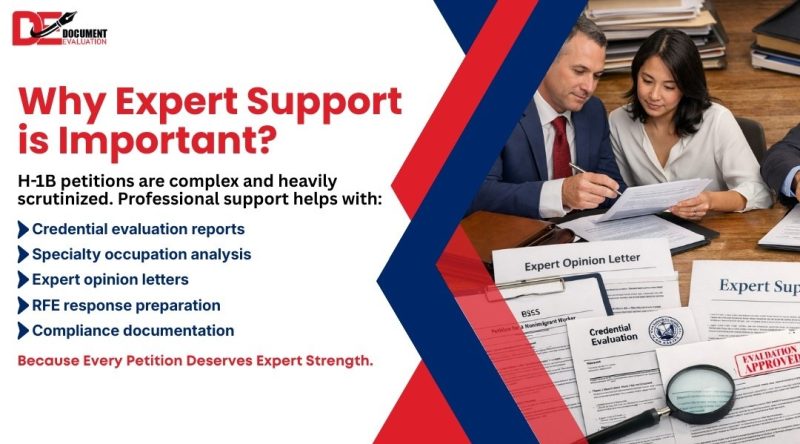
Here’s the truth: You can have a perfectly qualified candidate and a legitimate job offer and still get denied because of documentation gaps. We’ve seen it happen over and over.
That’s where Document Evaluation comes in.
What Do We Do?
| Service | How It Helps Your H-1B Case |
|---|---|
| Credential Evaluation | Proves Your Foreign Degree Is Equivalent to a U.S. Bachelor's Degree with a USCIS-Compliant Evaluation, Detailed Methodology, and Clear Equivalency Statement. |
| Work Experience Evaluation | Converts Professional Experience into Academic Equivalency Using the USCIS 3:1 Formula, Including Detailed Duty Analysis and Equivalency Tables. |
| Expert Opinion Letter (EOL) | An Independent Ph.D. or Industry Expert Confirms That Your Degree Matches Your Job Duties and That the Position Requires Specialized Knowledge. |
| RFE Response Support | Reviews Your RFE, Identifies Evidence Gaps, and Prepares Evaluations or Expert Letters Tailored to USCIS Questions. |
Why Choose Document Evaluation for Your H-1B Case?
- 99% client satisfaction - Based on post-service surveys.
- USCIS-compliant reports - We follow the USCIS Policy Manual and AAO precedent decisions.
- Revisions - You'll see a draft. If something's not right, we fix it. No charge.
- Fast turnaround - As quick as 5-7 business days for standard evaluations. Rush options available.
- Attorney-approved formats - Many of our clients are law firms. We know what USCIS wants to see.
Ready to strengthen your H-1B case? Visit us at Document Evaluation or contact our team. We’ll look at your degrees, your experience, and your job offer and tell you exactly what evidence you need.
Frequently Asked Questions
The H-1B visa allows US companies to hire foreign professionals for specialty occupations. To qualify, applicants generally need a job offer from a US employer, the position must require a bachelor's degree or equivalent, and the applicant must possess that degree or foreign equivalent in a related field.
A specialty occupation requires the theoretical and practical application of specialized knowledge and normally requires at least a bachelor's degree in a directly related field. USCIS reviews industry standards, employer hiring practices, and the specific job duties when making this determination.
Yes. USCIS may allow relevant work experience to be considered equivalent to education. Generally, three years of specialized work experience may be considered equivalent to one year of college-level education. A professional work experience evaluation is needed to document roles, duties, and equivalency.
Common H-1B RFE reasons include failure to establish a specialty occupation, wage level concerns, lack of educational equivalency, unclear job descriptions, third-party worksite issues, and additional verification requirements.
An Expert Opinion Letter provides independent third-party confirmation that an applicant's degree is related to the position and that the job requires specialized knowledge. It can be especially helpful for degree-job mismatches, interdisciplinary positions, or unique educational backgrounds.
Yes. Lower wage levels for complex positions may raise concerns about whether the role qualifies as a specialty occupation. USCIS may issue an RFE or denial if wage information does not support the position requirements.
The H-1B lottery system uses a weighted selection process based on offered wage levels. Higher wage levels receive additional selection entries, increasing the chances of selection compared to lower wage levels.
If an H-1B worker loses employment before their authorized stay expires, they may receive a one-time 60-day grace period during each validity period. During this time, they may seek new employment, change status, or prepare to leave the United States. Employment is not allowed unless proper authorization is filed.
Document Evaluation provides credential evaluations, work experience evaluations, and expert opinion letters designed to support USCIS filings. Their reports are detailed, methodology-driven, and prepared for submission with immigration petitions such as Form I-129.
To Conclude!
The H-1B visa offers one of the strongest opportunities for qualified professionals to work in the United States, but at the same time, it is one of the most challenging visa categories. Proper planning and accurate documentation, combined with expert support, are thus crucial in a context with increased RFEs and strict adjudications.
Whether you are filing first, responding to a Request for Evidence, or doing long-term strategy building for a green card, it makes a hell of a difference when an H-1B petition is well-prepared.
evaluation fast
Up Next in Our H-1B Visa Guide:
- Importance of H1B Expert Opinion Letters:
Learn why expert opinion letters are important in H-1B petitions, especially for specialty occupation cases and degree equivalency evaluations. This guide explains how expert letters help verify qualifications, support USCIS requirements, and strengthen overall petition credibility. - How to Reduce the Chances of RFE in H-1B With Expert letter:
Discover how a well-prepared expert opinion letter can help reduce the risk of RFEs in H-1B petitions. Learn what USCIS expects, which supporting documents matter most, and how strong evidence and clear professional evaluations improve approval chances. - Convert chinese work experience into us degree for h1b:
Understand how professional work experience from China may be evaluated toward U.S. degree equivalency for H-1B petitions. This guide explains credential evaluations, expert opinion letters, required documentation, and USCIS standards for combining education and work experience.

Akash Pundir is the Chief Operating Officer at Document Evaluation LLC, bringing over 5 years of international business operations and legal support experience across the United States, Australia, and India. He has overseen the strategic positioning and analysis of over 1,000+ complex USCIS cases, specializing in guiding expert evaluation teams to draft high-stakes Expert Opinion Letters (EOL), Academic Equivalencies, and defense packets for H-1B, EB-2 NIW, RFEs, and NOIDs. Driven by digital transformation, Akash ensures every evaluation adheres strictly to the latest USCIS legal frameworks and compliance benchmarks.
Comments (2)
Anonymous
March 18, 2026There is perceptibly a bunch to know about this. I think you made certain nice points in features also.
Document Evaluation LLC Editorial Team
March 19, 2026Thanks! Glad you found it helpful. Let me know if you have any questions about H1B visa process.