

 |
|How Expert Opinion Letters help Scientists and Researchers for an EB-1A Visa: A Complete Guide


You have the PhD. You have the papers. You have the citations. But USCIS officers are not scientists. They do not know your journal from any other journal. They do not know if your citation count is impressive or just average for your niche. That is the gap expert opinion letters fill. A good letter explains your work to a non-expert and tells the officer why you belong at the top.
The ten criteria for researchers. Which criteria should your letters focus on? Who should write them? How long should they be? What got other researchers denied based on real AAO decisions? And a complete example of a researcher, which was approved without an RFE.
To bridge this critical gap and validate your research credentials effectively, you can hire our specialized agency to secure an independent expert letter for EB-1A visa.
What Is the EB-1A Visa and Who Is It For?
The EB-1A visa is an employment-based green card category for individuals who have reached the very top of their professional field. Unlike most other work visas, EB-1A does not require a job offer or employer sponsorship. You can petition for yourself. That gives you control over your immigration process.
USCIS defines “extraordinary ability” as a level of expertise showing that you are part of the small percentage who have risen to the highest echelon of your field. This is a demanding standard. But for researchers and scientists with strong track records, a well-prepared application can help them meet this standard.
To be eligible, you must satisfy at least three of ten regulatory criteria. These include:
- Receipt of major prizes or awards
- Membership in associations that demand outstanding achievement
- Published material about you in professional or major media
- Service as a judge of others’ work in your field
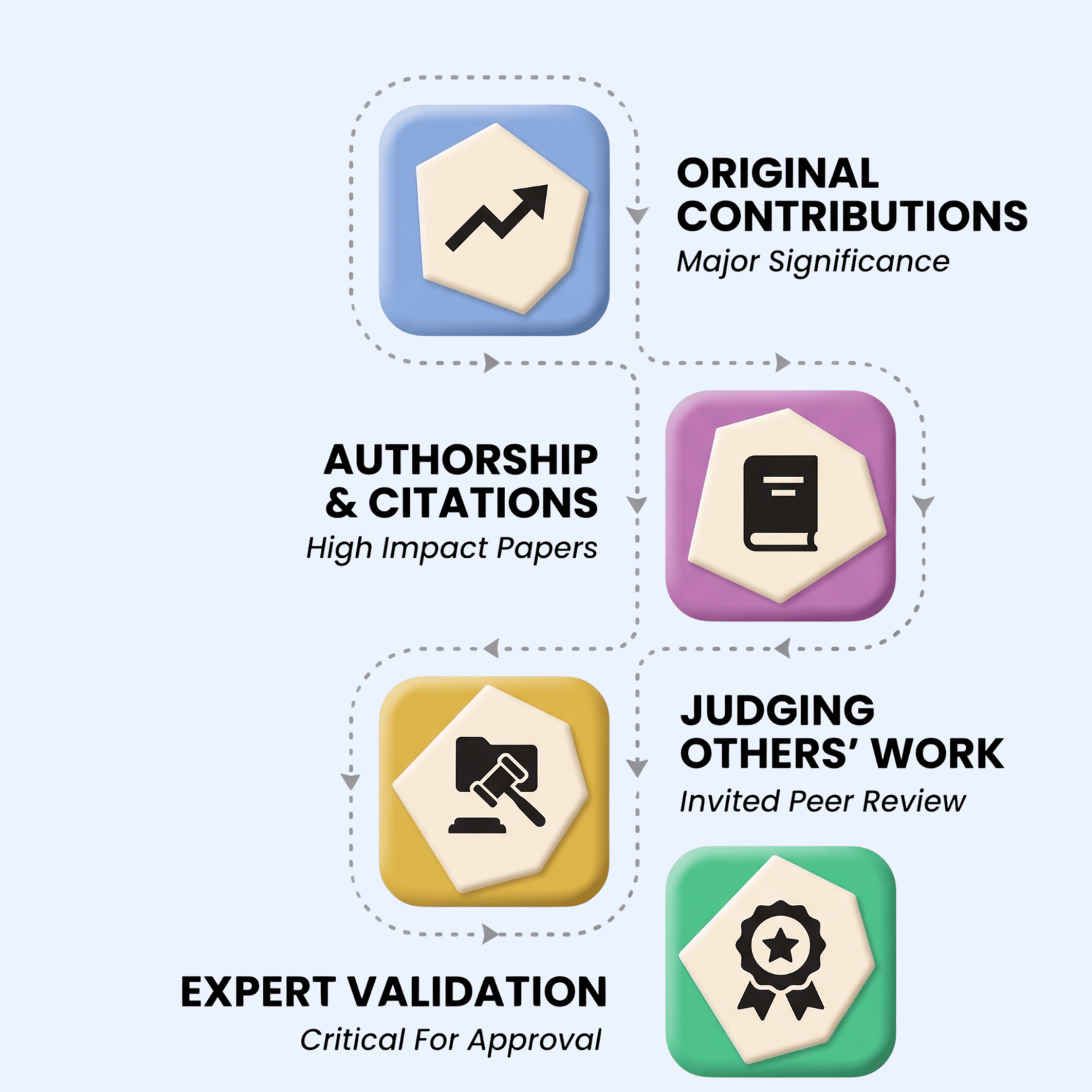
- Original scientific or scholarly contributions of major significance
- Authorship of scholarly articles in leading journals
- A high salary relative to others in your field
- Performance of a critical role for a distinguished organization
Satisfying three criteria is only the first step. USCIS then conducts a final merits determination. At this stage, the officer reviews your entire record together to decide whether you have sustained national or international acclaim. This is where expert opinion letters become essential. They help the officer understand why your work matters at the highest level of your field.
Which EB-1A Criteria Matter Most for Researchers and Scientists
Not all ten criteria work for researchers. Some fit. Some don’t. Here is what actually happens when people file.
The ones that work best:
Original contributions of major significance
This is your strongest category. Focus your expert letters here. Do not just say “important work.” Show what problem existed before you. Show what you did differently. Then prove it changed how other people work. Example: one researcher we saw wrote an algorithm. A letter from a lab in Germany said, “We stopped using the old method after his 2022 paper.” “Now we run his code as our first step.” That is major significance. A letter that just says “He is brilliant” is worthless.
Authorship of scholarly articles
This one is easy to prove but easy to mess up. Do not just list your papers. Your expert letter should say where you published, what the journal’s rejection rate is, and whether other labs cited you. Example: “Dr. Patel published in the Journal of Biological Chemistry. That journal rejects 75% of submissions. Her 2021 paper has been cited 140 times, putting it in the top 5% of all papers in that journal for that year. That works. A letter that says “She has many papers” is useless.
Judging the work of others
Peer review counts. Grant review committees count. Journal editor counts. But your letter must say you were invited because of your expertise. If you volunteered, that does not count. We had a client who served as a reviewer for NSF. The expert letter said, “NSF only invites researchers with at least ten first-author papers in top journals.” That got approved.
Membership in associations that require outstanding achievement
Most memberships do not count. Paying dues does nothing. Your expert letter must explain the selection criteria. Example: “The American Society for Clinical Investigation only admits researchers who have been cited over 500 times or have made a discovery that changed clinical practice.” That works. A letter that says “he is a member of Sigma Xi” is not enough unless you explain Sigma Xi’s actual admission bar.
Published material about your work
Media coverage counts, but only if it is about you, not your lab or your university. If a reporter quotes you as an expert in someone else’s story, that does not count. If a major outlet covers your discovery and names you, that counts. Your letter should attach that article and say why that outlet is credible.
The ones that are harder for researchers:
Leading or critical role
Many professors use this approach successfully. The real problem is not industry vs. academia. The problem is that the organization is distinguished. Being a department chair at a top-10 university is effective. Being a center director at a regional state school probably does not work. Being a “lead scientist” at a no-name startup, no. Your expert letter must explain why your specific organization stands out in your field.
High salary
You need Bureau of Labor Statistics data showing you are in the top 10% for your job title and metro area. If you are a senior scientist at a biotech company making $250k when the median is $140k, that works. But do not try this approach if you are a postdoc or assistant professor.
Major awards
Unless you have a Nobel, Breakthrough Prize, or similar, skip this criterion. Some researchers try to use a “best paper award” from a small conference. USCIS denies those almost every time unless the award is truly national or international in scope.
Who Should Write Your EB-1A Expert Opinion Letter?
This step is where many applicants make mistakes. Not all sanctions are equally valuable.
Who should write your letters:
- Experts who know your work independently, not just because they are your friend or former advisor. A professor who has cited your papers is a stronger reference than your PhD supervisor.
- Recognized authorities in your specific research area. A big name from a different field helps less than a mid-career expert who actually understands what you did.
- People who can point to specific contributions, not just say “good work.”
How many letters:
Most successful petitions include 5 to 8 letters. Quality matters more than quantity. Three strong, specific letters beat ten generic ones.
A note on international experts:
If you can get letters from researchers in other countries, that helps show “international acclaim.” But it is not strictly required. The standard is national OR international acclaim. Strong domestic recognition can be enough.
A note on solicited letters:
Some applicants worry that asking someone to write a letter makes it less credible. The AAO has made clear that there is no rule against solicited letters. The issue is not whether you asked. The issue is whether the letter is specific and supported by evidence.
What USCIS actually looks for:
The officer will check if the expert is truly qualified to judge your work. That means looking at their credentials, publications, awards, and position. A letter from someone with no experience in your field won’t help, even if they mean well.
Why Do Expert Letters Matter Most in the Final Merits Step?
Many applicants think meeting three criteria is enough. It is not. That is just step one.
Step two is the final merits determination. This is where USCIS looks at everything together. They ask, “Does this person have sustained national or international acclaim?” Are they truly among the small percentage at the very top of their field?
This stage is where expert letters become essential. An officer can count your citations and awards. But they need experts to explain what those numbers mean. Is 500 citations remarkable in your field or just average? Did your award go to 10 people or 100? Did your work change how others do research, or was it just another paper?
Strong expert letters answer these questions. Weak letters do not. And at the final merits stage, unclear praise will not save you
Real Mistakes That Got Expert Letters Rejected (Based on Recent AAO Decisions)
Reading actual AAO decisions is one of the best ways to understand what USCIS wants. Here are real mistakes from recent cases.
Mistake 1: praising the field instead of the person
The letter said, “This area has been essential for electronics reliability.” That is about the field, not the applicant. The fix: “The applicant’s specific circuit design solved a problem that had stalled the field for five years.”
Mistake 2: confusing company profit with field-wide impact
The letters said he saved clients money. That is not field-wide impact. The fix: “Other companies have now adopted his testing protocol as their internal standard, not just for cost savings but because it produces more accurate results.”
Mistake 3: unqualified expert
Even a qualified expert can ruin their letter by not explaining their credentials. Every expert letter should have a paragraph listing their publications, awards, or positions. If they skip that, the officer might give the letter no weight.
Mistake 4: Team awards
A team award can be used if you explain your specific role. The AAO rejected the gold diploma from the company because the applicant did not show his individual receipt of the award. If you were on a team of three and the award certificate lists all three names, that is fine. Get a letter from the award committee saying you were a core contributor.
Real EB-1A Approval Example: How A Researcher Used Expert Letters
Dr. Ananya Krishnan is a computational biologist who developed a novel protein folding algorithm used in drug discovery pipelines at multiple pharmaceutical companies. When she applied for her EB-1A green card, her attorney assembled a packet that included:
- A letter from a professor at ETH Zurich who independently adopted her algorithm and published work building on it
- A letter from a department chair at Johns Hopkins, who noted her work was now part of their graduate curriculum
- A letter from a senior researcher at the NIH who cited her contribution as filling a critical gap in understanding protein dynamics
Each letter was three to four pages. Each focused on one or two specific papers. Each explained in simple English why her work was better than what came before. Each highlighted the expert’s own credentials. And each directly tied her work to the “original scientific contributions of major significance” criterion.
Her petition was approved. No RFE.
Frequently Asked Questions
How many expert letters do I need for an EB-1A petition?
Most immigration attorneys recommend 5 to 8 letters. Quality matters more than quantity. A few specific, detailed letters from credible independent experts beat many generic letters.
Can my expert write the letter if they’ve never met me in person?
Yes. What matters is genuine familiarity with your work, not personal acquaintance. Many respected letters come from researchers who know the applicant only through their publications.
Should expert letters address all the EB-1A criteria I am claiming?
Each letter does not need to cover every criterion. That would feel unnatural. But your letters together should support the criteria you are relying on. Also remember that USCIS does a final merits determination after checking the criteria. Your letters should clearly explain why you are among the top in your field.
What if an expert writes a weak letter can I substitute it?
Yes. You are not obligated to submit every letter you receive. Review all letters before including them in your petition, and only submit the strongest ones.
Do expert letters need to be notarized?
No. They should be on institutional letterhead and signed, but notarization is not required by USCIS.
Can a letter writer be from industry rather than academia?
Absolutely. For researchers working in applied sciences or industry R&D, letters from senior professionals at major corporations or research institutes can be highly effective, sometimes more so than academic letters, depending on the field.
What if I receive an RFE about my expert letters?
An RFE allows you to submit additional or supplemental letters that address the specific concerns raised by USCIS. This is where having a few “reserve” expert contacts can be valuable, hold one or two potential writers back for this scenario.
Conclusion
An EB-1A expert opinion letter is not a flattering testimonial; it’s an evidence-driven, contextual explanation of why your work matters at a national or international level. Start early, choose independent and credible authors, give them the right materials, and ask for concrete, comparative statements that map directly to USCIS criteria. Doing this transforms scattered academic accomplishments into a coherent story of extraordinary ability, and that story is what adjudicators need to approve.

Continue Reading About EB-1A Petitions, Expert Opinion Letters & Extraordinary Ability Evidence:
- Complete Guide for EB-1A Green Card:
Learn how the EB-1A green card category works for individuals with extraordinary ability in science, business, education, athletics, and the arts. This guide covers eligibility requirements, USCIS criteria, supporting evidence, filing steps, processing times, and practical tips for building a stronger petition in 2026. - Expert Opinion Letters Strengthen EB-1A and EB-1B Green Card Petitions:
Expert opinion letters can play an important role in EB-1A and EB-1B petitions by providing independent evaluations of an applicant’s achievements, research contributions, leadership, and professional impact. Discover how these letters help strengthen evidence submitted to USCIS and support eligibility claims. - Response Guide for EB-1A RFE:
An EB-1A Request for Evidence (RFE) can be challenging, but a well-prepared response can improve approval chances. Explore common RFE issues, supporting documentation strategies, response timelines, and best practices for addressing USCIS concerns related to extraordinary ability petitions.
Akash Pundir is the Chief Operating Officer at Document Evaluation LLC, bringing over 5 years of international business operations and legal support experience across the United States, Australia, and India. He has overseen the strategic positioning and analysis of over 1,000+ complex USCIS cases, specializing in guiding expert evaluation teams to draft high-stakes Expert Opinion Letters (EOL), Academic Equivalencies, and defense packets for H-1B, EB-2 NIW, RFEs, and NOIDs. Driven by digital transformation, Akash ensures every evaluation adheres strictly to the latest USCIS legal frameworks and compliance benchmarks.
