

 |
Can A 3-Year Foreign Bachelor’s Degree Qualify For An H-1B?

- A three-year foreign degree can qualify for H-1B if it meets U.S. equivalency requirements.
- Degree length alone does not decide eligibility.
- A credential evaluation can help explain the degree’s U.S. equivalency.
- The degree must relate to the job’s specialty.
- Work experience counts only when it meets the applicable regulatory requirements.
- Complete academic records can help address USCIS concerns.
A three-year bachelor’s degree earned outside the United States may support H-1B eligibility, but it is not automatically equivalent to a US bachelor’s degree simply because it is called a bachelor’s degree. USCIS must be able to find that the foreign qualification is equivalent to the US bachelor’s degree required by the specific specialty occupation or that the beneficiary otherwise qualifies through an alternative route recognized by the regulations.
The number of years is only one factor. The outcome depends on the actual degree, the awarding institution and education system, the academic record, the credential evaluation and its methodology, and whether the qualification is directly related to the offered position.
💡 Next Step: Proving that a three-year foreign degree meets strict H-1B specialty occupation standards requires authoritative documentation. Secure professional assistance to Order Your USCIS H-1B Expert Letter and ensure your credentials satisfy every regulatory requirement.
Why Degree Length Alone Does Not Decide Equivalency
Many US bachelor’s programs take four years, but US immigration law does not impose a universal four-year duration requirement for foreign degrees. For H-1B purposes, the relevant question is whether the beneficiary holds a foreign degree that is equivalent to the US bachelor’s or higher degree required by the specialty occupation.
A three-year program may be structured differently from a four-year US program in ways that matter: entry standards, total instructional content, specialization, examinations, thesis or project requirements, and the point at which students enter the program. Conversely, a three-year degree is not automatically equivalent merely because it is full-time, rigorous, or awarded by a well-known university. Duration can be relevant context, but it cannot substitute for an assessment of the qualification itself.
This is why the country, institution, program, and documentation matter. A credential evaluator generally considers the foreign education system, the level and nature of the award, the institution’s recognition or standing, the program’s entry requirements and structure, and the academic record before comparing the qualification with a U.S. degree.
The H-1B Educational Requirement
An H-1B specialty occupation requires theoretical and practical application of highly specialized knowledge and, as a minimum for entry into the occupation in the United States, attainment of a bachelor’s or higher degree in a directly related specific specialty or its equivalent.
The offered position must also meet one of the regulatory criteria for a specialty occupation. For example, a US bachelor’s or higher degree in a directly related specific specialty, or its equivalent, may be normally required for entry into the occupation, for parallel positions in the industry, by the employer, or because the duties are so specialized that such a degree is normally associated with them.
To qualify as the beneficiary, a person may:
- Hold the required US bachelor’s or higher degree from an accredited college or university.
- Hold a foreign degree equivalent to the required US degree.
- Hold an unrestricted state license, registration, or certification that authorizes full practice of the specialty occupation in the state of intended employment, where applicable.
- Have education, specialized training, and progressively responsible experience equivalent to completion of the required US degree, together with recognition of expertise through progressively responsible positions directly related to the specialty.
USCIS defines “directly related” as a logical connection between the required degree, or its equivalent, and the duties of the position. Therefore, even a well-documented equivalent bachelor’s degree does not by itself establish H-1B eligibility if it is unrelated to the offered role or if the position itself does not meet the specialty-occupation standard.
How Foreign Degree Equivalency Is Assessed
Foreign educational equivalency is an individualized comparison between a foreign qualification and the US educational level it most closely resembles. It is not a mechanical conversion of years into US credit hours.
An academic credential evaluation may examine:
- The name, level, and official status of the qualification.
- The awarding institution and its recognition within the relevant education system.
- The program’s entry requirements, length, and structure.
- Official transcripts, marksheets, or other academic records.
- The subjects studied and, where relevant, the depth and progression of coursework.
- The final degree certificate and evidence of completion.
- The educational framework of the country where the degree was earned.
A credential evaluation can help explain the U.S. comparability of a foreign qualification within the scope of the documents reviewed and the evaluator’s methodology. It is supporting evidence, not a USCIS decision. USCIS retains authority to weigh the evaluation, the underlying documents, and the rest of the petition record.
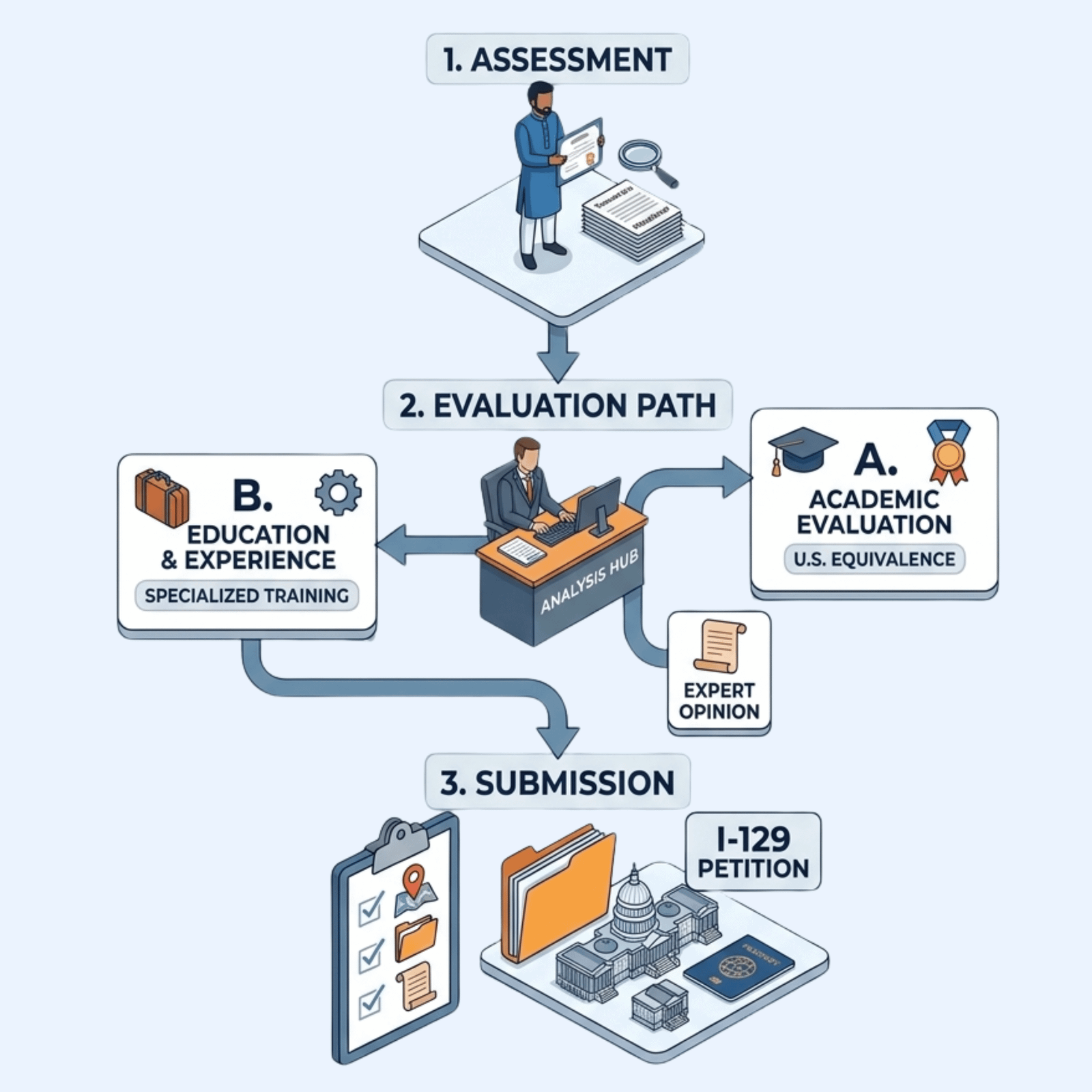
Credential Evaluation vs. Education-and-Experience Evaluation
These are different analyses, and confusing them can create problems in an H-1B petition.
| Question | Academic credential evaluation | Education-and-experience evaluation |
| Main issue | What is the US comparability of the foreign academic qualification? | Do education, specialized training, and/or progressively responsible experience together equal the required U.S. degree? |
| Typical documents | Degree certificate, transcripts or marksheets, institution and program information | Academic records plus employment verification, role descriptions, training records, and other evidence of progressively responsible experience |
| What it may establish | US equivalency of the degree itself, subject to the evaluator’s scope and methodology | A claimed equivalency based on a combination of qualifications and experience |
| What it does not establish | That the degree is related to the offered position or that the position is a specialty occupation | That ordinary employment alone replaces missing formal education |
USCIS recognizes an alternative route based on education, specialized training, and progressively responsible experience equivalent to completion of the required US degree, along with recognition of expertise through progressively responsible positions directly related to the specialty.
That standard is more demanding than simply having work experience in the field. A person should not assume that a few years of general employment automatically replaces a missing year of university study.
Why The Offered Position Matters
Equivalency and specialty-occupation eligibility are related but separate questions.
First, USCIS asks whether the beneficiary’s education or alternative qualification meets the level required for the position.
Second, it asks whether the position itself requires a bachelor’s or higher degree in a directly related specific specialty, or its equivalent, under the specialty-occupation criteria.
For example, a three-year foreign bachelor’s degree in computer science might be relevant to a software engineering role if the evidence establishes both US bachelor’s-degree equivalency and a logical connection between the degree field and the duties.
The same degree would not resolve an H-1B concern involving an unrelated occupation, a position that does not require a specialized degree, or a petition that fails to document the employer’s actual requirements and the role’s duties.
Evidence That May Clarify A Three-Year Degree
There is no universal document checklist for every three-year foreign degree. The appropriate evidence depends on the qualification, the education system, the purpose of the evaluation, and the specific issue raised.
Documents that may be relevant include:
- The final degree certificate or diploma.
- Official transcripts, marksheets, or consolidated academic records.
- Evidence identifying the awarding institution, such as its official name and location.
- Information about the program’s duration, entry requirements, and structure.
- Syllabi, course descriptions, or detailed academic records when needed to explain the curriculum.
- A foreign credential evaluation that explains the qualification, methodology, and U.S. comparability.
- Certified English translations for foreign-language documents.
- Employment or training evidence when the case relies on an education-and-experience equivalency theory.
A course-by-course evaluation may be useful when the petition needs a subject-level explanation of the foreign transcript, including US credit-hour and grade comparisons. Document Evaluation lists its course-by-course evaluation from $419, while a general academic equivalency evaluation starts at $119; pricing varies by service and turnaround tier.
When USCIS May Raise Educational Concerns
USCIS may question educational qualifications when the petition record does not clearly establish the foreign qualification, its US equivalency, or its relevance to the position. These are possible evidentiary concerns, not RFE triggers.
Common issues include:
- A credential evaluation that states a conclusion without explaining the methodology or the documents reviewed.
- Missing, illegible, or unofficial academic records.
- Unclear information about the awarding institution or the qualification’s level.
- A degree field that does not logically connect to the offered duties.
- Insufficient evidence where the petition relies on education combined with experience.
- A mismatch between the employer’s stated degree requirement, the job duties, and the beneficiary’s actual qualifications.
An RFE response should be built from the actual notice. The goal is not to submit every available document but to identify the precise concern and provide focused evidence that addresses it. Depending on the issue, that may involve a more detailed academic evaluation, additional educational documentation, clarification of the evaluation methodology, evidence of the institution or program, or a properly supported education-and-experience analysis.
Document Evaluation offers RFE response support for H-1B, EB-2, EB-3, and I-485 matters starting at $549, with pricing dependent on the service and turnaround option. Such documentation can support an attorney’s strategy, but it does not replace legal advice or guarantee that USCIS will accept the response.
When An Expert Opinion Letter May Help
An independent expert opinion letter may be useful when the case requires an individualized assessment of the beneficiary’s background, the offered role, or the relationship between the qualification and the position.
For an H-1B, an expert letter may address the specialty-occupation framework and the beneficiary’s qualifications, but it cannot change the underlying documents or override the regulatory requirements.
Document Evaluation describes its expert opinion letters as independent, individualized assessments prepared by field experts who review the person’s background, qualifications, proposed role or endeavor, and supporting documents. The company reports a network of more than 140+ field experts across more than 50 specialties and says clients can review and approve the matched expert before work begins.
The company’s expert opinion letter for H-1B specialty occupations starts at $469, with higher pricing for expedited turnaround. An expert letter is most valuable when it is based on the actual record and customized to the legal issue not when it simply repeats generic conclusions.
Practical Next Steps
If you hold a three-year foreign bachelor’s degree and are considering an H-1B petition:
- Collect the degree certificate, official transcripts or marksheets, and any available program or institution documentation.
- Determine whether the degree field has a logical connection to the offered position.
- Consider an academic credential evaluation to clarify US comparability.
- If the degree alone may not establish equivalency, discuss with immigration counsel whether an education and experience theory is appropriate and what evidence it needs.
- If USCIS issues an RFE, respond to the specific concerns in the notice rather than submitting unrelated documents.
Official Resources:
USCIS: H-1B Specialty Occupations
Electronic Code of Federal Regulations: 8 CFR § 214.2
US Department of Education: Recognition of Foreign Qualifications
USCIS Form I-129: Petition for a Nonimmigrant Worker
US Department of State: Foreign Affairs Manual – H Visas
Frequently Asked Questions
Is a three-year bachelor’s degree accepted for an H-1B visa?
It may be, but only if the evidence establishes that it is equivalent to the US bachelor’s or higher degree required by the specialty occupation or that the beneficiary qualifies through another regulatory route. A three-year duration alone neither qualifies nor disqualifies the degree.
Does a three-year degree from India qualify for H-1B purposes?
It depends on the particular degree, institution, program, academic record, and credential evaluation. USCIS does not apply a blanket rule accepting or rejecting every three-year Indian bachelor’s degree; the petition must establish equivalency and relevance to the offered specialty occupation.
Can a foreign credential evaluation establish US bachelor’s degree equivalency?
A credential evaluation can provide an expert assessment of US comparability, but it is supporting evidence rather than a guarantee of USCIS acceptance. USCIS considers the evaluation alongside the underlying academic documents and the rest of the petition.
Can work experience make up for a three-year bachelor’s degree?
Work experience may be relevant only under the regulatory route involving education, specialized training, and/or progressively responsible experience equivalent to completion of the required US degree, plus recognition of expertise through directly related progressively responsible positions. Ordinary work experience does not automatically replace a missing year of university education.
What documents may be needed to evaluate a three-year foreign degree?
Commonly relevant documents include the degree certificate, official transcripts or marksheets, institution and program information, and when needed course descriptions or syllabi. The exact documents depend on the qualification and the issue being addressed.
Can USCIS question a foreign degree evaluation in an H-1B RFE?
Yes! USCIS may request clarification if the evaluation lacks adequate analysis, the academic record is incomplete, the institution or program is unclear, or the degree does not appear related to the offered position. A response should address the specific concerns in the RFE.
What is the difference between a credential evaluation and an education-and-experience evaluation?
A credential evaluation assesses the US comparability of a foreign academic qualification. An education-and-experience evaluation assesses whether a combination of education, specialized training, and progressively responsible experience equals the required US degree, subject to the applicable regulatory requirements.
How much does an H-1B credential evaluation cost?
Document Evaluation currently lists academic equivalency evaluations from $119, course-by-course evaluations from $419, and academic-and-experience equivalency evaluations from $449, depending on the service and turnaround tier.

Master H-1B filing rules, 3-year degree equivalencies, and expert letter pricing below:
- H-1B Visa Eligibility & Filing Guide: Requirements, Qualifications, and Step-by-Step USCIS Process
Demystifies the H-1B specialty occupation visa pathway. Explains core employer sponsorship requirements, specialty occupation standards, foreign worker eligibility criteria, and how to navigate the annual cap lottery, LCA certification, and Form I-129 filing process. - Can a 3-Year Foreign Degree Qualify for an H-1B Visa?
Explains how foreign nationals with three-year bachelor’s degrees can meet USCIS four-year U.S. degree equivalency requirements. Details academic evaluations, coursework reviews, and applying the USCIS 3-for-1 rule—combining three years of specialized work experience for every missing year of college education. - H-1B Specialty Occupation Expert Opinion Letter Costs & Guide
Details standard market pricing and turnaround options for H-1B specialty occupation expert opinion letters. Explains key cost factors—including case complexity, degree-to-job duty alignment, and standard vs. express delivery speeds—to help employers and candidates budget effectively.
Akash Pundir is the Chief Operating Officer at Document Evaluation LLC, bringing over 5 years of international business operations and legal support experience across the United States, Australia, and India. He has overseen the strategic positioning and analysis of over 1,000+ complex USCIS cases, specializing in guiding expert evaluation teams to draft high-stakes Expert Opinion Letters (EOL), Academic Equivalencies, and defense packets for H-1B, EB-2 NIW, RFEs, and NOIDs. Driven by digital transformation, Akash ensures every evaluation adheres strictly to the latest USCIS legal frameworks and compliance benchmarks.