

 |
Indian Polytechnic Diploma And Work Experience Evaluation For The USA

- A three-year diploma does not guarantee US bachelor’s equivalency.
- Relevant work experience can support an equivalency assessment.
- H-1B cases require proof of the worker’s qualifications and the job requirements.
- Keep academic records and employment letters ready.
- Check the required evaluation type before ordering.
- An evaluation report does not guarantee visa approval.
You hold an Indian polytechnic diploma and have several years of technical experience, but no conventional four-year bachelor’s degree. Can your education and employment history be evaluated together for a US opportunity?
Yes, a combined assessment may be available when its methodology and intended purpose permit it. However, an Indian polytechnic diploma and work experience evaluation does not automatically establish bachelor’s equivalency or satisfy employment, licensing, admission, or immigration requirements. US recognition decisions depend on the relevant receiving authority, and evaluations are individual assessments.
Start by separating three questions: What does your diploma establish academically? What does your documented experience demonstrate? Does that background satisfy the particular requirement you face? The answer depends on your records and the rules governing their intended use not simply the number of years you studied or worked.
Navigating the complex 3-for-1 rule to establish academic equivalency through practical history requires authoritative documentation from a specialized agency. Hire our expert service to Order Your USCIS Work Experience Evaluation and secure a certified, regulation-compliant report tailored for your petition.
Can An Indian Polytechnic Diploma Be Evaluated In The USA?
An Indian polytechnic diploma can be submitted for a foreign credential evaluation: an assessment comparing qualifications earned outside the United States with US educational credentials. Evaluators may reach different conclusions because their criteria differ. There is no universal US equivalent for every Indian diploma.
Before requesting a conclusion, provide information about:
- The institution and awarding board.
- Entry qualifications and admission route.
- Program duration, academic level, and curriculum.
- Subjects, practical training, and examinations completed.
- Final award and complete academic records.
Program duration alone is insufficient context. For example, Punjab’s 2026-27 technical education prospectus lists three-year engineering diplomas with a 10th-standard entry requirement, a four-year Mechanical Engineering (Tool & Die) diploma, and separate lateral-entry routes. These are specific examples, not descriptions of every Indian polytechnic program.
Institutional recognition, program approval, and US equivalency are also different matters. Approval records help establish a program’s status in India; they do not independently determine its US equivalent. Check records applicable to the actual program and attendance period rather than relying only on the institution’s current status.
Identify the intended use first. An employer may request a general equivalency report, while a university or licensing board may require a particular evaluator or more detailed analysis.
Can Work Experience Be Combined With An Indian Diploma?
Education and experience may be considered together where the receiving organization’s rules and the evaluation method allow it. H-1B regulations, for example, recognize a qualification pathway involving education, specialized training, and progressively responsible experience, subject to additional requirements.
An Academic Evaluation examines formal education. An experience assessment examines what your employment evidence establishes about professional knowledge and responsibilities. Relevant considerations include:
- Duration and continuity of employment.
- Connection to the specialty being assessed.
- Complexity of duties and technical knowledge applied.
- Progression toward greater responsibility.
- Evidence supporting the claimed work.
For an H-1B experience-based qualification analysis, relevance and progressively responsible work matter not merely time employed.
“Diploma plus experience evaluation” is not one universally standardized report. Before ordering, ask whether the service provides an academic comparison, an employment assessment, or a combined opinion addressing a particular qualification standard. Do not assume an academic-only report includes employment analysis.
What Does A Work And Academic Evaluation Actually Establish?
A useful report explains its evidence, method, conclusions, and limitations. Its scope should make clear which question it addresses:
| Assessment | Main question | Important limitation |
| Academic credential evaluation | How does the documented foreign education compare with U.S. education? | It does not automatically include experience. |
| Work or combined evaluation | How does documented experience, alone or with education, relate to the stated assessment? | Its usefulness depends on the methodology and applicable requirements. |
| Eligibility determination | Does the applicant satisfy a job, license, admission, or immigration requirement? | The receiving organization or government authority decides. |
These distinctions follow the US system of recognition: employers, institutions, licensing authorities and immigration authorities make decisions within their respective responsibilities.
An evaluator’s professional assessment does not independently award a degree, issue a license, qualify someone for every job, or grant a visa. Its practical value lies in explaining the documented background not replacing the receiving authority’s decision.
Indian Diploma And Work Experience Evaluation For H-1B Cases
H-1B cases needs separate analyses of the position and the beneficiary the person for whom the petition is filed.
The position must satisfy the specialty-occupation requirements, including highly specialized knowledge and a bachelor’s or higher degree in a directly related specific specialty or its equivalent, as the minimum entry requirement. “Directly related” means a logical connection between the degree or equivalent and the duties.
Separately, the beneficiary must satisfy an applicable qualification pathway. Under 8 CFR § 214.2(h)(4)(iii)(C)(4), that can involve education, specialized training, and progressively responsible experience equivalent to completing the required US degree, together with recognition of expertise through progressively responsible positions directly related to the specialty.
For the education side of an H-1B case, see our H-1B education evaluation guide.
What The Education And Experience Regulation Requires
Section 214.2(h)(4)(iii)(D) addresses equivalence to completing a college degree for that pathway. It concerns a level of knowledge, competence, and practice equal to that of someone holding the relevant degree not the issuance of an actual degree.
One evidentiary route, paragraph (D)(1), is an evaluation from an official authorized to grant college-level credit for training or experience at an accredited college or university that has a program granting such credit. A professor’s title alone does not establish all those conditions.
Paragraph (D)(5), addressing a determination by the immigration agency, states:
“For purposes of determining equivalency to a baccalaureate degree in the specialty, three years of specialized training and work experience must be demonstrated for each year of college-level training the alien lacks.”
This is not an automatic “three years of employment equals one year of college” conversion. The same provision requires demonstrated theoretical and practical application of specialized knowledge, experience gained while working with appropriately qualified peers, supervisors, or subordinates, and recognition of expertise supported by qualifying documentation.
You therefore cannot assume a three-year Indian diploma represents three years of U.S. college-level education and then add a fixed employment period. The academic starting point and the experience evidence both require assessment under the applicable pathway.
Keep four questions separate:
- What does the academic evaluation conclude?
- How does documented experience support the qualification analysis?
- Does the position qualify as a specialty occupation?
- Does the complete petition establish eligibility?
An evaluation is supporting evidence, not an H-1B approval guarantee. An immigration attorney should assess which regulatory pathway fits the actual record.
For how three years of experience can count as one year of college, see our H-1B three-for-one rule guide.
What Documents Are Usually Needed?
Ask for a service-specific checklist before submitting records. Requirements vary by evaluator and receiving organization; not every applicant needs every item below.
Academic records
- Polytechnic diploma or final award certificate.
- Complete semester or annual marksheets and transcripts.
- Institution and awarding-board details.
- Entry qualification records, if requested.
- Curriculum, syllabus, and program-duration information, if needed.
- Relevant recognition or approval records, where available.
Employment records
For an experience-inclusive assessment, prepare:
- Employer letters identifying job titles, dates, duties, and employer details.
- Detailed descriptions of technical responsibilities and progression.
- Supporting pay, appointment, promotion, or other employment records, if requested.
- A résumé or curriculum vitae consistent with the underlying evidence.
Detailed records are particularly useful where an H-1B analysis must establish specialized knowledge and progressively responsible experience. A letter confirming only employment dates cannot explain those elements.
Identity and language records
An evaluator may request passport or identity documentation. Non-English records generally need English translations; confirm the evaluator’s requirements and any separate submission requirements.
If evidence is missing, request legitimate replacements or discuss acceptable alternatives. Never alter marksheets, embellish duties, or manufacture employment evidence.
How The Evaluation Process Works
A practical sequence is:
- Identify the purpose: employment, admission, licensing, or immigration documentation.
- Obtain the recipient’s instructions, including any required evaluator or report format.
- Confirm whether the service assesses education, experience, or both.
- Submit academic records and employment evidence within that scope.
- Address missing records, inconsistent dates, or verification questions.
- Review the written findings, assumptions, and limitations before using the report.
The first two steps are especially important because the U.S. Department of Education recommends using a service specified by the receiving organization. Different evaluators may also apply different criteria.
For immigration use, coordinate the report’s scope with the petition’s legal analysis. Do not assume a general academic report addresses the experience-related requirements of 8 CFR § 214.2(h)(4)(iii)(D).
Mistakes That Can Weaken An Evaluation
Use these checks before paying for a report or submitting evidence:
- Assuming all three-year diplomas are equivalent: Provide your exact award, entry route, and complete records.
- Counting employment years as automatic academic credit: Request an explanation of the applicable methodology and qualification standard.
- Ordering the wrong report: Obtain the recipient’s written requirements first.
- Providing duty-free employment letters: Request accurate descriptions of responsibilities and progression.
- Submitting inconsistent records: Reconcile names, dates, and qualifications through legitimate explanations or corrected source records.
- Confusing evaluation with eligibility: Keep the evaluator’s conclusion separate from the receiving authority’s decision.
- Treating a report as an immigration guarantee: Assess the complete petition, including the position.
- Reusing a report without checking: Confirm acceptance for each new purpose.
These corrections address two central limitations: credential evaluations are case-specific, and their acceptance rests with the relevant organization or authority.
Choosing The Right Diploma And Work Experience Evaluation Service
Before ordering, ask:
- Does this service assess academics, employment, or both?
- What methodology and evidence will support the conclusion?
- Can you assess my actual diploma and employment records?
- What additional documents might be necessary?
- Does the proposed report match the recipient’s requested scope?
- Will it explain its findings and limitations?
- What are the current price, turnaround, revision, and refund terms?
For an H-1B report relying on paragraph (D)(1), also ask how the signing official’s credit-granting authority and the institution’s relevant program will be documented.
Check acceptance independently. The Department of Education does not endorse individual evaluation services or associations, and it advises applicants to follow the receiving organization’s recommendations.
How Document Evaluation LLC Can Help
Document Evaluation LLC currently lists these relevant services:
- Academic Equivalency Evaluation
- Course By Course Evaluation
- Academic and Experience Based Equivalency Evaluation.
- Experience Based Equivalency Evaluation.
- H-1B-related expert opinion letters
The pricing page distinguishes a general academic comparison from detailed course analysis and combined academic-and-experience assessment. Contact us now for more details.
Conclusion: Match The Evaluation To The Requirement
An Indian polytechnic diploma and work experience evaluation should address your exact qualification, academic records, documented responsibilities, and intended use. Academic equivalency, professional experience, and eligibility remain separate questions, even when one report discusses them together.
Explore Document Evaluation LLC’s relevant evaluation options, or ask which report type matches your documentation and the receiving organization’s requirements before ordering.
Official Resources:
US Department of Education (Recognition of Foreign Qualifications)
Electronic Code of Federal Regulations (8 CFR § 214.2)
US Citizenship and Immigration Services (H-1B Specialty Occupations)
All India Council for Technical Education (AICTE)
Punjab State Board of Technical Education and Industrial Training
US Department of Education (Working in the United States)
Frequently Asked Questions
Is an Indian polytechnic diploma equivalent to a US bachelor’s degree?
Not automatically. A conclusion requires individual assessment; neither “polytechnic” nor “three-year diploma” establishes a universal U.S. degree equivalent. The recipient ultimately decides whether the assessed credential meets its requirements.
Can work experience compensate for an Indian polytechnic diploma?
Experience may help satisfy a requirement that expressly permits an education-and-experience pathway. It does not change the diploma originally awarded, and H-1B qualification rules require more than a specified employment duration.
Can a three-year Indian diploma be evaluated for US employment?
Yes, it can be submitted for evaluation, subject to the service’s scope and documentation requirements. Ask the employer whether it requires a particular evaluator; the employer is the recognition authority for its hiring purposes.
Can an Indian diploma and work experience be evaluated together?
A combined service may assess both, but confirm its purpose and methodology first. Document Evaluation LLC lists an academic-and-experience service separately from academic-only and experience-only options.
Is a work experience evaluation enough for an H-1B petition?
No—not by itself. Even relevant qualification evidence does not independently establish that the offered position satisfies specialty-occupation requirements or that the entire petition meets the governing rules.
What documents are required for an Indian diploma evaluation?
Expect to discuss the final award and complete academic records; additional entry, curriculum, or recognition evidence may be requested. Experience-inclusive reports require employment evidence as well. Obtain the evaluator’s specific checklist rather than assuming one document package works everywhere.
Will USCIS accept a foreign credential evaluation?
H-1B regulations provide for education evaluations from reliable services specializing in foreign educational credentials. Nevertheless, submitting an evaluation does not bind USCIS to its conclusion or establish every eligibility requirement; experience-inclusive evidence must fit the applicable regulatory route.
How do I choose the right evaluation for my diploma and experience?
Begin with the recipient’s requirements, not the report’s marketing name. Confirm the assessment scope, documentation, methodology, and evaluator acceptance before paying; for immigration use, align those choices with the applicable legal requirements.

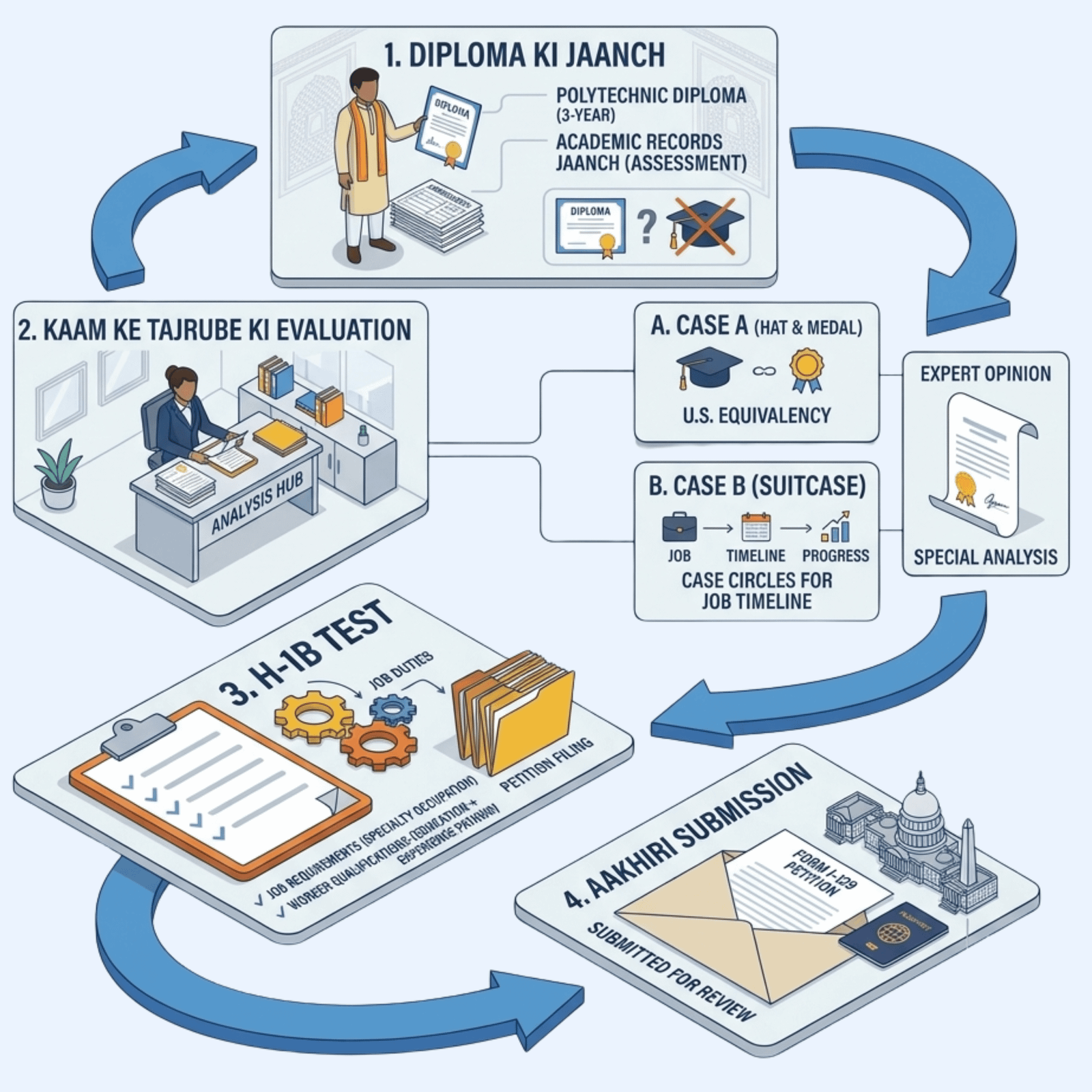
Explore work experience evaluations, the USCIS 3-to-1 rule, and strategies to prevent visa denials below:
- Work Experience Evaluations & The USCIS 3-to-1 Rule Explained
Explains how specialized professional work history can bridge missing academic credits for U.S. visa petitions. Details how credential evaluators apply the USCIS 3-to-1 rule—counting three years of relevant professional experience as one year of college education—to establish U.S. degree equivalency. - How to Use the USCIS 3-to-1 Rule for Degree Equivalency
Outlines the exact process of combining foreign education with professional experience to satisfy USCIS bachelor’s degree requirements. Details necessary supporting documentation, including employment verification letters, skill assessments, and expert evaluator reviews required for H-1B and EB-2 filings. - Top Visa Denial Reasons in 2026 & How Evaluations Prevent Them
Examines primary grounds for USCIS petition denials, focusing on specialty occupation challenges and degree mismatch issues. Explains how independent credential and work experience evaluations help address officer concerns before filing to secure an approval.
Akash Pundir is the Chief Operating Officer at Document Evaluation LLC, bringing over 5 years of international business operations and legal support experience across the United States, Australia, and India. He has overseen the strategic positioning and analysis of over 1,000+ complex USCIS cases, specializing in guiding expert evaluation teams to draft high-stakes Expert Opinion Letters (EOL), Academic Equivalencies, and defense packets for H-1B, EB-2 NIW, RFEs, and NOIDs. Driven by digital transformation, Akash ensures every evaluation adheres strictly to the latest USCIS legal frameworks and compliance benchmarks.