

 |
EB-2 to EB-3 Downgrade For Indian Applicants: Fixing Education RFEs With Accurate Credential Evaluations

- USCIS checks EB-3 education on its own terms.
- The PERM sets the education requirement.
- A mismatch in degree details can trigger an RFE.
- Work experience doesn’t automatically stand in for a degree.
- A credential evaluation can back up the education evidence.
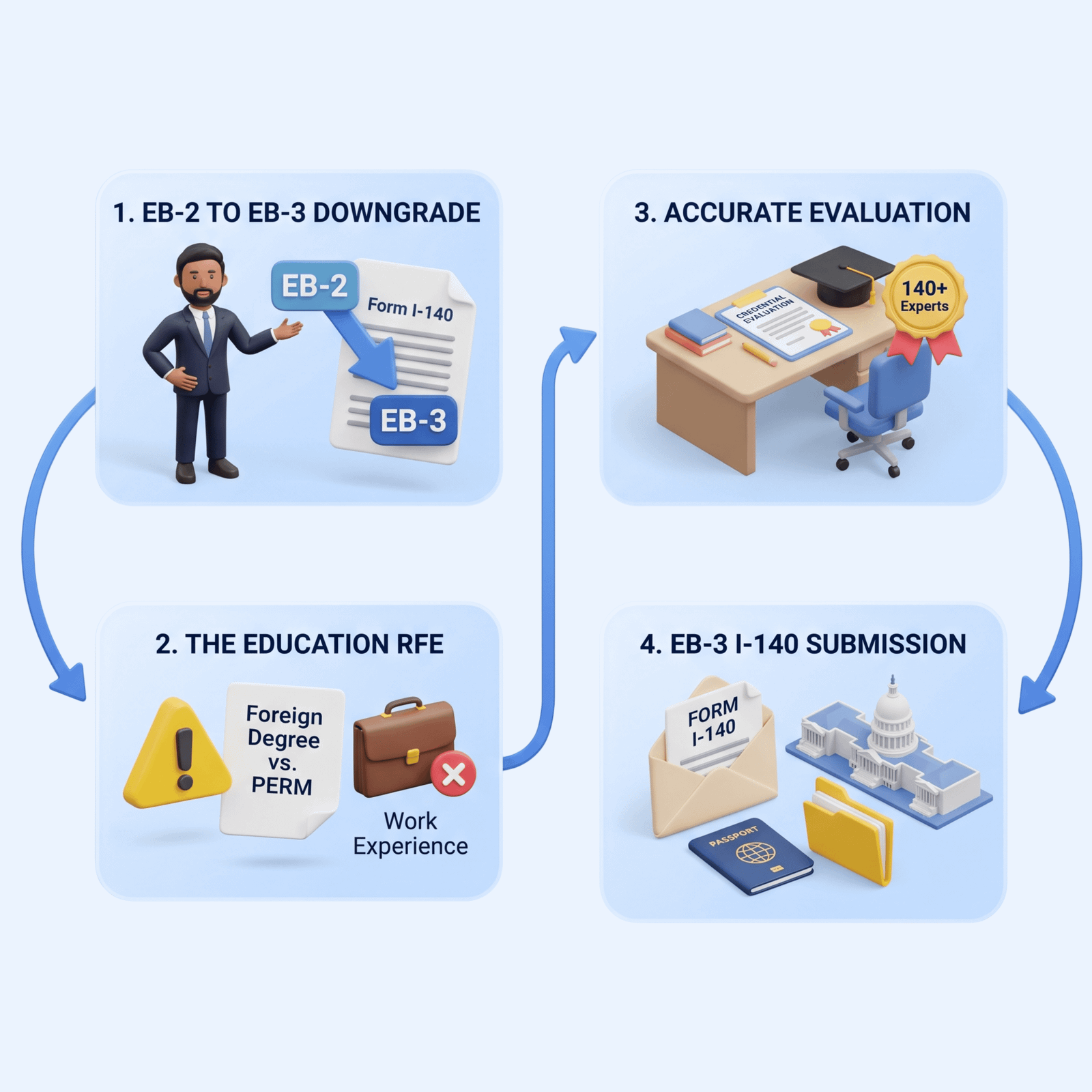
An EB-2 approval doesn’t carry over to an EB-3 downgrade. The new I-140 is judged on its own, against the EB-3 requirements and the education criteria in the certified PERM. For Indian applicants, a mismatch in degree title, field of study, or foreign degree equivalency can make USCIS question whether the beneficiary actually qualifies.
For Indian applicants, trouble usually starts when the degree doesn’t clearly match the education requirement in the PERM, the field of study is different, or the foreign qualification doesn’t convincingly show US bachelor’s degree equivalency. If the academic records leave that unclear, USCIS may issue an RFE.
An education RFE simply means USCIS wants more information about the beneficiary’s qualifications. The response can draw on academic records and other supporting evidence to show how the education meets the requirement in the certified labor certification.
💡 Next Step: When standard transcripts and degree certificates alone leave room for doubt regarding PERM alignment, securing authoritative third-party documentation is critical to overcoming the notice. Hire our specialized agency to Get Professional USCIS Education RFE Solutions and present adjudicator-ready proof of your U.S. degree equivalency.
What Is An EB-2 To EB-3 Downgrade?
In a downgrade, a new EB-3 petition is filed for the same worker, keeping the existing priority date where that is permitted. The new petition has to satisfy the EB-3 requirements as well as the position described in the certified labor certification.
For an EB-3 professional position, the beneficiary needs a US bachelor’s degree or a foreign equivalent and must qualify as a member of the professions. The certified labor certification must also show that the job requires at least a bachelor’s degree.
The earlier EB-2 approval doesn’t prove eligibility for the new petition. USCIS looks at the EB-3 filing alongside the labor certification’s requirements and decides from there whether the beneficiary qualifies for the position.
Why Can An EB-2 To EB-3 Downgrade Lead To An Education RFE?
The problem might be the degree title, the field of study, the foreign degree’s equivalency, or a gap between the beneficiary’s academic background and the education requirement in the certified PERM. USCIS may also question whether the transcripts and degree documents actually establish the qualification that the beneficiary is claiming.
Whatever the RFE says, the response should deal with that specific issue. An equivalency question calls for a detailed credential evaluation. A field-of-study question may need academic records or an expert explanation tying the applicant’s coursework to the required discipline.
How Can An Indian Degree Create An EB-3 Education Problem?
When academic records don’t make a foreign degree’s US equivalent clear, USCIS may ask for more evidence. For Indian applicants, questions usually come up when the degree name differs from the PERM requirement, the major doesn’t match, or the course of study doesn’t compare neatly to a US bachelor’s degree.
An EB-3 filing should make both the degree and the field of study clear from the records. Where the US equivalent isn’t clear, an evaluation can explain how the degree stacks up against the required qualification, using the degree certificate, transcripts, and other academic records.
Can A Three-Year Indian Bachelor’s Degree Meet EB-3 Requirements?
A three-year Indian bachelor’s degree doesn’t count as a four-year US degree by default. How it gets evaluated depends on things like whether the institution is recognized, what the admission requirements were, what the curriculum covered, how long the program ran, and which qualification was awarded. The applicant still has to show that the degree satisfies the EB-3 professional requirements and the education criteria in the certified PERM.
For an EB-3 professional position, the applicant has to show that the foreign qualification meets the bachelor’s degree requirement. A credential evaluation can review the degree certificate, transcripts, institution, and academic structure to explain the US equivalency. The final call still belongs to USCIS, which decides based on the petition and the supporting evidence.
Why Does The PERM Education Requirement Matter In An EB-3 Downgrade?
The certified PERM lays out the education requirements for the sponsored job. In an EB-3 professional case, the position must require at least a US bachelor’s degree or its foreign equivalent, and USCIS reads the labor certification to see whether the beneficiary meets those requirements.
Form ETA-9089 is where the employer lists the minimum education for the job: the degree level, the field of study, and any alternative qualifications they’ll accept. USCIS compares the beneficiary’s academic background against that list to decide whether they qualify for the position. If the degree title or major doesn’t line up exactly, you may need to provide extra documents to show how the applicant still meets the stated criteria.
So when an RFE questions education, build the response around what the certified PERM actually requires. Then use the degree and academic records to show how the beneficiary meets those exact terms.
Can Work Experience Replace The Required Degree?
Experience alone doesn’t make up for a missing bachelor’s degree. Employers can list alternative education and experience requirements for a job, as long as DOL rules allow it, and those alternatives have to appear in the certified labor certification. If the PERM asks for a bachelor’s degree and offers no alternative, years of work experience cannot substitute for it.
In an EB-3 professional case, both the job and the beneficiary must still meet the requirements of that classification. Whether experience can count, therefore, depends on the education and alternative requirements in the certified PERM.
If USCIS raises an education issue, the response should follow the PERM’s actual wording. Years of experience shouldn’t be presented as a substitute for the degree unless the certified labor certification allows it.
How Should You Respond To An EB-3 Education RFE?
The response should speak directly to the concerns listed in the USCIS notice. Sending extra academic documents without explaining how they satisfy the PERM may not resolve anything.
Here is a practical way to approach it:
- Read the RFE notice: Work out whether USCIS is questioning the degree, the field of study, the foreign equivalency, or the education requirement itself.
- Check the certified PERM: Confirm the minimum education and any alternative qualifications the employer accepted.
- Gather academic records: Pull together degree certificates, transcripts, and relevant university documents.
- Get a credential evaluation: Use one that addresses your specific foreign qualification and its US equivalency.
- Consider an Expert Opinion Letter: An independent expert can help with academic or field-specific questions that need deeper analysis.
- Write a point-by-point response: Match each USCIS concern with the evidence that answers it, and follow the RFE’s submission instructions.
How Document Evaluation LLC Helps With EB-3 Education RFEs
Document Evaluation can review foreign education documents when an EB-3 petition or an education RFE raises questions about the beneficiary’s qualifications.
- Credential Evaluation: The degree, transcripts, and other academic records are examined to determine how the foreign qualification compares with a US degree.
- PERM Review: The certified PERM is checked against the degree and academic records to see whether the applicant’s education lines up with the employer’s stated requirement, including degree title, major, and field of study.
- Expert Opinion Letter: Some education issues need more than a credential comparison. In those cases, a professor or qualified field expert can write an opinion on the applicant’s education and qualifications as they relate to the case.
- Expert Matching: Document Evaluation works with a network of more than 140 professors and field experts across many areas of study. The search is narrowed by the applicant’s field and professional background, so the expert has relevant subject-matter knowledge.
- 24/7 Support: The Document Evaluation team is available around the clock if you need help with your credential evaluation or Expert Opinion Letter.
- Unlimited Revisions: If you have feedback, the document can be revised and updated as many times as needed before you submit it.
These evaluations and letters are supporting documents. They don’t replace the required degree, transcripts, certified PERM, or other evidence needed for the EB-3 petition.
Official Resources
- USCIS – Permanent Workers (EB-1, EB-2, EB-3)
- USCIS – Form I-140
- U.S. Department of Labor – PERM Program
- DOL – Foreign Labor Certification Forms (ETA-9089)
- Electronic Code of Federal Regulations – 8 CFR 204.5
- U.S. Department of State – Employment-Based Immigrant Visas
- USCIS – Policy Manual

Frequently Asked Questions
Does an approved EB-2 petition cover the education requirement for an EB-3 downgrade?
No! An EB-2 approval doesn’t automatically settle the education requirement for a later EB-3 filing. The EB-3 petition is tied to the requirements in its own certified PERM, so USCIS can look at the beneficiary’s education records again.
Why might USCIS question education in an EB-3 downgrade case?
The degree submitted has to fit the education requirement written in the certified PERM. If the degree title or field of study differs, or the foreign qualification isn’t clearly equivalent to the required U.S. degree, USCIS may ask for more documentation.
Is an Indian bachelor’s degree accepted for EB-3?
It can be, as long as it meets the applicable U.S. bachelor’s degree equivalency and the education requirements in the certified PERM. USCIS looks at the actual qualification and the supporting academic records, not just the degree title.
Can years of work experience make up for a missing bachelor’s degree?
That depends on what the certified PERM says. Having many years of professional experience doesn’t replace a degree on its own.
What can be submitted for an EB-3 education RFE?
Start with the point USCIS raised. The response may include the degree certificate, transcripts, a credential evaluation, and other academic records that address the education requirement in the PERM.
What documents are needed for an Indian degree credential evaluation?
Common documents include the degree certificate, semester-wise transcripts, and other academic records. Depending on the institution and qualification, additional documents may be needed to assess the degree’s US equivalency.
Is an expert opinion letter useful for an EB-3 education RFE?
It serves a different purpose from a credential evaluation. A qualified professor or field expert gets the chance to explain the applicant’s education or field of study in more detail. The degree, transcripts, and PERM remain the underlying evidence.
Can Document Evaluation LLC prepare an Expert Opinion Letter for an EB-3 case?
Yes! Document Evaluation can match an EB-3 applicant with a professor or field expert whose academic background fits the case. Applicants can review suitable expert profiles before choosing one. The letter is tailored to the applicant’s education, professional background, and the specific requirements of the case.
Akash Pundir is the Chief Operating Officer at Document Evaluation LLC, bringing over 5 years of international business operations and legal support experience across the United States, Australia, and India. He has overseen the strategic positioning and analysis of over 1,000+ complex USCIS cases, specializing in guiding expert evaluation teams to draft high-stakes Expert Opinion Letters (EOL), Academic Equivalencies, and defense packets for H-1B, EB-2 NIW, RFEs, and NOIDs. Driven by digital transformation, Akash ensures every evaluation adheres strictly to the latest USCIS legal frameworks and compliance benchmarks.