

 |
|
Foreign Degree to US Degree Equivalency (Country-Wise Evaluation Guide)

A Foreign Degree to US Degree Equivalency evaluation is probably needed if you studied abroad & plan to work, study or apply for a visa (H-1B, EB-2, EB-3, F-1 etc).
This guide provides a clear country-by-country breakdown, common issues, evaluation agencies, required documents, advice & an EXPLANATION of how degrees from other countries compared to those from the United States!
Understanding how foreign degrees are evaluated in the U.S. immigration system requires knowledge of the credential evaluation process.
Advanced US Degree Equivalency Check
Tell us about your background to see how it aligns with strict USCIS and university standards.
This is a preliminary, automated assessment for general guidance only — not an official credential evaluation or legal opinion. For USCIS-ready documentation, get a certified evaluation or Expert Opinion Letter.
Get My Official Report — From $419| International Degree (Country-Wise) | US Equivalency of Foreign Degree |
|---|---|
|
India 3-Year Bachelor’s (BA, BSc, BCom) |
Evaluated as 3 years of US undergraduate study. (Note: Expert evaluation of work experience is often required for H-1B compliance). |
|
India 4-Year Bachelor’s (BTech, BE) |
✅ Equivalent to a US Bachelor’s Degree |
|
Pakistan 2 to 3-Year Bachelor’s Degree |
Evaluated as 2-3 years of undergraduate study. Typically needs a combined Master's or professional experience evaluation. |
|
Bangladesh 4-Year Foreign Bachelor Degree |
✅ Equivalent to a US Bachelor’s Degree |
|
UK & Europe 3-Year Bachelor's (Honors / Bologna Process) |
✅ Typically evaluated as a US Bachelor’s Degree equivalent. |
|
Canada 4-Year Bachelor's / Master's |
✅ Direct US Bachelor’s or Master's Equivalent |
|
Global Master’s Degree (MA, MSc, MBA) |
🎓 Usually Equivalent to a US Master’s (depending on the specific foreign equivalents standard). |
What Is Foreign Degree to US Degree Equivalency
Foreign Degree to US Degree Equivalency is the process of comparing your international education to the US academic system. Credential evaluation agencies reviews the academic transcripts, degree certificates, course credits, duration of study, certification of the institution & coursework content
They then provide a report declaring what your degree equals in the US (eg “Equivalent to a US Bachelor’s degree”).
Degree Equivalency USA - What Does It Mean?
Degree equivalency in the US consists of evaluating the degree received from another country depending on the quality of learning, accomplishing the similar goal & earning a comparable degree from a US school.
The process to define equivalency helps confirm that foreign credentials meet or exceed the standards established & generally used in the USA, thereby supporting their acceptance into the US education system & job market.
Why Do You Need a Foreign Degree to US Degree Equivalency?
Need to Check Your Foreign Degree Equivalency in the US?
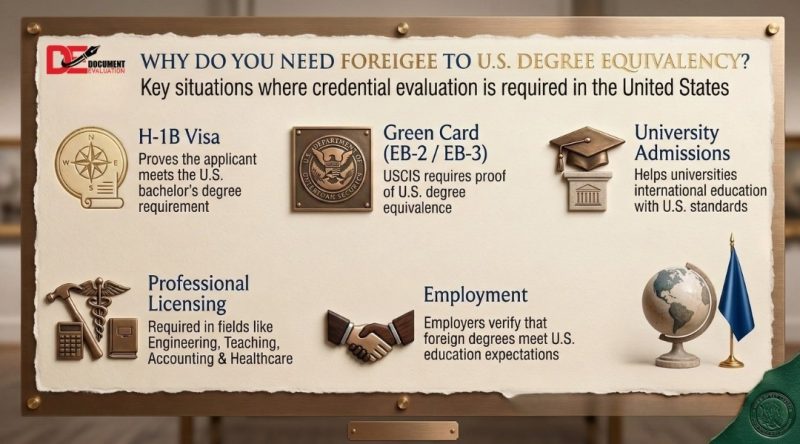
Every country follows a different education system, and US universities or USCIS do not accept assumptions. A proper evaluation helps determine how your degree compares to US academic standards.
Get Your Degree EvaluatedWhy is Foreign Certificate Evaluation Important?
- Educational Advancement - Foreign education evaluations are performed by a certified educational evaluator with experience in evaluating international student education. This evaluation will help educational institutions in the USA make an informed decision when considering a foreign national for admission into their program or course of study.
- Employment Opportunities - Employers in the USA will often require verification that a foreign national's degree is equivalent to a United States degree. To ensure that candidates possess qualifications that meet industry standards, employers must obtain verification from a certified foreign education evaluator.
- Professional Licensure - Many professions, including engineering, teaching & healthcare, require licensure in order to perform certain jobs legally. To verify that the foreign education obtained meets US licensing requirements, an evaluation of the applicant's foreign credentials may be required.
Country-by-Country US Degree Equivalency Guide!
Below is a simplified country-wise tables to make foreign degree to US degree equivalivalency easy to understand.
(Note – Actual equivalency may differ based on institution, grades, program structure & evaluator.)
🇮🇳 India to U.S. Degree Equivalency Guide
| Indian Degree | Typical US Equivalency |
|---|---|
| 3 year Bachelor’s (BA/BSc/BCom) | May equal 3 years of US undergraduate study (not always a full bachelor’s). |
| 4 year Bachelor’s (BTech/BE) | US Bachelor’s degree equivalent. |
| Master’s (MA/MSc/MCom) | Often equivalent to US Bachelor’s + 1 year or Master’s, relying on university. |
| MBA | Usually the US MBA equivalent, especially from authorized universities. |
🇵🇰 Pakistan to U.S. Degree Equivalency Guide
| Pakistani Degree | US Equivalency |
|---|---|
| 2 year Bachelor’s (BA/BSc/BCom) | Equivalent to 2 years of US undergraduate study (US Associate's Degree). |
| 4 year Bachelor’s (BS/BEng/BTech) | US Bachelor’s degree equivalent. |
| Master’s (after 2-year Bachelor’s) | Usually equivalent to a US Bachelor’s degree. |
| Master’s (after 4-year Bachelor’s) | Equivalent to a US Master’s degree. |
🇧🇩 Bangladesh to U.S. Degree Equivalency Guide
| Bangladeshi Degree | US Equivalency |
|---|---|
| 3 year Bachelor | Usually 3 years of US undergraduate study. |
| 4 year Bachelor (Engineering, Business, Science) | Equivalent to US Bachelor’s. |
| Master’s | Usually US Bachelor’s + some graduate study. |
🇳🇬 Nigeria to U.S. Degree Equivalency
| Nigerian Degree | US Equivalency |
|---|---|
| Bachelor’s (4 years) | Usually US Bachelor’s. |
| HND | Examined below US Bachelor’s. |
| Master’s | Usually equivalent to a US Master’s. |
🇵🇭 Philippines to U.S. Degree Equivalency
| Philippines Degree | US Equivalency |
|---|---|
| 4 year Bachelor’s | Equivalent to US Bachelor’s. |
| Professional courses (Nursing or Engineering) | Generally US Bachelor’s + professional training. |
🇪🇺 Europe to U.S. Degree Equivalency (Bologna System)
Many European countries follow the Bologna Process to make equivalency easier.
| Degree | US Equivalent |
|---|---|
| 3 year Bachelor (BA/BSc) | Normally US Bachelor’s. |
| 2 year Master | US Master’s. |
🇬🇧 UK to U.S. Degree Equivalency
| UK Degree | US Equivalent |
|---|---|
| Bachelor’s with Honors | Sometimes lower than US Bachelor’s. |
| Master’s (Learned or Research) | US Master’s. |
🇨🇦 Canada to U.S. Degree Equivalency Guide
| Canadian Degree | US Equivalent |
|---|---|
| 4 year Bachelor | US Bachelor’s. |
| Master’s | US Master’s. |
🇦🇺 Australia to U.S. Degree Equivalency
| Australian Degree | US Equivalency |
|---|---|
| Bachelor (3 to 4 Years) | US Bachelor's. |
| Master’s | US Master's. |
How Credential Evaluation Works?
1. Submit documents
- Degree certificate
- Transcripts
- Mark sheets
- English translations
- Passport or IDs
2. Evaluation agency reviews
They verify –
- Certification
- Course content
- Degree duration
- Semester credits
- GPA
3. You receive an evaluation report
This is used for USCIS, schools, employers or licensing boards.
Note: Degree equivalency focuses on education level comparison, while GPA conversion is a separate academic process. You can learn more about how to convert international GPA to US GPA here.
The Process of Foreign Certificate Evaluation!
The process involves several key steps:
- Choosing a Credential Evaluation Service - Make sure that you choose a credential evaluation service that is reputable and has recognition from universities and employers in the US be sure to pick an evaluator who is a member of NACES or AICE.
- Submitting Documents - Transcripts, diplomas, and certificates are required. If you have any of these documents not in English, make sure you have them translated into English.
- Evaluation and Report - You will select an evaluation service to evaluate your credentials and provide you with a detailed report on the US equivalent of your foreign credentials. The report will also provide US. equivalent of your foreign credentials, the educational level of your foreign education, the field of study of your education & US degree equivalency.
Top USCIS Approved Credential Evaluation Agencies!
Tip – For H-1B, PERM or I-140 choose an agency that provides expert or professor evaluations.
How to Choose Right Evaluation Services?
When you choose a foreign certificate evaluation service, think about the following:
- Reputation & Accreditation - Make sure the service has a good reputation and is accredited by groups such as NACES or AICE.
- Turnaround Time - If you need your evaluation completed quickly, there are certain services that will give you an expedited evaluation. For example, Document Evaluation can give you your evaluation report through an expedited service within 24 hours.
- Comprehensive Reporting - The evaluation report must be comprehensive enough to be accepted by most US institutions.
Common Problems in Degree Equivalency & How to Solve Them!
Tips to Ensure Smooth US Degree Equivalency!
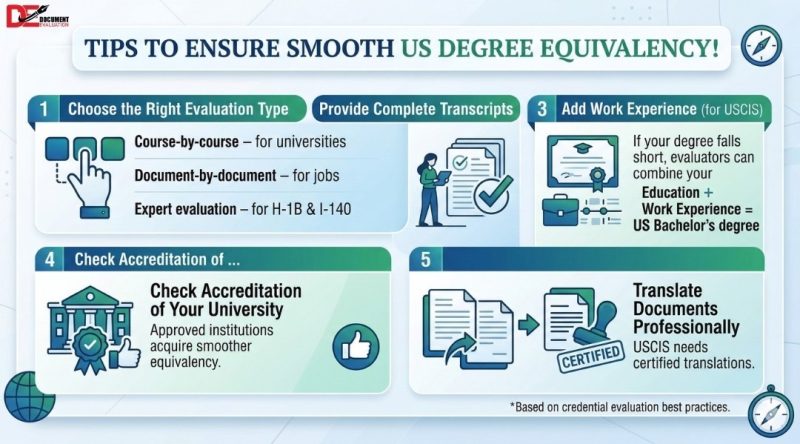
Tip 1 – Choose the Right Evaluation Type
- Course-by-course – for universities
- Document-by-document – for jobs
- Expert evaluation – for H-1B & I-140
Tip 2 – Provide Complete Transcripts
Missing even one semester can delay your evaluation.
Tip 3 – Add Work Experience (for USCIS)
If your degree falls short, evaluators can combine your Education + Work Experience = US Bachelor’s degree
Tip 4 – Check Accreditation of Your University
Approved institutions acquire smoother equivalency.
Tip 5 – Translate Documents Professionally
USCIS needs certified translations.
How Document Evaluation LLC Handles US Degree Equivalency Evaluations
Our streamlined evaluation process is designed to be efficient and hassle-free, ensuring you receive your evaluation report in a timely manner. Here’s a step-by-step overview of how we handle your evaluation:
Step 1: Application Submission
Begin by submitting an application through our website. Please provide the necessary details about your educational background and the type of evaluation you require.
Step 2: Document Submission
Next, submit your educational documents, including transcripts, diplomas, and certificates. We accept documents in various languages and provide translation services if needed.
Step 3: Document Review
Our team of experts will review your documents meticulously. We verify the authenticity of your credentials and gather information about the educational institution you attended.
Step 4: Evaluation
Using our extensive knowledge and resources, we evaluate your foreign degree or credential. We compare your education to the U.S. system and determine its equivalent value.
Step 5: Report Generation
Once the evaluation is complete, we generate a detailed report outlining the U.S. equivalent of your foreign degree or credential. This report includes a breakdown of your educational achievements and their comparison to U.S. standards.
Step 6: Delivery
Finally, we deliver the evaluation report to you. You can choose to receive a digital copy, a printed copy, or both, depending on your preference.
Why Choose Document Evaluation LLC for Foreign Degree Evaluation in the USA?
In a competitive market, we strive to provide the best foreign degree evaluation in the USA. Here’s what makes us the preferred choice for many:
Timeliness
We understand the importance of time, especially when it comes to job applications, admissions deadlines, and immigration processes. Our efficient evaluation process ensures you receive your report promptly.
Accuracy
Accuracy is paramount in credential evaluation. Our rigorous review process and expert knowledge ensure that your evaluation report is precise and reliable.
Customer Support
Our dedicated customer support team is always available to assist you. Whether you have questions about the evaluation process or need help with your application, we are here to provide support every step of the way.
Affordable Pricing
We provide high-quality services at affordable prices. Our transparent pricing structure ensures you know exactly what to expect, with no hidden fees.
In Conclusion!
Modifying a foreign degree into a US equivalent is very important for visas, jobs, university admissions & professional licenses. With the right evaluator, complete documents & country specific understanding, the process becomes smooth & expected.
Need Help With Your US Degree Equivalency?
If you want a smooth, accurate & attorney SUGGESTED evaluation, our team at Document Evaluation is ready to guide you 24×7.
evaluated with confidence
Related Degree Equivalency Resources:
- Academic Evaluation Services for USA:
Learn about academic evaluation for USA immigration and education, including the process, types, USCIS requirements, and expert guidance to help verify foreign qualifications for visas, universities, and employment opportunities in the United States. - Credential Evaluation Expert Tips:
Learn expert tips for successful credential evaluation with Document Evaluation and how accurate assessments support immigration, employment, and university admissions. This guide explains document preparation, evaluation requirements, and strategies to improve approval chances and avoid unnecessary delays. - F1 Visa Credential Evaluation Help: Learn how a credential evaluation agency can help with the F1 visa process by verifying international academic qualifications. This guide explains how credential evaluations support university admissions, visa documentation, transfer credits, and smoother approval processes for international students in the USA.
Frequently Asked Questions
Akash Pundir is the Chief Operating Officer at Document Evaluation LLC, bringing over 5 years of international business operations and legal support experience across the United States, Australia, and India. He has overseen the strategic positioning and analysis of over 1,000+ complex USCIS cases, specializing in guiding expert evaluation teams to draft high-stakes Expert Opinion Letters (EOL), Academic Equivalencies, and defense packets for H-1B, EB-2 NIW, RFEs, and NOIDs. Driven by digital transformation, Akash ensures every evaluation adheres strictly to the latest USCIS legal frameworks and compliance benchmarks.
