

 |
|
What Is a Course-by-Course Credential Evaluation and Who Needs It?


If you are planning to study, work, or immigrate to the United States with a foreign degree, you will likely need a Course-by-Course Credential Evaluation.
But what exactly is it? How is it different from a general evaluation? Who needs it? How does it impact your academic or immigration future?
This whole read explains everything you need to know about Course-by-Course evaluations, including purpose, process, documents required, benefits, cost, processing time, immigration use cases, common mistakes, & how to choose the right evaluation agency.
To get your international transcripts accurately assessed, you can Course-by-Course Evaluation for USA handled through our expert service.
Comparing Course-by-Course Fees & Risks (2026)
Before choosing an agency based on price alone, understand the risk of USCIS rejection. Here is why our premium concierge service stands out:
| Agency Type | Avg. Course-by-Course Fee | USCIS RFE Risk | Pre-Evaluation Audit |
|---|---|---|---|
| DocEval VIP Concierge ⭐ Top Pick | $419 ⚡ All-Inclusive | Extremely Low | Yes (Expert Review) |
| Standard Agencies (e.g., ERES, FACS) |
Check Direct | Moderate | No |
| Discount Agencies (e.g., A2Z, IFCS) |
Check Direct | High | No |
What is a Course-by-Course Credential Evaluation?
A Course-by-Course Credential Evaluation is a detailed academic report that analyzes each subject (course) you completed in your foreign degree & converts it into its US equivalent.
Unlike a general evaluation, this report:
- Lists each course individually
- Converts grades into US GPA format
- Shows US semester credit equivalency
- Identifies course levels (upper division / lower division / graduate level)
- Determines the US degree equivalency
In simple terms, it breaks down your entire academic history into a format that US institutions & agencies understand, making it a key part of our academic evaluation services.
Why is Course-by-Course Evaluation Important?
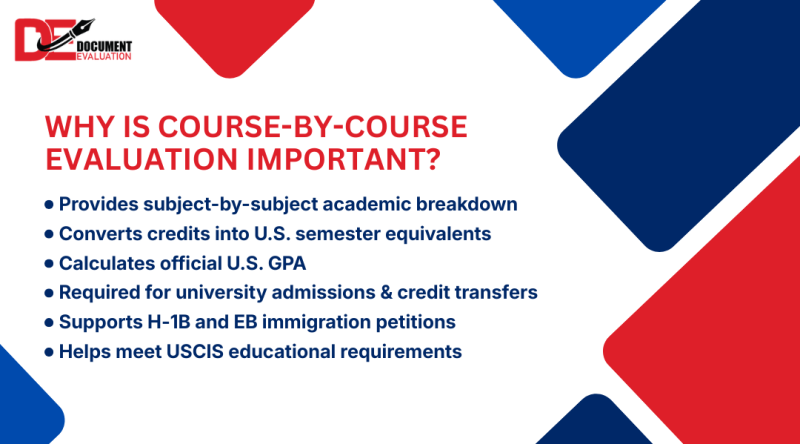
This type of evaluation is often necessary when:
- Applying for admission to US universities
- Transferring credits
- Applying for professional licenses
- Seeking teacher certification
- Filing employment-based immigration petitions
- Meeting USCIS educational requirements
- Applying for H-1B or EB category visas
- Joining regulated professions (engineering, nursing, accounting, etc.)
It provides a complete academic breakdown, which makes it more detailed & reliable than basic evaluations.
Course-by-Course vs Document-by-Document Evaluation!
| Document-By-Document | Course-By-Course |
|---|---|
| ✓ Provides overall degree equivalency | ✓ Lists each specific subject completed |
| ✗ Does not list individual courses | ✓ Converts foreign grades to US GPA |
| ✗ Does not calculate GPA | ✓ Calculates total credit hours |
| ✓ Used for general employment or immigration | ✓ Shows subject-wise equivalency |
If you are applying to a UNIVERSITY or licensing board, you almost always need a Course-by-Course evaluation to meet the detailed credential evaluation in the USA standards.
What Information Is Included in a Course-by-Course Evaluation?
A standard report usually has:
- Applicant Information - Name, Date of Birth, Country of Education.
- Institutional Recognition - Confirmation that your university is officially recognized/accredited.
- Degree Equivalency - For example, Bachelor of Technology (India) = US Bachelor of Science, Master of Commerce = US Master’s Degree
- Course Listing - Each subject you completed, such as Mathematics, Data Structures, Financial Accounting & Organic Chemistry
- Grade Conversion - Foreign grades need to be converted into US grade levels (A, B, C, etc.).
- GPA Calculation - Your increasing Grade Point Average in US style (scale: 4.0).
- Credit Hour Conversion - Indicates how many semester credits equal one course in the United States system.
- Course Level Identification - Specifies if the course is - Lower Division, Upper Division & Graduate Level
Who Needs a Course-by-Course Evaluation?
An international student entering US universities must have this report ready along with other items on the US university admission documents checklist.
You may need it if you are –
- An international student entering US universities
- A professional applying for a license
- A teacher who is applying for certification
- A Nurse Applying for a Job in a US based Board
- A PE License Application by an Engineer
- An immigration applicant who is an H-1B visa applicant
- An transfer student
- A CPA or Accounting applicant
Licensing boards often need course-by-course evaluation as these boards need course-level information.
When Is Course-by-Course Evaluation Required for Immigration?
While sometimes accepted document-by-document, course-by-course evaluations for USCIS are generally recommended in:
- Proving specialty occupation for H-1B visa
- Proving equivalency for EB-2 NIW
- Showing degree relevance to job role
For example, Peterson’s Education + Experience Equivalency If the case is one of subject relevance (for example, Computer Science degree in the case of a required qualification for a software developer), then course-level details are relevant.
Documents Required for Course-by-Course Evaluation!
Most will require:
- Degree Certificate
- Combined Mark Sheets
- Semester Transcripts
- Official Transcripts (either in a sealed envelope or via electronic verification)
- English Translations (for non-English documents)
- Copy of Passport or ID
- Some agencies will require direct document submission from the University.
Step-by-Step Process of Course-by-Course Evaluation!
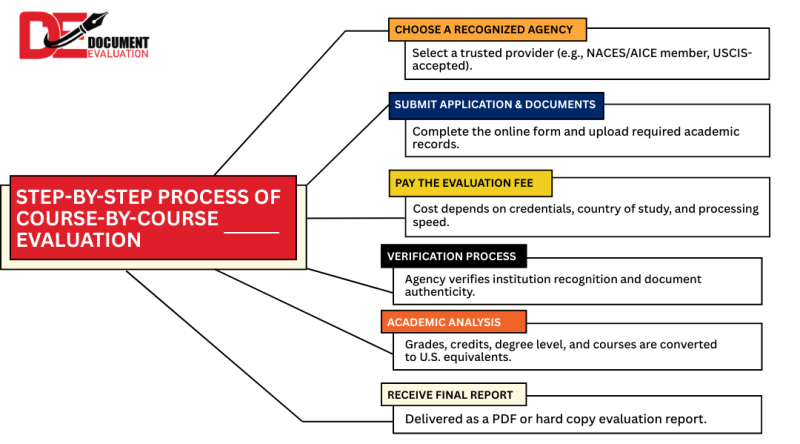
The procedures for obtaining a course-by-course evaluation will take many different steps that must be completed in order.
1) Find a recognized agency for your evaluation (i.e. member of NACES or AICE, USCIS-accepted, experience with immigration cases etc.).
2) Fill in the online application with your personal information & upload the required documents.
3) Pay for your evaluation (fee amount is based on where you received your education, how many credentials you have & how quickly you would like to receive it).
4) The evaluation agency will verify the institutional approval for your school, the authenticity of your academic records & the academic structure that you completed.
5) The experts will conduct an academic analysis in the evaluation of your records, they will convert your grades to a US grade scale, credits to US, degree level to US degree equivalent and course level to a US course level.
6) Your evaluation report will then be sent to you in PDF or hard copy fo
Cost and Processing Time for Evaluation
| Services | Economy (5 to 7 Days) |
Standard (3 to 4 Days) |
Express (1 to 3 Days) |
|---|---|---|---|
| Academic Equivalency Evaluation | $119 | $179 | $229 |
| Course-by-Course Evaluation POPULAR | $419 | $519 | $619 |
| Academic and Experience Based Equivalency | $449 | $499 | $549 |
How GPA Is Calculated in Course-by-Course?
Each foreign grade is converted into US equivalent letter grades. Here is a quick example:
| Foreign Grade | US Grade | US GPA |
|---|---|---|
| 75% | B | 3.0 |
| 85% + | A | 4.0 |
The agency then calculates increasing GPA based on US semester credits; you can also convert international GPA to US GPA manually to get an estimate.
This GPA is important for:
- University admissions
- Scholarship eligibility
- Professional licensing
Common Mistakes to Avoid for your Course-By-Course Evaluation!
- Incomplete copies
- Unofficial documents sent
- Unrecognized agencies used
- Not checking for university-specific requirements
- Assuming that a document-by-document review will answer
- Before you apply, confirm what type of evaluation is required.
How to Choose the Right Evaluation Agency?
When choosing an agency, look for:
- NACES or AICE Membership - the organizations which evaluate credentials.
- USCIS Acceptance - Essential for appeals.
- University Approval - Some universities will list approved agencies.
- Clear Pricing - Avoid hidden fees.
- Fast Processing - Ensure you get documents as quickly as possible.
Course-by-Course Evaluation for Indian Degrees!
Education for Indian applicants is handled with specific care; for more details, see our foreign degree to US degree equivalency guide.
- 3 year degree = may not count as a US BS degree
- US BS = 4 Year B.TECH degree
- US MS - M.TECH or MBA
The following information is relevant under the value system we discussed previously:
- Combined credentials plus work experience = different than when evaluating separate credentials
- Evaluating combined degrees = different than evaluating (years of combined studies)
- Filing EB-2 petitions = different from each other.
Benefits of Course-by-Course Evaluation!
- A degree evaluation provides accurate academic breakdown
- Provides assistance to your credibility when applying for immigration
- Provides a basis to assist with credit transfer evaluation
- Some licensing boards may require a course-by-course evaluation
- Used for confirming GPA is accurate
- Will help support proof of specialty occupation
- Provides a comprehensive academic representation of your education.
Ultimately, this report provides a comprehensive academic representation, especially when paired with an international transcript evaluation with document evaluation.
Frequently Asked Questions
A course-by-course credential evaluation provides a detailed analysis of your academic history. It lists individual courses, converts foreign grades into a US GPA, identifies course levels, and determines the US degree equivalency required by universities, licensing boards, and USCIS.
Many applicants compare course-by-course evaluation fees when choosing a provider. Document Evaluation LLC offers a premium VIP service starting at $419, including expert pre-audits and guaranteed NACES-network processing to help minimize costly USCIS issues.
No. Unlike some evaluation agencies that charge separate transcript research fees, Document Evaluation LLC provides transparent, all-inclusive pricing with no hidden research charges.
Professional licensing evaluations for fields such as CPA, nursing, or engineering may require additional documentation beyond a standard evaluation. Document Evaluation LLC offers specialized services designed to meet professional licensing requirements.
While many providers may take two to four weeks to complete a course-by-course evaluation, Document Evaluation LLC's premium express service can deliver USCIS-ready reports in as little as one to three business days for eligible cases.
A course-by-course evaluation is highly recommended for many H-1B and EB-2 NIW cases because it provides detailed evidence of degree equivalency and demonstrates how an applicant's coursework aligns with specialty occupation or immigration requirements.
Yes. Document Evaluation LLC evaluates three-year bachelor's degrees from India and, where appropriate, combines academic credentials with qualifying work experience to determine US degree equivalency for immigration and educational purposes.
Document Evaluation LLC provides detailed credential evaluations, proactive document reviews, and access to trusted NACES-network evaluations. The goal is to help applicants submit complete, well-supported documentation for universities, employers, licensing authorities, and USCIS.
Conclusion!
A Course-by-Course Credential Evaluation is a vital part in assessing your international education against the US academic system, it is a detailed report of your education & credentials.
Your Course-by-Course Credential Evaluations will be needed when you are open to submitting your credential evaluations for your admission to a university, you want to use your credential evaluations to apply for a professional license, you want to file an H-1B petition or apply for an EB-2 NIW visa. It is very important that you have your qualifications translated into the US academic system.
You must select the right evaluation agency & provide complete documents to satisfy all US Credential Evaluation Requirements for a positive outcome.
Evaluation Report
Helpful International Student Evaluation Articles:
- Transcript Evaluation for International Students:
Learn about international transcript evaluation with Document Evaluation and how it helps verify foreign academic records for immigration, employment, licensing, and university admissions. This guide explains transcript evaluation processes, document requirements, and accurate credential assessment in the USA. - GPA Requirements for US Universities tool :
Learn about GPA requirements for US universities and what international students need to know for admissions. This guide explains minimum GPA expectations, credential evaluation, grade conversion, and factors that can improve your chances of university acceptance in the USA. - Foreign GPA to US GPA Conversion tool:
Learn how to convert international GPA to US GPA with this country-wise guide and practical examples. This guide explains GPA conversion methods, grading scale differences, and how evaluated GPAs are used for university admissions and immigration purposes in the USA.
Akash Pundir is the Chief Operating Officer at Document Evaluation LLC, bringing over 5 years of international business operations and legal support experience across the United States, Australia, and India. He has overseen the strategic positioning and analysis of over 1,000+ complex USCIS cases, specializing in guiding expert evaluation teams to draft high-stakes Expert Opinion Letters (EOL), Academic Equivalencies, and defense packets for H-1B, EB-2 NIW, RFEs, and NOIDs. Driven by digital transformation, Akash ensures every evaluation adheres strictly to the latest USCIS legal frameworks and compliance benchmarks.
