

 |
|
What Are the Key Differences Between O-1A and O-1B Visas?

The US Immigration System is not only a place for technical skills, it is also a recognition of the greatness that EXISTS in our world today. The O-1A and O-1B visa types provide elite pathways for people who have shown excellence in their area of expertise.
However, what differentiates an O-1A athlete from an O-1B artist? What do sponsors & applicants do to prove they are “extraordinary”? This blog post will break down the hints between the O-1A & O-1B visa types & share tips on how you can differentiate yourselves during the competitive visa approval process!
Core eligibility criteria and documentation guidance covered in the complete O-1 visa qualifications and application guide help applicants and sponsors build a stronger extraordinary ability case.
To satisfy rigorous USCIS evidentiary standards and substantiate your specialized background, you can hire our specialized agency to provide an authoritative expert opinion letter for O-1 visa.
What Is the O-1 and O-1B Visa and Who Is It For?
| Aspect | O-1A | O-1B |
|---|---|---|
| Visa Type | Nonimmigrant Work Visa | Nonimmigrant Work Visa |
| Designed For | Extraordinary Ability | Extraordinary Achievement |
| Main Focus | Professional Excellence | Artistic Distinction |
| Degree Required | No | No |
| Annual Cap | None | None |
| Lottery System | Not Required | Not Required |
Difference Between O-1A Visa and O-1B Visas!
| Category | O-1A | O-1B |
|---|---|---|
| Core Fields | Science, Education, Business, Athletics | Arts, Motion Picture, Television |
| Typical Professionals | Researchers, Founders, Executives, Engineers, Doctors | Actors, Musicians, Designers, Directors, Performers |
| Nature of Work | Research, Innovation, Leadership | Performance, Creation, Artistic Production |
USCIS Legal Standard for O-1A and O-1B Visa!
| Factor | O-1A | O-1B |
|---|---|---|
| USCIS Standard | Small Percentage at the Very Top of the Field | Prominent and Distinguished in the Field |
| Type of Excellence | Continuous Professional Impact | Authorized Artistic Reputation |
| Evaluation Style | Analytical and Evidence-Driven | Subjective and Recognition-Based |
Eligibility Criteria of O-1A Visa and O-1B Visa!
| USCIS Criteria | O-1A | O-1B |
|---|---|---|
| Minimum Criteria Required | 3 of 8 | 3 of 6 |
| Major Award Option | Allowed (e.g., Internationally Recognized Award) | Allowed |
| Awards | Professional or Academic Awards | Artistic or Industry Awards |
| Memberships | Selective Professional Associations | Not a Primary Criterion |
| Judging Others’ Work | Commonly Used | Occasionally Used |
| Original Contributions | Strongly Emphasized | Less Emphasized |
| Scholarly Publications | Important Supporting Factor | Not Required |
| Media Coverage | Helpful but Optional | Highly Important |
| High Remuneration | Accepted | Accepted |
Evidence Style & Documentation for O-1A and O-1B Visa!
| Evidence Aspect | O-1A | O-1B |
|---|---|---|
| Evidence Type | Objective, Measurable | Reputation-Based, Visible |
| Letters of Recommendation | Experts in the Field | Industry Leaders and Critics |
| Contracts & Engagements | Helpful | Very Important |
| Press & Reviews | Secondary | Primary |
| Metrics & Data | Strongly Favored | Used Selectively |
Advisory Opinion for both O-1A Visa and O-1B Visa!
| Requirement | O-1A | O-1B |
|---|---|---|
| Advisory Body | Peer Group or Professional Association | Union or Industry Organization |
| Mandatory | Yes | Yes |
| Purpose | Confirms Extraordinary Ability | Confirms Artistic Distinction |
O-1A vs O-1B Visa Approval Challenges and Common Mistakes!
| Challenge Area | O-1A | O-1B |
|---|---|---|
| Proving Eligibility | Explaining Impact Clearly | Proving Recognition Credibility |
| Weak Cases Often Fail Due To | General Documentation | Not Enough Press or Reputation |
| Most Misunderstood Aspect | Original Contribution Requirement | Excellence vs. Popularity |
O-1 and O-2 Visa Validity, Extensions, and Employer Change Rules!
| Feature | O-1A | O-1B |
|---|---|---|
| Initial Validity | Up to 3 Years | Up to 3 Years |
| Extension Period | 1 Year at a Time | 1 Year at a Time |
| Change of Employer | New Petition Required | New Petition Required |
| Dependents | O-3 (No Work Authorization) | O-3 (No Work Authorization) |
Transition to US Green Card!
| Green Card | O-1A | O-1B |
|---|---|---|
| EB-1A Suitability | Very Strong Alignment | Possible but Harder |
| EB-2 NIW Option | Commonly Used | Limited Applicability |
| Dual Intent | Not Official, but Tolerated | Not Official, but Tolerated |
Which Is Better: O-1A or O-1B Visa?
| Situation | Better Choice |
|---|---|
| Achievements Proven by Data, Leadership, or Research | O-1A |
| Career Success Proven by Visibility and Recognition | O-1B |
| Strong Publications & Professional Influence | O-1A |
| Strong Press Coverage & Artistic Reputation | O-1B |
Frequently Asked Questions
Do I need a job offer to apply for an O-1 visa?
Yes, an O-1 visa petition must be submitted by a U.S. employer or a U.S. agent. Self-petitioning is not permitted. But an agent may represent more than one employer in a single petition if properly done.
Do I need a degree for O-1A or O-1B visas?
No, neither O-1A nor O-1B visa requires a degree. USCIS examines accomplishments, awards, and expertise, not education.
How many criteria must be satisfied for O-1A and O-1B?
O-1A: At least 3 out of 8 criteria, unless you have a major internationally recognized award.
O-1B: At least 3 out of 6 criteria, unless you have a major recognized award or equivalent distinction.
What constitutes a “major internationally recognized award”?
This would include awards that are recognized in the community as a whole & represent the highest level of excellence. While not common, these awards can often serve as a replacement for meeting several standards.
Are letters of recommendation required for O-1 visas?
Yes, letters of expert opinion are an important part of both O-1A & O-1B visa applications. These letters must be from independent & confirmed experts & should address the importance of the applicant’s contributions, not only the applicant’s qualities.
How important is media coverage for O-1A and O-1B?
For O-1A, media coverage is desirable but not required.
For O-1B, valid media coverage, reviews, & recognition are often necessary to demonstrate artistic excellence.
Can freelancers or self-employed individuals apply for an O-1 visa?
Yes, Freelancers can apply through a US agent who files the petition & includes an itinerary of engagements. This is often the case for artists, performers, & consultants.
How long can I stay in the US on an O-1 visa?
Initial approval: Up to 3 years
Extensions: 1 year at a time, with no maximum limit, as long as qualifying work continues.
Can O-1 visa holders apply for a green card?
Yes, many O-1 holders later apply for:
– EB-1A (Extraordinary Ability Green Card)
– EB-2 NIW, where applicable
Even though O-1 is not officially dual intent, pursuing permanent residence is commonly accepted in practice.
In Conclusion!
The US Citizenship & Immigration Services (USCIS) views O-1A visas differently from O-1B visas. In order to have a successful case, you will need to select the appropriate type of visa & to present documentation in the manner USCIS expects for that visa type.
With the appropriate structure, both types of visas will give you the ability to work in the US as an artist (O-1B) or a professional (O-1A) without limitation on the number of approvals granted by the government.
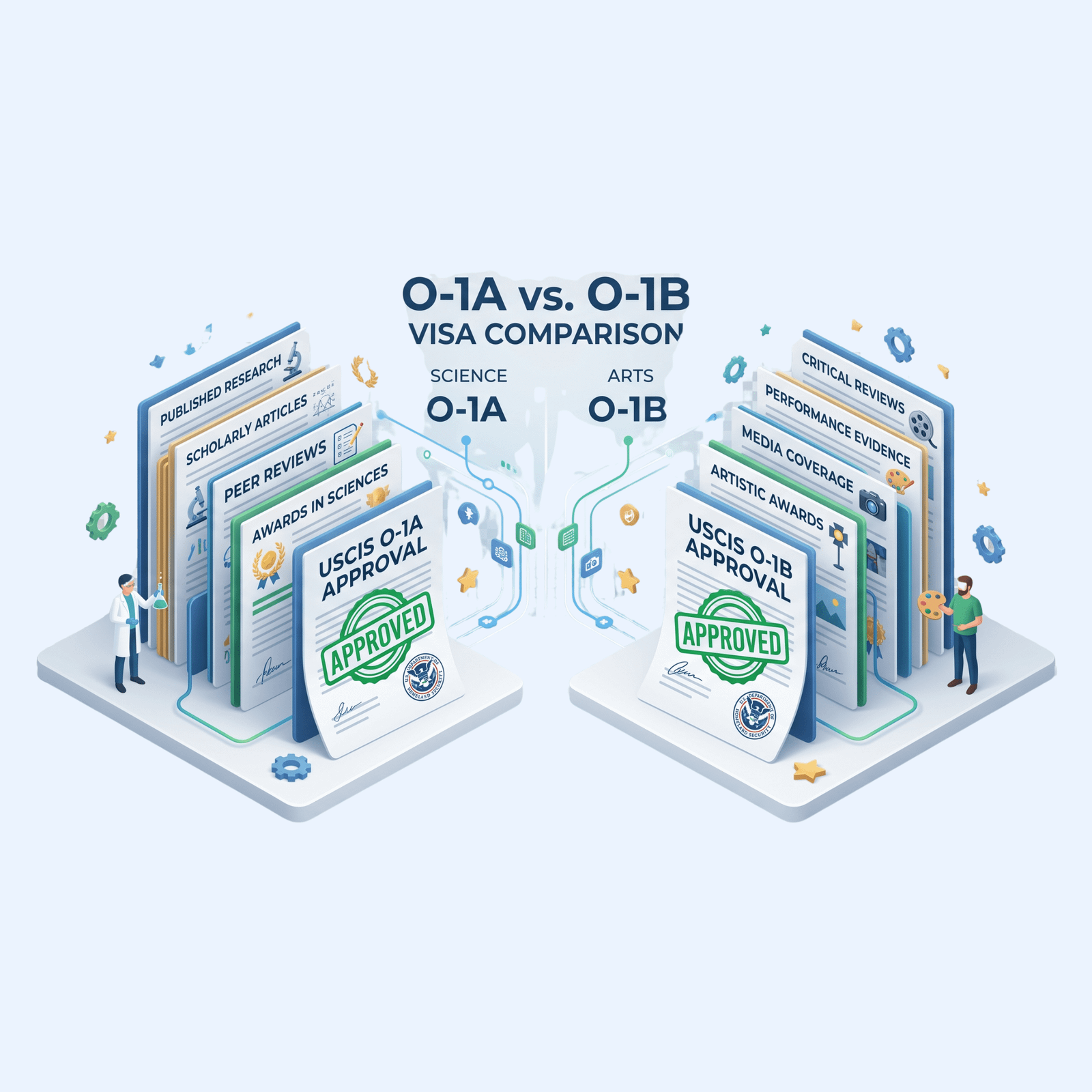
Comparing O-1A vs O-1B Visas? Understand Eligibility & Criteria
Break down the differences between professional excellence and artistic distinction, evidence standards, and green card pathways.
Essential O-1 Visa & Evidence Resources
- O1 visa application process 2026:
Learn about O-1 visa qualifications, requirements, application process, and costs for extraordinary ability applicants. This guide explains USCIS eligibility criteria, supporting evidence, filing steps, petition expenses, and important factors that affect O-1 visa approval in the USA.
- Proof of extraordinary ability for O-1 visa:
Learn about the best evidence for O-1 visa applications, including what actually works and what does not. This guide explains strong supporting documents, USCIS evidence standards, common mistakes, and strategies to improve approval chances for extraordinary ability visa petitions.
- Best O-1 Visa Services in the USA:
Discover the best O1 visa services in the USA and how top agencies help applicants prepare strong petitions. This guide explains expert support for evidence preparation, opinion letters, RFEs, documentation strategy, and improving approval chances for O1 visa applications.
Akash Pundir is the Chief Operating Officer at Document Evaluation LLC, bringing over 5 years of international business operations and legal support experience across the United States, Australia, and India. He has overseen the strategic positioning and analysis of over 1,000+ complex USCIS cases, specializing in guiding expert evaluation teams to draft high-stakes Expert Opinion Letters (EOL), Academic Equivalencies, and defense packets for H-1B, EB-2 NIW, RFEs, and NOIDs. Driven by digital transformation, Akash ensures every evaluation adheres strictly to the latest USCIS legal frameworks and compliance benchmarks.
