

 |
|
Why Translated Documents Get Rejected and How to Avoid It
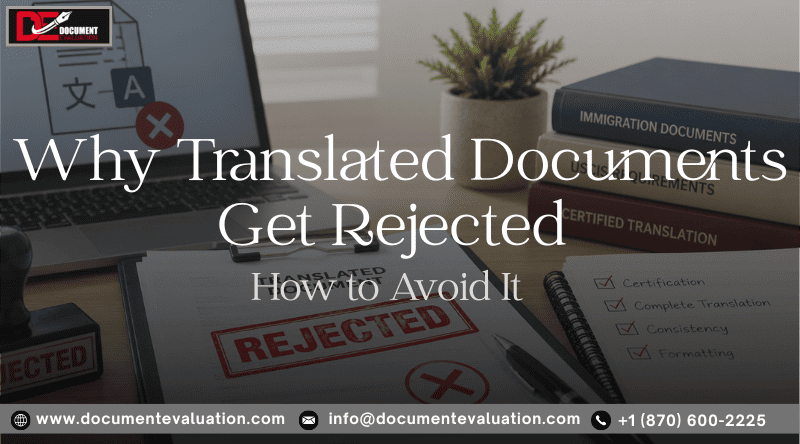

- Prevent Delays: Certified translations help prevent RFEs, delays, and document rejections.
- Translate Everything: Translate the entire document, including stamps, seals, signatures, and handwritten notes.
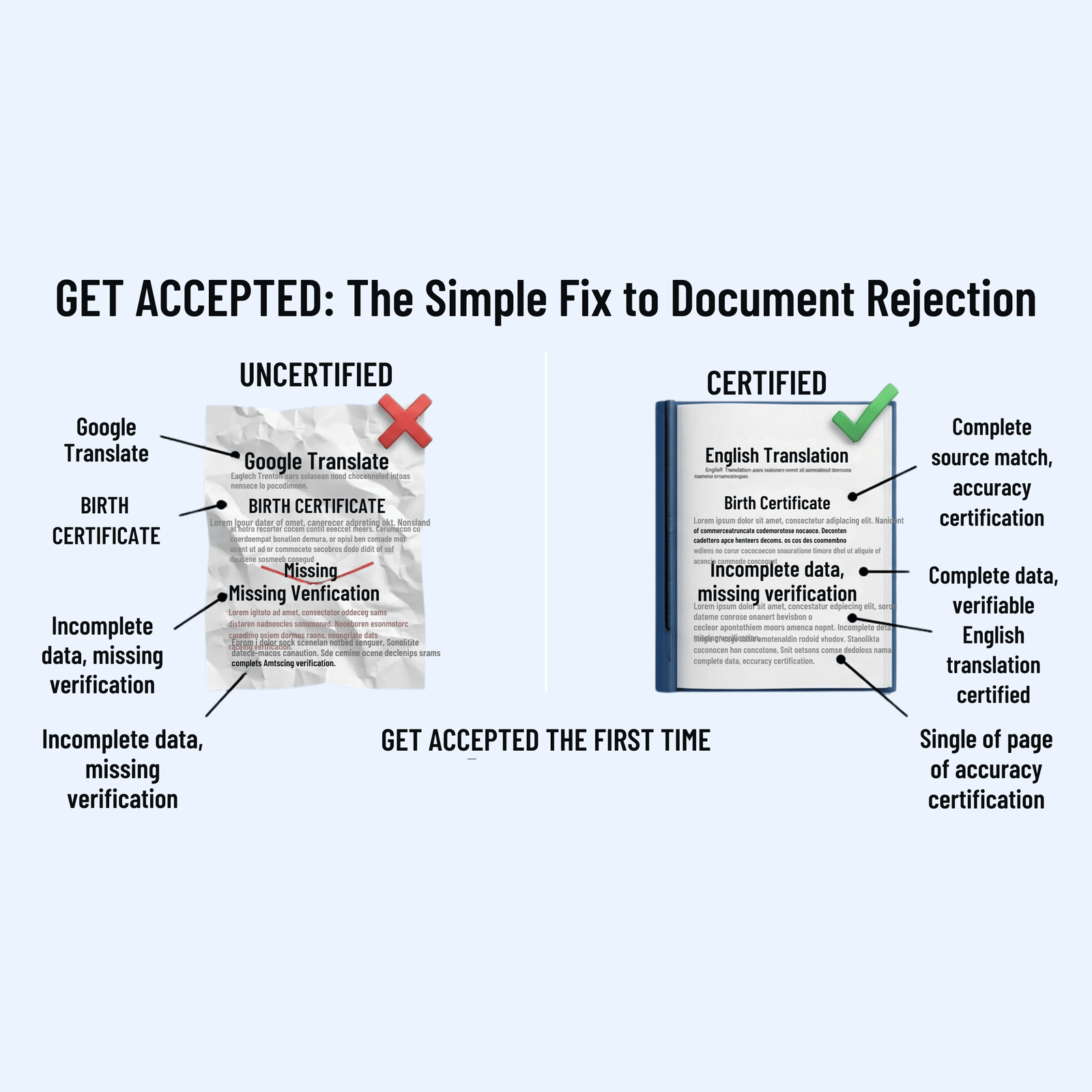
- Accuracy Certificate: Always include a Certificate of Translation Accuracy with eligible translations.
- Ensure Consistency: Ensure names, dates, and personal details match across all documents.
- Avoid Machine Translation: Avoid machine translations for immigration, legal, and academic submissions.
- Maintain Formatting: Maintain formatting that closely matches the original document.
- Clear Source Files: Clear, high-quality source documents improve translation accuracy.
- Professional Services: Professional translation services save time, reduce costs, and increase acceptance rates.
If you’ve ever sent in a translated document for a visa, a university application, a licensing board, or a new job and if your submission was returned, you are not alone. It’s common, and you can prevent the entire document from being returned once you understand and address the basic causes.
Many applicants just assume any English version of their paperwork will pass. It won’t. USCIS, universities, licensing boards, and employers each have their own rules about what a translation must include and how it should be formatted. If you skip even one detail, such as a missing certification statement, a name spelled differently across documents, or a stamp or seal that was never translated, you may suddenly face an RFE, weeks of delay, or outright rejection of the document.
We’ve explained below all the common reasons why translated documents get sent back.
To ensure your files meet every strict federal certification standard right from the start, you can hire our specialized agency for certified Document Translation for USCIS.
Why Are Translation Documents Rejected?
A translation isn’t just a language exchange; it must meet the required standards. Reviewing officers use it to verify your identity, education, work history, and civil records. If anything about the translation looks off, incomplete, or inconsistent with the original, that’s usually enough to trigger a request for more documents or a denial.
If you’re filing an H-1B petition or waiting on one, first you should check the approval rate. USCIS is approving the vast majority of petitions this year, even after the lottery system changes. But a high number doesn’t guarantee your case: it still depends on petition quality, eligibility, and documentation.
So where do the FY 2026 numbers actually stand? And what do they mean if you’re filing fresh versus renewing?
Top 8 Common Reasons for Translated Documents Being Rejected
#1 Missing certification statements
If a document isn’t originally in English, a translated version by itself isn’t enough. It needs a signed statement, too, confirming that the translation is complete and accurate and was done by someone actually qualified to handle it.
It’s easy to miss, especially when the translation itself is done well. But without that certification attached, the document just doesn’t meet the standard. We’ve seen cases where someone submits a birth certificate that’s perfectly translated, forgets the certification, and ends up with an RFE that pushes their case back by weeks, sometimes months.
#2 Incomplete translations
If you just translate the main body of a document and skip the stamps, handwritten notes, or margin comments that seem like they don’t matter. Reviewers don’t see it that way, though. Their expectation is usually that everything on the page gets translated: seals, watermarks, footnotes, page numbers, annotations, the works.
A stamp might have the name of the issuing authority on it. A handwritten note in the margin could point to an amendment made to the original record. Leave that out, and the reviewer will probably question the resulting gap.
#3 Incorrect terminology
Legal and academic terms don’t usually have a clean one-to-one match across languages. A degree title, a court term, a civil registration category: translate these word-for-word, and you might end up with something that’s technically correct but doesn’t actually mean anything to a US reviewer.
This is where experience really matters. A translator with experience in these kinds of documents knows how to capture the meaning rather than just exchange words, which often prevents a reviewer from second-guessing the document’s authenticity.
#4 Poor formatting
Reviewers want to be able to compare your translation with the original and follow along easily. If sections get rearranged, tables go missing, or the layout doesn’t match up, that comparison becomes difficult, and difficult to verify usually means more scrutiny, not less.
It’s the small stuff too: headings, logos, page numbering, and alignment. None of it changes what the document actually says, but all of it affects how easily a reviewer can trust it at a glance.
#5 Illegible source documents
No translator can get things right if they can’t actually read the text in front of them. Blurry scans, cropped photos, torn pages, and dark photocopies all make names, dates, and registration numbers easy to get wrong. If you’re planning to submit a translation, start with the clearest, highest-resolution copy of the original you can find.
#6 Machine-generated translations
Free translation tools are quick, and for casual use, they get the job done. But for immigration, legal, or academic documents, they’re a risk. Machine translation often misses legal nuance, gets names wrong, strips out formatting, and ends up using different terminology in different sections of the same document.
And there’s another problem: it doesn’t come with the certification most institutions ask for. So even if the translation itself turns out decent, it still won’t be enough on its own.
#7 Inconsistent personal information
If your passport spells your name one way and your translated birth certificate spells it differently, a reviewer’s going to catch that, even if it’s just an honest typo. The same goes for birth dates, addresses, and ID numbers. Every document you hand in needs to tell a consistent story, which means checking these details carefully before anything gets filed.
#8 Missing translator credentials
Most institutions want the translator to identify themselves clearly: name, signature, date, a certification statement, and sometimes contact information too. Skip that, and even a translation that’s completely accurate can end up getting treated as incomplete.
Consequences of Rejected Translation Documents
It’s all too simple to think of a rejected translation as a minor setback; just fix it and resubmit. In practice, it can cost more than time.
- FEs from USCIS put your case on hold until you submit a corrected translation.
- Processing delays from a rejection can add weeks or months to a timeline that was already tight.
- Extra costs add up fast; many applicants end up paying for the original translation and the fix.
- Missed deadlines are a real risk with universities and licensing boards, which often don’t make exceptions for late submissions.
- Outright denials occur when you don’t correct the missing documentation in time.
How Document Evaluation LLC Gets It Right the First Time
Our certified translation process is built around the exact things reviewers look for:
- Every eligible translation comes with a Certificate of Translation Accuracy, put together to match what immigration authorities, universities, employers, and licensing boards actually expect to see.
- We translate the whole document, stamps, seals, handwritten notes, signatures, and footnotes, not just the main text.
- Our translators know the terminology, not just the language. Legal, academic, and immigration-specific terms get translated for what they mean, not just word-for-word.
- Formatting follows the source document, so headings, tables, and layout stay recognizable and easy for a reviewer to compare side by side.
- Every translation goes through a quality check before it’s delivered: names, dates, numbers, consistency,
- And turnaround is built around deadlines that don’t move. Immigration filings, admissions cycles, licensing windows: none of them wait around, so neither do we.
Frequently Asked Questions
Do I really need to translate stamps and handwritten notes?
Yes, reviewers expect everything on the page to be translated: stamps, seals, handwritten notes, watermarks, footnotes, all of it. These often hold important information, like the issuing authority or an amendment, and leaving them out just creates gaps that raise questions.
Can I just use Google Translate for this document?
No, machine translations aren’t reliable enough for official purposes. They tend to miss legal and academic nuance and use inconsistent terminology, and, maybe most importantly, they don’t come with the certification statement institutions require.
Can my translation get rejected just because my name is spelled differently somewhere?
Yes, if your name, birth date, or ID number appears differently across documents, say your passport versus your translated birth certificate, a reviewer will pick up on it. Inconsistent personal information is one of the more common rejection triggers.
What happens if my USCIS translation gets rejected?
You’ll likely get a Request for Evidence (RFE) or a Notice of Intent to Deny (NOID). Either way, your case gets put on hold while you resubmit a corrected translation, and that can add weeks, sometimes months, to your processing time.
Does the layout of the translation actually matter?
Yes, reviewers need to be able to compare your translation against the original fairly easily. If the layout, tables, headings, or page numbers don’t line up, that comparison gets difficult, and difficult to verify usually means more scrutiny.
What exactly is a “Certificate of Translation Accuracy”?
It’s a signed statement confirming the translation is complete, accurate, and was done by someone qualified. It’s required for every official translated document; without it, the document just doesn’t meet the standard.
Can a blurry scan of my original document cause a rejection?
Yes, a translator can’t accurately translate text they can’t read. Blurry scans, dark photocopies, cropped images: all of it makes it difficult to get names and dates right, which increases the chance of errors and rejection.
How do I make sure my translation isn’t rejected the first time around?
Go with a certified provider, like Document Evaluation LLC. They handle the certification; translate every part of the document, including stamps and notes; use people who actually know the terminology; keep formatting consistent; and run quality checks so names and dates match up before anything’s submitted.
Conclusion
Most rejected translations are due to a few common mistakes: a missing certification, a skipped stamp, or a name that doesn’t quite match. None of this is complicated, but it does require attention to detail and an understanding of what reviewers want.
Working with a certified provider like Document Evaluation LLC means that attention is built into the process from the start, so your documents have the best possible shot at being accepted the first time: no resubmissions, no unnecessary delays.
Need Certified Translations for Your U.S. Visa Application? Explore our expert guides below:
- Guide to Visa Document Translation
Everything you need to know about translating documents for visa applications, from certification requirements to USCIS compliance. - EB-2 Visa Translation Guide
Learn which documents require certified translation for an EB-2 visa and how to meet USCIS requirements before filing. - Avoid Visa Translation Mistakes
Learn the most common translation errors that can delay your visa application and how certified translations help prevent issues.
Akash Pundir is the Chief Operating Officer at Document Evaluation LLC, bringing over 5 years of international business operations and legal support experience across the United States, Australia, and India. He has overseen the strategic positioning and analysis of over 1,000+ complex USCIS cases, specializing in guiding expert evaluation teams to draft high-stakes Expert Opinion Letters (EOL), Academic Equivalencies, and defense packets for H-1B, EB-2 NIW, RFEs, and NOIDs. Driven by digital transformation, Akash ensures every evaluation adheres strictly to the latest USCIS legal frameworks and compliance benchmarks.
