


Key Takeaways
- USCIS wants every foreign-language document translated into English in full, along with a signed Certificate of Translation Accuracy. No exceptions.
- Technically, you're allowed to translate the documents yourself, but it's usually smarter to get an independent, qualified translator involved. It saves you from delays or an RFE down the line.
- Small mistakes matter more than people think: wrong legal terms, a missing stamp, date formats that don't match US conventions. Any of these can hurt your case.
- For a translation to actually count as USCIS-compliant, it needs to be complete, accurate, and certified by someone qualified to do it.
- Going with a professional translation service usually means faster processing and a lower chance of your documents getting bounced back.
Each year, thousands of immigration cases experience delays or are denied due to PROBLEMS with document translations. Should your birth certificate, marriage certificate, academic transcripts, or any other documents you might need to submit not be in English, they have to be provided along with the English translation by USCIS.
This issue certainly leads to another CRUCIAL question that arises in such cases: can you do the translations yourself for USCIS? As it turns out, the process is not as simple as it might seem at first glance. There are certain requirements for each and every translation submitted to USCIS, and their failure may bring some troubles to your immigration process.
What USCIS Actually Requires For Foreign-Language Documents?
USCIS is pretty specific about what needs to accompany every foreign-language document you submit:
- A full English translation, not a summary, not a partial version
- A signed Certificate of Translation Accuracy
- Confirmation that the translator is actually competent in both languages
- Everything translated, including stamps, seals, handwritten notes, and signatures; nothing was left out
Miss any of this, and you’re looking at delays.
Why You Shouldn't Translate Your Own Documents for USCIS
The regulation doesn’t technically forbid self-translation, but ask any immigration attorney, and you’ll hear the same advice every time: don’t translate your documents. Read the reasons below:
1. Self-Translation Creates a Conflict of Interest
An applicant translating their own document and then turning around and certifying it as accurate, that’s an obvious conflict built right into the process.
An officer reviewing that might reasonably wonder whether the translation is truly objective or whether it’s been quietly nudged in the applicant’s favor. Authority is clear about this issue, recommending that someone other than the immigrant handle the translation; neutral, third-party paperwork is simply more credible.
2. Self-Translation Can Lead to Unintentional Errors
Even with the best of intentions, staying fully objective while translating your documents is genuinely challenging. It shows up in small ways, softening language that sounds harsh, rewording an unclear phrase in a way that happens to help your case, or leaving out a detail that feels minor to you but matters to USCIS.
Officers go through a large volume of applications. A translation that reads a little too polished, a little too convenient, tends to stand out, and once it does, the rest of the file can end up under closer review too.
3. Legal and Technical Terms Require Professional Expertise
Legal and civil documents contain terminology that fluent speakers can easily get wrong. Some of the most common mistakes include:
- Confusing legal terms that carry different meanings under US law
- Flipping date formats (DD/MM/YYYY vs. MM/DD/YYYY)
- Misreading stamps, seals, or handwritten notes
- Leaving abbreviations or official titles untranslated
Take “notario” in most Spanish-speaking countries; it’s a title with real legal authority. A US notary public’s role is far more limited. Mix the two up, and it can genuinely weaken an applicant’s case.
What the US Government Says About USCIS Document Translations
As per the US Department of State, any foreign language document sent to USCIS should have an English translation certified by the translator. It is mandatory for the translator to sign a declaration that he/she is authorized to translate the document and the translation is true and complete.
The certification process typically includes:
- The name & signature of the translator.
- An affirmation of his/her language skills.
- An assurance that the translation is complete and accurate.
- Date and contact details of the translator.
It is recommended to adhere to these guidelines to increase the likelihood of USCIS acceptance of your documents.
Add Your Heading Text Here
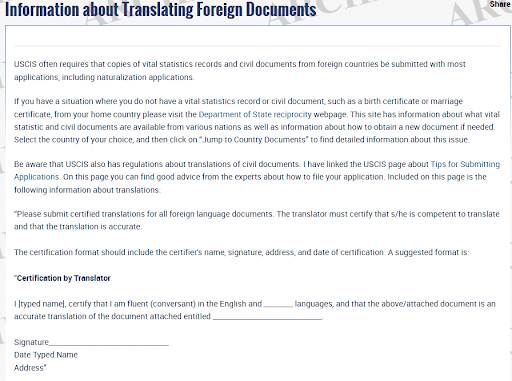
Source: U.S. Department of State, Official Guidance on Translating Foreign Documents for Immigration Purposes.
Who Can Translate Your Documents?
To meet the “competent translator” standard without raising red flags, the translator should be from the following:
- They need to be genuinely fluent in both languages, the source language and English, not just conversational.
- They can’t have a stake in the case. So that rules out the applicant, the petitioner, and, generally speaking, close family members as well.
- They have to be willing to sign a certification statement, vouching for both their competence and the accuracy of the translation.
Beyond that, USCIS isn’t critical about who it is. It could be:
- A certified translator or a professional translation service
- A bilingual friend, coworker, or companion as long as they’ve got no personal interest in the outcome
- A community organization that helps immigrants with document translation
What Should a USCIS Translation Certification Include?
Every translated document you submit to USCIS needs a signed certification attached to it, usually something like this:
“I, [translator’s name], certify that I am fluent in English and [language] and that the above is a true and accurate translation of the attached document.”
That statement, along with the translator’s signature, printed name, address, and date, typically gets attached directly to the translation or stamped right onto it.
What Happens If You Submit a Self-Translated Document to USCIS?
The submission of self-translated documents does not mean automatic denial of the case; rather, it just means unnecessary delays. Below are the possible scenarios for your case:
#1 You may receive an RFE: USCIS will request that you provide a certified translation of the documents according to its criteria.
#2 Your processing of the application will be delayed: It will take some time before you find an appropriate translator and resubmit the documents.
#3 Your documents will be considered unacceptable: If the translation submitted is not according to the criteria set by USCIS, then it will not be accepted until you resubmit your documents.
How Much Does Translation Cost At Document Evaluation?
| Service | Economy | Standard | Express |
|---|---|---|---|
| Translation | $30 (2-3 Days) | $50 (Next Day) | $70 (Same Day) |
Why Choose Document Evaluation For Your Translation?
Reason 1: We Review Your Documents Before Translation
All documents are thoroughly checked for missing pages, blurred text, or any problems with formatting before starting the translation process to avoid any errors.
Reason 2: We Ensure Accuracy and Consistency
Our professionals verify all personal names, dates, figures, and other important information to ensure that the translation is done accurately & consistently for all details.
Reason 3: We Deliver USCIS-Ready Translations
We adhere to the translation and certification standards recognized by USCIS and other officials to help you provide official documents without any problems.
Reason 4: We Save Your Time And Money
Through our efficient process, you will be able to ensure that your work is free from any translation mistakes, rejections, and revisions. Thus, you will be saving both time and money through our process.
Reason 5: We Build client trust
Our mission is to provide you with accurate, confidential, and professional translation services. Through our reliable process, we have earned the trust of many individuals, students, professionals, & even businesses.
Frequently Asked Questions
Yes, the USCIS doesn't prohibit you from translating your documents yourself. But that would be unwise. As the person involved in this case, the USCIS might doubt the quality of the translation. If it turns out to be unsatisfactory, you will delay the application process.
Every foreign-language document needs a full, word-for-word English translation plus a signed Certificate of Translation Accuracy. You have to translate all your text, stamps, seals, handwritten notes, and signatures.
Most likely, you'll get an RFE from USCIS asking you to get a real certified translation and resubmit. Self-translation may lead to an RFE, so it’s better to hire someone independent from the start.
The common translation mistakes are wrong legal terms, flipped date formats, missing stamps or handwritten notes, and mistranslated abbreviations or job titles.
The person translating must be proficient in both languages & be able to verify that the translation is complete and correct. It is not necessary for the translator to be certified by USCIS, but he or she cannot be the applicant nor have any stake in the application process.
Conclusion
USCIS doesn’t require a certified translator, but it’s strongly recommended. Go with an independent, qualified translator, and you get a translation that’s both accurate and properly certified, which means fewer delays, fewer RFEs, and fewer questions about reliability. A pre-translation document evaluation adds one more layer of confidence, making sure the paperwork is complete and accurate before it ever reaches USCIS.
with total confidence
Learn more about certified translations, USCIS requirements, and common translation mistakes with these helpful guides.
1. Visa Document Translation Guide: Everything You Need for a Successful Application
Learn how to translate documents for visa applications, understand certified translation requirements, avoid common mistakes, and prepare accurate paperwork for USCIS and other immigration authorities.
2. EB-2 Visa Translation Requirements: Essential Documents and Certification Guide
Discover which EB-2 visa documents require certified translation, USCIS standards, and best practices to ensure your application is complete and compliant before filing.
3. Common Translation Mistakes That Can Delay Your Visa Approval
Find out how translation errors, missing certifications, and inaccurate document translations can lead to visa delays or requests for additional evidence, and learn how to avoid them.

Akash Pundir is the Chief Operating Officer at Document Evaluation LLC, bringing over 5 years of international business operations and legal support experience across the United States, Australia, and India. He has overseen the strategic positioning and analysis of over 1,000+ complex USCIS cases, specializing in guiding expert evaluation teams to draft high-stakes Expert Opinion Letters (EOL), Academic Equivalencies, and defense packets for H-1B, EB-2 NIW, RFEs, and NOIDs. Driven by digital transformation, Akash ensures every evaluation adheres strictly to the latest USCIS legal frameworks and compliance benchmarks.