

 |
|
O-1 Visa Approval Rate 2026: True Statistics for Extraordinary Talent

- USCIS approved 91% of O-category petitions in Q1 FY2026, and the approval rate has remained strong.
- The number depends on evidence quality, not just meeting the minimum eligibility requirements.
- Independent achievements, awards, publications, media coverage, and expert recommendation letters are what actually drive an approval decision.
- Petitions that clearly map their evidence to USCIS criteria tend to move faster and avoid RFEs more often than ones that don’t.
- A high approval rate isn’t a guarantee for any individual case; careful preparation and solid documentation still make the difference between approval and an RFE.
The O-1 visa is still one of the stronger employment-based nonimmigrant options for people with extraordinary ability in science, education, business, athletics, or the arts. Unlike the H-1B, there’s no annual lottery or numerical cap, which makes it worth a serious look for anyone with a genuinely strong case.
If you’re planning to file in 2026, it helps to know where the numbers actually stand right now. The O-1 still has one of the highest approval rates of any employment-based visa, but USCIS has gotten noticeably pickier about the quality of evidence behind that approval.
Let’s know more about the O-1 visa approval rate in 2026…
To ensure your petition satisfies these rigorous adjudication standards, you can secure professional assistance to draft an authoritative O-1 expert opinion letter.
What Is the O-1 Visa Approval Rate in 2026?
The O-1 visa continues to be one of the most reliable employment-based immigration routes in the United States. Unlike lottery-based categories, the O-1 is decided purely on the strength of the petition, and that shows up clearly in the numbers.
Latest USCIS O-1 Visa Data
USCIS releases quarterly Employer Information System data covering all “O-category” petitions (which includes O-1, O-2, and O-3). Based on the most recent releases available in 2026:
Approval vs. Denial Numbers
| Fiscal Year | Approval Rate |
|---|---|
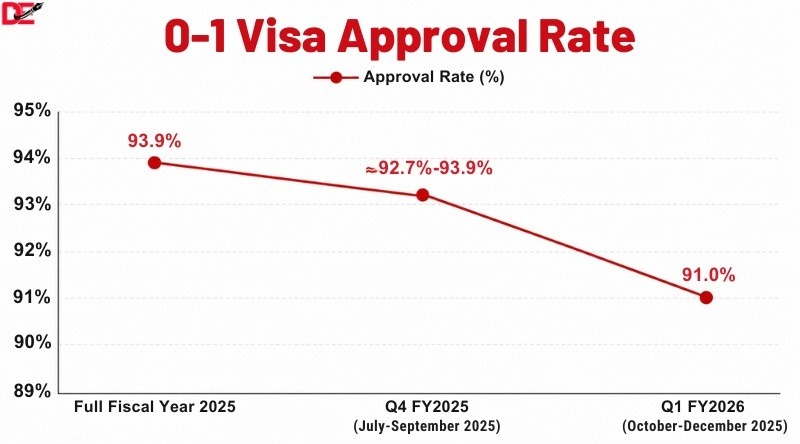
| Full Fiscal Year 2025 | 93.9% |
| Q4 FY2025 (July–September 2025) | ≈92.7%–93.9% |
| Q1 FY2026 (October–December 2025) | 91.0% |
| Period | Adjudicated | Approved | Denied |
|---|---|---|---|
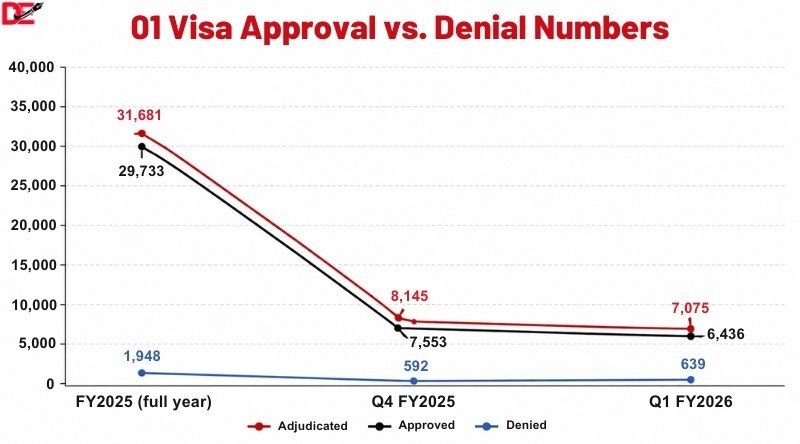
| FY2025 (full year) | 31,681 | 29,733 | 1,948 |
| Q4 FY2025 | 8,145 | 7,553 | 592 |
| Q1 FY2026 | 7,075 | 6,436 | 639 |
O-1 Visa Approval Rate Trends (2022–2026)
| Fiscal Year | Approximate Approval Rate |
|---|---|
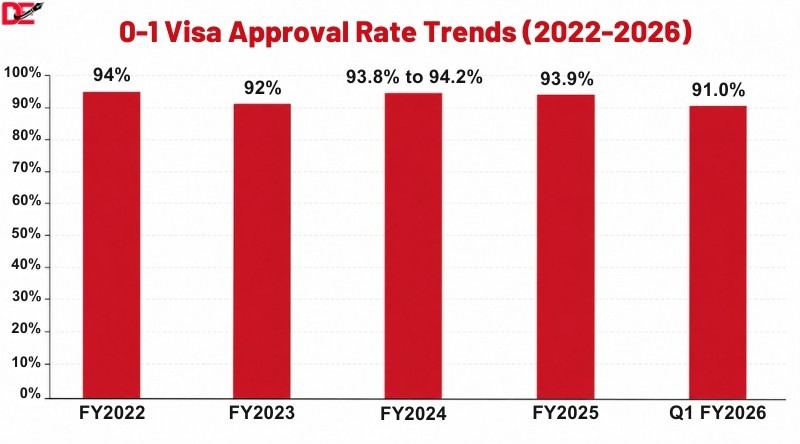
| FY2022 | 94% |
| FY2023 | 92% |
| FY2024 | 93.8% to 94.2% |
| FY2025 | 93.9% |
| Q1 FY2026 | 91.0% |
Why Does the O-1 Visa Have a High Approval Rate?
The O-1’s consistently strong numbers aren’t accidental; they’re a secondary effect of how the category is structured.
- No Annual Lottery:
Unlike the H-1B, the O-1 has no annual cap and no random selection process. Every eligible petition gets decided on its merits. This removes an entire layer of uncertainty that has nothing to do with the strength of an applicant’s case.
- Merit-Based Category:
The O-1 was built specifically for individuals with extraordinary ability or achievement. The strict eligibility requirements lead to self-selecting individuals who attempt to file; they generally only file if they have a reliable case to make.
- Strong Pre-Filing Preparation:
O-1 petitions are rarely filed casually. Because the requirements are well-known and demanding, most petitioners, whether self-represented founders or those working with counsel, invest significant time assembling evidence before submission, which naturally improves outcomes.
- Employer/Petitioner Screening:
O-1 cases require a US employer or authorized agent to sponsor the petition. That sponsor has its incentive to only move forward with candidates who have a strong, well-documented case, which acts as an informal quality filter before a petition ever reaches USCIS.
- Clear Eligibility Criteria:
USCIS lays out specific, organized criteria for O-1A (sciences, business, education, and athletics) and O-1B (arts, motion picture, and television). The clear criteria, including awards, publications, critical roles, high salary, and media coverage, allow petitioners to know exactly what they need to show, which reduces the odds of an incomplete or poorly targeted filing. If you’re still unsure which category fits your case, this O-1A vs. O-1B visa guide breaks down the distinctions in detail and can help clear up most of your doubts.
Who Has the Best Chances of O-1 Approval?
Certain professional backgrounds tend to align particularly well with O-1 criteria because they generate the kind of objective, verifiable evidence USCIS is looking for.
- Scientists and researchers typically build their case around peer-reviewed publications, citation counts, patents, and conference presentations; these map almost directly onto the O-1A criteria.
- Software engineers and AI professionals have more evidence categories available to them now than they did a few years ago: open-source contributions, technical leadership roles, compensation well above peers, and media coverage of their work. Officers are taking these more seriously than they used to.
- Physicians generally point to board certifications, fellowships, published research, and leadership positions in clinical or academic settings.
- Entrepreneurs have a more difficult time. A case can be built around original business contributions, a critical role at a high-growth company, funding raised, and press coverage, but these petitions face heavier scrutiny when most of the evidence is self-reported rather than independently verifiable.
- Athletes generally have it easiest, evidence-wise; international rankings, competition results, and recognition from governing bodies are about as objective as evidence gets.
- Artists, musicians, and actors filing under O-1B tend to rely on reviews, box office or sales numbers, lead roles, and recognition from industry bodies.
What Factors Affect O-1 Visa Approval in 2026?
#1 Quality Of Evidence Matters More Than Quantity
Meeting the basic minimum number of regulatory criteria doesn’t guarantee approval. USCIS still runs a “final merits determination” afterward, essentially asking whether, looking at everything together, this person is genuinely among the small percentage who’ve risen to the top of their field.
#2 Recognition Can’t Stay Local
One of the most common weak points is evidence that only shows regional or organizational recognition. If everything submitted shows that the person is well-known only within one company or one city, that won’t be enough to support the petition’s case for national or international recognition.
#3 Recommendation Letters Lose Weight When They’re Not Independent
Letters from a manager or teammates don’t carry much weight anymore. What matters is a letter from someone outside the applicant’s immediate circle who can speak specifically to their standing in the field, not just offer general praise.
#4 Media Coverage Isn’t All Equal
A profile in a reputable, independent outlet is worth far more than a press release, a self-published article, or something from a pay-to-publish platform. Officers can usually tell the difference.
#5 Awards And Publications Are Still The Strongest Categories
That hasn’t changed. Nationally or internationally recognized awards, paired with a genuine track record of publications or citations, remain some of the most persuasive evidence available.
#6 Employer Support Has To Be Concrete
A clear itinerary, well-defined job duties, and a solid explanation of why this specific role needs someone of extraordinary ability all strengthen the case.
#7 Organization Is As Important As The Content Itself
Petitions where every piece of evidence is clearly tied to a specific regulatory standard move through adjudication far more smoothly than a large, undifferentiated stack of documents that requires the officer to make connections.
How to Improve Your O-1 Visa Approval Chances?
- Submit Verifiable Evidence
Documentation that can independently confirm rankings, publication records, award databases, and salary data is much more effective than claims based mainly on the applicant’s own word. - Bring In Independent Recommendation Letters
Letters are most persuasive when they come from recognized experts outside the applicant’s immediate circle and address specific contributions and standing in the field, rather than general praise. - Organize The Petition Around The Criteria
Every exhibit should tie clearly back to the specific standard it supports. This makes the adjudicator’s job easier and leaves less room for guesswork. - Go Beyond The Minimum Criteria
Barely scraping by on a few categories doesn’t leave much room for error. A stronger case builds depth across multiple relevant categories, not just the bare minimum. - Work With Immigration Counsel Who Handles O-1 Cases Regularly
Attorneys who specialize in this visa category tend to know current USCIS scrutiny patterns and can catch likely RFE issues before the petition is even filed.
Frequently Asked Questions
What is the O-1 visa approval rate in 2026?
The most recent data (Q1 FY2026) puts the O-category approval rate at roughly 91%, consistent with the trend of staying above 90% since FY2022.
Who qualifies for an O-1 visa?
People with extraordinary ability in the sciences, education, business, or athletics fall under O-1A, while extraordinary ability or achievement in the arts, motion pictures, or television falls under O-1B. Either way, the applicant needs to show sustained national or international recognition.
How long does O-1 processing take?
Standard processing has stretched out lately; some reports put it around 12 months as of mid-2026 without premium processing. With premium processing, USCIS guarantees a decision within 15 business days for an extra fee.
Can entrepreneurs apply for O-1?
They can, though the path usually runs through original business contributions, a critical role at a company they lead, funding raised, and independent media coverage. These cases tend to face more scrutiny than more traditional profiles, simply because the evidence is harder to independently verify.
What evidence matters most?
Anything independently verifiable: awards, publications, citation records, rankings, and coverage from reputable outside media. This consistently outweighs self-reported achievements or recognition that comes from within the applicant’s own company.
Can the O-1 visa be renewed?
Yes, in increments, as long as it’s to continue or complete the same event or activity. Extensions generally hold up at rates similar to or better than initial petitions, provided the underlying case is still strong.
How can I improve my approval chances?
Lean on objective, verifiable evidence, get detailed letters from independent experts, structure the petition around each specific regulatory criterion, and work with someone who actually keeps up with current USCIS adjudication trends.
Conclusion
The O-1 visa has remained one of the more predictable, consistently high-approval pathways in US employment-based immigration, holding above 90% through FY2025 and into Q1 FY2026, even while EB-1A and EB-2 NIW have both seen sharper declines. But a high approval rate doesn’t mean a low bar. It mostly reflects that the applicant filing O-1 petitions is already well-prepared, with evidence that’s objective and verifiable rather than self-asserted.
As RFE rates and documentation expectations keep rising gradually across 2026, the petitions that hold up will be the ones built with the same rigor USCIS applies when reviewing them: clear criteria mapping, independent verification, and a complete, well-organized record from the first filing onward.

Explore More O-1 Visa Guides and Expert Resources
- O-1 Visa Guide: Eligibility, Requirements, Process, and Costs:
Learn everything about the O-1 visa, including eligibility requirements, qualifying evidence, application steps, filing costs, processing timelines, and practical tips for a successful USCIS petition. - O-1 Visa for Designers: Eligibility, Portfolio, and USCIS Requirements:
Discover how designers can qualify for an O-1 visa, build a strong professional portfolio, meet USCIS eligibility requirements, and prepare compelling evidence of extraordinary ability. - How to Choose the Right O-1 Visa Service Provider in the USA:
Learn what to look for in an O-1 visa service provider, including experience, immigration documentation support, expert opinion letters, and client-focused guidance to help strengthen your petition.
Akash Pundir is the Chief Operating Officer at Document Evaluation LLC, bringing over 5 years of international business operations and legal support experience across the United States, Australia, and India. He has overseen the strategic positioning and analysis of over 1,000+ complex USCIS cases, specializing in guiding expert evaluation teams to draft high-stakes Expert Opinion Letters (EOL), Academic Equivalencies, and defense packets for H-1B, EB-2 NIW, RFEs, and NOIDs. Driven by digital transformation, Akash ensures every evaluation adheres strictly to the latest USCIS legal frameworks and compliance benchmarks.
