

 |
EB-1 Visa Processing Time in October 2026: EB-1A And EB-1B Wait Times Explained

- EB-1 timing can differ from one case to another.
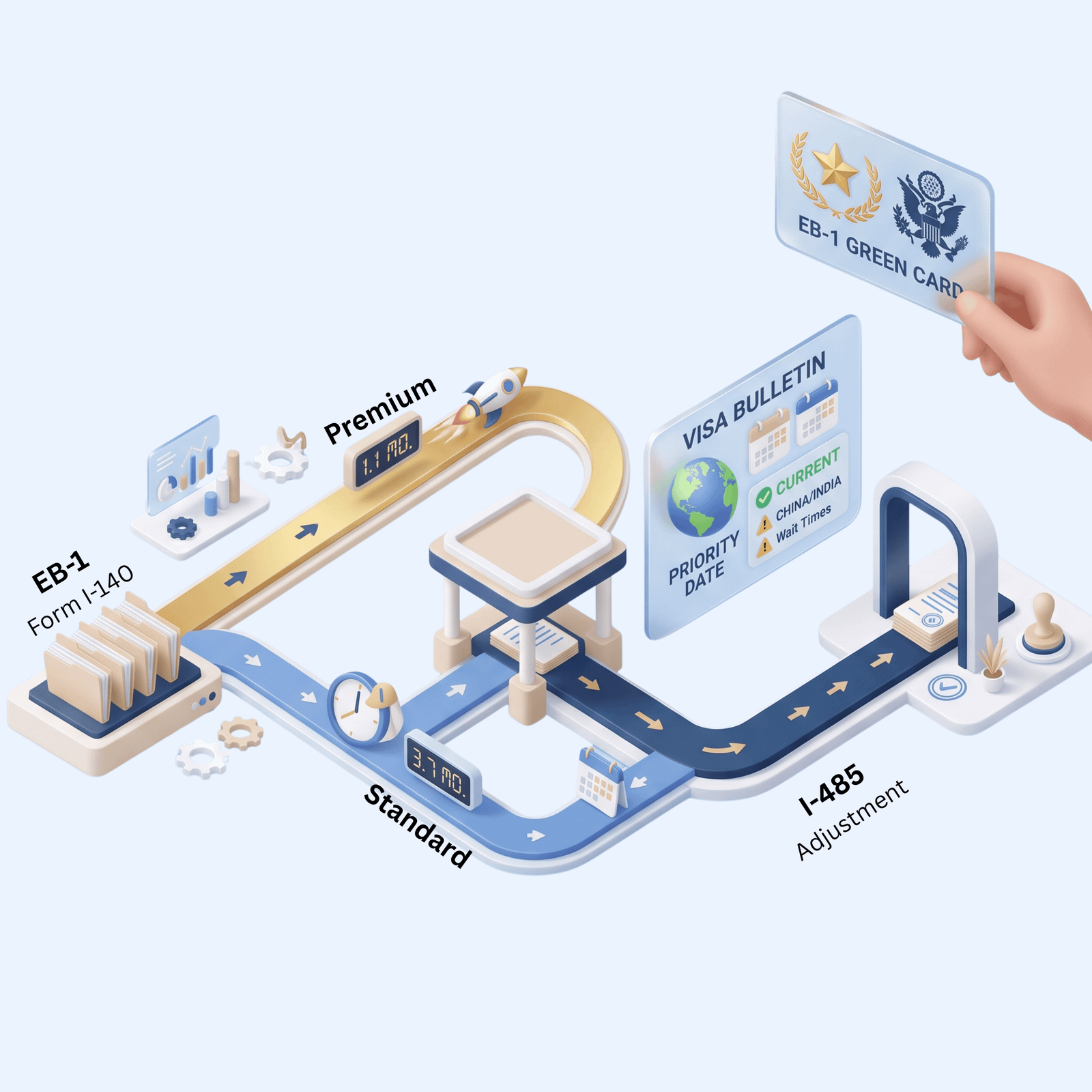
- Regular I-140: 3.7-month median; premium: 1.1 months.
- India and China have EB-1 cutoff dates in October 2026.
- An RFE or missing evidence can hold up the case.
- Premium processing covers the I-140 decision, not the rest of the green card process.
The EB-1A and EB-1B processing time can vary based on where you are in the process. USCIS reviews the Form I-140 first. Once it is approved, your priority date and visa availability can affect when you move forward with the green card process.
USCIS’s FY 2026 historical data, covering cases completed through June 30, 2026, shows a 3.7-month median for non-premium Form I-140 cases and 1.2 months for cases filed with premium processing. These numbers come from cases USCIS had already completed, so they should not be treated as the expected timeline for a petition filed in October 2026.
Your chargeability area also affects your timeline. The October 2026 Visa Bulletin lists EB-1 as current for most chargeability areas. Applicants born in mainland China face a Final Action Date of July 1, 2023, while those chargeable to India face a Final Action Date of February 1, 2023.
Because securing a swift Form I-140 approval is vital to advancing through these visa queues without costly evidentiary setbacks, you can hire our specialized agency to Get Professional EB-1 Visa Expert Letter Service and substantiate your extraordinary achievements with authoritative peer evaluations.
What Is The EB-1 Processing Time In October 2026?
If you file an EB-1 Form I-140 under regular processing, USCIS takes several months to decide the petition. Eligible applicants can choose premium processing for faster action on the I-140 stage.
The I-140 decision covers only one part of the process. After USCIS approves your petition, you may still need to wait for an immigrant visa number, so complete either adjustment of status through Form I-485 or immigrant visa processing through a US consulate.
Here is the historical processing time mentioned below:
EB-1 Processing-Time Snapshot
| EB-1 Stage | What It Covers | Latest Official Time/Data | Important Note |
| I-140 Standard Processing | USCIS review and adjudication | 3.7-month FY2026 median | Historical median through July 31, 2026 |
| I-140 Premium Processing | Faster USCIS adjudication | 1.1-month FY2026 median | Historical median; premium processing has its own USCIS timeframe |
| Visa Availability | Waiting for an immigrant visa number | October 2026 Visa Bulletin | Depends on your chargeability area and priority date |
| I-485 | Adjustment of status | 5.9-month FY2026 historical median | Employment-based I-485 processing remains separate from I-140 |
| Consular Processing | Immigrant visa application | No single EB-1-wide official timeline | Timing varies by individual case and consular processing |
EB-1A vs. EB-1B Processing Time In 2026
USCIS still does not publish a nationwide processing figure that gives a specific number of months to either category.
Both categories need Form I-140, but they serve different types of applicants. USCIS also reviews different types of evidence for each classification.
| Factor | EB-1A | EB-1B |
| General category | Extraordinary ability | Outstanding professors/researchers |
| Self-petition | Generally available | Generally employer-sponsored |
| Form I-140 | Yes | Yes |
| Premium processing | Available under current USCIS rules | Available under current USCIS rules |
| Visa availability | Depends on Visa Bulletin | Depends on Visa Bulletin |
| I-485 stage | Separate | Separate |
| Main timeline variables | USCIS adjudication + visa availability | USCIS adjudication + visa availability |
Does The Visa Bulletin Affect EB-1 Wait Times?
Yes, I-140 processing and visa availability follow different timelines.
Your priority date determines when you can move forward in the employment-based immigrant visa process. The Department of State publishes a Visa Bulletin each month to show which priority dates can move forward.
For October 2026, the EB-1 Final Action Dates are
- All Chargeability Areas Except Those Listed: Current
- Mexico: Current
- Philippines: Current
- China mainland-born: July 1, 2023
- India: February 1, 2023
The October 2026 Dates for Filing chart shows EB-1 as current for most chargeability areas. China & India have a filing date of December 1, 2023. F
When a category shows “Current,” applicants do not have to meet a specific cutoff date for that chargeability area. For applicants from China and India, they must meet the applicable date before they can proceed at the relevant stage.
The October 2026 Visa Bulletin also warns that strong demand & visa-number use could make EB-1 unavailable for India later in the month or fiscal year.
So, an approved I-140 does not always mean you can immediately complete the green card or immigrant visa process. The Visa Bulletin and your priority date can determine when you can move forward.
What Can Delay An EB-1 Case?
USCIS processing data only reflects cases that the agency has already completed. A new EB-1 petition may take less or more time than that figure. Extra time can come from an RFE, document issues, visa availability, or delays later in the green card process.
A case may take longer because of:
- A Request for Evidence (RFE)
- Weak or complicated supporting evidence
- Questions about eligibility
- Missing or conflicting documents
- A busy USCIS workload
- Changes in case-processing procedures
- A request for more evidence
- Limited visa numbers
- Changes in priority dates
- An issue with the I-485 after I-140 approval
- Delays in consular processing
USCIS processing times can change as the agency handles different workloads, staffing levels, case types, and evidence requests.
If an EB-1 case takes longer than the posted time, there is no standard extra wait period. The actual delay will depend on the issue involved & the steps USCIS needs to take before the case can move ahead.
Does An RFE Make EB-1 Processing Take Longer?
An RFE can add time to an EB-1 case because USCIS must wait for your response before finishing its review.
You need to send the requested documents by the deadline shown on the RFE. Once USCIS receives the response, the officer reviews the new information and then decides the case.
There is no fixed number of months that an RFE adds to every EB-1 case. The extra time can vary based on what USCIS asks for, how much evidence you need to provide, when the response reaches USCIS, and what happens after the officer reviews it.
How To Avoid Unnecessary EB-1 Processing Delays
You cannot control USCIS workload or changes in visa availability. However, you can address issues that may otherwise slow down your case.
Before filing your EB-1 petition, make sure you:
- Prepare the petition carefully.
- Arrange your supporting evidence in a clear order.
- Match your evidence to the EB-1 classification you are claiming.
- Review the case for possible weaknesses before filing.
- Consider premium processing if your petition qualifies and a faster I-140 decision fits your situation.
- Check the Visa Bulletin regularly.
- Respond to USCIS notices before the stated deadline.
- Keep personal, employment, and supporting information consistent across your documents.
Premium processing applies to the eligible USCIS adjudication stage. It does not guarantee approval or remove delays caused by visa availability, Form I-485 processing or consular processing.
Can An Expert Opinion Letter Help an EB-1 Case?
An independent expert opinion letter can support certain EB-1 petitions when the evidence needs professional explanation.
For example, an expert can provide context about your specialized achievements, professional impact, recognition or technical work. This type of opinion can help when the documents alone do not clearly point out the subject matter and the explanation directly supports the evidence in your petition.
An expert opinion letter does not serve as a required document for every EB-1 case. It also cannot guarantee approval or shorten USCIS processing time. The value of an expert opinion letter depends on your case, the evidence you already have and the specific issue the letter addresses.
Frequently Asked Questions
How long does EB-1 take in 2026?
USCIS FY2026 data through July 31, 2026, puts the median I-140 processing time at 3.7 months without premium processing and 1.1 months with premium processing. The I-140 is only one part of the EB-1 process, so visa availability, Form I-485, or consular processing can add more time.
How long does EB-1 I-140 take?
The latest FY2026 USCIS figures show a 3.7-month median for regular I-140 processing and 1.1 months for cases filed with premium processing. These numbers come from cases handled through July 31, 2026, so an individual petition may receive a decision earlier or remain pending longer.
Does premium processing make EB-1 faster?
Premium processing gives eligible EB-1 I-140 petitions a faster USCIS decision timeline. It only applies to the I-140, so it does not shorten the wait for an immigrant visa number or change the time required for Form I-485 or consular processing.
Does EB-1 have a waiting period?
The wait depends on where the applicant is chargeable and the priority date of the case. In October 2026, EB-1 is current for most chargeability areas, while India has a final action date of February 1, 2023, and China has a final action date of July 1, 2023.
Does the Visa Bulletin affect EB-1 processing time?
Yes. The Visa Bulletin sets the dates used to determine when an immigrant visa number is available. An approved I-140 does not by itself remove a visa-number wait, so applicants with priority dates after the applicable cutoff may need to wait before completing the final green card stage.
How long after I-140 approval does EB-1 take?
The time after I-140 approval mainly comes down to visa availability and which final processing route the applicant uses. Someone with a current priority date may move to the next stage without a long visa wait, while a case subject to a cutoff date may have to remain pending until the priority date becomes eligible.
Is EB-1 faster than EB-2?
EB-1 may offer a shorter wait than EB-2 when its visa availability is better, but the difference changes by chargeability area and priority date. USCIS processing also affects the overall timeline, so the two categories cannot be compared by I-140 processing time alone.
Can an EB-1 case be delayed by an RFE?
An RFE can extend the case timeline because USCIS needs to receive and review the requested evidence before making a decision. The amount of additional time will depend on the response and the further review required.
Can I speed up my EB-1 case?
Premium processing is available for eligible I-140 petitions and can shorten the wait for USCIS action. It does not remove a visa-number backlog, shorten Form I-485 or consular processing, or guarantee an approval.
Conclusion
Your EB-1 timeline does not end when USCIS decides your I-140. You also need to account for visa availability and the steps that follow I-140 approval.
USCIS FY2026 historical data through July 31, 2026, shows a median of 3.7 months for non-premium I-140 cases and 1.1 months for premium-filed cases. Employment-based I-485 cases had a 5.9-month historical median.
In October 2026, EB-1 remains current for most chargeability areas, while India and China have cutoff dates. To estimate how long your case may take, review your I-140 processing option, priority date, chargeability area and the time required for Form I-485 or consular processing.

Explore EB-1A qualification rules, approval statistics, and expert opinion letter strategies for researchers below:
- EB-1A Qualification Blueprint: Evidence Rules, Criteria & Filing Steps
Outlines fundamental extraordinary ability standards under the 10 USCIS criteria, detailing how to establish sustained national or international acclaim and navigate the two-step Kazarian review. - EB-1A Approval Rates : USCIS Trends & Self-Petition Pitfalls
Analyzes recent USCIS adjudication statistics, explaining why self-petitions fail during the final merits determination and outlining strategies to build a petition that survives strict officer scrutiny. - EB-1A Expert Letters: Validating Major Significance for Researchers
Explains how independent expert evaluation letters corroborate original scientific contributions, contextualize citation impact, and prove that a researcher stands among the small percentage at the top of their field.
Akash Pundir is the Chief Operating Officer at Document Evaluation LLC, bringing over 5 years of international business operations and legal support experience across the United States, Australia, and India. He has overseen the strategic positioning and analysis of over 1,000+ complex USCIS cases, specializing in guiding expert evaluation teams to draft high-stakes Expert Opinion Letters (EOL), Academic Equivalencies, and defense packets for H-1B, EB-2 NIW, RFEs, and NOIDs. Driven by digital transformation, Akash ensures every evaluation adheres strictly to the latest USCIS legal frameworks and compliance benchmarks.