

- EB-2 NIW has no fixed citation requirement.
- Industry professionals can show their work through project records and proven results.
- Explain your role and support your claims with evidence.
- Respond to each concern raised in the RFE.
- An Expert Opinion Letter can explain your work’s value but cannot guarantee approval.
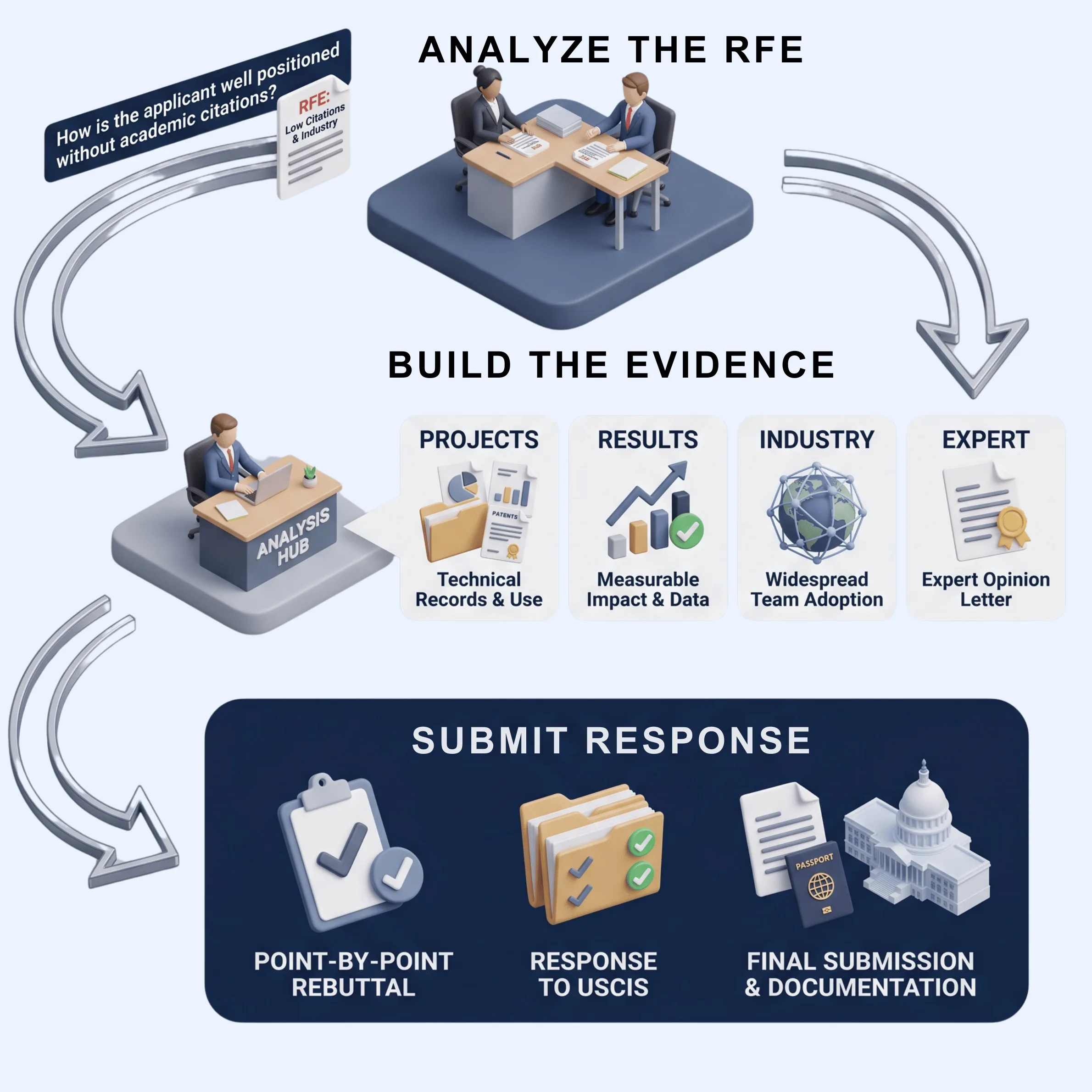
An engineer builds a system that several business units at a company end up using. A data scientist builds models that make forecasts more accurate. A healthcare professional helps bring in a technical process, and clinical workflows start running better. None of them wrote a paper about it, so none of them has many citations. Then the RFE arrives on their EB-2 National Interest Waiver (NIW) petition. The USCIS officer questions their achievements, their influence in the field, or whether they can advance the proposed endeavor. For anyone in that position, one question comes up first: can a thin citation record sink the whole case?
The answer depends on what the rest of the file shows. The Dhanasar matter sets no minimum citation count. USCIS counts citation history as one possible kind of evidence when it decides if a person is well positioned to advance the endeavor, and it also looks at education, skills, achievements, progress, plans, and interest from relevant parties. An industry practitioner needs to show what the work achieved, which parts they handled, and how the supporting records address the officer’s concerns. Adoption records, technical implementation records, measured results, or an independent expert opinion can help, as long as each one supports a specific claim and the documents behind it are strong.
💡 Next Step: When translating complex technical impact into compelling legal arguments under tight deadlines, dedicated professional assistance can protect your petition from denial. Partner with our specialized immigration team to Get Professional EB-2 NIW RFE Solutions tailored specifically to the evidentiary needs of industry professionals.
Can Low Citations Lead To An EB-2 NIW RFE?
An EB-2 NIW RFE may question whether the evidence establishes one or more of the requirements under the applicable legal framework. When citations or publications appear in the notice, the first step is to determine what USCIS is actually questioning.
For example, an RFE might discuss a limited publication record while evaluating whether the applicant has demonstrated a record of success in related efforts. Another notice might question whether the petition establishes the applicant’s ability to advance the proposed endeavor. These concerns overlap in some cases, but they are not identical.
A low citation count does not automatically trigger an RFE or establish a basis for denial. Nor should applicants assume that every citation-related question can be answered by submitting additional recommendation letters.
Read the notice closely. Identify the specific factual or evidentiary gap USCIS has described, then assess whether the original petition adequately addressed it. Use the response to address the missing evidence or unclear claims identified in the notice. Repeating your qualifications will not resolve those gaps.
Does USCIS Require A Minimum Number Of Citations For EB-2 NIW?
The Matter of Dhanasar framework does not prescribe a universal minimum citation count.
USCIS Policy Manual, Volume 6, Part F, Chapter 5, lists documentation of a strong citation history among the types of evidence that may support a finding that a person is well positioned to advance a proposed endeavor. It also identifies other evidence, including expert letters describing specific achievements, evidence of influence within the field, intellectual property, plans for future work, contracts, and documentation showing how others use the applicant’s work. USCIS considers the evidence as a whole. No single document automatically establishes eligibility.
Citation counts also need context. An academic researcher whose work is published in journals may have a different professional record from a software engineer developing ownership systems or an industrial engineer implementing manufacturing improvements. The time since publication, the nature of the field, and the type of contribution may help explain the record, but they do not create an alternative legal test.
Applicants should not rely on arbitrary citation benchmarks or claim that a particular number is sufficient. What matters is whether the full record meets the NIW requirements.
Why Industry Practitioners May Have Few Academic Citations
Research and industry work leave different kinds of evidence. A researcher publishes findings, and other scholars cite them. Someone working in industry might build a forecasting model used inside the company, improve how a factory runs, design a cybersecurity system, or help get a new technology up and running. Much of this work stays within the company, documented in internal records rather than academic papers.
Some made-up examples:
- Software engineering: An engineer works on a platform that a company uses across several of its business units. Deployment records and technical documents show how far it spread, and they help make clear what the engineer actually did.
- Manufacturing: A specialist comes up with a process that cuts equipment downtime. If the company’s operational records are credible, they will show the change and the results.
- Data science: A professional builds a model that the business uses for forecasting. Project records, validation reports, and proof that people really used the model all help show their part in it.
- Healthcare technology: A professional helps put in place a system that makes workflows more reliable. Implementation records and well-documented outcomes show what changed and who helped change it.
None of these examples proves NIW eligibility on its own. One employer being happy with a project says little about national importance. A company’s overall success does not, by itself, establish an individual employee’s contribution.
Applicants need to identify their contributions, explain their significance, and show how the records support the proposed endeavor.
What Evidence Can Help When An EB-2 NIW Applicant Has Low Citations?
The right evidence depends on your work and the concerns raised in the RFE. Select documents that support specific claims rather than submitting records that do not address the officer’s concerns.
Proof that your work was actually used
Technical reports, deployment records, product documentation, project acceptance records, customer agreements or adoption data can show your contribution went beyond an idea or proposal. If a software system was rolled out, that shows it was used. It doesn’t show what you built. For that you’ll likely need design documents, project assignments or other reliable records with your name and role on them. A product’s widespread use does not establish the extent of your individual contribution. Use project records or other reliable evidence to show your specific role.
Measurable results
If you have reliable numbers, use them. Better system reliability, shorter processing time, lower operating costs, higher production quality or beating a known benchmark are all fair examples. But a number on its own says little. Say what was measured, over what period, where the data came from, and how your work fed into it. If a team delivered the result, describe your documented part and don’t take credit for the whole thing. Some contributions can’t be put into numbers. In that case, use detailed technical records and other credible evidence, and don’t invent figures.
Your technical contribution and responsibility
Project plans, design specs, technical reports, patents, research records, product documentation and corroborating statements can show what you actually did. A senior title gives context but doesn’t explain an achievement. It’s more useful to show the decisions you made, the problem you solved, the methods you developed or the implementation you led than to describe general management duties. The aim is to separate your own contribution from ordinary job duties and from how well your employer did overall.
Independent recognition and expert letters
Independent evaluations, relevant professional recognition, outside technical assessments and detailed expert letters can help when your work is hard to judge from job titles or internal descriptions. A good expert letter analyzes the technical side of your contribution, explains why it matters in the field, and looks at the documented evidence of use or impact. It should list the materials the expert reviewed and give reasons for the conclusions. A letter that praises the applicant without examining documented achievements provides limited support. And no letter can stand in for missing records or make unsupported claims reliable.
Progress on your proposed endeavor
Your past work and your future plans do different jobs. If the RFE questions whether you’re well positioned to carry out the endeavor, show where things stand now. That could be development milestones, research plans, contracts, interest from prospective customers, partnerships, funding or documented progress on a project. Together these show the plan is concrete and you’ve already started on it. A plan alone doesn’t prove you’re well positioned, and a successful past project doesn’t prove every future one will work. Explain how the pieces connect.
How To Respond To A Low-Citation EB-2 NIW RFE
Submitting more documents will not help if they do not address the concerns in the RFE. Focus on evidence that answers each point.
Find The Exact Concern
Read the RFE closely. Is the officer doubting your track record, your influence, your qualifications, your proposed endeavor, or one particular Dhanasar prong? A mention of publications doesn’t mean the whole petition is considered weak.
Go Back To Your Original Filing
Re-read the endeavor statement, the evidence, the expert letters and the explanations you already gave. Note which claims weren’t backed up properly and which facts were left vague.
Explain How Your Kind Of Work Gets Documented
If you do applied research, engineering, product development or operations, say how that work normally leaves a paper trail. Use this to give context for your evidence. Explain how your work is documented and why the available records are relevant to the claims in your petition.
Pick Records That answer The Concern
Implementation records can show your work is actually in use. Technical documentation can show what you personally contributed. Independent analysis can help the officer interpret both. Choose records based on how directly they address the concern raised in the RFE.
Show What You Personally Did
If you worked on a team or for an employer, state your real role and back it up with records. Don’t credit one person with a company’s revenue, product success or efficiency gains unless the facts support it.
Tie Each Argument to The Right Prong
Say what the evidence shows and why it matters for the specific requirement the officer questioned. A successful career doesn’t automatically prove the national importance of the endeavor.
Be Upfront About Weak spots
Don’t hide the citation record, and don’t claim citations never matter. Give context where it helps, then lean on evidence that’s well documented.
Check consistency And Follow The Notice
Make sure the response matches your original petition and the supporting records. Follow the RFE’s deadline and filing instructions. For any new evidence, explain why it’s relevant instead of leaving the officer to connect the dots.
The right approach depends on the actual notice and your full petition record. If the RFE raises several issues or challenges the overall argument, it’s worth talking to an immigration attorney.
Reviewing EB-2 NIW RFE Reasons And How To Respond with a qualified immigration professional can help you identify gaps in your evidence and determine whether specialized RFE response services are appropriate for your case.
How The Three Dhanasar Prongs Apply To Low-Citation Cases
The three prongs are separate questions, and a low citation count doesn’t mean you can skip analyzing each one.
Prong 1: Substantial Merit And National Importance
This prong is about the endeavor you propose to work on. The focus is on the proposed endeavor’s merit and national importance, not simply the number of citations to your past work.
Describe the endeavor specifically and support its merit and national importance with evidence. That could be the impact you expect, what it means more broadly, or whether it could help a valuable technology or field move forward. Your professional achievements give context, but getting recognition for your work doesn’t prove the new work is nationally important.
Prong 2: Well Positioned To Advance The Proposed Endeavor
This prong examines whether you are well positioned to advance your proposed endeavor. USCIS can look at your education, skills and knowledge, what you’ve achieved in related work, your plans and how far you’ve got with them, and whether customers, users, investors or others have shown interest.
If you come from an industry, technical records, documented implementation, credible results and evidence of what you personally did can show your experience and achievements. Low citations don’t automatically make you poorly positioned. But if you use other evidence in their place, it still has to support your claim.
Prong 3: Whether A Waiver Would Benefit The United States
The third prong asks if, on balance, the United States would benefit from waiving the job offer and permanent labor certification requirements. This is the broader balancing analysis from Matter of Dhanasar.
A low citation count doesn’t automatically create a deficiency here. If the RFE raises a Prong 3 concern, your response has to address that concern directly. Technical achievement on its own doesn’t settle the balancing test.
How Document Evaluation Helps With an EB-2 NIW RFE for Low Citations or Industry Practitioners
When USCIS questions your citation record or the research basis of your work, your response must show how your experience, documented achievements, and progress support your ability to advance the proposed endeavor. Document Evaluation LLC helps organize this evidence and address the specific concerns raised in the RFE.
End-to-End RFE Response Preparation
Our team prepares a cover letter that takes each USCIS concern in the order it appears in the notice. Each response section addresses a specific USCIS concern and connects the explanation to the supporting evidence.
- Citation concerns are answered with other signs of your impact
- Your proposed work is explained in simple, clear terms
- Legal points and technical details placed together
Expert Opinion Letters
Citation counts vary by field, and industry professionals may have limited academic publications. An expert opinion letter can explain the significance of your industry contributions, technical expertise, and project outcomes, particularly when traditional academic citations do not fully reflect your work.
- 140+ professors and field experts to choose from
- 50+ specialized disciplines covered
- Letters written around your exact role and projects
- Used only when your case needs them
Custom Exhibit Structuring
Evidence such as patents, project outcomes, implementation records, awards, and recommendation letters should support the specific concerns raised in the RFE. We organize these documents by issue and prepare an exhibit index that connects the evidence to the corresponding response.
- Exhibit list with clear labels
- Documents grouped by the USCIS concern they answer
- Formatting that follows USCIS evidence standards
1-3 Day Turnaround
An RFE comes with a fixed date, and gathering letters or company records can eat up days. Fast-track service is available for urgent RFE deadlines, with a 1–3 day turnaround depending on the scope of work and receipt of the required documents.
- Fast-track option for urgent filings
- Same level of review as a regular timeline
Direct Attorney Collaboration
When an immigration attorney is handling your case, we coordinate with them to keep the supporting documentation and response materials aligned with the petition’s legal strategy.
- Drafts sent for your lawyer’s review
- One shared plan for the whole response
USCIS Format Compliance Assurance
A well-organized response package helps present the supporting evidence clearly and consistently. We review the document structure, exhibit references, and formatting, making revisions until the package is finalized and ready for submission.
- Changes made as many times as needed
- Final check done before you file
24/7 Availability
Our team is available 24/7 to assist with RFE-related questions, document updates, and coordination during the response preparation process.
- Send new documents or questions anytime
- Fast replies as your due date gets closer
Conclusion
A low citation count doesn’t kill an EB-2 NIW case. If you’re in industry, you can still respond to an RFE with what you’ve actually done: project results, technical records, and a clear account of your role in the work. Just make sure each document connects to a specific NIW requirement. Adding random paperwork to fill the gap where citations would be usually doesn’t help.
Document Evaluation LLC writes expert opinion letters and helps with RFE documentation, mostly so an officer can see what your work really amounts to. What’s worth including depends on the RFE and on what records you have. For your response strategy, talk to an immigration attorney.
Official Resources:
USCIS Policy Manual Advanced Degree or Exceptional Ability
Matter of Dhanasar, 26 I&N Dec. 884 (AAO 2016)
USCIS Policy Manual Requests for Evidence and Notices of Intent to Deny
USCIS Employment-Based Immigration: Second Preference (EB-2)
USCIS Form I-140, Immigrant Petition for Alien Workers
Frequently Asked Questions
How many citations do I need for an EB-2 NIW?
There isn’t a required number. Dhanasar doesn’t set a citation threshold, and USCIS reviews the whole petition together. Citations are one thing an officer might look at to judge whether your work has influenced others in the field, but nobody is counting them against a cutoff.
Can I qualify for an EB-2 NIW without academic publications?
You can. Having no publications won’t sink a petition on its own. What you do need is to meet the EB-2 requirements and show all three NIW prongs, and the evidence you use should match your actual field and work history.
Can an industry professional respond to an NIW RFE without a strong citation record?
Yes. Look at what the officer is actually questioning and answer that. Implementation records, technical documentation, outcomes that can be checked, and proof of what you personally did on a project can all support your achievements and your ability to carry out your proposed endeavor.
What evidence can demonstrate the impact of industry work?
Deployment records, project documents, credible performance numbers, contracts, and patents (with something showing why they matter) are all possibilities. Records showing that other people or companies use your work are useful too. None of these is enough alone. Each one counts only if it backs up the specific claim you’re making.
Can an Expert Opinion Letter help explain low citations?
It can help. A qualified expert can explain why your documented work is technically significant and why that may not show up in academic citations. The letter needs to be independent, grounded in evidence, and tied to the points raised in the RFE. It won’t guarantee approval, and it can’t fill in facts that are missing from your record.
Does a low citation count automatically mean an EB-2 NIW denial?
No. A low count doesn’t settle the case by itself. The result turns on your full record, your proposed endeavor, the legal standards that apply, and whether the evidence establishes each element.
Should I submit more publications or different evidence in response to an RFE?
That depends on what USCIS flagged and what you already sent. If more publications are relevant, they can help. In other situations, industry evidence or clearer documentation of your own role will respond to the concern better.

Explore EB-2 NIW expert letters and step-by-step Dhanasar Prongs 1, 2, and 3 RFE response guides below:
- What is an EB-2 NIW Expert Letter?
Explains how an independent advisory evaluation corroborates key legal prongs under Matter of Dhanasar, establishing petitioner credibility, endeavor significance, and waiver justifications for USCIS officers. - How to Beat Dhanasar Prong 1 RFEs?
Outlines targeted strategies to satisfy substantial merit and national importance standards, showing how to document broader societal, technological, or economic impact beyond a single employer. - How to Overcome Dhanasar Prong 2 RFEs?
Details proven methods to demonstrate you are well-positioned to advance your venture, leveraging third-party investments, institutional interest, relevant track records, and measurable progress milestones. - How to Win the Dhanasar Prong 3 Balancing Test?
Breaks down the final balancing test, illustrating why bypassing the PERM labor certification requirement ultimately benefits the United States even when qualified U.S. workers may be available.