

 |
|
Dhanasar Prong 1 RFE: How To Address Substantial Merit And National Importance


- Address the exact issues raised by USCIS.
- Show how your work could have a wider impact.
- Back up your claims with relevant evidence.
- Make sure all documents tell the same story.
- Use expert opinions when they help explain your case.
- Submit your response before the deadline.
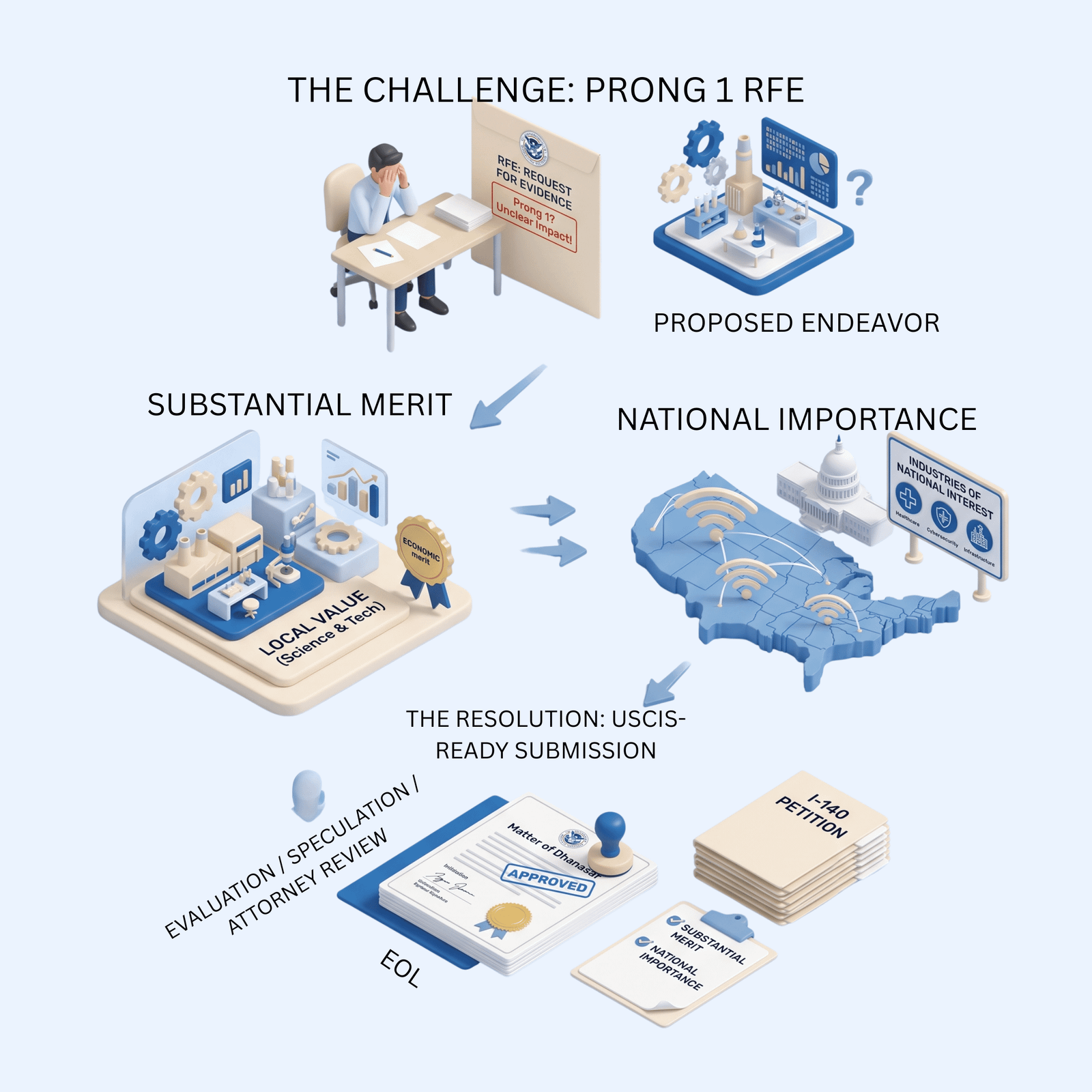
A planned project might be tackling a real issue related to science technology medicine, or business but continue to be seen as lacking national significance. There’s sometimes a disconnect between the project and its potential larger implications. Answering why an industry is significant isn’t the same as demonstrating that a specific project could have broader applications than the applicant’s position.
Where this is relevant is in a Dhanasar Prong 1 RFE from USCIS. Whereas in Matter of Dhanasar, the petitioner is necessary to demonstrate that the endeavor in question has both substantial merit & national importance, the evidence provided by the petitioner must support the specific statements made about the endeavor rather than simply establish eligibility or an interesting goal.
An appropriate answer will start with the concern actually expressed in the RFE. What you are not trying to do is just upload more documents. Rather, you are trying to show the how the activity proposed satisfies the standard and then provide the evidence that shows it.
To articulate this broader impact and substantiate your endeavor with authoritative third-party analysis, you can hire our specialized agency to secure a comprehensive Dhanasar Prong 1 expert opinion letter tailored directly to the adjudicator’s specific concerns.
💡 Next Step: To articulate this broader impact and substantiate your endeavor with authoritative third-party analysis, you can hire our specialized agency to secure a comprehensive Dhanasar Prong 1 EB-2 NIW expert opinion letter tailored directly to the adjudicator’s specific concerns.
What Is A Dhanasar Prong 1 RFE?
A Dhanasar Prong 1 RFE is a Request for Evidence concerning the first requirement of the three-part framework used to evaluate an EB-2 National Interest Waiver (NIW) petition. USCIS may question whether the proposed endeavor has substantial merit, national importance or both.
The wording of the RFE matters because these concerns are related but distinct. Evidence that demonstrates the practical value of a project may help establish substantial merit without adequately addressing its potential broader implications. Conversely, reports describing a nationwide problem may establish that the problem deserves attention without showing how the petitioner’s specific proposed work could contribute to addressing it.
The response should therefore be based on the officer’s stated concerns rather than a general collection of additional documents. If USCIS has already accepted the endeavor’s substantial merit but questions national importance, the response should concentrate on the unresolved issue while maintaining the relevant context.
Why Does USCIS Question Substantial Merit Or National Importance?
Several evidentiary weaknesses can leave the first prong insufficiently established. These are possible problems, not an official checklist of reasons every RFE is issued.
- A proposed endeavor is described too broadly: Statements such as “advance artificial intelligence” or “improve healthcare in the United States” identify broad objectives but do not explain the work the applicant actually intends to undertake. Without specific goals, activities or intended outcomes, it becomes difficult to assess the endeavor’s potential impact.
- The petition relies on the importance of an entire industry: A government report identifying cybersecurity as a national priority, for example, establishes the relevance of the field. It does not automatically establish the national importance of every cybersecurity consulting business or software project. The petition needs to explain the relationship between the documented need & the proposed work.
- Predicted benefits lack supporting evidence: A business plan could estimate more jobs, greater efficiency or significant cost reductions. Those estimates are more credible when the assumptions, new methods, target markets and basis for analysis are discussed. A forecast by itself does not make the likely impact seem credible or far reaching.
- The evidence focuses on the applicant rather than the endeavor: Degrees, publications, awards, and professional experience can be relevant to other parts of an NIW petition. However, an impressive record does not independently establish that the proposed endeavor has national importance. The response must connect each piece of evidence to the specific issue it is intended to resolve.
Substantial Merit vs. National Importance Under Matter of Dhanasar
The first prong contains two separate elements, and both must be established.
Substantial merit: What value does the endeavor offer?
Substantial merit concerns the value of the proposed endeavor. Under Matter of Dhanasar, that value may arise in areas including business, entrepreneurship, science, technology, health, education, and culture.
Economic benefits can be relevant, but immediate or quantifiable financial returns are not essential in every case. Scientific research, for example, may have substantial merit because it advances knowledge even when its commercial applications remain uncertain.
National importance: What broader implications could the endeavor have?
National importance emphasizes the possible future impact of a particular endeavor. USCIS evaluates its nature and wider effects, rather than basing its assessment only on the geographic area where the work takes place.
Locally oriented a project may still be eligible if the broader community would benefit from its application. For instance, a new manufacturing process at one facility might be of greater interest if there is evidence that the process could be applied elsewhere in a larger sector. The project’s local origins alone do not necessarily make it ineligible.
Imagine a futuristic health technology professional who is eager to invent a computer program that can detect prescription errors in a hospital record. This program may be fairly significant; prescription safety may be quite important to healthcare. To meet the national importance requirement, the petitioner would need to justify the specific solution, how it would be used, and the evidence that it could have wide effects, rather than just impressive general facts about medication errors.
This is the main difference of many Prong 1 arguments: a serious issue can exist without the petition demonstrating sufficiently how the proposed endeavor is related to the issue.
How To Respond To A Dhanasar Prong 1 RFE
An effective response should follow the logic of the RFE and the evidence available in the case.
- Start with the precise objection: Identify which claims USCIS considers unsupported. Does the officer question the endeavor’s value, its prospective impact, or the connection between the two? If the RFE raises several concerns, address each one separately so that the response does not leave a material issue unanswered.
- Clarify the proposed endeavor where necessary: Describe the work in concrete terms: what the petitioner intends to develop, research, implement, or deliver; what problem it addresses; and what outcomes are reasonably anticipated. This explanation must remain consistent with the original petition and the supporting documents. A response should clarify the existing endeavor, not introduce an entirely different project merely to create a stronger national-importance argument.
- Connect the evidence to each disputed claim: A report about a national shortage, a technical description of the proposed solution, and a document showing an implementation plan serve different purposes. Explain the relationship between them rather than assuming the officer will draw the intended conclusion.
- Address limitations honestly: Be transparent on the facts when initially laying out the project: distinguish facts from aspirational evidence. Don’t present mission, jobs, or revenue projections as fact, because they are not. An argument in favor of the effort states what is certain, what is uncertain, and why what is certain makes the potential impact worth attempting.
- Check consistency across the petition: The proposed activity, business plan, personal statement, letters of expertise, and other supporting documentation must be compatible in giving the same purposes. It is a problem if one document describes the work as the development of a specified form of technology and the other describes a general consulting service.
USCIS evaluates the record under the applicable evidentiary standard, which requires establishing eligibility by a preponderance of the evidence. Simply increasing the number of exhibits does not resolve an evidentiary gap if those exhibits do not support the disputed claim.
What Evidence Can Support National Importance?
The appropriate evidence depends on the endeavor and the specific questions raised in the RFE. No single document type establishes national importance in every case.
| Evidence | What it may help establish | Limitation to consider |
| Government reports and policy documents | The significance of a documented national or industry problem | A policy priority does not automatically establish the importance of the applicant’s particular work |
| Industry research and credible market studies | The scale of a problem, unmet demand, or potential applications | General market growth does not prove that a specific project will produce the projected benefits |
| Technical documentation and research | The proposed solution, its capabilities, or its relevance to a field | Technical sophistication alone does not establish broader implications |
| Business plans and project proposals | Intended activities, implementation stages, target users, and projected outcomes | Unsupported assumptions or vague projections may weaken the argument |
| Contracts, letters of interest, or implementation records | Evidence of planned use, actual demand, or progress toward implementation | A single commercial relationship may not establish wider impact without additional context |
| Independent expert analysis | The technical significance of the work and the connection between the endeavor and its potential broader effects | The analysis must be credible, specific, and grounded in evidence |
The distinction between context and proof is especially important. A government report might document the need for more reliable energy infrastructure. The petitioner still needs to explain how the proposed engineering work relates to that need and why its anticipated implications extend beyond an ordinary individual assignment.
A startup’s business plan may, for example, illustrate a product that would have commercial viability. Whether it also indicates a matter of national importance will depend on the character of the venture in question & the evidence of the stated national significance.
Petitioners are not required to have all these types of evidence. The answer should be based on evidence that addresses what the officer was concerned about and supports the case that the record supports.
Can an Expert Opinion Letter Help With a Dhanasar Prong 1 RFE?
An independent expert opinion letter may be useful when the national-importance argument depends on technical or industry-specific questions that are difficult to explain through the applicant’s own statements alone.
For example, an expert with relevant knowledge of advanced manufacturing might explain why a proposed process differs from conventional methods, what problem it addresses, and how the documented technical characteristics could have implications for other manufacturers. The letter becomes more useful when its analysis refers to the actual project, supporting records, and relevant evidence rather than relying on broad statements about the importance of manufacturing.
For a Prong 1 RFE, the expert should address the unresolved issue. If the concern is the endeavor’s potential broader impact, a letter devoted mainly to the applicant’s education and career achievements may not answer the question.
The expert’s qualifications, independence, familiarity with the subject, and reasoning all matter. An expert opinion is supporting evidence, not a substitute for the underlying documentation or the petitioner’s overall argument. USCIS does not require an Expert Opinion Letter in every NIW case, and obtaining one does not guarantee approval.
Applicants seeking this type of documentation can review Document Evaluation LLC’s EB-2 NIW Expert Opinion Letter service to understand the available support.
When Should You Seek Professional Help With An EB-2 NIW RFE?
You might need professional help if there are multiple issues raised in the RFE, the proposed project is technically difficult, or the evidence isn’t sufficiently comprehensive to demonstrate the relationship between the work and the proposed effect.
An immigration lawyer can guide the legal strategy, place the RFE within the big picture of the petition, and help interpret the specific legal standard. An outside expert can offer opinions related to the industry. And a credential evaluation provider can evaluate educational credentials if that is an issue. These are all separate roles.
Document Evaluation LLC offers independent expert opinion letters and RFE-related documentation assistance for applicable cases. The RFE support services may also be appropriate where the RFE has a requirement for further documentary or expert analysis.
Conclusion
A Dhanasar Prong 1 RFE requires a focused examination of what the proposed endeavor is expected to accomplish and why its potential implications satisfy the national-importance standard. The strongest response is not necessarily the longest one. It is the one that addresses the officer’s actual concerns, connects the argument to relevant evidence, and avoids claims the record cannot support.
If your RFE raises questions about the technical significance of your work or the evidence supporting your proposed endeavor, consider whether an independent expert assessment or other targeted documentation would help address those issues. For questions about legal strategy and filing requirements, consult a qualified U.S. immigration attorney.
Authoritative Sources:
Frequently Asked Questions
What does a Dhanasar Prong 1 RFE mean?
It means USCIS has requested extra evidence or clarification concerning either the proposed endeavor has substantial merit & national importance. The RFE’s wording determines which aspects need a response.
Is substantial merit the same as national importance?
No, substantial merit concerns the value of the endeavor, while national importance focuses on its potential prospective impact & broader implications. Evidence may support one element without fully establishing the other.
Can a locally focused endeavor satisfy national importance?
Yes, under Matter of Dhanasar, an endeavor does not necessarily need to operate nationwide. Its potential implications may extend beyond the immediate location, but the petition must support that connection with relevant evidence.
Does an EB-2 NIW Prong 1 RFE require an Expert Opinion Letter?
No, USCIS does not prescribe an Expert Opinion Letter as a universal requirement for the first prong. An independent expert’s analysis may help explain specialized technical issues when it is relevant to the specific evidentiary concern.
Can government reports prove national importance?
Government reports can establish the significance of a problem or the relevance of a field. They generally need to be connected to the petitioner’s particular endeavor to support the broader argument.
Does a Prong 1 RFE mean my EB-2 NIW petition will be denied?
No, an RFE is a request for additional evidence before a decision, not a final denial. The outcome depends on the complete record, the response, and whether the applicable eligibility requirements are established.
Should I submit new evidence or explain the evidence already filed?
That depends on the officer’s concern. Some responses need additional documentation; others need a clearer explanation of existing evidence. Many require both. Follow the RFE instructions and the deadline stated in the notice, and seek legal advice when necessary.

Explore Dhanasar criteria, expert letters, and complete EB-2 NIW filing rules below:
- Matter Of Dhanasar EB-2 NIW Criteria And Requirements
Analyzes the three-prong legal precedent set in Matter of Dhanasar, detailing how petitioners must prove substantial merit and national importance, well-positioned status, and the beneficial balance of waiving the labor certification requirement under current USCIS adjudication standards. -
What is an EB-2 NIW Expert Letter? (Dhanasar Framework Explained)
Explains how independent expert opinion letters directly substantiate each Dhanasar prong, highlighting best practices for drafting university professor and industry authority endorsements that confirm national impact and applicant credentials. - What Is the EB-2 NIW Visa: Complete Guide
Serves as an end-to-end overview of the National Interest Waiver green card category, covering advanced degree and exceptional ability thresholds, self-petition filing procedures, and key evidence needed to bypass PERM sponsorship.
Akash Pundir is the Chief Operating Officer at Document Evaluation LLC, bringing over 5 years of international business operations and legal support experience across the United States, Australia, and India. He has overseen the strategic positioning and analysis of over 1,000+ complex USCIS cases, specializing in guiding expert evaluation teams to draft high-stakes Expert Opinion Letters (EOL), Academic Equivalencies, and defense packets for H-1B, EB-2 NIW, RFEs, and NOIDs. Driven by digital transformation, Akash ensures every evaluation adheres strictly to the latest USCIS legal frameworks and compliance benchmarks.
