

 |
|
Dhanasar Prong 2 RFE: How To Prove You Are Well Positioned To Advance Your Endeavor


A strong professional background can support an EB-2 NIW petition, but the significance of that background depends partly on the work the petitioner intends to pursue. A researcher’s publications, an engineer’s technical experience, or an entrepreneur’s previous business success may demonstrate relevant capabilities. The petition must also explain how those capabilities relate to the specific proposed endeavor.
That distinction matters when USCIS issues a Dhanasar Prong 2 RFE. The concern may not be whether the petitioner is qualified in their profession, but whether the submitted evidence establishes that the individual is well positioned to advance the proposed endeavor. Addressing that concern requires more than adding documents to the original filing. The evidence must help explain the connection between the petitioner’s demonstrated abilities, past accomplishments, future plans, and intended work.
💡 Next Step: To clearly establish this critical evidentiary link and satisfy rigid adjudicator standards, you can hire our specialized agency to Get Professional RFE Solutions for USCIS Petitions tailored directly to your proposed endeavor.
What Is A Dhanasar Prong 2 RFE?
A Dhanasar Prong 2 RFE or Request for Evidence is when USCIS requests more evidence or documents as to whether the EB-2 National Interest Waiver (NIW) petitioner is in a good position to carry out the proposed endeavor. What they are concerned about depends on the specific case and prior evidence submitted.
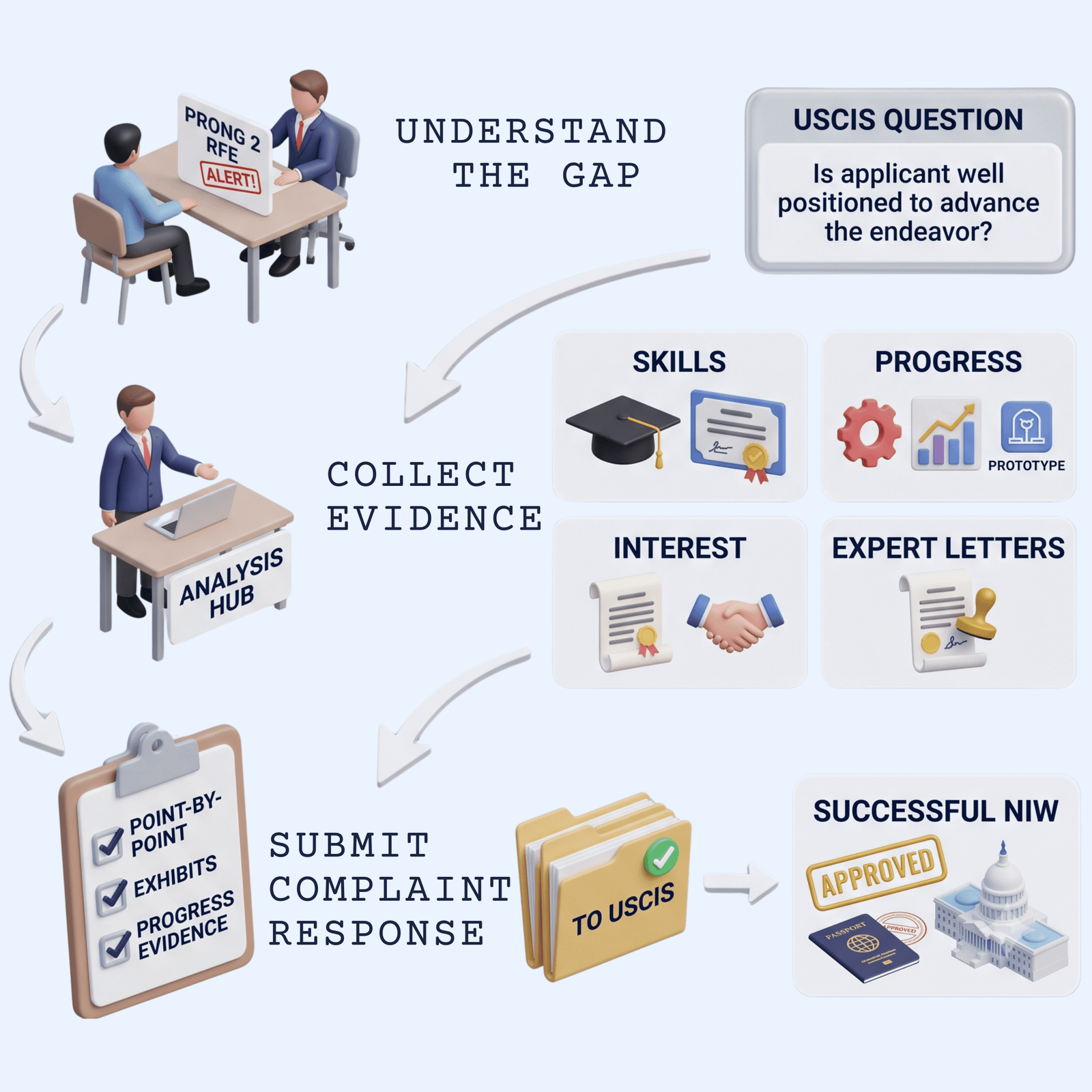
The structure used is from Matter of Dhanasar, 26 I& N Dec. 884, 890 (AAO 2016). The second prong is about the foreign national and their ability to benefit the proposed work. The decision recognizes a number of relevant factors on this, like education skills, knowledge, success in similar endeavors, the alien’s plans, the alien’s progress toward the endeavor, and the interest of relevant parties.
An RFE might call into question whether the petitioner’s credentials matter, whether the plan described is credible or specific enough, or whether the evidence links past accomplishments to future undertakings. These are different evidentiary issues. A response should specify, which of these the USCIS really identified, not just assume every potential weakness is relevant.
Why Does USCIS Question Whether An Applicant Is Well Positioned?
One possible concern is a gap between the petitioner’s professional record and the work described in the petition. For example, a software engineer may have extensive experience developing enterprise applications but propose to build a specialized system for improving agricultural disease detection. The engineering background may be relevant, yet the petition should explain how the person’s technical knowledge, previous projects, collaborators, and proposed activities support that particular endeavor.
Second, the petition may list achievements without explaining what they actually show. Publication patents awards, or finished projects alone may not clarify the petitioner’s specific role, the outcome & what it has to do with the proposed work. Relevant documentation can help establish the importance of the achievements and make it easier for someone to judge them.
Another concern might be whether the plan is credible. A business plan, research proposal, or professional development plan outlines an applicant’s plans, but simply having such a plan does not show that he/she has a reasonable chance of implementing it. If the applicant has related experience or preliminary work, access to certain resources, or clear expression of interest from others, these elements may be useful to demonstrate that a plan is credible.
These are only a few things to watch out for and not reasons why an officer issued an RFE. Depending upon the notice they receive, the officer’s reason may be different.
What Does Well Positioned Mean Under Matter of Dhanasar?
The second prong demands that the petitioner prove, by the greater weight of the evidence, that he is well positioned to develop the proposed endeavor. This prong asks whether it is more probable than not that the petitioner will succeed, taking into account the evidence in its totality. Matter of Dhanasar acknowledges that the petitioner cannot predict the future, and does not need to prove that the endeavor is more likely than not to succeed in the end.
The decision distinguishes three separate questions:
- Prong 1: Does the proposed endeavor have substantial merit and national importance?
- Prong 2: Is the petitioner well positioned to advance that endeavor?
- Prong 3: On balance, would waiving the job offer and labor certification requirements benefit the United States?
Satisfying one prong does not necessarily mean that the others are established. For instance, evidence that the proposed research is in the national interest and advances a national problem may establish Prong 1, but can not stand alone to establish the petitioner’s ability or preparation to advance it.
The second prong of the test is not restricted to the sole analysis of minimum qualifications. Here, USCIS examines the petitioner’s education skills, knowledge experience, previous successes in related ventures, the model, plan, or proposal for activities, the development toward the project, and interest from potential customers, users, investors, or other appropriate sources and persons.
The guidance on NIW from USCIS was revised in January 2025 and gives guidance on business plans, letters of support, and evidence in the aggregate. You should consult the Policy Manual and the precedential decision when drafting a response.
What Evidence Can Support Dhanasar Prong 2?
No single document establishes eligibility in every case. The useful question is what the evidence demonstrates about the particular petitioner & their proposed endeavor.
-
Education, skills, And Specialized Knowledge
An early-stage company may have a proof of concept or research plan rather than a finished product. A founder may have developed a prototype without yet securing paying customers. Describe the project’s current stage accurately and use existing records to demonstrate actual progress. Do not present anticipated achievements as completed results.
-
A Record Of Success In Related Efforts
A descriptive plan details the applicant’s goal and how it aligns with their experience. For some projects, this could be data collection and analysis; for others, it might be describing the research goal, approaches to the development process, intended users, implementation plan, or requirements.
Specificity can be important, because general aspirational statements do not tell us how it will be accomplished. Yet, the petitioner should not claim uncertain projections as certain or insert commitments that cannot be proven. A business plan is appropriate for an entrepreneur, while a research agenda or project plan may be more appropriate for an academic or scientist.
-
A Credible Plan For Future Activities
A descriptive plan details the applicant’s goal and how it aligns with their experience. For some projects, this could be data collection and analysis; for others, it might be describing the research goal, approaches the development process, intended users, implementation plan, or requirements.
Specificity can be important, because general aspirational statements do not tell us how it will be accomplished. Yet, the petitioner should not claim uncertain projections as certain or insert commitments that cannot be proven. A business plan is appropriate for an entrepreneur, while a research agenda or project plan may be more appropriate for an academic or scientist.
-
Progress Toward The Proposed Endeavor
Potential evidence of progress includes completed research, preliminary findings, prototypes, pilot testing, project milestones, grant applications, signed agreements, or other relevant work. The appropriate evidence depends on the stage and nature of the endeavor.
An early-stage company may have a reasonable research plan and some proof of concept rather than a finished product. The founder may have a prototype but not yet have paying customers. Provide the most appropriate description of the stage and set out what existing records indicate don’t present likely future achievements as if they are in the past.
-
Interest From Relevant Parties
The significance of this evidence depends on its source, detail, and relevance. A signed research collaboration agreement that identifies specific responsibilities may provide more concrete support than a general expression of interest. A potential customer’s letter may help demonstrate demand, but it does not guarantee future sales or prove that the proposed endeavor will succeed.
-
Expert Opinion Letters And Recommendation Letters
An independent expert opinion letter can show how the proposed work is directly related to a petitioner’s specialized experience, previous employment, or technical knowledge. Effective letter writing: lists the records (e.g. resumes publications, patents) the expert used to determine the knowledge and skills of the petitioner; discusses the expert’s knowledge of the work; and makes a logical link between those records and the knowledge and skills of the petitioner.
A referral letter will also be useful, mostly if the writers indicate a particular piece of work they have directly observed. General praise of good character, hard work, professionalism, or promise is less helpful if it does not clarify what the petitioner actually did or how it was relevant to the project.
Either type of letter is no substitute for substantiating records, the amount of support it offers depends on the degree of certainty of its factual base and on the validity of its analysis.
How To Respond To A Dhanasar Prong 2 RFE
A strong EB-2 NIW RFE response should address the officer’s stated issues rather than simply increase the number of exhibits. The following approach can help organize the response, although the actual RFE & case record settle the appropriate strategy.
1. Identify The Specific Evidentiary Gaps
Read the RFE thoroughly & outline the questions it poses. A question of relevance about past experience will require a different response than a question about an inchoate future plan. Respond to each substantive issue explicitly.
2. Clarify The Proposed Endeavor
Explain how the endeavor was represented in the original petition. The answer should clarify the endeavor evenly & avoid a sudden & unexplained shift in goals, scope or activities. If clarifying is needed, it should be treated separately from a major change in the basic proposal.
3. Connect Qualifications To The Proposed Work
Identify the most related education, skills, experience & achievements. Explain how they support the activities the petitioner aims to undertake. For example, if the endeavor involves developing a medical technology, describe the petitioner’s relevant engineering, research, testing or product-development experience rather than depending solely on a list of job titles.
4. Support The Future Plan With Appropriate Evidence
Explain the proposed activities, current stage of preparation & next steps. Use records that substantiate the claims. Depending on the endeavor, these may include project documentation, research materials, business records or evidence of access to relevant resources.
5. Address Progress And External Interest Where Relevant
If USCIS raises an issue about progress, show work accomplished & include relevant documentation that is available. If RFE is about collaboration or market interest, explain the nature of the relationship & document the substance of that relationship. Avoid suggesting that a future arrangement is already settled.
6. Explain How New Exhibits Answer The RFE
Each important exhibit should have a clear objective. A response that adds a certificate, reference letter or business document without explaining its significance may leave the original interest unresolved.
7. Review The response As A Complete Record
Verify that the petitioner’s statements, the expert opinion, evidence submitted in support of the petition & the description of the activity are aligned. The response should be said as a single, evidence-based argument not a list of professional achievements.
The objective is to set up the petitioner’s positioning through relevant, credible evidence. No response format, individual exhibit or combination of documents guarantees approval.
Can An Expert Opinion Letter Help With A Prong 2 RFE?
When the record includes specialized work & it is not self-evident that the petitioner’s experience relates to the proposed endeavor or you need to explain how the experience relates to the endeavor, an independent EB-2 NIW Expert Opinion Letter might assist.
You could, for example, have a technical specialist describe why a prior body of work of a researcher brings relevant background material for the proposed research program. An expert who is knowledgeable about a relevant industry might analyze the entrepreneur’s reported experience versus the proposed business venture.
The helpful letter should reference the material reviewed, detail the expert’s credentials on the subject and corroborate all opinions with facts. If the RFE mentions a specific problem with the petitioner’s skills, the analysis should counter the issue instead of restating what the petition stated.
It’s also worth noting still that An Expert Opinion Letter is not a requirement for all NIW cases, nor can it simply substitute a lack of evidence by claiming the petitioner’s qualifications. It brings an expert analysis of the facts, not a “win.”
When Should You Seek Professional Help With An EB-2 NIW RFE?
If the RFE addresses multiple issues or calls for highly technical work, or if there is not a strong nexus between the petitioner’s achievements and future proposed activity, professional help might also be advantageous.
An immigration lawyer can review the legal concerns, the issues raised by the RFE, how the RFE relates to the rest of the petition, and suggest a way to respond. A third-party expert opinion letter can be used when it is appropriate to explain the technical or professional nature of the petitioner’s area of work. Credential evaluation may be necessary when there is a need to evaluate foreign degrees to a given immigration category, but its function is different from an expert opinion letter.
Why Choose Document Evaluation LLC For Your Dhanasar Prong 2 RFE?
We help you answer this by providing expert opinion letters and supporting documents that connect your education, skills, and work history to the plan in your petition.
What we offer:
- Expert Opinion Letters from an independent expert who writes around your own record and endeavor, with no generic templates
- 140+ professors and top field experts across 50+ fields
- Supporting documentation that responds to the points raised in your RFE
- Unlimited revisions until the final letter works for you
- 24/7 support for questions at any stage
We explain how your past work shows the knowledge and experience your endeavor requires and can point to records USCIS is able to verify. A letter like this makes your evidence easier to follow, but it doesn’t replace the evidence itself or guarantee approval. The outcome depends on the expert’s analysis, your documents, and what the RFE asks.
Frequently Asked Questions
What does a Dhanasar Prong 2 RFE mean?
It’s a request for additional evidence or clarification about whether the petitioner is well-positioned to carry out the proposed endeavor. The notice spells out the issues to be addressed by the response.
What does USCIS consider when determining whether someone is well positioned?
In Matter of Dhanasar, matters to be considered are education skills, knowledge, success in related endeavors, future plans, progress toward the endeavor and interest from related parties. These are not binding and their applicability depends on the specific case.
Can work experience help establish Prong 2?
Yes! Work experience may establish particular expertise, skills, or accomplishments if you can make a convincing link between the experience and the proposed venture.
Must the proposed endeavor have already succeeded?
No! Matter of Dhanasar assumes some degree of risk, and therefore does not require showing that an applicant’s future work will succeed. Showing that they are well-positioned for further advancement with evidence of relevant experience, work progress, and a realistic plan may be sufficient.
Can an Expert Opinion Letter help with a Prong 2 RFE?
Perhaps it can provide some context as to why the petitioner submits evidence of demonstrated achievement, experience, and expertise, and how the petitioner’s abilities relate to the work altogether. The relevance of the explanation varies based on the familiarity of the expert and the evidence.
Conclusion
Establishing that a petitioner is well positioned to advance a proposed endeavor requires more than demonstrating a strong professional background. The evidence should explain how the individual’s knowledge, relevant accomplishments, future plans, and available resources support the work they intend to pursue.
For a Dhanasar Prong 2 RFE, the most useful response is one that addresses the officer’s actual concerns and explains the significance of the supporting evidence. Where specialized professional analysis would help clarify that relationship, an independent expert opinion letter may provide additional context. Petitioners who need help with an EB-2 NIW Expert Opinion Letter or RFE documentation can review the services available through Document Evaluation LLC.
Official Resources:
- Matter of Dhanasar, 26 I&N Dec. 884 (AAO 2016)
- USCIS Policy Manual
- USCIS Policy Manual update, January 15, 2025
- USCIS EB-2 classification information
- USCIS AAO non-precedent decision, February 12, 2024

Explore Dhanasar Prong 1 defense, RFE denial realities, and EB-2 NIW core rules below:
- How to Beat Dhanasar Prong 1 RFEs
Outlines actionable defense strategies to overcome USCIS challenges regarding substantial merit and national importance. Details how to reframe your proposed endeavor, document broader economic or societal impact beyond your immediate employer, and supply objective independent evidence to secure approval. - Why a USCIS RFE Isn’t a Denial (And What to Do)
Outlines a step-by-step roadmap for petitioners facing an RFE, detailing how to identify evidentiary gaps, avoid generic responses, and submit targeted proof before the final deadline. - What Are Dhanasar EB-2 NIW Rules?
Breaks down the three-prong legal framework established in Matter of Dhanasar for self-petitioning foreign nationals. Explains how to substantiate national importance, demonstrate that you are well-positioned to advance the endeavor, and prove the ultimate benefit of waiving the PERM labor certification requirement.
Akash Pundir is the Chief Operating Officer at Document Evaluation LLC, bringing over 5 years of international business operations and legal support experience across the United States, Australia, and India. He has overseen the strategic positioning and analysis of over 1,000+ complex USCIS cases, specializing in guiding expert evaluation teams to draft high-stakes Expert Opinion Letters (EOL), Academic Equivalencies, and defense packets for H-1B, EB-2 NIW, RFEs, and NOIDs. Driven by digital transformation, Akash ensures every evaluation adheres strictly to the latest USCIS legal frameworks and compliance benchmarks.
