

 |
|
Does An RFE Mean Denial? What USCIS Is Really Asking For


Key Takeaways
- An RFE isn’t a denial. USCIS just wants more proof before deciding.
- Read the notice closely and find out what the officer is actually questioning.
- Send evidence that answers that point, and leave out anything unrelated.
- Don’t miss the deadline.
- You can submit additional evidence in response to an RFE, but it should address the issue USCIS raised and support eligibility that existed when the case was filed.
- If the issue is tricky, like education, employment, or eligibility, talk to an immigration attorney.
You open your USCIS case notice and see three letters: RFE. That can be enough to make you worry that your application or petition is headed for a denial. But an RFE is not a denial. It means USCIS is asking you for more evidence before deciding the case.
The important part is understanding why the officer sent the request. An RFE can point to a missing document, an eligibility requirement that has not been sufficiently established, or an issue where the evidence in the file does not provide USCIS enough information to make a decision. USCIS policy says officers generally issue an RFE when additional evidence could resolve the problem.
So, getting an RFE does not tell you what the final decision will be. It tells you that your case still needs something. To effectively bridge those evidentiary gaps and safeguard your petition against denial, you can hire our specialized agency for comprehensive RFE response services tailored directly to your notice.
What Does An RFE Mean In An Immigration Case?
A Request for Evidence (RFE) is sent by USCIS when they need more information or supporting documents for your case.
The request is tied to the application or petition you already filed. USCIS reviews the record, identifies an issue that needs more support, and explains what it wants you to submit.
The request could be fairly narrow. For example, USCIS may ask for a particular document or additional evidence supporting one part of your eligibility. In other cases, the notice can raise a more complicated issue that requires you to explain the facts and provide several pieces of supporting evidence.
The RFE itself should tell you what USCIS wants and when the response is due. That deadline matters.
Why Would USCIS Send An RFE?
There is no single reason behind every RFE. The issue depends on what you filed and what USCIS needs to establish before approving it. Some requests are about missing evidence. Others concern the quality or sufficiency of evidence already submitted.
USCIS may request:
- A document that was not included with the original filing
- More evidence supporting an eligibility requirement
- Clarification about information in your application or petition
- Records supporting a statement made in the filing
- Evidence connecting your documents to the requirement being reviewed
- Additional information needed to evaluate the case
USCIS reviews the record as a whole when determining whether the applicant or petitioner has established eligibility. The officer considers the evidence submitted and the specific requirements that apply to the case.
That is why the wording of your RFE matters so much.
How To Read Your USCIS RFE And Understand What USCIS Wants
The document USCIS requests is not always the actual issue.
For example, suppose the RFE asks for additional employment records. The officer may not simply want another employment document. The records may be needed to establish a particular requirement connected to the petition.
The same thing can happen with education documents.
If USCIS questions whether your degree or academic background meets a requirement, sending another document without addressing that concern may not solve the problem. You need to understand what the requested evidence is supposed to establish.
Read the RFE with one question in mind:
What does USCIS believe has not been established yet?
Once you identify that point, the requested documents make more sense. Do not start by collecting every document you can find. Read the notice from beginning to end. Pay close attention to the section where USCIS explains the issue with your case.
Then look at the evidence USCIS specifically requests.
You should be able to answer three things:
- What requirement is USCIS reviewing?
Identify the part of your eligibility that is being questioned. - What evidence does USCIS say is missing or insufficient?
This tells you where the problem lies in the existing record. - What does USCIS want you to provide?
Match each requested document or explanation to the issue raised in the notice.
This makes the response much easier to organize. It also reduces the chance of submitting a large amount of material that does not answer the officer’s concern.
What Should You Do After Receiving An RFE?
Check the receipt number and make sure the RFE belongs to the correct case. Read the requested evidence carefully & compare it with the documents that were submitted with the original filing.
If someone prepared your original application or petition, the person handling the RFE should also review the original filing. The response needs to make sense alongside what USCIS already has.
You should also look for anything that has changed since the original filing. If your circumstances have changed, do not simply assume that the new information can be added into the RFE response without considering how it affects the original case. The response should deal with the case USCIS is actually reviewing.
Should You Send As Many Documents As Possible?
No, more paperwork does not make your RFE response stronger.
USCIS guidance has long emphasized that an RFE should identify the evidence that is actually needed rather than asking for broad amounts of unnecessary material. The agency has also explained that unnecessary or irrelevant evidence can make the record harder to review.
Your response should have a reason for each document. If a document does not help answer the issue in the RFE, adding it may not improve the response.
A useful way to review your evidence is to ask:
What does this document prove, and how does that relate to the issue USCIS raised?
If you cannot answer that clearly, reconsider whether the document belongs in the response.
Can You Submit New Evidence With An RFE Response?
Yes, USCIS gives you this opportunity so you can provide additional evidence that may establish your eligibility. What you need to submit depends on the issue mentioned in the notice. It could be missing records or more detailed evidence about your education, employment, finances, a qualifying relationship, or another requirement.
Make sure the new evidence fits with the rest of your case. If it gives information that conflicts with what you submitted earlier, do not leave that difference unexplained. A contradiction that is not addressed can give the officer another issue to consider.
What If You Already Submitted the Document USCIS Is Asking For?
If you already provided the requested evidence, compare the document you submitted with the wording of the RFE. USCIS may be saying that the document itself is missing, or it may be saying that the document you submitted does not establish the particular requirement being reviewed. These are different problems.
Simply resending the same document may not resolve the RFE if the officer has already reviewed it and determined it to be insufficient. Your response should explain why the evidence now being submitted addresses the specific concern.
What Happens If You Do Not Respond To The RFE?
If you do not send your RFE response on time, USCIS may review your case with the evidence already on file. If the evidence already in the file does not support your eligibility, USCIS may deny the application or petition.
Do not count on getting another notice after the deadline. USCIS generally does not grant extensions for responding to an RFE, and the case may be decided based on the evidence already in the record. The date listed on your RFE is the date you need to work toward.
How Much Time Do You Have to Respond to an RFE?
The notice tells you when your response is due.
USCIS guidance provides a maximum response period of 12 weeks (84 days) for most RFEs, although the actual deadline is the one stated in your notice. USCIS generally does not grant extensions beyond the applicable response period.
Do not calculate the deadline based on the general timeframe found online. Check your actual RFE. If you need documents from an employer, university, government agency, or another source, start requesting them as soon as possible.
Can You Send Only Part Of The Requested Evidence?
Yes, you can submit only some of the requested evidence, but USCIS may decide the case without giving you another chance to provide the missing documents. USCIS can still decide your case without giving you another chance to submit the documents you left out.
When a document is unavailable, explain the reason and include other evidence you have. If you leave a specific request unanswered, especially one tied to an eligibility requirement, it could affect the decision on your case.
Does An RFE Delay Your USCIS Case?
An RFE can affect the time it takes to finish a case. USCIS processing-time calculations include the time from receipt to completion, including the time an applicant, petitioner, or requestor takes to respond to a request for more information. That does not mean every RFE adds the same amount of time.
Once USCIS receives your response, the officer still has to review the additional material and make a decision. The amount of review required depends on the case and the issue raised in the RFE. So there is no reliable rule such as “USCIS will decide your case within X days after an RFE.”
What Should An RFE Response Include?
There is no single response format that works for every immigration case.
Your response should follow the instructions in your RFE and include the evidence needed to address the concerns raised in the notice.
Depending on the case, the submission may contain:
- A copy of the RFE
- A response letter or legal brief
- The documents USCIS requested
- Additional supporting evidence
- Explanations addressing specific concerns
- Translations where required
- Supporting exhibits arranged in a clear order
The response should clearly connect the concern raised in the RFE with the evidence you are providing. Adding more pages without addressing that concern does not necessarily strengthen the response.
What Happens After USCIS Receives Your RFE Response?
After USCIS receives your RFE response, the officer reviews the new documents together with the evidence already submitted in your case. The officer looks at your response and addresses the specific concern mentioned in the RFE to make a decision.
USCIS may approve the case if the complete record establishes eligibility. If the evidence does not establish eligibility, USCIS may deny the application or petition. You can check your case update at Case Status Online.
When Should You Consider Professional Help With An RFE?
Not every RFE requires the same level of help.
A request for one missing document may be relatively straightforward. In contrast, a request that questions a central part of your eligibility can be very different.
You may want professional assistance when the RFE:
- Questions a core eligibility requirement
- Challenges the evidence submitted with the case
- Raises an issue involving your education or professional qualifications
- Questions employment or job-related evidence
- Requests evidence that is difficult to obtain
- Raises a legal or factual issue that is not easy to explain
- Requires a detailed response connecting several documents to one eligibility requirement
The right response depends on the actual notice and the evidence already in your case.
How Document Evaluation LLC Can Help With an RFE
An RFE may ask about your degree, transcripts, academic records, or whether your education meets a particular requirement. If that happens, simply sending the same degree document again may not answer what USCIS wants to know. You may need an evaluation or other documentation that addresses your educational background.
Document Evaluation LLC offers credential evaluations and document review for cases that need them. If your situation calls for an expert opinion letter, it is written around your background and the documents in your case, not copied from a standard template. We work with more than 140 professors and field experts and help you find an expert whose field and background fit your needs. You can review the available expert profiles and choose the one you prefer. The service also includes 24/7 support and unlimited revisions.
An expert opinion letter is only one part of the evidence you may submit. It cannot replace documents or other evidence required to establish that you qualify for the immigration benefit.
Frequently Asked Questions
Is an RFE a bad sign?
No, an RFE is not a denial. It simply means the officer couldn’t make a decision with what you filed and wants more proof on a specific point. A case can still be approved after an RFE if the response and the rest of the record establish eligibility.
Can a case be approved after an RFE?
Yes. If your response and the rest of the file show you meet the requirements, USCIS can approve it. What matters is how well your response answers the exact issue the officer raised.
Does USCIS always send an RFE before denying a case?
No. Under USCIS regulations, an officer can deny a case outright if required initial evidence is missing, or if the record already shows you are not eligible. In other situations, such as when the officer finds negative information you haven’t seen, USCIS usually sends a Notice of Intent to Deny (NOID) first.
What happens if I miss the RFE deadline?
USCIS may deny the case or make a decision based on the evidence already in the file, depending on the circumstances. The RFE notice states your due date. For most RFEs, the maximum response period is 12 weeks (84 days), with additional mailing time applicable when the notice is served by mail. USCIS generally does not grant extensions, so plan to file well before the date.
Can I send new evidence in response to an RFE?
Yes! An RFE gives you an opportunity to submit additional evidence addressing the issues USCIS identified. The new evidence should support eligibility that existed when you filed and should not be used to create eligibility that arose only later.
How long will USCIS take to decide after I respond?
There’s no set timeline. Some offices get through RFE responses in a few weeks, others take months, so it really depends on who has your file. You can look up current times for your form on the uscis.gov processing times page, and if you filed with premium processing, that clock restarts the day USCIS receives your response.
Conclusion
An RFE isn’t a denial, USCIS wants more proof before making decisions. Read the notice closely, answer exactly what the officer asked with documents that support each point, and skip anything unrelated. Don’t miss the deadline, and if the issue is complicated, like education or employment, get an immigration attorney’s help.

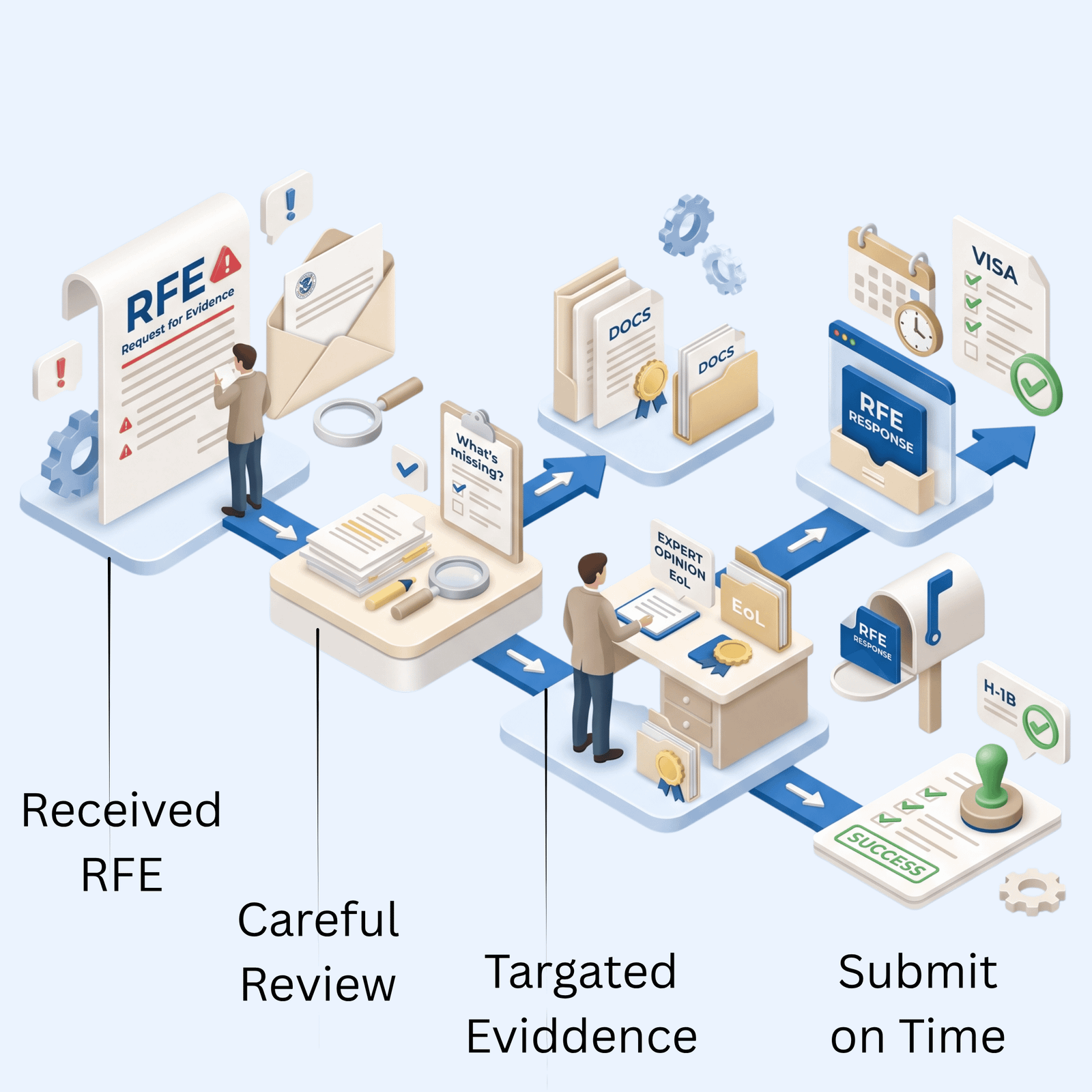
Explore complete USCIS RFE response strategies, missed deadline remedies, and expert evaluation services in the guides below:
- USCIS RFE Master Guide: Meaning, Sample Notices & Proven Response Strategies
Breaks down what a USCIS Request for Evidence actually signals, analyzing sample notice structures, strict response deadlines, and evidence assembly tactics to turn challenges into petition approvals. - Missed Your USCIS RFE Deadline? Immediate Remedies, Motions & Next Steps
Outlines urgent damage-control steps if an RFE cutoff is missed, detailing Form I-290B Motions to Reopen, extraordinary circumstance exceptions under 8 CFR, refiling rules, and status preservation strategies. - Top RFE Response Services: Academic Evaluations & Specialty Occupation Defense
Evaluates leading U.S. credential evaluation and expert opinion letter services, explaining how independent academic equivalencies and university professor letters overcome complex degree and specialty occupation RFEs.
Akash Pundir is the Chief Operating Officer at Document Evaluation LLC, bringing over 5 years of international business operations and legal support experience across the United States, Australia, and India. He has overseen the strategic positioning and analysis of over 1,000+ complex USCIS cases, specializing in guiding expert evaluation teams to draft high-stakes Expert Opinion Letters (EOL), Academic Equivalencies, and defense packets for H-1B, EB-2 NIW, RFEs, and NOIDs. Driven by digital transformation, Akash ensures every evaluation adheres strictly to the latest USCIS legal frameworks and compliance benchmarks.
