

 |
EB-1A Petition Cover Letter Writing Service: Requirements, Cost, And Benefits

- EB-1A allows you to file Form I-140 without an employer.
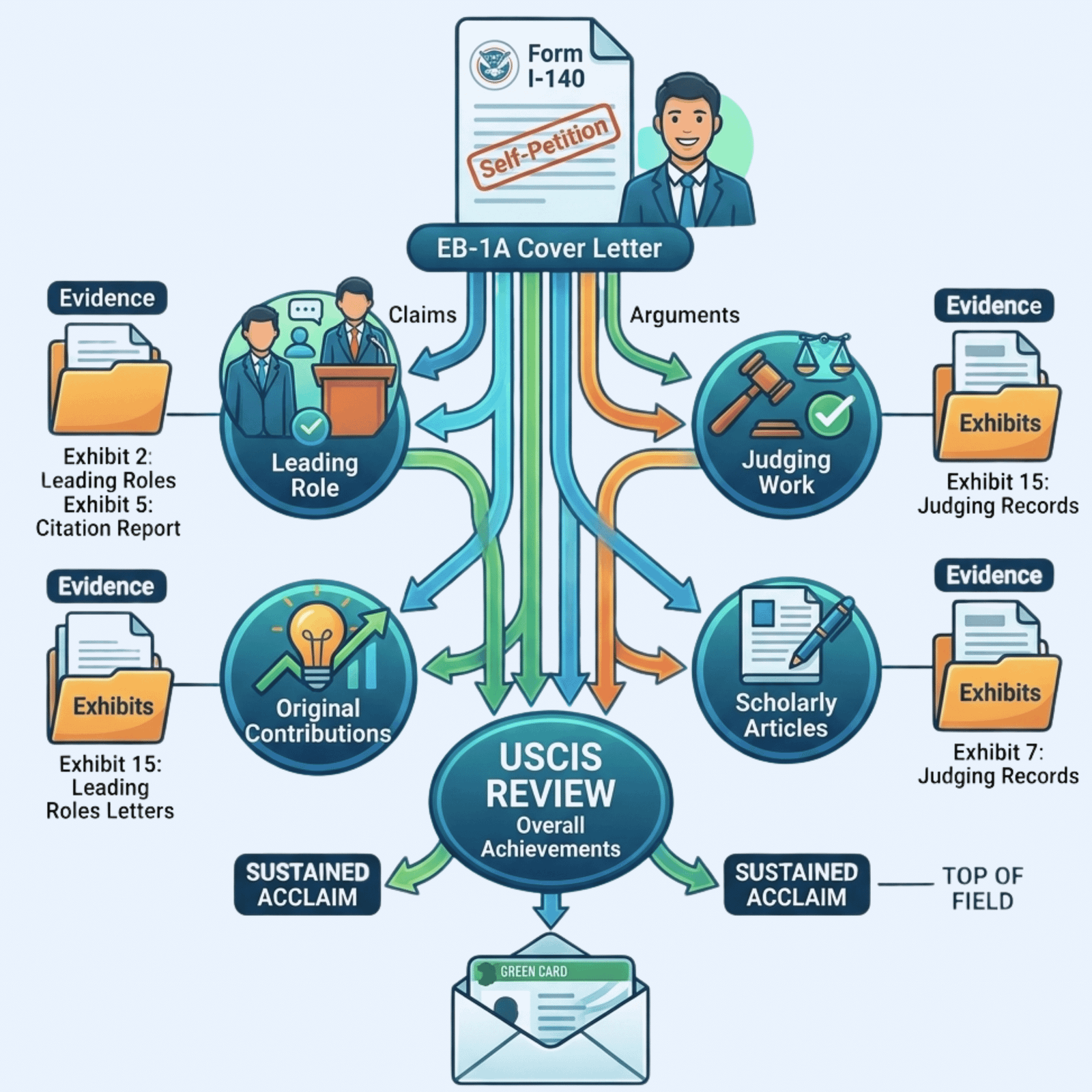
- A cover letter links each criterion you claim to the evidence that supports it.
- USCIS reviews your evidence and overall achievements before deciding.
- Each claim should match the documents you submit.
- Document Evaluation LLC offers cover letter services starting at $1,199.
- No cover letter can guarantee USCIS approval.
Strong credentials do not win an EB-1A case on their own. Every claim in the petition needs a document behind it, and the officer must be able to tell which of the ten regulatory criteria that document is meant to satisfy. If the petition leaves this to guesswork, an applicant with real achievements can still receive a Request for Evidence (RFE).
A cover letter shows the officer which criterion each achievement falls under and which exhibit backs it up. Form I-140 does not require one, but many petitioners file one so the arguments and exhibits are easy to follow. Many applicants pay a professional to write it. The sections below explain what the letter contains and how Document Evaluation LLC prices its preparation service.
💡 Next Step: Bridging extraordinary professional achievements with strict immigration standards requires authoritative validation. Hire our specialized team to Get Professional EB-1 Visa Expert Letter Service and ensure every regulatory criterion in your petition is backed by expert analysis.
What Is an EB-1A Petition Cover Letter?
An EB-1A cover letter links the evidence in your Form I-140 petition to the extraordinary ability standard. It usually opens with your professional background. After that, it names each criterion your evidence supports, such as published scholarly articles or judging the work of others, and explains why the accomplishment matters in your field. Exhibits are labelled so that every claim points to a source.
USCIS does not prescribe a format. The decision rests on the evidence in the petition.
What Are The EB-1A Eligibility Requirements?
EB-1A is the employment-based green card for people with extraordinary ability in the science, art, education, business or athletics. USCIS looks for sustained national or international recognition of your work. You must also show that you will continue working in your field in the United States and that your presence will substantially benefit the country. No employer or job offer is required, and you can file the petition yourself.
You can meet the initial evidence requirement with a one-time achievement, such as a major or an internationally recognized award, or with evidence for at least three of the ten criteria in 8 CFR 204.5(h)(3). If those criteria do not readily apply to your occupation, 8 CFR 204.5(h)(4) allows comparable evidence instead. USCIS decides whether the evidence meets the requirement.
Meeting three criteria does not secure approval. USCIS first checks whether the initial evidence requirement is met. It then weighs all the evidence together to decide whether you have sustained acclaim and are among the small percentage at the top of your field.
Your cover letter should address both steps. It should show how your evidence satisfies each criterion you rely on and then how that evidence as a whole demonstrates extraordinary ability.
What Should An EB-1A Petition Cover Letter Include?
The contents of your cover letter depend on your achievements, the evidence you hold and the criteria you are claiming. A strong letter usually includes the sections below.
1. Introduction And Summary Of Your Qualifications
Begin by stating your field and the classification you are requesting. Give a brief account of your background, then highlight the two or three accomplishments that best show your standing. A full list of every award, paper, and job makes the letter harder to read. Choose the achievements with the clearest recognition and impact, and let the exhibits carry the rest.
2. Matching Your Evidence To The EB-1A Criteria
This is the core of the letter. For each criterion you claim, explain how your evidence meets it. If you are claiming judging, state what you reviewed and for whom, and cite the records that confirm it. If you are claiming original contributions of major significance, describe what you created first. Then show separately why it mattered to your field.
Every claim needs a specific exhibit and concrete detail that can be verified. A researcher claiming judging might write: “From 2021 to 2024, we reviewed 14 manuscripts for [Journal Name], an international peer-reviewed publication (Exhibit 7).”
3. Showing Sustained Acclaim
The officer needs to see recognition that goes beyond a single achievement or a short stretch of time. That might be major awards, published coverage of your work, proof that others use your contributions or statements from established professionals in your field. For each record, say what it shows about your standing and attach the exhibit that supports it.
4. Your Plans to Continue Working in the US
You must show that you intend to continue working in your field of extraordinary ability. Describe what you plan to do in the United States and support it with documents. Letters from prospective employers, an employment agreement, or a personal statement outlining your work can all serve this purpose. Describe how the work you plan to do in the US connects to your area of expertise, and include documents that back up those plans.
5. How Your Work Will Benefit The United States
You must also show that your entry will substantially benefit the country going forward. Explain what your own work is expected to contribute, with specific examples drawn from your skills, research, or professional output.
6. Exhibit List And Supporting Documents
The letter ends with a list of every exhibit it cites. Give each exhibit a descriptive title and a reference number that matches the filed documents. The list usually begins with academic and professional records. It then moves through the evidence for each criterion you claim, such as awards with proof of their standing, published material about your work, judging records, publications and citations, evidence of original contributions, and documentation of leading or critical roles. Expert letters and evidence of your US plans come last.
How Does Document Evaluation LLC Help With Your EB-1A Petition Cover Letter?
Document Evaluation writes EB-1A petition cover letters based on your professional background, the criteria you claim, and the evidence you have for each one. Exhibit organization and expert opinion letters are separate services and are quoted on their own.
-
Case-Specific EB-1A Cover Letter Preparation
We write each letter around your background, achievements, planned work in the United States, and available evidence. It is built on the EB-1A criteria that apply to your case, and we do not start from a generic template.
-
Evidence Organization And Exhibit Structuring
Every exhibit has to match a claim in the letter. Our team can sort your supporting records into a numbered exhibit package that matches the references in your cover letter. The exhibit is quoted separately from the cover letter package.
-
Expert Opinion Letters
If independent expert analysis would strengthen your case, we can connect you with our network of over 140 university professors and field experts across 50 specialized disciplines. An expert letter can explain the nature and significance of your contributions, using the expert’s knowledge and the evidence on file.
-
Coordination With Your Immigration Attorney
If you already work with an immigration attorney, we coordinate the cover letter and supporting documents with the attorney’s strategy so that your evidence is presented consistently with the legal arguments.
-
Turnaround Options For Different Deadlines
We offer three turnaround plans, which are listed with prices in the next section. Your actual timeline depends on the plan you select, the materials you provide, and the scope of the project.
Document preparation helps you present your case clearly. It does not replace the advice of a qualified immigration attorney, and it cannot guarantee that USCIS will approve your petition.
How Much Does An EB-1A Petition Cover Letter Writing Service Cost?
Document Evaluation charges between $1,199 to $1,499 for an EB-1A cover letter, depending on the turnaround plan you choose.
- Economy, $1,199: suited to applicants with no urgent deadline.
- Standard, $1,299: a mid-range timeline.
- Express, $1,499: delivery in 1 to 3 days for eligible orders.
Delivery dates for Economy and Standard are confirmed when you request a quote. Expert opinion letters, RFE responses, and evidence organization with exhibit structuring are not included in these prices and are quoted separately.
Check here for more about pricing
Frequently Asked Questions
1. Do I need a cover letter for an EB-1A petition?
No. USCIS does not require one, and Form I-140 is decided on the evidence you submit. Most petitioners include a letter anyway, because it tells the officer which exhibit supports which claim.
2. Can I write my own EB-1A cover letter?
You can. EB-1A is a self-petition category, and the strength of your evidence matters more than the polish of the letter. If you want an outside check, a document preparation service or an immigration attorney can review your draft.
3. How long should the cover letter be?
USCIS sets no page limit. The length depends on how many criteria you claim and how much context your evidence needs. A straightforward case may need only a few pages, while a complex one can run much longer.
4. Will a strong cover letter guarantee approval?
It will not. USCIS decides based on the petition as a whole, including the evidence and the overall merits of your case. A clear letter makes your argument easier to follow, but approval depends on the evidence behind it.
5. Can I file without an employer or job offer?
Yes, since no sponsoring employer is needed and you file Form I-140 on your own behalf. You still have to document your plans to keep working in your field, as described above.
6. Do expert opinion letters help?
An expert letter can help when it analyzes your work in specific terms and the expert is qualified to speak on it. How much weight it carries depends on the expert’s credentials, the facts it covers, and how it ties to the rest of your file. It does not replace the primary evidence for the criteria you claim.
7. Can Document Evaluation LLC help organize my supporting documents?
We can. We offer document preparation and exhibit organization, and the level of support varies by package and by the documents involved. Confirm what is included before you order.
Conclusion
A cover letter works best when it is built on your strongest records. Start with the achievements you can document most fully, match each one to its criterion, and check that every statement in the letter has an exhibit behind it.
You can write the letter yourself, since EB-1A is a self-petition category. If you would like support, Document Evaluation prepares cover letters and supporting documents around your case, and you can request a quote to compare against the work you need done.
Official Resources:
USCIS (Employment-Based Immigration: First Preference (EB-1))
USCIS ( Form I-140, Immigrant Petition for Alien Workers)
USCIS Policy Manual (Extraordinary Ability)
Electronic Code of Federal Regulations (8 CFR § 204.5)
USCIS (Green Card for Employment-Based Immigrants)

Explore EB-1A qualification rules, expert letter strategies, and RFE defense guides below:
- How to Qualify for an EB-1A Visa: Requirements & Complete Filing Guide
Outlines the core legal criteria for the EB-1A Extraordinary Ability Green Card. Explains how to meet at least 3 out of 10 USCIS evidentiary standards, bypass employer sponsorship, and build a persuasive petition for the final merits determination. - How Expert Opinion Letters Strengthen EB-1A Cases for Researchers
Explains how independent expert testimony helps scientists, engineers, and researchers meet strict USCIS evidentiary thresholds. Details how peer evaluations substantiate major significance, original scientific contributions, and widespread implementation of research. - How to Beat an EB-1A RFE: Common Denial Reasons & Defense Strategies
Breaks down primary triggers for EB-1A Requests for Evidence, focusing on USCIS challenges under Kazarian final merits analysis. Outlines actionable defense strategies to prove sustained national or international acclaim and resolve officer doubts effectively.
Akash Pundir is the Chief Operating Officer at Document Evaluation LLC, bringing over 5 years of international business operations and legal support experience across the United States, Australia, and India. He has overseen the strategic positioning and analysis of over 1,000+ complex USCIS cases, specializing in guiding expert evaluation teams to draft high-stakes Expert Opinion Letters (EOL), Academic Equivalencies, and defense packets for H-1B, EB-2 NIW, RFEs, and NOIDs. Driven by digital transformation, Akash ensures every evaluation adheres strictly to the latest USCIS legal frameworks and compliance benchmarks.