

 |
|
EB-2 NIW Processing Time in October 2026: How Long It Takes & How to Avoid Delays

- EB-2 NIW I-140 processing is currently around 30 months.
- Eligible cases can use 45-business-day premium processing.
- An RFE can add time to the I-140 review.
- I-140 approval and visa availability are separate matters.
- Clear and complete evidence can help prevent avoidable delays.
How long does an EB-2 NIW petition take in October 2026? For many applicants, the processing time is one of the first things to consider before filing. USCIS currently shows a processing range of about 30 to 33 months for an EB-2 NIW Form I-140 under Service Center Operations (SCOPS). This is the processing time listed for the NIW category, not a fixed date by which every case will be decided.
Eligible applicants can request premium processing, which gives USCIS 45 business days to take an applicable action. A case can still take longer if USCIS issues an RFE or the petition has missing or unclear evidence. Knowing the current processing time & the issues that can slow a case down can help with filing and planning.
For applicants preparing their petition, understanding the role and purpose of an EB-2 NIW expert opinion letter can also help ensure the supporting evidence clearly presents the value of their proposed endeavor.
What Is The EB-2 NIW Processing Time?
For EB-2 NIW cases, processing time generally means the time USCIS takes to make a decision on the Form I-140 petition.
An EB-2 NIW case can involve several steps:
- Preparing the petition & supporting evidence
- Filing Form I-140 with USCIS
- Waiting for USCIS to adjudicate the petition
- Waiting for an immigrant visa number if the applicant’s category is backlogged
- Filing Form I-485 or completing consular processing, depending on the applicant’s situation
- Completing the final steps toward permanent residence
The NIW has an important advantage over the regular employment-based process. A qualifying applicant can self-petition without a US employer sponsoring the case. The national interest waiver can also waive the usual job offer and permanent labor certification requirements.
EB-2 NIW Processing Time In October 2026
The latest available USCIS processing-time data published in September 2026 places the EB-2 NIW category at approximately 30 to 33 months under Service Center Operations (SCOPS).
| EB-2 NIW Stage | October 2026 Timing | What It Means |
| I-140 standard processing | 30-33 months | Current published USCIS processing range for the NIW category |
| I-140 premium processing | 45 business days | USCIS must take an applicable action within the premium-processing period |
| Employment-based I-485 | Varies | Separate from I-140 adjudication |
| Immigrant visa availability | Depends on country and priority date | Determined by the Visa Bulletin |
| Consular processing | Varies | Depends on the individual case and processing post |
USCIS does not use these processing figures as a promise that every petition will receive a decision within the stated period. The agency’s processing-time methodology is based on recently completed cases & is updated regularly.
Image Credits: egov.uscis.gov
Why Should You Not Treat 29 Months As A Fixed Deadline?
The USCIS processing-time figure is based on cases that the agency has already completed. It does not tell an applicant exactly where a newly filed petition sits in the queue. Processing can also change as USCIS shifts workloads between locations. The agency may move cases between facilities based on workload and staffing requirements.
For this reason, applicants should check the current USCIS processing-time tool instead of relying on an older processing-time figure published months earlier. The category selected in the USCIS tool also matters. A general I-140 processing time may not accurately represent the time for an NIW petition.
How Has EB-2 NIW Processing Time Changed?
I-140 processing times have changed over the past few years, but general I-140 figures should not be used to estimate an EB-2 NIW case. USCIS historical data shows a national median of 7.9 months for all non-Premium I-140 classifications in FY2025 and 3.7 months through July 31, 2026. These figures cover different I-140 categories & use a different measurement. These figures cover different I-140 categories and use a different measurement.
For an EB-2 NIW petition, the current NIW-specific processing time is a better reference. Applicants should not expect an NIW case to take only four to eight months based on the general I-140 median.
What Can Affect EB-2 NIW Processing Time?
Your processing time for the EB-2 NIW can depend on the evidence in your petition, the details of your proposed endeavor, and whether USCIS needs additional information. Visa availability can also affect how long you wait for permanent residence after I-140 approval.
1. Your Petition’s Evidence And Complexity
Before USCIS considers your national interest waiver request, it must first determine whether you qualify for the underlying EB-2 classification.
If you are using an advanced degree to qualify, you must provide evidence that your degree meets the applicable requirements. If you earned your degree or gained your professional experience outside the United States, you may need to provide additional documentation to establish its US equivalency.
If your petition does not clearly support your educational or professional qualifications, USCIS may need more information before making a decision.
2. Your Proposed Endeavor
Your NIW petition must explain the work you plan to pursue in the United States. Your resume and past achievements alone are not enough.
USCIS evaluates your case under the three-prong framework established in Matter of Dhanasar. You must establish that:
- Your proposed endeavor must have substantial merit and national importance.
- You must show that you have the ability and background to carry out the proposed endeavor.
- The United States must benefit from waiving the job offer & labor certification requirements.
Your proposed endeavor should clearly state what you plan to do and why the work has national importance. A broad description of your occupation may not properly explain the specific work you intend to pursue.
3. Requests For Evidence
An RFE may increase the overall time required to resolve an EB-2 NIW petition. If USCIS asks for more documents or information, you must provide a complete response within the deadline stated in the notice. USCIS will consider the additional material before issuing a decision.
An RFE does not mean the petition has been denied. The officer may need more evidence to resolve an issue in the petition. The final decision comes after USCIS considers the original filing and the RFE response.
4. Visa Availability
An approved I-140 does not mean that you will receive a green card immediately. You must also have an immigrant visa available based on your priority date & country of chargeability.
For October 2026, the Visa Bulletin shows the following EB-2 Final Action Dates:
- All Chargeability Areas Except Those Listed: January 1, 2025
- China: October 1, 2021
- India: November 1, 2013
- Mexico: January 1, 2025
- Philippines: January 1, 2025
For October 2026, the EB-2 Dates for Filing are March 15, 2026 for most chargeability areas, January 1, 2023 for China, and January 15, 2015 for India.
The Department of State has also indicated that increased demand could lead to retrogression or further restrictions during the fiscal year.
As a result, two applicants may receive I-140 approval at around the same time but still have different waits before they can obtain permanent residence.
Does An RFE Increase EB-2 NIW Processing Time?
Yes, an RFE requires the petitioner to spend additional time preparing the requested evidence. USCIS must then review the response before completing the adjudication.
In an NIW case, an RFE may ask questions about issues such as
- EB-2 eligibility
- The applicant’s proposed endeavor
- The national importance of the proposed work
- Evidence showing that the applicant is well positioned
- The third Dhanasar prong
- Inconsistencies within the petition or supporting documents
What Evidence Can Help Reduce Avoidable Delays?
Applicants cannot control every part of USCIS processing. They can reduce problems caused by missing, unclear, or poorly connected evidence.
The petition should make it easy for the officer to understand both the applicant’s EB-2 eligibility & the NIW claim.
Evidence of EB-2 Eligibility
Depending on the basis of eligibility, the petition may include:
- Degree certificates
- Academic transcripts or records
- Evidence establishing the US equivalency of a foreign degree
- Documentation of qualifying progressive work experience
- Evidence supporting an exceptional-ability claim, where applicable
Evidence Supporting the Proposed Endeavor
The petition should clearly explain what the applicant plans to pursue in the United States.
Depending on the field, relevant evidence may include:
- A detailed professional or research plan
- Business or project documents
- Research plans
- Technical materials
- Contracts or project commitments
- Publications
- Patents
- Implementations or completed projects
- Evidence of the expected impact of the proposed work
Evidence Showing the Applicant Is Well Positioned
Your previous work should relate to the work you plan to continue in the United States. Relevant evidence can include:
- Publications & citation records
- Patents and other intellectual property
- Research results
- Industry recognition
- Media coverage
- Leadership experience
- Project responsibilities
- Funding or investment
- Awards
- Relevant professional memberships
- Expert or professional recommendation letters
USCIS also looks at the occupation listed in the petition & the specific proposed endeavor. The Dhanasar requirements must be considered against the facts & evidence in each case.
Foreign degrees, work experience and specialized achievements may need additional documentation. Depending on the evidence in your case, the documentation can include a credential evaluation, work-experience evaluation, or expert opinion letter.
Frequently Asked Questions
Can I use premium processing for an EB-2 NIW in October 2026?
Yes, USCIS allows premium processing for eligible EB-2 NIW I-140 petitions. Once the required conditions are met, USCIS has 45 business days to take the required action on the petition. The premium processing fee is separate from the regular filing fees.
Can I file an EB-2 NIW without a US employer?
Yes, the NIW allows qualifying applicants to self-petition. The waiver can remove the usual job offer and permanent labor certification requirements. The applicant must still establish eligibility for the EB-2 classification and satisfy the NIW requirements.
Does an approved EB-2 NIW I-140 give me a green card?
No, the I-140 establishes the approved immigrant petition. The applicant must still have an available immigrant visa number and complete the appropriate adjustment-of-status or immigrant-visa process.
Can an RFE make an NIW case take longer?
Yes, the petitioner needs additional time to prepare the response, and USCIS needs time to review the submitted evidence.
Is the Visa Bulletin the same as the EB-2 NIW processing time?
No, USCIS processing times show how long the agency may take to decide the petition. The Visa Bulletin deals with immigrant visa availability and depends on the applicant’s priority date and country of chargeability.
How can I check the latest EB-2 NIW processing time?
Use the USCIS processing-time tool and select the specific I-140 NIW category that applies to your petition. Applicants should use the information on their USCIS receipt notice to identify the appropriate form, category, and processing office.
Final Takeaway
In October 2026, the latest published USCIS processing range for an EB-2 NIW I-140 is 30 to 33 months under Service Center Operations (SCOPS). Premium processing is available for eligible petitions & gives USCIS 45 business days to take an applicable action. Premium processing is available for eligible petitions & gives USCIS 45 business days to take an applicable action.
The 29 months refers to the I-140 petition itself. It does not cover the time needed to obtain an immigrant visa after approval. That additional wait can be significant for applicants from India & China because of the EB-2 visa backlogs.

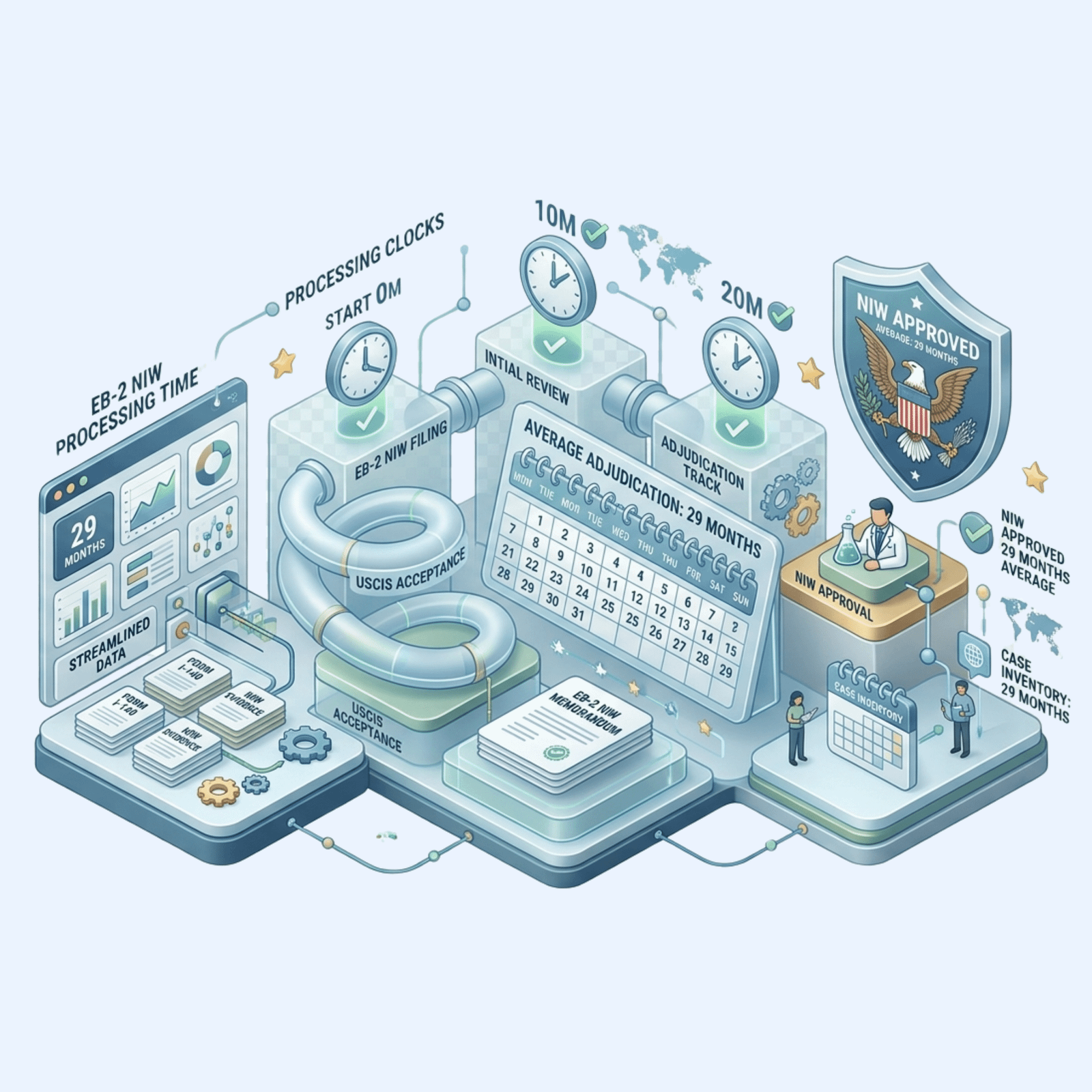
Tracking EB-2 NIW Processing Times in September 2026? What You Need to Know
Break down current 29-month standard processing timelines, 45-day premium processing options, RFE impacts, and visa bulletin updates.
Related Resources
- What Is the EB-2 NIW Visa: Complete 2026 Guide:
Learn about EB-2 NIW eligibility, the National Interest Waiver requirements, self-petitioning, the Dhanasar framework, supporting evidence, and the overall I-140 process. - EB-2 NIW Expert Opinion Letter for Pilots:
Learn how an EB-2 NIW expert opinion letter can support pilots by explaining their professional qualifications, proposed endeavor, and potential contribution to the United States. - EB-2 NIW Expert Letter for STEM Researchers & Academics:
Explore how expert letters can help STEM researchers and academics present their qualifications, research background, proposed endeavor, and supporting evidence for an EB-2 NIW petition. - Can You Get an EB-2 NIW Without Publications?:
Clarifies that USCIS does not strictly require academic publications for the National Interest Waiver. Explains how industry professionals, engineers, and entrepreneurs can build a winning case using alternative evidence like commercial success, patents, and real-world product adoption. - How to Win a Low-Citation EB-2 NIW RFE:
Outlines proven defense strategies for industry practitioners facing USCIS scrutiny over low citation counts. Details how to leverage independent expert letters, third-party validation, and measurable operational outcomes to prove substantial merit and national importance.
Akash Pundir is the Chief Operating Officer at Document Evaluation LLC, bringing over 5 years of international business operations and legal support experience across the United States, Australia, and India. He has overseen the strategic positioning and analysis of over 1,000+ complex USCIS cases, specializing in guiding expert evaluation teams to draft high-stakes Expert Opinion Letters (EOL), Academic Equivalencies, and defense packets for H-1B, EB-2 NIW, RFEs, and NOIDs. Driven by digital transformation, Akash ensures every evaluation adheres strictly to the latest USCIS legal frameworks and compliance benchmarks.
