

 |
|EB-2 NIW Approval Rate 2026: Latest USCIS Data, Trends & Success Factors

- Approval rates remain well below historical levels despite a slight uptick.
- USCIS now demands stronger evidence and a explicitly defined, nationally important endeavor rather than relying on implications.
- Independent expert letters and consistent documentation significantly impact approval outcomes.
- A thorough, evidence-backed petition outweighs the speed of filing.
Preparing an EB-2 National Interest Waiver petition in 2026? You’ve probably already noticed that the numbers don’t look like they used to. Approval rates that once sat near 95.7% have dropped sharply, and USCIS asks complex questions before signing off on anything. We explain the latest data, why the shift happened, and what is currently driving approval.
USCIS releases official I-140 approval and denial statistics by fiscal year and quarter, but it doesn’t publish a single “EB-2 NIW approval rate” number on its own. That figure has to be calculated from the underlying count of receipts, approvals, and denials, and different trackers calculate it slightly differently. Some count only NIW-specific petitions; others include all EB-2 filings.
Some use calendar quarters, others fiscal quarters. That’s why you’ll see slightly different percentages floating around on law firm blogs and case-tracking sites. The numbers below reflect the most consistent, USCIS-sourced figures currently available. Always cross-check against the USCIS Immigration and Citizenship Data page before making any filing decisions, since it’s updated more frequently than most third-party sources.
To navigate these tightening standards with confidence, you can hire our specialized agency to provide an EB-2 NIW expert opinion letter.
What Is the EB-2 NIW Approval Rate For 2026?
Latest approval statistics
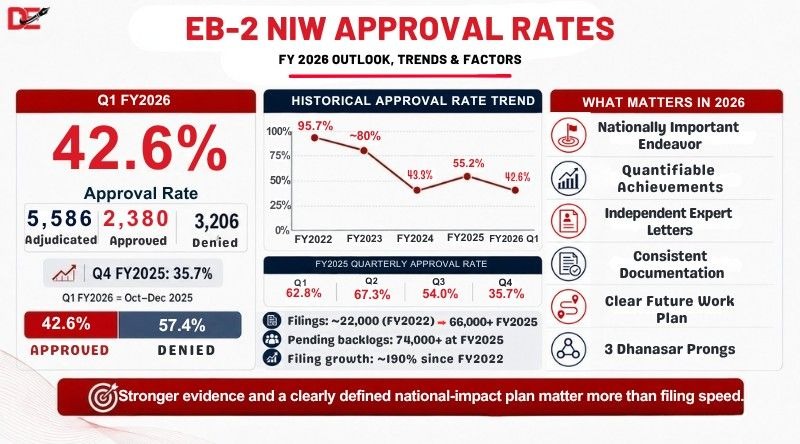
The most recent official quarter on record is Q1 of Fiscal Year 2026 (October-December 2025), in which USCIS adjudicated 5,586 EB-2 NIW petitions, approving 2,380 and denying 3,206, an approval rate of roughly 42.6%.
You can verify this data at the official USCIS Immigration and Citizenship Data page
Approval vs. denial numbers
42.6% is actually an improvement over the prior quarter. Q4 of FY2025 (July-September 2025) saw approval rates fall to just 35.7%, the lowest point recorded in the current downturn and the first time in NIW history that denials outnumbered approvals for two consecutive quarters.
Some third-party case-tracking platforms that follow individual applicants through the process have reported slightly higher “regular processing” approval rates in early 2026, in the mid-40% range, suggesting a modest recovery from the September 2025 low. These figures come from self-reported case outcomes rather than full USCIS datasets, so they’re best treated as a directional signal rather than an official statistic.
Q1 FY2026 data at a glance
| Metric | Q1 FY2026 |
|---|---|
| Petitions adjudicated | 5,586 |
| Approved | 2,380 |
| Denied | 3,206 |
| Approval rate | ~42.6% |
| Prior quarter (Q4 FY2025) | 35.7% |
What Are The EB-2 NIW Approval Rate Trends (2022-2026)?
Historical table
| Fiscal Year | Approval Rate | Notes |
|---|---|---|
| FY 2022 | ~95.7% | Historic high, following expanded NIW guidance after Executive Order 14012 |
| FY 2023 | ~80% | First signs of tightening as filing volume surged |
| FY 2024 | ~43.3% | Sharp drop; filings up roughly 190% since FY2022 |
| FY 2025 | ~55.2% (full year) | Highly volatile; see quarterly breakdown below |
| FY 2026 (Q1) | ~42.6% | Slight recovery from FY2025 Q4’s 35.7% low |
FY2025 quarterly breakdown
FY2025 illustrates just how much adjudication patterns fluctuate within a single year:
- Q1: ~62.8%
- Q2: ~67.3%
- Q3: ~54.0%
- Q4: ~35.7%
Year-over-year comparison
Two things stand out when you compare years:
- Volume has exploded: USCIS received roughly 22,000 EB-2 NIW petitions in FY2022 versus over 66,000 in FY2025, close to a 190% increase in just a few years.
- The pending backlog has grown just as fast: By the end of FY2025, over 74,000 NIW petitions were sitting in the queue, up roughly 31% from where the backlog started that year.
Why Has the EB-2 NIW Approval Rate Declined?
- Filing volume: Petitions jumped from FY 2022 to FY 2025, and a bigger applicant pool naturally means a wider spread in case quality. A lot of those filings simply wouldn’t have cleared the bar even back when standards were looser.
- USCIS tightened adjudication: Officers are applying the Dhanasar framework with noticeably less flexibility in 2022 and 2023. A petition that was well-written but thin on substance might have gotten approved back then; today it’s far more likely to draw an RFE or an outright denial.
- Evidence standards have risen: USCIS guidance, including AAO clarifications from late 2024, now expects measurable, quantifiable outcomes tied to specific national or institutional priorities. General statements about a field’s importance no longer have the same impact they once did.
- Dhanasar is getting read more literally: The three prongs are substantial merit and national importance, being well-positioned to advance the endeavor, and the labor certification waiver being worth it. They haven’t changed on paper. But officers are evaluating each one more closely now, especially “well-positioned,” which needs real proof you can actually pull off what you’re proposing.
- Petitions are being read more carefully: CVs, recommendation letters, and personal statements are all being checked against each other now. A mismatch that might have slipped through a few years ago is far more likely to get flagged today.
What Factors Affect EB-2 NIW Approval in 2026?
Rather than treating the information as a list of traps to avoid, it’s more useful to think about what a strong 2026 petition actively demonstrates:
- National importance of the endeavor: The proposed work needs to tie to a recognizable US priority, public health, technological competitiveness, economic growth in a specific sector, national security, or something in that range. Unclear language such as “advancing my field” is insufficient.
- Strong evidence of achievements: This category means publications, patents, awards, media coverage, secured funding, shipped products, or measurable outcomes that trace back specifically to the applicant, not just to the team or organization they happened to be part of.
- Independent expert opinion letters: Letters from people who haven’t worked directly with the applicant are more valuable than those from close collaborators. They show the applicant’s reputation reaches beyond their immediate circle, which is precisely what USCIS wants to see.
- Consistent documentation: Every document in the petition, including the CV, letters, personal statement, and evidence exhibits, needs to tell the same story. Gaps or contradictions between them are one of the most common triggers for an RFE.
- A clear future work plan: USCIS wants a reliable, detailed plan for what the applicant intends to do in the US, how it connects to their past work, and why they’re actually positioned to carry it out.
- Eligibility under Dhanasar: The petition should be built clearly around the three Dhanasar prongs, point by point, rather than leaving the officer to piece together how the evidence maps to the legal standard.
Which Applicants Have Better Approval Chances?
Approval rates vary meaningfully by field and profile. Applicants who tend to see stronger outcomes include the following:
- Researchers have a solid record of peer-reviewed publications and citation counts that show real, independent influence in their field.
- Physicians, especially those in underserved areas or specialties related to public health needs, tend to see stronger outcomes.
- STEM professionals consistently have stronger approval trends than non-STEM fields. Part of the reason is simple: technical contributions are just easier to back up with objective, measurable evidence.
- AI and technology experts benefit from the current policy focus on technological competitiveness.
- Entrepreneurs tend to succeed when they can point to measurable business impact, job creation, or capital raised. This group has historically faced more scrutiny than research-based profiles, so expectations run a bit higher here.
- Public health professionals, especially those whose work connects to specific federal or state health priorities.
How to Improve Your EB-2 NIW Approval Chances?
- Build evidence before you file: Give yourself time to collect publications, media coverage, letters, and other objective evidence that actually holds up under scrutiny.
- Put numbers on your impact: Wherever possible, translate accomplishments into figures: funding amounts, citation counts, patients treated, users reached, revenue generated, whatever applies to your case.
- Write the petition around the prongs, not around yourself: The personal statement and legal brief should map directly onto the Dhanasar prongs, point by point. General claims about talent or potential are not very helpful on their own.
- Get letters that actually say something: Aim for a mix of experts outside your immediate professional circle, and make sure the letters speak to specific, documented contributions rather than generic praise.
- Check everything against everything: Before filing, go through every document against every other document. They need to match dates, titles, numbers, and claims.
How Document Evaluation Supports EB-2 NIW Petitions?
At Document Evaluation, several categories of professional evaluation strengthen a petition’s evidence record:
Expert opinion letters: Written by qualified professionals in the applicant’s field, these letters translate technical work for a non-specialist USCIS officer and tie it back to the national importance standard.
Credential evaluation: For applicants with foreign degrees, this establishes US degree equivalency, which matters because it’s part of the underlying EB-2 eligibility requirement (advanced degree or exceptional ability), separate from the NIW waiver itself.
Academic evaluation: This evaluation helps put research output, coursework, or institutional standing into context for the officer reviewing the case.
USCIS-focused documentation: Evaluations and letters written specifically with the Dhanasar framework in mind tend to align far better with what officers are looking for in 2026’s stricter review environment. Generic recommendation letters, by contrast, tend to fall flat.
Frequently Asked Questions
What is the official EB-2 NIW approval rate for 2026?
The latest official numbers cover Q1 FY 2026, October through December 2025, putting the approval rate at roughly 42.6%. That comes from USCIS data: 2,380 approvals out of 5,586 petitions adjudicated that quarter.
Why has the approval rate dropped so much since 2022?
Two things happened at once. Filing volume jumped nearly 190% since FY 2022, and USCIS tightened its application of the Dhanasar framework. Higher evidence standards and closer scrutiny of every petition detail are doing most of the work here.
What matters most for a successful petition in 2026?
The endeavor needs to be specific and nationally important, backed by real evidence, publications, patents, and funding, not just claims. The petition itself should be built clearly around the three Dhanasar prongs, with a credible plan for future work, not unclear statements about potential.
Which fields have the best approval odds right now?
STEM fields are performing better overall, especially AI and technology, along with researchers who have solid publication records. Physicians in underserved areas and public health professionals also see stronger trends, largely because their work ties directly to clear national priorities.
How much difference does an expert opinion letter actually make?
Quite a lot, especially when it comes from someone genuinely independent rather than a close collaborator. A good letter does real work: it translates your technical contributions for a non-specialist officer and ties them directly to the Dhanasar framework.
What’s the difference between “regular processing” rates and the official USCIS number?
The official rate is based on all USCIS adjudications, including premium processing. Some third-party trackers report higher numbers based on self-reported user data, which is worth looking at, but treat it as a directional signal rather than an official statistic.
What’s the biggest mistake that leads to a denial?
Inconsistent documentation, more than almost anything else, triggers RFEs and denials. Gaps or contradictions between your CV, recommendation letters, personal statement, and evidence exhibits read as a reliability problem to the officer reviewing your case.
Is it still worth filing given how low approval rates have gotten?
Yes, though the approach needs to change. The pathway hasn’t collapsed; it’s just less forgiving than it used to be. Filing early still helps lock in a priority date, but only once the case is genuinely strong, not the moment you technically qualify.
What actually improves approval chances at this point?
Build quantifiable evidence before you file, and structure the whole petition around the three Dhanasar prongs rather than general claims. Independent expert letters help a lot, and every document in the file needs to tell the same, consistent story.
Conclusion
The EB-2 NIW approval rate has fallen a long way from its 2022 highs, from roughly 95% down into the 35 to 55% range across recent quarters. That’s a high drop, but it hasn’t collapsed the pathway. What’s actually changed is the margin for error. Petitions built on generic claims, thin evidence, or inconsistent documentation are far more likely to get denied than they would have been three years ago. Petitions built on specific, quantifiable, independently verified evidence, mapped explicitly to the Dhanasar framework, still perform well.
Given rising visa retrogression and growing pending backlogs, filing sooner still matters for locking in a priority date. But in 2026, “sooner” should mean as soon as the case is genuinely strong, not as soon as the applicant technically qualifies.

Tracking EB-2 NIW Approval Rates in 2026? Latest USCIS Trends & Data
Analyze recent Q1 2026 approval statistics, Dhanasar framework requirements, and key factors to strengthen your national interest waiver petition.

Explore our related EB-2 NIW guides below to better understand eligibility, documentation, and USCIS requirements.
- EB-2 NIW USA Guide: Eligibility, Requirements, and USCIS Process:
Learn everything about the EB-2 NIW process, including eligibility requirements, filing steps, processing timelines, USCIS expectations, and practical tips to strengthen your National Interest Waiver petition. - EB-2 NIW for Pilots and Aviation Professionals: Expert Opinion Letter Guide
Discover how an EB-2 NIW Expert Opinion Letter helps pilots and aviation professionals demonstrate national importance, professional expertise, and eligibility for a stronger USCIS petition. - EB-2 NIW Expert Opinion Letter for STEM Researchers and Academics:
Learn how an EB-2 NIW Expert Opinion Letter supports STEM researchers and academics by highlighting their contributions, research impact, and qualifications under the Dhanasar framework for USCIS.
Akash Pundir is the Chief Operating Officer at Document Evaluation LLC, bringing over 5 years of international business operations and legal support experience across the United States, Australia, and India. He has overseen the strategic positioning and analysis of over 1,000+ complex USCIS cases, specializing in guiding expert evaluation teams to draft high-stakes Expert Opinion Letters (EOL), Academic Equivalencies, and defense packets for H-1B, EB-2 NIW, RFEs, and NOIDs. Driven by digital transformation, Akash ensures every evaluation adheres strictly to the latest USCIS legal frameworks and compliance benchmarks.
