

 |
|
H-1B Specialty Occupation RFE Approval Rate In October 2026: Latest Statistics and Approval Trends


- USCIS has not published an October 2026 RFE approval rate for H-1B Specialty Occupation cases.
- In FY2024, RFEs were issued in 8% of completed H-1B cases.
- Third-party analyses of USCIS data reported RFE approval rates of 84.5% in FY2026 Q1 and 79.9% in FY2026 Q2.
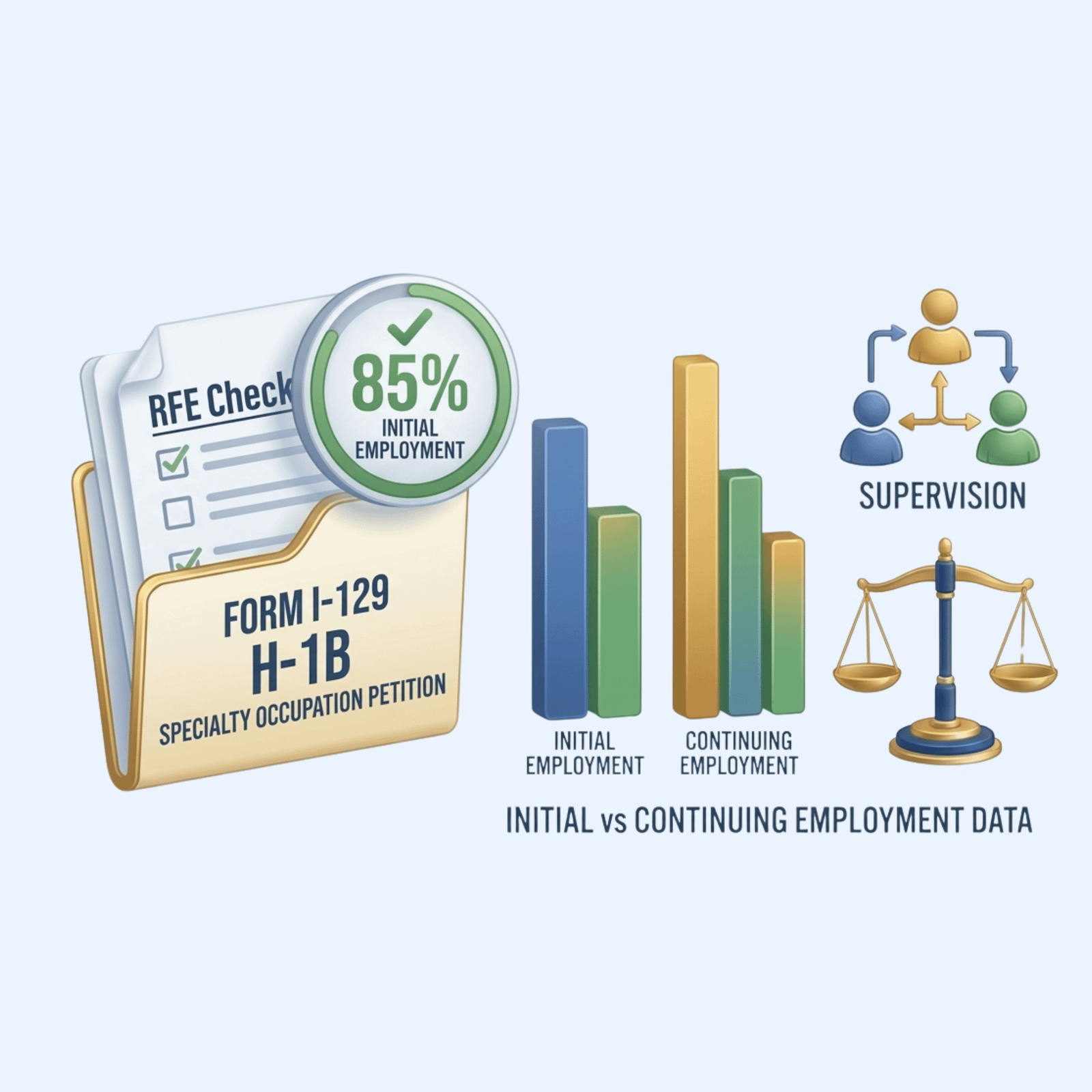
- In FY2024, continuing-employment cases had fewer RFEs than initial-employment cases: 6% compared with 13%.
- Premium processing does not improve approval odds; it only speeds up USCIS processing.
What happens after USCIS issues an H-1B Specialty Occupation Request for Evidence (RFE), and how often are those petitions ultimately approved?
That is a more complicated question than a single percentage suggests. USCIS does not publish a standalone “H-1B Specialty Occupation RFE approval rate for October 2026.” Government data can show completed H-1B petitions, petitions with RFEs, approvals, and, in certain datasets, approvals for cases that received RFEs. But those figures must be matched to the correct reporting period and case population before calculating a meaningful rate.
Successfully overcoming these inquiries often requires specialized legal and technical drafting to prove complex job duties. If you are facing a strict deadline, working with an expert service to Hire Writers for H-1B Specialty Occupation RFE can ensure your response meets all USCIS evidentiary standards.
What Is The H-1B Specialty Occupation RFE Approval Rate In October 2026?
There is no separately published official USCIS percentage, specifically the “H-1B Specialty Occupation RFE approval rate for October 2026.”
An H-1B RFE rate and an approval rate after an RFE are different things.
USCIS’s historical RFE datasets can report metrics such as
- H-1B petitions received
- H-1B petitions initially approved
- H-1B petitions initially denied
- Total completions
- Completions with an RFE
- Percentage of completions with an RFE
- Petitions approved among cases with an RFE
- Percentage of RFE cases approved
USCIS’s published FY2016-FY2021 I-129 RFE dataset specifically included both “Completions with RFE” and “Approved with RFE” as separate measures.
Does USCIS Publish An H-1B RFE Approval Rate?
USCIS has published H-1B RFE statistics that include an approval-after-RFE measure in its Form I-129 data.
That historical dataset distinguishes between the overall approval percentage and the percentage of completed petitions that had an RFE. It also separately identifies petitions approved after an RFE.
The distinction can be summarized as follows:
| Statistic | What it measures |
| H-1B approval rate | Percentage of completed H-1B petitions approved |
| H-1B RFE rate | Percentage of completed H-1B petitions that had an RFE |
| RFE approval rate | Percentage of RFE cases that were approved |
| H-1B denial rate | Percentage of completed petitions denied |
These measurements should not be mixed.
USCIS’s FY2024 H-1B report states that 33,393 RFEs were issued in H-1B adjudications, representing 8% of 407,625 completed petitions. The 8% figure is therefore an RFE rate among completed petitions, not an RFE approval rate.
USCIS also notes that “completions” means approvals and denials combined.
What Are The Latest H-1B RFE Statistics Available In 2026?
The most useful verified government figures should always include their reporting period.
| H-1B Metric | Reporting Period | Figure | What It Measures | Source |
| H-1B petitions completed | FY2024 | 407,625 | Approved + denied petitions | USCIS |
| H-1B cases with RFE | FY2024 | 33,393 | Completed H-1B petitions involving an RFE | USCIS |
| H-1B RFE rate | FY2024 | 8% | RFEs as a share of completed petitions | USCIS |
| October 2026 RFE approval rate | October 2026 | Not separately published | No standalone USCIS October rate verified | USCIS |
| FY2026 Q1 RFE rate | Oct-Dec. 2025 | 9.0%* | Completions with RFE | Third-party analysis of USCIS data |
| FY2026 Q2 RFE rate | Jan-Mar. 2026 | 8.7%* | Completions with RFE | Third-party analysis of USCIS data |
| FY2026 Q1 approval after RFE | Oct-Dec. 2025 | 84.5%* | RFE cases approved | Third-party analysis of USCIS data |
| FY2026 Q2 approval after RFE | Jan-Mar. 2026 | 79.9%* | RFE cases approved | Third-party analysis of USCIS data |
The FY2026 quarterly figures above come from a third-party analysis of USCIS Data Library information. They should not be presented as USCIS-published quarterly approval rates or as an October 2026 rate. They should not be characterized as an October 2026 USCIS-published percentage.
USCIS’s public historical processing-time information also currently identifies FY2026 data as covering October 1, 2025, through May 31, 2026, for that particular dataset. This illustrates why a fiscal-year figure should not automatically be described as an October 2026 figure.
What Are The H-1B RFE Rate Vs. H-1B RFE Approval Rate?
An H-1B RFE rate answers: How many completed H-1B cases received an RFE?
An H-1B RFE approval rate answers a different question: Of the H-1B cases that received an RFE, what percentage were subsequently approved?
For example, suppose a dataset contained 10,000 completed H-1B cases and 800 had RFEs. The RFE rate would be
800 ÷ 10,000 = 8%
If 600 of those 800 RFE cases were subsequently approved, the approval rate among RFE cases would be
600 ÷ 800 = 75%
The two percentages cannot be substituted for one another.
USCIS’s historical data structure reinforces this distinction by separately reporting completions with RFEs and approvals with RFEs.
Why Do H-1B Specialty Occupation RFEs Happen?
The specialty occupation issue is one of the recurring subjects USCIS identifies in H-1B RFEs.
USCIS explains that an RFE does not mean the petition has already been denied. Instead, it means the evidence submitted with the petition has not established eligibility to the officer’s satisfaction, and the petitioner is being given an opportunity to provide additional evidence.
Under the H-1B regulations, the position must qualify as a specialty occupation. The regulatory framework looks at requirements such as whether a bachelor’s degree or higher in a specific specialty is normally required, whether that degree requirement is common to comparable positions, whether the employer normally requires such a degree, and whether the particular duties are sufficiently specialized and complex.
That means the job title alone is not enough. USCIS’s FY 2024 data showed that continuing-employment cases had a lower RFE incidence than initial-employment cases, approximately 6% versus 13%.
Here are the things that USCIS sees:
- What are the actual duties of the offered position?
- What does the employer’s business involve?
- What minimum education does the position require?
- What is the relationship between the required degree and the job duties?
- How specialized or complex are the duties?
- What evidence supports the employer’s educational requirements?
- Does the beneficiary have the required qualifications?
Does An H-1B Extension Have A Higher Approval Rate?
Historically, continuing-employment H-1B cases have generally shown stronger outcomes than initial-employment cases.
But applicants should not assume that an extension is automatically approved.
The petition still needs to establish eligibility and should accurately document the continuing employment relationship.
Can Premium Processing Improve H-1B RFE Approval Chances?
No.
Premium processing is a processing service, not an approval guarantee.
Using premium processing does not make USCIS apply a different eligibility standard to the petition.
It may affect how quickly USCIS takes action, but it does not turn a weak specialty occupation case into a strong one.
H-1B RFE Approval Rate By Initial And Continuing Employment
USCIS’s historical H-1B data also shows differences between initial employment and continuing employment.
For FY 2024, USCIS reported that:
- 13% of initial-employment completions involved an RFE.
- 6% of continuing-employment completions involved an RFE.
Among initial-employment cases, approximately 11% were approved with an RFE, and approximately 2% were denied with an RFE.
For continuing employment, approximately 5% were approved with an RFE, while about 1% were denied with an RFE.
This shows why a single H-1B RFE approval percentage is not sufficient.
Frequently Asked Questions
Is there an H-1B Specialty Occupation RFE approval rate In October 2026?
There isn’t a separate USCIS figure for October 2026. USCIS has not reported how many H-1B Specialty Occupation cases that received an RFE were later approved in that month.
What does the 8% H-1B RFE rate for FY2024 mean?
In FY2024, 33,393 of the 407,625 completed H-1B petitions involved an RFE. The resulting 8% figure measures RFE activity among completed cases; it is not the percentage of RFE cases that were approved.
Are the H-1B RFE rate and RFE approval rate the same?
No, an RFE rate tells you how many completed petitions received a request for more evidence. An RFE approval rate tells you how many of those cases were approved after the response was filed.
What were the H-1B RFE figures in FY2026?
Third-party analyses of USCIS Data Library information reported an RFE rate of 9.0% in FY2026 Q1 and 8.7% in FY2026 Q2. The same analysis reported that 84.5% of RFE cases were approved in Q1 and 79.9% in Q2. These figures are tied to those specific quarters and should not be described as an October 2026 USCIS-published rate.
Do H-1B extensions receive fewer RFEs?
In FY2024, the difference was clear. RFEs appeared in about 6% of continuing-employment cases, compared with roughly 13% of cases involving initial employment.
Conclusion
There is no verified USCIS-published October 2026 H-1B Specialty Occupation RFE approval rate that should be quoted as a single official percentage.
USCIS reported that H-1B RFEs represented 8% of completed petitions in FY2024, with 33,393 RFEs among 407,625 completed cases. More recent third-party analyses of USCIS Data Library information report FY2026 quarterly RFE and post-RFE approval figures, but those figures should remain tied to their specific reporting periods and methodology rather than being presented as an official October 2026 USCIS rate.

Got an H-1B Specialty Occupation RFE? Here’s What the Numbers Actually Mean!
With post-RFE approval rates hovering near 80%, an RFE is a chance to clarify job complexity and duties not an automatic denial. Differentiate between initial filings and extensions to build a stronger case.
Master H-1B filing rules, Expert Opinion Letter costs, and 3-for-1 degree evaluation strategies with the guides below.
- H-1B Visa Requirements: Eligibility Rules & USCIS Filing Roadmap
Details core H-1B qualification criteria, employer petition requirements, and specialty occupation rules to guide applicants through step-by-step USCIS filing. - What Does an H-1B Expert Opinion Letter Cost? Pricing & Turnaround
Breaks down standard market rates for H-1B expert evaluation letters, outlining key cost factors like turnaround speed, specialty complexity, and RFE defense needs. - H-1B 3-for-1 Rule: Converting Work Experience to a U.S. Degree
Explains how USCIS evaluates three years of relevant work experience as equivalent to one year of university education, featuring real-world examples and evaluation tips.
Akash Pundir is the Chief Operating Officer at Document Evaluation LLC, bringing over 5 years of international business operations and legal support experience across the United States, Australia, and India. He has overseen the strategic positioning and analysis of over 1,000+ complex USCIS cases, specializing in guiding expert evaluation teams to draft high-stakes Expert Opinion Letters (EOL), Academic Equivalencies, and defense packets for H-1B, EB-2 NIW, RFEs, and NOIDs. Driven by digital transformation, Akash ensures every evaluation adheres strictly to the latest USCIS legal frameworks and compliance benchmarks.
