

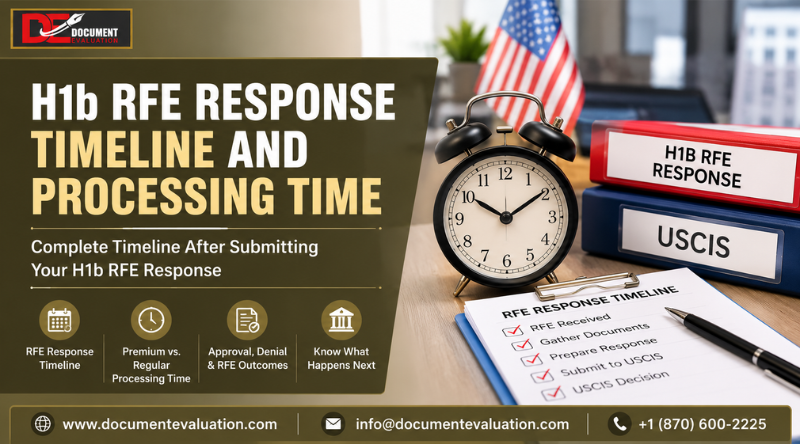

Receiving an H-1B Request for Evidence (RFE) can feel stressful. After months of waiting, seeing that letter from USCIS often brings confusion and concern. What did the officer find lacking? How long is the response window? What happens after submitting the response?
Here is what applicants should know: an RFE is not a denial. It is a request for more information. With the right response, many petitions that receive RFEs are ultimately approved. Understanding the process helps reduce stress and leads to better outcomes.
If your notice specifically questions how your foreign education aligns with your position, you can secure specialized H-1B degree equivalency RFE help through our agency. Hiring professional assistance ensures your academic credentials and course evaluations are expertly structured to satisfy strict USCIS standards.
H-1B RFE & NOID timeline estimator
Enter the date on your USCIS notice to see your response deadline and next steps.
—
—
What to do next
Need help responding?
Tell us about your case and our team will get back to you with a clear, flat-fee plan.
What Is An H-1B RFE, And Why Does USCIS Issue It?
Having an H-1B RFE issued is not as uncommon as many applicants think it is. The original application has not been refused yet; the officer may need further evidence from the applicant before making a decision. Generally, application cases with specialty job types, consulting, and incomplete documents will be more likely to draw RFE than basic and non-specialty job types. A properly organized and complete response will therefore have a large effect on the resulting outcome of all applications related to H-1B RFEs.
The H-1B RFE Timeline: All Steps
Once USCIS issues a Request for Evidence, the clock starts ticking. Understanding each stage of the timeline helps avoid missed deadlines and unnecessary stress.
Step 1: RFE Issued (Day 0)
Attorneys or the petitioners will be able to see the USCIS RFE notice date in the upper left corner of the notice letter sent by USCIS. It is important to note that the response due date is based on this RFE notice date and not on when you received the RFE notice letter in hand.
The letter will usually arrive several days after the date on the notice letter. Therefore, it’s best to check your online case status right after an RFE is issued because the USCIS case status portal usually updates before you physically receive the RFE casework in hand.
IMPORTANT: The standard response period is 84 days (12 weeks) from the notice date. Some RFEs may give up to 87 days when mail time is factored in. The exact deadline is printed on the RFE notice. Extensions are almost never granted.
Step 2: Review And Analysis (Days 1-14)
Carefully read the RFE; USCIS has provided a complete list of missing or insufficient evidence.
Below are some suggestions on how to handle this part of the process.
- Read the RFE at least three times to pick out all requests.
- Recognize the exact criteria or issues with which USCIS has questions.
- Specify whether the problem identified in the RFE is weak evidence, missing documents, or a legal theory.
- Identify if there are multiple requests (one document) or if there are many requests (multiple documents).
You must address all issues the RFE raises; one missing item could be the basis for a denial of your case.
Step 3: Gathering Evidence And Preparing The Response (Days 15-60)
This stage is where most of the work occurs. Collect documents that directly answer what USCIS asked for and do not send unrelated evidence.
Common evidence collected during this stage:
- Updated employer support letters that address each RFE point directly
- Educational transcripts & degree evaluations
- Client letters confirming work locations and job duties
- Contracts fixing the employer-employee relationship
- Expert opinion letters for specialty occupation questions
A good response does more than hand over documents. It includes a cover letter that explains, point by point, how each piece of evidence resolves USCIS’s concern. Organization matters. Label exhibits clearly. Use tabs or bookmarks if submitting electronically.
Step 4: Submission To USCIS
When you’re done preparing your response, ship it back to USCIS using a tracking delivery company, such as FedEx or UPS. You will need to save the tracking number & receipt once your package has been delivered.
Make sure to keep your important records, which are:
- A complete copy of your response packet
- Proof of delivery from the courier
- The original RFE receipt
Once your response has been uploaded to USCIS system, the status of your case will be changed to “Response To USCIS’ Request For Evidence Was Received”.
Step 5: Adjudication: Waiting For A Decision
Once USCIS gets your response, an officer will review the submission. Your case status can show at this stage there is “Case Is Being Actively Reviewed by USCIS.” This means USCIS has assigned an officer to review your file.
There are four possible outcomes after the review is completed:
- Approved – The Petition has been approved
- Denial – The Petition has been denied and the response was considered to be insufficient
- Another RFE –USCIS needs additional information
- Notice of Intent to Deny (NOID) – If you do not supply evidence to overcome this denial, your petition will be denied
The time this takes depends on the service center and whether premium processing was used.
How Long Does Uscis Take To Decide After An RFE Response?
The wait time after submitting an RFE response depends on two main factors: whether the case is in premium processing or regular processing.
Premium Processing Cases
For petitions filed with premium processing, USCIS must take judgment action within 15 business days of receiving the complete RFE response.
Important details about premium processing:
- The 15 business day clock starts when USCIS receives the response, not when it was mailed
- Weekends & federal holidays do not count toward the 15 days
- “Adjudicative action” means approval, denial, another RFE, or a Notice of Intent to Deny
- If USCIS misses the 15-business-day deadline, the premium processing fee is refunded. However, USCIS continues to speed up processing even after the refund
Can premium processing be added after an RFE? Yes. Employers can upgrade a regular processing case to premium processing after an RFE is issued by filing Form I-907. The 15-business-day clock begins when USCIS receives both the I-907 and the complete RFE response at the correct service center.
Regular Processing Cases
The time it takes to make a decision on an RFE case is less predictable in the case of an RFE that is not filed under expedited processing (premium processing). After USCIS receives the RFE response, the time to deliver a decision will generally take between two to six months.
There are several factors that contribute to the amount of time an RFE case takes to resolve:
- The service center handling the case (Texas and California centers have different average wait times)
- Current USCIS workload and backlog levels
- The complexity of the case and the RFE issues raised
- Whether additional security or background checks are necessary
Checking Case Status
To view your case status, visit the USCIS Online Case Status website and use the 13 character receipt number found on your Form I-797C. You may see the following status messages about your case:
- USCIS has received your response to their request for evidence.
- An officer is currently reviewing your file and actively working on your case.
- Your petition has been approved.
- Your petition has been denied.
RFE Vs. Noid: Timeline Differences
Many applicants confuse RFEs with Notices of Intent to Deny (NOIDs). The timelines are very different, and this distinction matters.
| Aspect | RFE | NOID |
|---|---|---|
| Purpose | Requests additional evidence. | Informs the applicant that USCIS intends to deny the petition. |
| Response Window | 84 days (plus mailing time). | 30 days (plus mailing time). |
| Severity | Lower; usually indicates missing information or documentation. | Higher; USCIS believes the case has fundamental issues. |
| Best Response Strategy | Submit the requested evidence and supporting documentation. | Submit a detailed legal response supported by strong evidence. |
NOID response deadline: 30 days, plus mailing time (3 days for US delivery, 14 days international).
After the NOID response, USCIS will either approve the petition or issue a final denial. In contrast to an RFE, a NOID typically does not offer a second chance if the response is insufficient.
H-1B RFE Checklist
H-1B RFE Checklist
Immediate Steps (48 Hours):
- Reread RFE 3 times
- Note respond by date (IN UPPER LEFT)
- Identify all issues raised by USCIS
- Check online case status for updates
Preparing to Respond (Days 3-30):
- Collect documents that respond to each issue
- Draft response letter with exhibits
- Get updated employer support letter
- Gather education transcripts (If degree is an issue)
- Get client letters and project details (If client is not directly engaging)
- Request expert opinion letter (if occupation is an issue)
- Make sure that all documents are consistent (Job titles, dates, salary)
Before submission:
- Check every RFE issue is addressed
- Label exhibits clearly
- Make a complete copy for your records
- Use tracked courier service (FedEx/UPS)
- Keep delivery confirmation
Frequently Asked Questions
If USCIS does not receive your response within the given timeframe, the petition is often processed as if you don’t reply to USCIS on time, and they will usually deny your case.
Yes. Many H‑1B petitions are initially sent an RFE and then approved once the employer provides clear, well‑organized evidence.
Premium processing can be very useful if you need a faster decision after your RFE response, but it does not shorten the RFE response window itself.
Yes, but only send papers that answer the RFE questions. Don’t add extra stuff. Keep it short and organized.
An RFE asks for more evidence; a NOID means USCIS plans to deny unless you convincingly rebut the issues. NOIDs are more serious and require a stronger, more urgent response.
If you’re in the US on a valid status (e.g., OPT, H‑4, etc.), travel is usually allowed, but it can complicate some cases. Always check with your attorney before international travel.
Conclusion
Understanding the H-1B RFE timeline removes much of the uncertainty. The response window is typically 84 days from the notice date. Premium processing decisions come within 15 business days after the response. Regular processing takes 2 to 6 months.
Answer every question USCIS asked. Send only relevant evidence. Do not wait until the deadline.
Don’t let an RFE turn into a denial. Let document evaluation help you build a response that actually works. Get expert-reviewed evidence, specialty occupation analysis, and professional response letters so USCIS gets exactly what they need to say yes.

Received an H-1B Request for Evidence? Don't Panic Respond Strategically.
An RFE is not a denial. Secure specialized academic credential evaluations and expert opinion letters to directly satisfy strict USCIS standards and turn your RFE into an approval.
Get Expert H-1B RFE Help
Continue Reading About H-1B RFEs, Specialty Occupation Evidence & USCIS Approval Strategies:
- H-1B Visa – Eligibility criteria and requirements:
Learn the eligibility criteria and requirements for the H-1B visa, including educational qualifications, specialty occupation standards, employer sponsorship rules, and the USCIS application process. Understand the key documents needed to improve your chances of approval. - H-1B RFE Explained: How to Prepare a Successful USCIS Response:
Discover why USCIS issues H-1B RFEs and how to respond effectively. Learn about common RFE triggers, required evidence, expert opinion letters, credential evaluations, and proven strategies for building a successful USCIS response package. - How to Avoid H-1B Petition Denials a Complete Guide:
Learn how to avoid H-1B petition denials by understanding the most common reasons USCIS rejects applications. This guide covers specialty occupation requirements, degree equivalency issues, employer documentation, RFEs, compliance concerns, and practical strategies to improve approval chances and build a stronger H-1B petition.

Akash Pundir is the Chief Operating Officer at Document Evaluation LLC, bringing over 5 years of international business operations and legal support experience across the United States, Australia, and India. He has overseen the strategic positioning and analysis of over 1,000+ complex USCIS cases, specializing in guiding expert evaluation teams to draft high-stakes Expert Opinion Letters (EOL), Academic Equivalencies, and defense packets for H-1B, EB-2 NIW, RFEs, and NOIDs. Driven by digital transformation, Akash ensures every evaluation adheres strictly to the latest USCIS legal frameworks and compliance benchmarks.
