

 |
|
What is an H-1B RFE and How Should You Prepare a Successful Response?
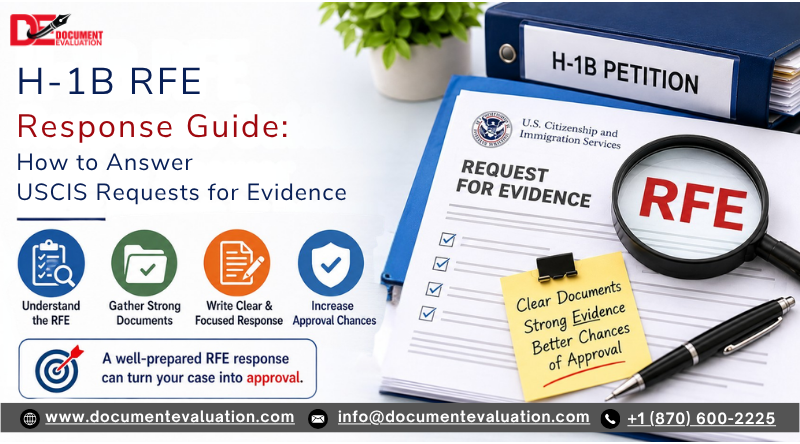

Every year, many H-1B petitions receive RFEs, and a significant portion of them get approved after a well-prepared response. The outcome, however, depends almost entirely on how you respond: what you submit, how you frame it, and whether it directly addresses every concern the officer raised.
You walk through the entire H-1B RFE response process in plain, practical terms. Whether you’re an employer’s HR team handling an RFE for the first time, a sponsored employee anxious about your status, or an immigration attorney looking for a structured resource to share.
If your notice specifically challenges the complexity or duties of the position, you can hire our specialized agency to craft a robust H-1B specialty occupation RFE response. Securing expert service ensures your job duties, educational alignment, and industry standards are convincingly documented for USCIS approval.
What does an H-1B RFE mean?
An H-1B RFE means “Request for Evidence.” It is a notice from USCIS stating that it needs additional documents or clarification before it can decide on the H-1B petition. It does not mean denial. Usually, USCIS is asking for proof on one or more points, such as whether the job is a specialty occupation, whether the worker is qualified, or whether the employer has the right relationship with the employee.
Why Might Your H-1B Petition Receive a Request for Evidence (RFE)?
A Request for Evidence (RFE) is typically issued by US Citizenship and Immigration Services (USCIS) when there is doubt regarding the legitimacy of an H-1B application. A typical basis for issuing an RFE is if there is a lack of understanding of how the proposed role requires a degree and specialized skills. An RFE may also be issued to an applicant applying for an H-1B based on their education and experience if they do not match the job in question.
Another situation where RFEs are often issued is with respect to consulting or third-party contracted employees. USCIS generally seeks confirmation from petitioners that they will have supervision or control over the Contractor’s work. In many cases, it is not that there are not enough documents present, but rather that the documents are not strong enough or clear enough. Generic job descriptions, inconsistency within the documents, and project details that are missing are all types of documents that can give rise to probable cause for an RFE. USCIS generally wants well-supported and clearly written documentation.
How to Read an H-1B RFE Notice (Anatomy of the Document)
Before you build your H-1B RFE response, you need to understand exactly what you are looking at. The RFE notice itself has a predictable structure. Knowing the structure helps you find the most important information in under 60 seconds.
Every H-1B RFE notice contains five parts:
- Case header: Your receipt number, beneficiary name, and employer information.
- Jurisdictional statement: The legal rules USCIS is using to review your case.
- Common mistakes: Addressing only some points or misrepresenting facts, which should always be corrected.
- Analysis section: This is the most important part. USCIS explains exactly what is missing or unclear.
- Request for evidence: A numbered list of documents or explanations USCIS wants.
The single most important piece of information is the deadline. Look at the first page of the RFE notice. You will see a response deadline, usually 30, 60, or 87 days from the notice date. Do not confuse the “notice date” with the date you received the mail. USCIS counts from the notice date.
7 Types of H-1B RFEs and Exactly How to Respond to Each One
There are seven major types of H-1B RFEs, each requiring a different response. Your H-1B RFE response will depend on the reason for the questioning.
Specialty Occupation RFE (most common)
USCIS asks, “Is this position really a specialty occupation requiring a four-year university degree or higher in a specific area?”
What to submit: 3 or more actual job postings from different companies that require a university degree for the job listed in your H-1B petition, along with a detailed statement of work for the position clearly identifying that the employee will be performing non-routine and complex tasks.
Beneficiary Qualification RFE (degree match)
USCIS asks, “Does the employee have a degree that matches the duties of the worker’s position?”
What to submit: A credential evaluation of each class taken that maps each course to the corresponding job duties. Any generic evaluation of the degree will be insufficient.
Employer-Employee Relationship RFE (common for consultants)
USCIS asks, “What is the true level of control that the employer has over the day-to-day activities of the employee?”
What to submit: both a signed contract and an SOW for the consultancy services, along with details on how the employer has the right to supervise the employee and how the employee fits into the organizational structure.
Availability of Work RFE (Third-Party Placements)
USCIS asks: “Is there active work available for this worker?”
What should be submitted? Get a letter from the client on their company paper. The letter should say the project start date, how long the project is, and the employee’s job.
Maintenance of Status RFE (H-1B Transfer)
USCIS asks, “Has the beneficiary violated their previous visa status?”
What should be submitted? Please provide all pay stubs covering the period between jobs, along with a current I-94 printout from the CBP website.
Wage Level 1 RFE or Entry-Level Position RFE
USCIS asks, “Will an entry-level position require a degree?”
What should be submitted? Give a simple list of the special job tasks and get a letter from a professor in that subject saying the job needs those skills.
LCA Compliance RFE (Work Location Issues)
USCIS asks, “Is the area where the work is actually being done the same as the work site on the LCA?”
What should be submitted? Signed itineraries and logs of the actual locations the employee works at on the job.
How an Expert Opinion Letter Can Support an H-1B RFE Response
If your H-1B RFE questions whether the job is a specialty occupation, there is one document that carries more weight than almost anything else: an independent expert opinion letter.
What is an expert opinion letter for an H-1B RFE?
It is a letter written by a qualified, independent expert who has no connection to your employer. This person explains why your job requires a specialized degree. Common experts include university professors, senior industry researchers, or experienced professionals in the same field.
Why USCIS takes expert opinion letters seriously:
USCIS officers see hundreds of employer-written job descriptions. An independent expert is neutral. That neutrality makes the evidence more credible.
What must a strong expert opinion letter include?
A strong H-1B RFE expert opinion letter should usually include:
- Expert’s credentials: Updated CV showing subject-matter expertise
- O*NET alignment: Proper classification of the role under O*NET standards
- Academic correlation: Direct comparison between job duties & specialized degree coursework
- Professional conclusion: A clear statement confirming the role qualifies as a specialty occupation under USCIS criteria
Self-Audit Checklist Before You Submit Your H-1B RFE Response (Find Red Flags First)
Before you collect documents for your H-1B RFE response, do a quick self-check first. Resolving the issues early makes your response stronger and helps reduce the risk of denial.
Ask yourself these questions:
- Does the job title on the offer letter exactly match the job title on the LCA (Form ETA-9035)? If not, fix it.
- Do the proposed job duties match the standard description for your SOC (Standard Occupational Classification) code? If not, rewrite them.
- Does the employee’s college transcript show courses that directly align with the job duties? If not, get a course-by-course evaluation.
- If you are using work experience instead of a degree, do you have a professional evaluation letter that states every three years of experience equals one year of college?
- Are all signatures, dates, and notarizations current? Old signatures raise questions.
What Happens After You Receive an H-1B RFE?
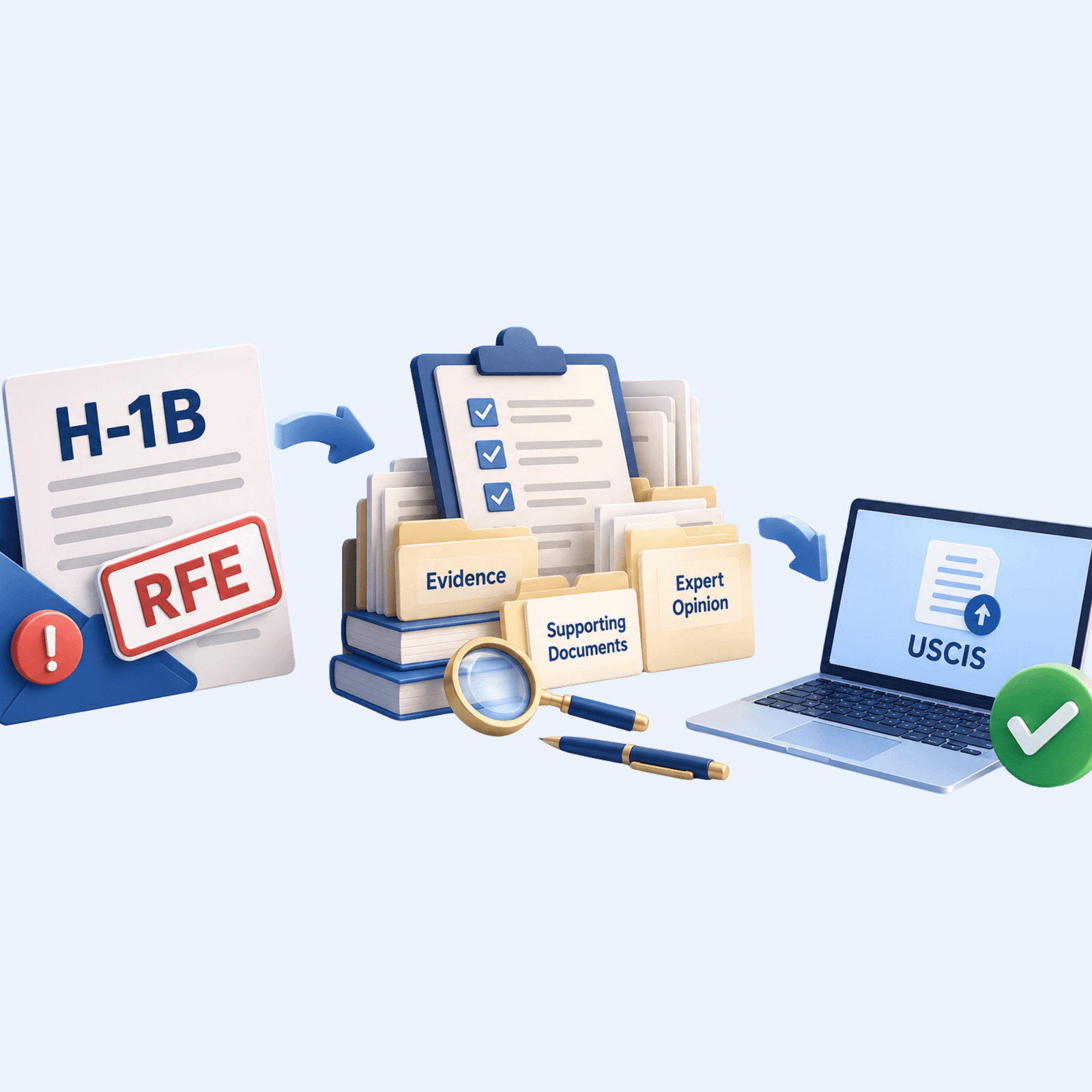
Step 1: USCIS issues RFE, notice sent to the company or attorney
Step 2: Review the RFE; make sure that each issue mentioned is all covered
Step 3: Prepare Supporting Documentation. Put together your supporting evidence to address all of the requested items; this is the time to gather all other types of documentation you wish to present
Step 4: Write a legal response to each Item in the Rfe, write down your written explanation for every item in the Rfe, and then prepare to provide whatever evidence is needed
Step 5: Send a Response to USCIS. The response must be submitted to USCIS before the deadline listed on the RFE notice.
Step 6: USCIS Review. The immigration officer considers whether or not the response meets the standard of evidence
Step 7: Receive the final decision by the immigration officer. After completing the above, you can receive an approval or denial and, on rare occasions, another request for information.
Step-by-Step: How to Build a Strong H-1B RFE Response
Receiving an H-1B RFE can be stressful, but how you prepare your response can make a significant difference. USCIS usually wants clear explanations and strong supporting documents before making a final decision. Instead of rushing, it is important to handle the response carefully and in an organized way.
Step 1: Identify All Concerns Listed in the RFE
After reading the RFE notice carefully and understanding the issues, you will want to start creating a list of all the concerns listed in the RFE. Usually, the RFE identifies the specific issues with respect to the job description, qualifications/education, employer, salary, or project as they relate to your specific petition.
Step 2: Collecting Supporting Documentation
After you list all of the concerns identified in the RFE, you need to collect supporting evidence relative to the issues that exist. Supporting documentation that you will possibly need will probably be job descriptions, transcripts (with copies of your diploma), credential evaluations, letters and contracts from clients, project documentation, pay records, and letters verifying your employment history. The purpose is to provide clear evidence of your eligibility for the H-1B classification while also eliminating any unnecessary documentation.
Step 3: Develop an In-Depth Cover Letter
The cover letter is one of the essential parts of the response. It should clearly outline the case, and it should pull together all supporting documentation. Your cover letter should address each issue from USCIS separately and detail how each piece of evidence supports the petition.
Step 4: Arrange Your Response Properly
When USCIS officers review a clean and organized response package, they will have an easier time understanding the case. To assist them, the appropriate ordering of documents, using labels or section dividers, and providing easy access to exhibits will help in this.
Step 5: Review Everything Before Submission
Before sending the response, check that:
-
- Every RFE issue has been answered
- All documents are included
- Information is consistent across all paperwork
- The mailing address is correct
- The package is submitted before the deadline
It is also smart to keep a complete copy of everything submitted for future reference.
Weak vs. Strong H-1B RFE Response Examples
Many H-1B sponsors have their RFE response denied because they were too unclear. Below is a side-by-side comparison. Use the strong response for your RFE responses to avoid having them denied.
Weak response: “The degree held by the individual being sponsored would be sufficient for the position of marketing manager due to its relatedness to the position.”
Why weak: The reference “relatedness” provides no definitive proof that this is so. USCIS is looking for definitive evidence; opinions are insufficient.
Strong response: “The RFE requests information regarding the match between the degree being sponsored and the position of marketing manager. Attached are Exhibit A, which lists by specific course a course-by-course evaluation of 18 credits completed in consumer behavior, market research, and brand strategy; Exhibit B, which provides a mapping between the 7 specific job duties and the 7 corresponding specific courses; and Exhibit C, which provides a statement from a tenured professor of marketing that the courses listed in Exhibits A and B are the correct standard curriculum for persons who will work in the position of marketing manager in accordance with O*NET classification code 11-2021.00.”
Why strong: Responds directly to the RFE, uses specific exhibits, and provides third-party documentation.
H-1B RFE Processing Time After Response (Premium vs. Regular)
| Step | Premium Processing | Regular Processing |
|---|---|---|
| USCIS Receives RFE Response | Day 0 | Day 0 |
| Online Case Status Update / Acknowledgement | Usually within a few days to 1–2 weeks | Usually within a few days to 1–2 weeks |
| USCIS Review Target After RFE Response | About 15 calendar days after USCIS receives and logs the response | No fixed deadline; varies by case and service center |
| The Clock Restarts After RFE Response Is Received | Yes | Not applicable |
| Second RFE Possible? | Yes, although uncommon | Yes |
| Best For | Urgent travel, employment start dates, and status-related concerns | Lower-cost filings without time-sensitive needs |
Mistakes That Lead to H-1B RFE Denials
1. Sending Generic Documents
USCIS processes many applications daily; therefore, officers notice generic written responses and will respond accordingly to these types of responses. Therefore, responses need to be customized to the specific petition.
2. Ignoring Certain Questions
Many applicants focus their responses on the major issues of the application and leave out the minor issues. However, even a minor unanswered question can be grounds for a denial.
3. Contradictory Information
Dates, titles of jobs, salaries, job duties, etc., must be consistent across all documentation. Different answers will raise a concern about the applicant’s credibility.
4. Weak Specialty Occupation Explanation
Just saying “The job requires a bachelor’s degree” is not enough; there must be a thorough and well-documented explanation of why the job needs a bachelor’s degree.
5. Waiting Too Long to Start
The amount of time needed to complete the items required to respond to an RFE: client communication, academic evaluation, attorney review, employer documentation, and waiting until the last week to complete the required items will create an unnecessary risk.
Latest H-1B RFE Trends for 2025-2026 (What USCIS Is Questioning Now)
USCIS is continuing to focus on whether the H-1B job is truly a specialty occupation, whether the employer can clearly show control over the worker, and whether the evidence is specific enough to support the petition. In 2025-2026, unclear job descriptions, inconsistent records, and weak explanations drive many RFEs less by missing documents than they used to.
USCIS Focus on Specialty Occupation Cases
One of the biggest RFE trends is continued scrutiny of specialty occupation claims. USCIS wants to see a clear connection between the job duties and a degree in a specific field, not just broad statements that the role is “professional” or “technical.” Strong petitions usually explain the duties in detail, show why the work is complex, and connect the role to industry standards or academic requirements.
Increased Scrutiny for Third-Party Placements
Third-party placements and consulting cases continue to receive extra attention because USCIS wants proof that the petitioner still controls the worker’s employment. That usually means the response should show supervision, work assignment structure, client/project details, and ongoing employer oversight. If the client site details are missing or the contracts are unclear, USCIS is more likely to ask for more evidence.
Remote Work and Wage-Level RFEs
Remote work and wage-level issues are also getting more attention in 2025-2026, especially when the salary does not seem to match the job duties or experience level. USCIS is looking closely at whether the wage, role, and required qualifications all make sense together. When those details do not line up clearly, an RFE may be issued to ask for additional explanation or support.
Can an H-1B Be Approved After an RFE?
Yes. Many H-1B petitions are approved after an RFE. RFEs are common, and approval typically depends on four factors:
-
- Quality of evidence: Official documents beat emails. Signed letters beat verbal agreements.
- Organization: A clean response with a cover letter and page numbers helps the officer say yes.
- Clarity: Answer every RFE question separately. Do not bury responses in long paragraphs.
- Consistency: Job titles, duties, and locations must match across every document.
A carefully prepared response can improve the chances of approval by giving USCIS clear, organized, and relevant evidence. The officer just needs clear reasons to approve you. Give them those reasons.
Note: This guide is for general educational purposes only and does not replace advice from a licensed immigration attorney. Every H-1B RFE is different, so the response should be prepared according to the specific issues raised by USCIS.
Frequently Asked Questions
What is an H-1B RFE?
An H-1B RFE (Request for Evidence) is a notice from USCIS requesting additional documents or clarification before making a decision on your petition. It does not mean your case has been denied, but it indicates that USCIS requires more evidence.
Why does USCIS issue an H-1B RFE?
USCIS may issue an H-1B RFE when it has questions about the job position, the beneficiary’s qualifications, the employer-employee relationship, or when submitted documents are unclear, inconsistent, or insufficient.
How should I respond to an H-1B RFE?
You should respond by addressing every concern raised by USCIS and submitting clear supporting evidence for each issue. A well-organized cover letter with properly labeled exhibits helps USCIS review the response efficiently.
Can USCIS approve my H-1B petition after an RFE?
Yes. Many H-1B petitions are approved after an RFE when the response fully addresses USCIS’s concerns. The quality and relevance of the supporting evidence are more important than the quantity of documents submitted.
Is an H-1B RFE a troubling sign?
No. An H-1B RFE simply means USCIS needs additional information before making a final decision. A complete and well-supported response can still result in approval.
What happens if my H-1B RFE response is weak?
If your response does not adequately address USCIS’s concerns or lacks sufficient evidence, your H-1B petition may be denied. A clear, direct, and well-documented response is essential.
What is the most important part of an H-1B RFE response?
The most important part is directly addressing every issue identified by USCIS. All supporting documents should be consistent, specific, relevant, and easy for the reviewing officer to understand.
How long do I have to respond to an H-1B RFE?
The response deadline is stated on your RFE notice. USCIS commonly provides 30, 60, or up to 87 days, depending on the case. Missing the deadline may result in denial of the petition.
Can an Expert Opinion Letter help with an H-1B Specialty Occupation RFE?
Yes. A well-prepared Expert Opinion Letter can explain why the position qualifies as a specialty occupation and why the required job duties demand a specific degree field. It should directly address USCIS concerns and be supported by evidence.
What documents should be included in an H-1B RFE response?
Common supporting documents include the job description, offer letter, Labor Condition Application (LCA), employer support letter, client letter or Statement of Work (SOW), contracts, academic transcripts, credential evaluation, payroll records, Form I-94, and an Expert Opinion Letter when appropriate.

Conclusion
Receiving an H-1B RFE can feel stressful, especially when your job, travel plans, or future in the USA depends on the outcome of the petition. USCIS needs additional documents or clarification before it can decide on the H-1B petition. Respond to every issue carefully & submit strong evidence to answer USCIS questions.
If you are unsure how to prepare the response properly, professional guidance can help avoid costly mistakes. Document Evaluation helps applicants and employers with H-1B documentation, credential evaluations, expert opinion letters, and RFE responses to complex immigration cases.
Learn More About H-1B Specialty Occupation Requirements
- H-1B Visa Requirements & USCIS Guide:
Learn about H-1B eligibility, specialty occupation requirements, USCIS filing steps, RFEs, supporting documents, and expert opinion letter support for stronger petition approval chances.
- Why H-1B Petitions Get Denied?
Learn the most common reasons H-1B petitions face denial, including weak documentation, specialty occupation issues, RFEs, and employer-related mistakes, along with practical ways to improve approval chances. - Reduce H-1B RFE Risk with Expert Letters:
Learn how a strong specialty occupation expert opinion letter can help reduce H-1B RFEs by clearly explaining job requirements, degree relevance, and USCIS specialty occupation compliance.
Akash Pundir is the Chief Operating Officer at Document Evaluation LLC, bringing over 5 years of international business operations and legal support experience across the United States, Australia, and India. He has overseen the strategic positioning and analysis of over 1,000+ complex USCIS cases, specializing in guiding expert evaluation teams to draft high-stakes Expert Opinion Letters (EOL), Academic Equivalencies, and defense packets for H-1B, EB-2 NIW, RFEs, and NOIDs. Driven by digital transformation, Akash ensures every evaluation adheres strictly to the latest USCIS legal frameworks and compliance benchmarks.
