

 |
|
What Are the Common Reasons for L-1, O-1, and TN Visa RFEs and How to Respond?

As an EMPLOYER or an international skilled worker trying to successfully navigate the US immigration system, FACING an RFE can be very frustrating for you.
An RFE will be issued by USCIS after you send it an application for a visa (e.g L1 (non-immigrant, intra-company transfer), O (extraordinary ability), or TN (North America Free Trade Agreement) due to a lack of evidence or documentation to support your application.
The following blog post explains when & why RFEs are issued, identifies the most common mistakes that lead to being issued an RFE & provides a step-by-step plan to eliminate the issues in order to respond to the RFE & keep your application moving forward.
If you need targeted support to address complex evidentiary demands for your petition, you can hire our specialized agency to craft a compelling O-1 extraordinary ability RFE response. Obtaining professional assistance ensures your documentation satisfies strict USCIS standards to keep your visa approval on track.
What Is an RFE (Request for Evidence)?
An RFE or Request for Evidence, is issued from US Citizenship and Immigration Services (USCIS) when they need further documentation or evidence in order to finalize the decision on a visa application.
An RFE does not indicate that your petition has been denied by USCIS rather, it is an indication that USCIS has requested additional information to help determine your eligibility.
The request will provide an explanation of what specifically is missing & provide a time frame in which you need to respond. You still can have your petition approved if you provide a clear, well-organized, & complete response within the allotted time frame.
Overview of L-1, O, and TN Visas!
Before diving into RFEs, let’s briefly understand each visa category.
| Visa Type | Purpose | Who Qualifies? | Main Criteria |
|---|---|---|---|
| L-1 Visa | Internal Transfer | Managers, Executives, and Specialized Knowledge Employees | Qualifying Corporate Relationship and Qualifying Employment |
| O-1 Visa | Individuals with Extraordinary Ability | Professionals in Science, Arts, Business, or Athletics | Sustained National or International Acclaim |
| TN Visa | USMCA Professionals | Canadian and Mexican Professionals | Job Offer in a Listed Profession and Required Qualifications |
L-1 Visa RFE:Common Issues and Solutions!
The L-1 visa is frequently scrutinized, especially under the L-1A (manager/executive) & L-1B (specialized knowledge) categories.
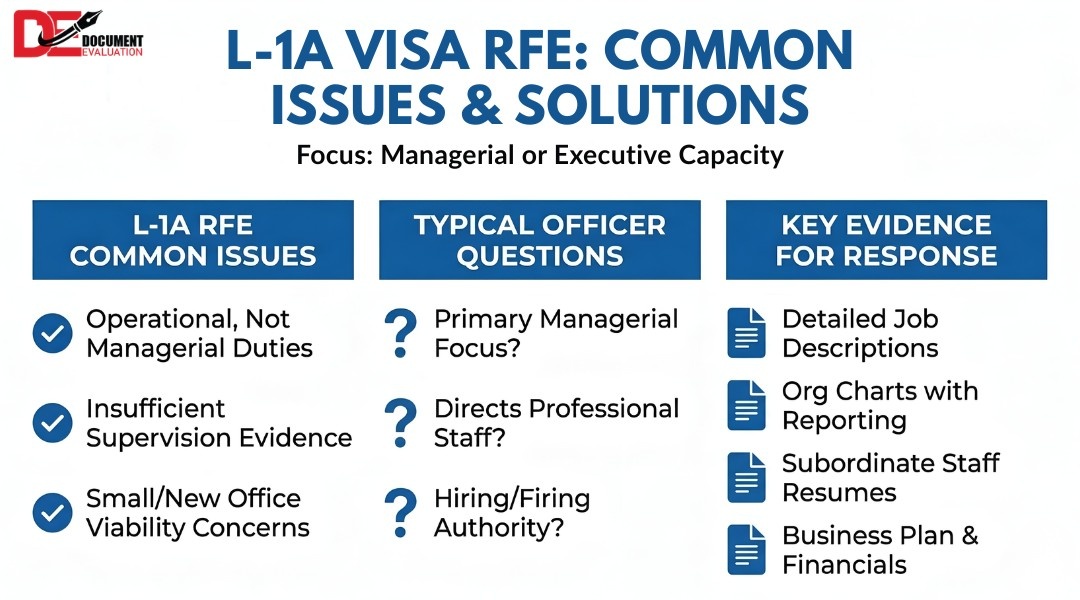
1. L-1A RFE: Managerial or Executive Capacity
Common RFE Issues:
- Duties seem operational, not managerial
- Lack of evidence of supervision
- Lack of evidence of subordinate professional staff
- Limited US office concerns
- Viability of new office issues
Typical RFE Language
- Officers often question whether the beneficiary
- Primarily engages in managerial work
- Directly supervises professional employees
- Has the ability to hire and fire
Evidence to Include in Response
| Evidence Type | Why Does It Matter? |
|---|---|
| Detailed Job Description (Percentage Breakdown) | Shows the Percentage of Managerial Versus Operational Duties Performed. |
| Organizational Charts | Demonstrates the Reporting Structure, Hierarchy, and Supervisory Responsibilities. |
| Payroll Records of Subordinates | Confirms the Existence of Employees Managed by the Beneficiary. |
| Company Financial Statements | Establishes the Organization's Operational Scale and Business Activity. |
| Business Plans (for New Office) | Supports Business Growth Projections and Future Operational Plans. |
Strategic Response Tips
- Rewrite job duties clearly separating strategic vs daily tasks
- Provide revised org charts showing reporting lines
- Include affidavits from company executives
- Clarify decision-making authority
2. L-1B RFE: Specialized Knowledge
This is one of the most frequent L-1 RFEs.
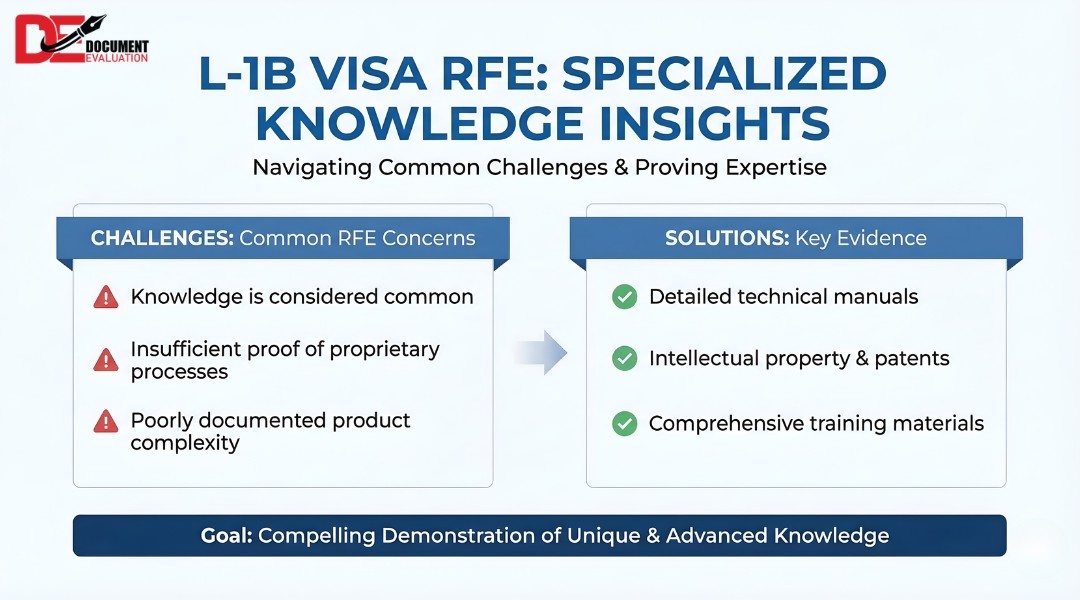
Common Concerns:
- Knowledge is common or can be easily transferred
- Lack of sufficient evidence of proprietary processes
- Poor documentation of product complexity
Supporting Documentation Checklist:
- Technical manuals
- Training documents
- Intellectual property documents
- Patents
- Evidence of internal proprietary systems
- Detailed explanation of why the knowledge is uncommon.
O-1 Visa RFE: Extraordinary Ability Challenges
The O-1 visa requires demonstrating extraordinary ability under regulatory criteria.
Most Common O-1 RFE Triggers
| Issue | Explanation |
|---|---|
| Weak Evidence of Sustained Acclaim | The Officer Questions Whether the Applicant Has Demonstrated Long-Term Recognition in the Field. |
| Media Coverage Not Significant | The Published Articles May Not Be from Major or Widely Recognized Media Sources. |
| Awards Not Nationally Recognized | Local or Minor Awards May Not Meet USCIS Standards for Extraordinary Ability. |
| Salary Evidence Insufficient | High Salary Claims Should Be Supported with Industry Comparisons and Reliable Compensation Data. |
The O-1 standard is high and subjective, which leads to many RFEs.
Because the O-1 category has strict and highly scrutinized eligibility standards, applicants should clearly understand the official O-1 visa qualification requirements before filing.
O-1 RFE Response Strategy
Enhance Regulatory Criteria
The O-1 visa category demands satisfaction of at least 3 of the criteria listed. Typical criteria include:
- National or international awards
- Published writings about the beneficiary
- Original work of major importance
- High compensation
- Membership in associations requiring extraordinary achievements
In preparing a response:
- Use objective industry standards
- Attach expert opinion letters
- Submit independent media analysis
- Add citation metrics if appropriate
TN Visa RFE: Professional Qualification Scrutiny
TN Visa Requests For Evidence- Scrutiny Of Professional Qualifications
The TN visa is one of the classes of non-immigrant visas available under the USMCA (previously NAFTA).
Unlike L-1 and O-1 visas, TN visa Requests for Evidence typically include scrutiny of the following:
- Does the job qualify as one of the listed professions?
- Does the degree meet the requirements of the profession?
- Is the position a true professional position?
Common TN RFE Reasons
| RFE Concern | Example |
|---|---|
| Job Duties Don't Match Profession | A Software Role Filed as a Computer Systems Analyst Instead of a More Appropriate Specialty Occupation. |
| Degree Mismatch | A Marketing Degree Submitted for an Engineering Position Without Supporting Evidence of Equivalency. |
| Employer-Employee Relationship | An Independent Contractor Arrangement That Does Not Clearly Establish Employer Control. |
TN RFE Response Documentation
- Detailed job description tied directly to USMCA profession
- Degree transcripts and evaluation (if foreign)
- Employer support letter
- Organizational chart
- Clarification of supervisory structure
How to Respond to An RFE?
RFE Step 1: Analyze the RFE
Read through the RFE carefully to understand:
- The Legal Basis
- Evidence Not Attached
- Deadline for Responding
Sample RFE Response Structure!
| Section | Content |
|---|---|
| Cover Letter | Overview of the RFE Response and Supporting Evidence. |
| Legal Argument | Citations to Applicable USCIS Regulations, Policies, and Supporting Legal Authority. |
| Point-by-Point Rebuttal | Direct Responses Addressing Each Concern Raised by the USCIS Officer. |
| Exhibits | Supporting Documentation, Evidence, and Reference Materials. |
| Conclusion | Restates Eligibility and Summarizes Why the Petition Meets USCIS Requirements. |
How to Prevent RFEs for YOUR L-1, O, OR TN Petition
It’s ALWAYS better To Prevent than to cure:
- BEST PRACTICES
- Provide Percentage Based Duty Breakdown
- Include Detailed Organizational Chart
- Include Expert Letters (As Applicable)
- Avoid Providing Vague Job Descriptions
- Match Degree To Position (TN Petition Cases)
- Provide Comparative Salaries (O-1 Petition Cases)
Processing Times and Cost of RFEs!
| Services | Economy | Standard | Express |
|---|---|---|---|
| Processing Time | 5 to 7 Days | 3 to 4 Days | 1 to 3 Days |
| RFE Response | $629 | $829 | $999 |
| RFE Response (H-1B, EB-2, EB-3, I-485) | $549 | $699 | $999 |
| RFE Response (EB-1C or L-1A) | $1099 | $1399 | $1999 |
| RFE Response (EB-1A, EB-1B, EB-2 NIW) | $1199 | $1399 | $2199 |
Frequently Asked Questions
No. An RFE (Request for Evidence) does not mean your L-1, O-1, or TN visa has been denied. It simply means USCIS requires additional information or supporting documentation before making a final decision on your petition.
The response deadline is stated in your RFE notice. In most cases, applicants are given between 30 and 87 days to submit a complete response with the requested evidence.
For L-1A petitions, USCIS commonly questions whether the beneficiary truly performs managerial or executive duties. For L-1B petitions, RFEs typically focus on whether the applicant has demonstrated specialized knowledge required for the position.
O-1 visa RFEs are commonly issued when USCIS needs additional evidence showing the applicant has sustained national or international recognition and meets the extraordinary ability requirements for O-1 classification.
TN visa RFEs are commonly issued when the applicant's job duties do not clearly match an approved TN profession, or when the educational qualifications are not sufficiently related to the offered position.
Yes. You should respond to every issue identified in the RFE and include supporting documentation that directly addresses USCIS concerns and strengthens your case.
In Conclusion!
An RFE (Request For Evidence) for your L-1, O-1, or TN visa is not the end of your case. An RFE means that the USCIS has some questions or concerns, & they are asking for more information before making a decision. If you carefully read the RFE & respond to all points clearly, along with strong supporting documents, and if you submit a well-prepared and organized response, the chance for approval will be good. Responding properly to an RFE can turn the RFE into a successful outcome.
O-1 visa petition
Explore More USCIS RFE & Employment Visa Resources
- Complete Guide to USCIS Requests for Evidence (RFE) and Effective Response Strategies:
Understand the purpose of a USCIS Request for Evidence (RFE), review an official sample notice, learn why RFEs are issued, and explore practical response strategies, documentation requirements, and best practices to strengthen your petition and avoid unnecessary delays. - Comprehensive Guide to O-1 Visa Eligibility, Requirements, and Application Process:
Explore the O-1 visa classification for individuals with extraordinary ability, including eligibility criteria, qualifying evidence, regulatory requirements, application procedures, supporting documentation, and key considerations for building a strong petition. - Step-by-Step Guide to Preparing a Strong USCIS RFE Response:
Learn how to analyze a Request for Evidence, organize supporting documentation, address each USCIS concern with clear evidence, and prepare a complete, well-structured response that improves the likelihood of a successful case outcome.
Akash Pundir is the Chief Operating Officer at Document Evaluation LLC, bringing over 5 years of international business operations and legal support experience across the United States, Australia, and India. He has overseen the strategic positioning and analysis of over 1,000+ complex USCIS cases, specializing in guiding expert evaluation teams to draft high-stakes Expert Opinion Letters (EOL), Academic Equivalencies, and defense packets for H-1B, EB-2 NIW, RFEs, and NOIDs. Driven by digital transformation, Akash ensures every evaluation adheres strictly to the latest USCIS legal frameworks and compliance benchmarks.
