

 |
|
Minimum GPA for MS in USA – Requirements for Indian Students


Most INTERNATIONAL students want to GET a Master’s Degree in the US because of the opportunities & advantages that one can gain by getting a Master’s Degree.
The most important part of the method is your academic history & this is based on your GPA (Grade Point Average), along with proper academic evaluation for USA.
However, finding the minimum GPA for a US Master’s Degree CAN BE DIFFICULT, as the GPA requirements differ from university to university.
This guide will give you a comprehensive overview of GPA & help you get familiar with the requirements for GPA & your situation if your GPA is not good enough.
To ensure your international credentials are properly translated into U.S. standards, you can hire our specialized agency to secure an accurate Academic Evaluation for Immigration.
What is GPA and How is it Evaluated?
The GPA or Grade Point Average is the way to measure the way a person is progressing with their academics, as represented below:
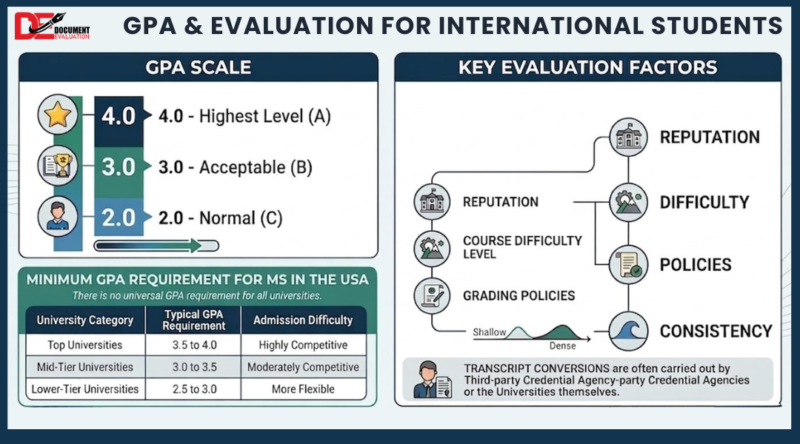
On a 4.0 scale:
- 4.0 - This would be the highest level or the "A" grade.
- 3.0 - This would be the acceptable or the "B" grade.
- 2.0 - This would be the okay or normal level of performance or the "C" grade.
For many international students, particularly from India, the majority of the US colleges & universities do not convert the percentage to the GPA or the grade point average on the basis of any mathematical formula but examine many other factors while processing the transcript documents as described below:
- Reputation of University/College
- Course Difficulty Level
- Grading Policies of Institution
- Consistency in shallowness or density of Coursework
In some cases, there are also:
Rarely do universities guide conversions of transcript grades themselves. Normally these conversions are carried through a third-party credential evaluation service or the university itself.
Minimum GPA Requirement for MS in USA
There is no universal GPA requirement that applies to all universities. However, based on general admission trends, the following ranges provide a realistic understanding:
GPA Requirements by University Tier
| University Category | Typical GPA Requirement | Admission Difficulty |
|---|---|---|
| Top Universities | 3.5 to 4.0 | Highly Competitive |
| Mid-Tier Universities | 3.0 to 3.5 | Moderately Competitive |
| Lower-Tier Universities | 2.5 to 3.0 | More Flexible |
A GPA of 3.0 on a 4.0 scale is often considered the minimum requirement for many MS programs. This is roughly equivalent to 65 to 70% in the Indian system, though exact conversions vary.
To ensure accuracy in your application, many students rely on the best credential evaluation services.
Indian Percentage to US GPA Conversion (Approximate)
For a more precise calculation, you can use tools to convert international GPA to US GPA based on your academic records.
Since most Indian students apply with percentage-based scores, the following table provides a general comparison:
| Indian Percentage | US GPA Equivalent |
|---|---|
| 75% and Above | 3.7 to 4.0 |
| 65% to 74% | 3.3 to 3.6 |
| 55% to 64% | 2.7 to 3.2 |
| Below 55% | Below 2.7 |
It is important to note that universities often review your academic records holistically rather than relying strictly on these conversions.
Is GPA the Only Factor That Matters?
While GPA is considered to be a very important component, it is by no means the only component to evaluate an individual for admission. Admissions officers at universities in the USA use a holistic process of admission whereby they assess all aspects of your application.
Factors Used to Evaluate Application Besides GPA:
- SOP (Statement of Purpose)
- LORs (Letters of Recommendation)
- (if applicable/required) GRE or GMAT Test Scores
- TOEFL/IELTS Test Scores
- Research Work and Projects
- Internships/Work Experience
- Ensure you have all items from the US University Admission Documents Checklist ready.
You may have a high GPA, but if you have accomplished any of these factors successfully, it will greatly increase your chances of being accepted regardless of your GPA.
Can You Get Admission with a Low GPA?
Yes, You can still be accepted into college even if you have a low cumulative GPA, provided that your overall application reflecting who you are has sufficient alternate areas of strength.
Many Colleges/Universities are willing to accept students who have GPAs under 3.0 if the following items are exhibited:
- An upward trend in grades over the course of 4 years
- High standardized test scores
- Relevant work experience
- Clearly defined career goals
For example, a student with a cumulative GPA of 2.8 who has a high GRE score and has work experience related to the field they are pursuing will likely receive admission offers from excellent (or prestigious) colleges/universities.
Universities That Accept Low GPA
Many colleges in America have an open or flexible admission policy and will consider your application even if your average grade point average is less than 2.5 to 3.0 GPA.
Here are some examples of colleges that allow students with low GPAs
- California State University
- Texas A&M University (certain campuses only)
- University of Central Missouri (UCM)
- Wichita State University
Many of these colleges will give more weight when looking at your overall application than just looking at the average GPA.
Course-Specific GPA Requirements
Different MS programs have different expectations based on competitiveness & demand.
Typical GPA Requirements by Field
| Program | Minimum GPA Expectation |
|---|---|
| MS in Computer Science | 3.0 to 3.5 |
| MS in Data Science | 3.2 to 3.7 |
| MS in Engineering | 3.0 to 3.5 |
| MS in Business Analytics | 3.2 to 3.6 |
| MS in Healthcare / Public Health | 3.0 and Above |
Highly competitive fields such as Computer Science & Data Science generally require higher GPAs due to large applicant pools.
What is a Safe GPA for MS in USA?
There are no specific “safes” GPAs, however, following 3 guidelines can help:
- 3.5 GPA or better - Excellent chance of admission to top level colleges
- 3.0 - 3.4 GPA - Good chance of admission to mid level colleges
- GPA below 3.0 - Will need to improve other areas
A well-rounded application will be more important than overall grade point averages.
How to Improve Your Profile with a Low GPA?
Although you may have a GPA that is less than desired, it may still be possible to enhance your opportunities by using strategic methods.
1. Strong Test Scores
A solid GRE score (310+) can demonstrate you are qualified academically and can make up for a lower GPA.
2. Appealing Statement of Purpose
To compensate for a lower GPA, your statement of purpose should use professional academic writing vocabulary to highlight your strengths and potential through the following:
- Explain why you had academic difficulties
- Describe achievements you have made that demonstrate growth
- Clearly state what your career goals are
3. Relevant Experience
Experience gained through working, interning, or participating in research can help greatly to strengthen your application.
4. Coursework
Taking additional courses, e.g, certification programs, prerequisite courses, demonstrate academic commitment & subject matter expertise.
5. Applying Strategically
Make sure that your list of universities you apply to includes:
- One or more ambitious universities.
- One or more moderate universities.
- One or more safe universities.
Does GPA Affect Scholarships?
The short answer is yes – GPA has an impact on awarding scholarships to students.
Generally, the higher the GPA a student has, the better their chances are for getting:
- Merit-based scholarships
- Teaching and/or research assistantships
That is not to say that there aren’t scholarships that also consider factors like:
- Leadership skills
- Extracurricular accomplishments
- Work experience
Frequently Asked Questions
No. A 3.0 GPA is not mandatory, but it is one of the most commonly expected minimum GPA requirements for admission to many US universities.
Yes. You can apply with less than 60% in graduation, but a strong overall profile, including relevant work experience, test scores, and supporting documents, can help strengthen your application.
No. GPA requirements vary depending on the university, academic program, and level of competition for admission.
Both GPA and GRE scores can be important, but GPA reflects your long-term academic performance, while the GRE measures your aptitude through a standardized examination.
Yes. Relevant professional work experience can strengthen your application by demonstrating practical skills, industry knowledge, and career growth that complement your academic background.
Yes. US universities typically evaluate international transcripts using their own credential evaluation standards to determine the equivalent US GPA.
Backlogs may affect your admission prospects, but strong academic achievements, supporting documents, and relevant experience can help reduce their impact.
Yes. While admission may be more competitive, applicants with a low GPA may still receive admission to top universities if they have an exceptional overall profile, strong test scores, relevant experience, and compelling application materials.
In Conclusion!
There is no single minimum GPA required to be granted admission into a master’s (MS) program in the United States, each institution & each program has its own guidelines that are not absolute nor uniform.
However, a GPA of 3.0 or greater is usually expected, but should not be considered the only criteria upon which to base admission decisions.
Being well-prepared and submitting a complete application, while understanding how your Indian degree in the USA is evaluated, will be beneficial in obtaining acceptance.
Planning in advance & strategically applying, while presenting a very strong general profile (i.e, academic, professional & community involvement) will be instrumental in your search of an MS program.
International GPA
More USA Academic Evaluation Guides:
- Trusted Course-by-Course Credential Evaluation:
Learn about course-by-course credential evaluation for USCIS, universities, GPA calculation, and costs. This guide explains how subjects, grades, and credits are evaluated to meet immigration, education, licensing, and university admission requirements in the USA.
- Difference General Academic Evaluation and Course by Course :
between general academic evaluation and course-by-course evaluation for immigration, employment, and university admissions. This guide explains how each evaluation type works, what details they include, and which evaluation best fits your academic or USCIS requirements - International Transcript Evaluation with Document Evaluation:
Learn about international transcript evaluation with Document Evaluation and how it helps verify foreign academic records for immigration, employment, licensing, and university admissions. This guide explains transcript evaluation requirements, document verification, and accurate credential assessment for US standards.
Akash Pundir is the Chief Operating Officer at Document Evaluation LLC, bringing over 5 years of international business operations and legal support experience across the United States, Australia, and India. He has overseen the strategic positioning and analysis of over 1,000+ complex USCIS cases, specializing in guiding expert evaluation teams to draft high-stakes Expert Opinion Letters (EOL), Academic Equivalencies, and defense packets for H-1B, EB-2 NIW, RFEs, and NOIDs. Driven by digital transformation, Akash ensures every evaluation adheres strictly to the latest USCIS legal frameworks and compliance benchmarks.
