

 |
|
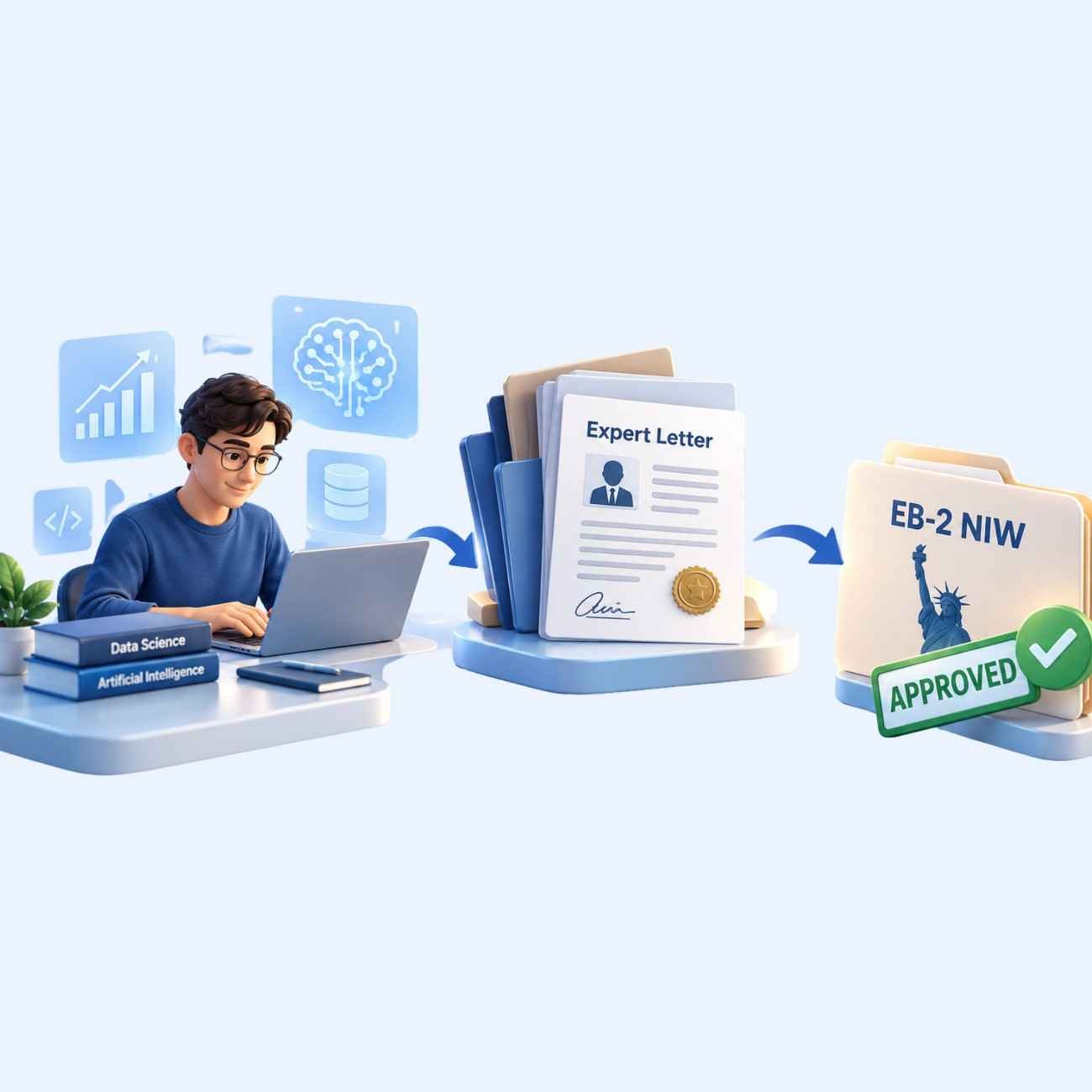
How Data Scientists & AI Engineers Use EB-2 NIW Expert Letters


If you’re a data scientist or AI engineer pursuing a US green card through the EB-2 National Interest Waiver route, there’s one document that can determine the success of your entire petition, i.e., the expert opinion letter. Not your publications, not your resume.
Most applicants underestimate it. They collect a few general letters from colleagues, attach them to the petition, and then USCIS sends back a request for evidence months later.
The expert opinion letter isn’t a formality. It’s a structured legal argument that must directly address why your work matters to the United States at a national level and why you’re the right person to do it.
Now let’s get into the important part …
Rather than navigating these complex evidentiary requirements alone, you can secure professional assistance by requesting our custom-tailored expert opinion letter for EB-2 NIW.
What Is EB2 NIW and Why Is It Relevant for Data Scientists and AI Engineers?
The EB-2 National Interest Waiver (NIW) is an employment-based green card category that lets you self-petition, i.e., with no employer sponsorship, no PERM labour certification, and no waiting for a company to file on your behalf. For data scientists and AI engineers, the EB-2 NIW is a significant opportunity.
To qualify, you need an advanced degree or excellent ability in your field. Then, your core argument is your work is in the national interest of US, & if USCIS needed the normal job market test, it would hurt the country.
Fields such as artificial intelligence, machine learning, cybersecurity, and data science are often well-positioned for NIW petitions because they can prove clear national importance when properly documented.
Why Are Expert Opinion Letters Important in EB2 NIW Applications?
An expert opinion letter is a formal document written by a known expert in your field. Commonly, a professor, senior researcher, or industry leader confirms the value and national importance of your work. It is neither a character reference nor a recommendation letter. It’s an evidence based argument.
Your NIW is a legal case. The expert opinion letter is your expert witness testimony. For an expert opinion letter to be powerful, it must clearly prove credibility, include specific evidence & align with USCIS evaluation standards.
What Is the Dhanasar Framework in EB2 NIW Petitions?
The USCIS Administrative Appeals Office came out with the Matter of Dhanasar decision a while back. This completely replaced the old NYSDOT framework that people used to use for NIW petitions. Here’s the thing: every expert opinion letter you send in needs to address all three parts of this framework. No shortcuts.
Prong 1: Your Proposed Endeavour Has to Have Substantial Merit and National Importance
USCIS doesn’t care about local impact. They want to see that your work matters at the U.S. level. For data scientists and AI engineers, that means linking your work to things like healthcare AI, climate modeling, national security, economic infrastructure, or scientific progress. A letter that just says “she builds really good machine learning models” won’t be enough. Not even close.
Here’s a mistake I see tech professionals make all the time. You might have built an ML model that saved your current employer $2 million. That’s impressive — don’t get me wrong. But USCIS sees that as a local business win, not a national one.
A smart expert letter changes the situation. Instead of bragging about company profits, the expert explains how your algorithm actually helps protect the entire U.S. financial system or makes healthcare data safer for millions of people. You’re basically taking your local success and scaling it up to a national level.
Before vs. After: See the Difference:
| Weak Claim (This Gets Denied) | Strong Expert Claim (This Gets Approved) |
|---|---|
| “I built an ML model that saved my employer $2 million.” | “The applicant built a predictive machine learning algorithm that strengthens the U.S. financial cybersecurity infrastructure against fraud. The innovation helps prevent millions of dollars in potential national economic losses.” |
Prong 2: You Need to Show You’re Well-Positioned to Pull This Off
This part is all about what you offer. The person writing your letter has to go through your publications, documents, projects, technical skills, and results, then connect all of that to the specific work you’re proposing. You can’t just say “I’m talented.” You have to prove that you’re the right person for this specific job.
Now, AI engineers aren’t like traditional researchers. You don’t always have academic papers to show off. A good expert letter knows what really matters in the tech world. The expert will point to things like:
- Your GitHub repos with lots of stars and forks (people actually using your code)
- Your Kaggle rankings if you’ve placed well in competitions
- Any proprietary LLM work you’ve done, custom models, fine-tuning, that kind of thing
- IEEE publications if you have them
- Papers you’ve presented at big AI conferences like NeurIPS, ICML, or CVPR
The whole point here is to show that other developers and companies are actually relying on your work. That’s what USCIS wants to see.
Prong 3: Why Waiving the Job Offer and Labor Certification Actually Makes Sense for the U.S.
Here’s the question USCIS is asking: Is it better for the U.S. to just approve you now or make you go through the normal immigration process? Your expert letter needs to answer that directly. Explain why your work matters, why you’re uniquely positioned to do it, and what the U.S. stands to lose if you have to leave or wait indefinitely.
Here’s the argument that works:
Think about how fast AI moves. If a data scientist has to sit around waiting 1 to 2 years for a standard PERM labor certification, their specific models or research could become outdated before they even get started. That doesn’t help anyone. The U.S. needs this technology right now. Delaying someone’s contribution doesn’t just hurt their employer; it actually slows down progress in a field where America is trying to stay ahead of the rest of the world.
For the official rules, check out the USCIS Policy Manual and the actual Matter of Dhanasar decision. That’s where they lay out how NIW petitions are supposed to be evaluated.
How to Structure an EB2 NIW Expert Opinion Letter Step by Step?
A good expert letter is 3 to 5 pages long & has a logical, evidence-driven structure.
Here’s how a proper expert opinion letter is organized:
Section 1: The Expert’s Credentials (half a page)
Brief biography of the letter writer, including their degrees, current position, publications & reasons they are able to comment on your work. This section builds reliability with the immigration officer.
Section 2: Overview of the Applicant’s Work (one page)
Keep one thing in mind: the USCIS adjudicator reviewing your case is a legal officer, not a coder. They don’t know how PyTorch, TensorFlow, or deep neural networks operate. If your petition is full of heavy programming jargon, it will likely trigger an RFE simply because the officer didn’t understand what you actually do.
The expert letter acts as a bridge. It takes your complex data architecture and breaks it down into plain English, making it incredibly easy for a non-technical officer to recognize your value.
Section 3: National Importance of the Work (one to one and a half pages)
The writer explains why this work matters nationally. For an AI engineer building fraud detection systems, the task might mean connecting their work to US financial infrastructure & financial crime. For a data scientist working on climate models, the link to national climate policy and disaster preparedness is obvious, but it still needs to be made clear.
Section 4: The Applicant’s Unique Qualifications (one page)
The expert explains why you, specifically, can do this work. Mentioning your publications, tools you’ve built, datasets you’ve contributed to, documents filed, or industry recognition is all valuable.
Section 5: Conclusion and the Case for Waiver
The letter should end by clearly arguing that US interests oppose requiring labour certification and that waiving it is the right outcome.
Complete Checklist for Data Scientists & AI Engineers Expert Opinion Letter
- Writer’s full credentials and current institutional affiliation
- Explanation of how the writer knows about the applicant’s work (not necessarily personally)
- Plain-language description of the applicant’s field & specific work
- Statement of national importance tied to a specific sector or policy area
- Evidence of the applicant’s unique qualifications (publications, documents, awards, results)
- Direct argument for waiving labour certification
- Writer’s signature on institutional letterhead
- The letter is 3 to 5 pages in length
- Language accessible to a non-technical immigration officer
Do’s and Don’ts for Data Scientists & AI Engineers Expert Opinion Letter
| Do’s | Don’t |
|---|---|
| Choose writers who are truly independent of you. | Submit generic letters that lack specificity. |
| Brief your writers on the Dhanasar standard. | Use letter writers who are close personal friends or co-workers only. |
| Provide writers with your CV, publications list, and a summary of your proposed work. | Let letters devolve into technical jargon without plain-language explanation. |
| Connect your work to specific national priorities (healthcare, security, climate, economy). | Forget the waiver rationale in the conclusion. |
| Ensure each letter adds a unique perspective. | Submit letters under 1.5 pages. |
| Get letters from a mix of academic and industry voices. | Rely exclusively on international experts without demonstrating relevance to US national interests. |
Real-World Scenario | How a NOID Response Became a USCIS Approval?
Most guides give you a fictional example. Here’s something better: what a real applicant went through and how the right expert opinion letters turned a near-denial into a full approval.
How Does a NOID Impact an Ongoing EB2 NIW Petition?
Emmanuel was deep into his EB-2 NIW process when USCIS issued a Notice of Intent to Deny (NOID), one of the most stressful moments any applicant can face. His case now needed not just a formal response but two additional expert opinion letters, drafted & submitted under serious time pressure. By his admission, the situation was tense, and he put significant pressure on the team supporting him.
He brought his case to Document Evaluation LLC, and guess what? The petition was ultimately approved by USCIS.
What Did Document Evaluation LLC Actually Do?
This task was not a simple letter-writing job. The team at Document Evaluation LLC had to prepare two expert opinion letters specifically made around USCIS’s stated concerns in the NOID, not generic letters or repurposed templates. Letters were built to respond to a specific legal challenge under deadline pressure, while keeping Emmanuel informed and steady throughout the process.
Akash handled communication and transparency at every step. Kevin, his case manager, managed the details because, in a NOID response, every detail matters.
The result? USCIS approved the petition.
Frequently Asked Questions
What is an EB-2 NIW Expert Opinion Letter for AI Engineers?
An EB-2 NIW Expert Opinion Letter for AI Engineers is a formal letter written by a recognized expert explaining how an AI engineer’s work benefits the United States and supports eligibility for a National Interest Waiver petition.
Can a Notice of Intent to Deny (NOID) be overturned with better expert letters?
Yes. A Notice of Intent to Deny (NOID) may be overcome by submitting stronger, detailed expert opinion letters that directly address the concerns raised by USCIS and provide additional supporting evidence.
How many Expert Opinion Letters are needed for a Data Science NIW?
Most immigration attorneys recommend including three to six Expert Opinion Letters for a Data Science NIW petition to help build a strong and well-supported case.
What is the most common mistake in AI-focused Expert Opinion Letters?
The most common mistake is using vague or generic language without clearly explaining how the applicant’s AI research or professional contributions provide measurable benefits to the United States.
Do I need a Ph.D. to get an Expert Opinion Letter for a National Interest Waiver?
No. A Ph.D. is not required to obtain an Expert Opinion Letter for a National Interest Waiver. USCIS primarily evaluates your qualifications, professional experience, achievements, and the national importance of your work.
What Can You Learn From This NOID Case?
Most applicants prepare for approval. Very few prepare for pushback. A NOID feels like the end of the road, but it doesn’t have to be. What determines the outcome at that stage isn’t your resume or your credentials. It’s the strength of your expert opinion letters and whether they directly address what USCIS is questioning.
This is precisely why the expert opinion letter can’t be treated as a checkbox. When USCIS challenges your case, these letters are your primary and often your only line of defence.
If you’re filing an EB-2 NIW petition or facing a NOID, Document Evaluation LLC has handled both. The process is stressful enough. Your documentation shouldn’t add more

Continue Reading About the EB-2 NIW Process:
- EB2 NIW expert opinion letter guide:
Learn how an expert opinion letter can strengthen your EB-2 NIW petition by demonstrating your qualifications, experience, and the national importance of your work. This guide explains USCIS expectations, required supporting evidence, expert selection, letter structure, and common mistakes applicants should avoid during the filing process. - EB-2 NIW USA Requirements & Processing Guide:
Understand the complete EB-2 National Interest Waiver process, including eligibility requirements, USCIS criteria, supporting documents, processing timelines, and petition strategies. This guide helps professionals, researchers, entrepreneurs, and skilled workers prepare a stronger EB-2 NIW application with confidence. - Best Expert Opinion Letter Services for EB-2 NIW in the USA:
Choosing the right expert opinion letter service can significantly improve your EB-2 NIW petition. This guide explains what to look for in a reliable service provider, including qualified experts, USCIS-compliant documentation, strong evidence support, and industry-specific evaluations that help reduce RFEs and strengthen approval chances.
Akash Pundir is the Chief Operating Officer at Document Evaluation LLC, bringing over 5 years of international business operations and legal support experience across the United States, Australia, and India. He has overseen the strategic positioning and analysis of over 1,000+ complex USCIS cases, specializing in guiding expert evaluation teams to draft high-stakes Expert Opinion Letters (EOL), Academic Equivalencies, and defense packets for H-1B, EB-2 NIW, RFEs, and NOIDs. Driven by digital transformation, Akash ensures every evaluation adheres strictly to the latest USCIS legal frameworks and compliance benchmarks.
