

 |
|
H-1B Approval Rate 2026: Real Numbers Every Applicant Should Know
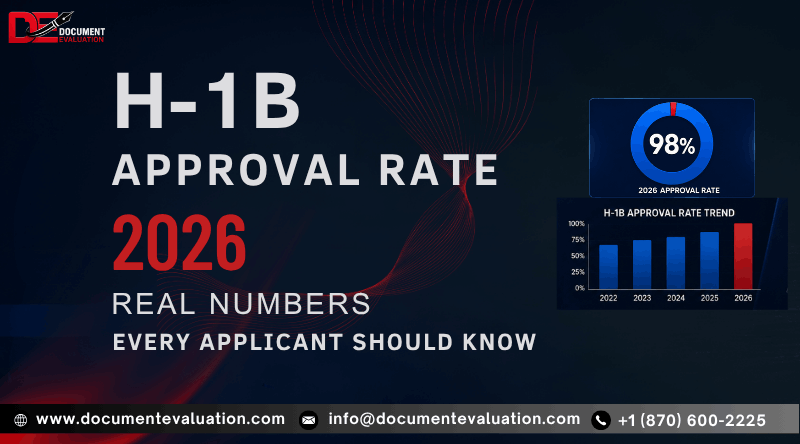

- FY 2026’s approval rate stands at approximately 98%, making it one of the highest in recent years.
- New petitions are currently running at 96.8% and extensions at 97.4%.
- A lower volume of registrations this year has directly improved overall lottery odds.
- Despite high approval rates, strong documentation and verified eligibility remain the deciding factors for success.
- Level 1 wage petitions are receiving heightened scrutiny, making absolute accuracy critical.
If you’re filing an H-1B petition or waiting on one, first you should check the approval rate. USCIS is approving the vast majority of petitions this year, even after the lottery system changes. But a high number doesn’t guarantee your case: it still depends on petition quality, eligibility, and documentation.
So where do the FY 2026 numbers actually stand? And what do they mean if you’re filing fresh versus renewing? Regardless of your filing status, securing professional assistance to acquire an H-1B expert opinion letter from a specialized agency can reinforce your documentation quality and prevent costly RFEs.
H-1B Approval Rates: Where Things Stand in FY 2026
USCIS has approved about 98% of H-1B petitions in the first half of FY 2026, that is, 98 out of every 100 cases, a noticeable jump from previous years when approval rates weren’t nearly as high.
Approval rate with petition type:
| Petition Type | Approval Rate (FY 2026) |
|---|---|
| Initial (New H-1B) | ~96.8% |
| Extension (Renewal) | ~97.4% |
| Overall | ~98% |
Historical H-1B Approval Rate Trends (2022-2026)
To understand the significance of the FY 2026 approval rate, it is helpful to compare it with previous years:
| Fiscal Year (FY) | Petitions Adjudicated | Petitions Approved | Approval Rate |
|---|---|---|---|
| 2022 | ~400,000 | ~390,500 | 97.62% |
| 2023 | ~405,000 | ~396,500 | 97.88% |
| 2024 | ~408,000 | ~400,000 | ~98.0% |
| 2025 | 415,275 | 406,569 | 97.9% |
| 2026* | ~410,000 | ~401,800 | ~98.0% |
What the 2026 Approval Rate Means for You
If you’re a new applicant:
Your odds start with the H-1B lottery; getting selected is the first hurdle. For FY 2026, the selection was conducted through the beneficiary-centric random lottery, with a selection rate of approximately 35%.
However, beginning with the FY 2027 cap season, USCIS is replacing the random lottery with a wage-weighted selection system. Under this new rule, which takes effect on February 27, 2026, each beneficiary receives several entries based on their offered wage level: Level I gets 1 entry, Level II gets 2, Level III gets 3, and Level IV gets 4.
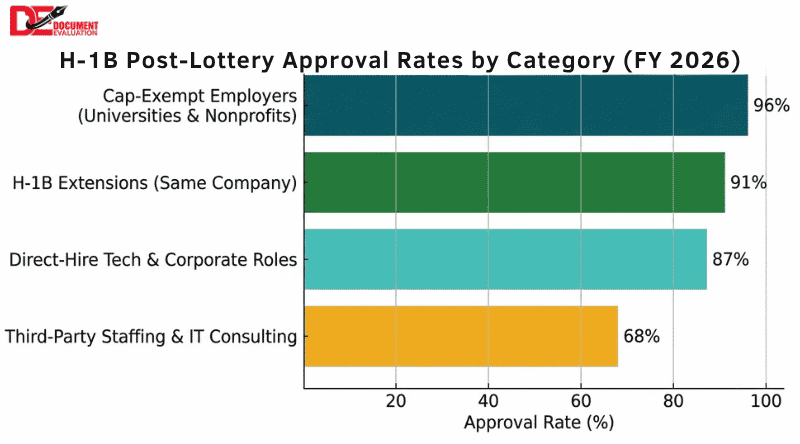
This means higher-wage positions will have significantly better odds of selection, while entry-level (Level I) roles could see their selection rate drop to around 15%. Once your petition clears the lottery and moves to Form I-129 adjudication, approval rates stay strong at around 90%, though USCIS is analyzing entry-level (Level I) wage petitions more closely than before.
If you’re extending an existing H-1B:
You’re in good shape; for renewal and transfer, approvals sit near 98%. The catch is timing: standard processing can stretch up to 10.5 months, though you can keep working for up to 240 days while a timely-filed extension is pending. Many applicants opt for premium processing (Form I-907) just to avoid the uncertainty, especially when H-4 dependents’ work authorization is riding on the outcome. And if you already have an approved I-140, you’re not boxed in by the standard 6-year limit; extensions in 1 or 3 year increments are available for long-term planning.
Frequently Asked Questions
What is the current H-1B overall approval rate for FY 2026?
Around 98% so far this fiscal year. Basically, 98 out of every 100 petitions USCIS looks at get a yes, and that’s been the case since 2021, so it’s not really new territory.
Are new H-1B petitions approved at the same rate as renewals?
Close, but not identical. New petitions land around 96.8%, extensions a touch higher at 97.4%. Makes sense when you think about it; USCIS already has a history with the employer and employee on a renewal, so there’s less to question.
How does the FY 2026 rate compare to previous years?
Barely moved, honestly: 97.6% in 2022, 97.9% in 2023, 98.0% in 2024, and 97.9% in 2025. This is just what “normal” looks like now.
Why did H-1B registrations drop sharply in FY 2026?
Mainly the beneficiary-centric selection system. Registrations fell almost 27%, down to around 344,000. Before this change, one person could register multiple times with different employers, which inflated the total count; that loophole is mostly closed now.
Has the selection rate improved because of fewer registrations?
Yes, it went from 29% last year to about 35% this year. Fewer names in the pool for the same number of spots means better odds if you’re registering.
Are H-1B renewals setting any records this year?
Looks like it. Nine months into FY 2026, renewals already crossed 273,000, nearly matching what all of FY 2025 produced. At this rate, it’ll be the busiest year yet for extensions.
Is USCIS scrutinizing certain H-1B petitions more closely?
Entry-level, Level 1 wage petitions are especially scrutinized. Officers are focusing on whether the role qualifies as a specialty occupation and whether the employer-employee relationship is valid. Weak documentation here is a common reason petitions are denied.
How long does H-1B extension processing take without premium processing?
Up to 10.5 months at the standard pace. Not ideal, but you’re not stuck; a timely-filed extension lets you keep working for up to 240 days while USCIS makes up its mind.
Should I consider premium processing for my H-1B petition?
For many people, yes. Filing Form I-907 gets you a decision in 15 days instead of waiting, worth the extra cost if an H-4 dependent’s work authorization depends on the result.
Can I extend my H-1B beyond the 6-year limit?
Yes, as long as you’ve got an approved I-140. You can push past the 6-year mark in 1- or 3-year chunks, which buys time while your green card case moves through the system.
Conclusion
FY 2026 is encouraging news either way; whether you’re filing for the first time or extending an existing H-1B, the numbers are favorable. But a near-98% approval rate doesn’t mean the process is automatic. It still requires a well-documented petition and clear proof that you meet the eligibility bar.
Policies change, processing times vary, and RFEs can still be unexpected. The ones who come out ahead in FY 2026 are the ones who file carefully, stay on top of documentation, and don’t treat a high approval rate as a reason to relax.

Tracking H-1B Approval Rates for FY 2026? What Every Applicant Needs to Know
Analyze FY 2026 approval trends, lottery odds, extension timelines, and USCIS scrutiny on entry-level wages.
Stay informed and avoid common H-1B filing mistakes. Explore our expert guides today:
- H-1B Visa Guide: Eligibility & USCIS Process
Learn H-1B visa eligibility, requirements, the USCIS process, RFEs, and expert guidance for a successful petition. - H-1B Visa Work Experience Requirements
Find out how much work experience you need for an H-1B visa and how experience can support your eligibility. - H-1B $100K Fee Update Explained
Understand how the H-1B $100K fee decision may affect credential evaluations, expert opinion letters, and H-1B applicants.
Akash Pundir is the Chief Operating Officer at Document Evaluation LLC, bringing over 5 years of international business operations and legal support experience across the United States, Australia, and India. He has overseen the strategic positioning and analysis of over 1,000+ complex USCIS cases, specializing in guiding expert evaluation teams to draft high-stakes Expert Opinion Letters (EOL), Academic Equivalencies, and defense packets for H-1B, EB-2 NIW, RFEs, and NOIDs. Driven by digital transformation, Akash ensures every evaluation adheres strictly to the latest USCIS legal frameworks and compliance benchmarks.
