

 |
|
How Much Work Experience Do You Need for an H-1B Visa in 2026?

One of the most common questions professionals ask when considering the H-1B visa pathway is about the experience requirement. The short answer is that there is no fixed number of years required, but your experience matters in a very specific way. Let me explain how it works.
If your degree doesn’t directly align with your target role, you can secure an expert opinion letter for H-1B petitions through a specialized agency to formally evaluate your work history. Hiring professional assistance ensures your practical experience satisfies USCIS equivalency standards and strengthens your overall petition.
The Real H-1B Visa Experience Requirement: It is About Education First
The H-1B visa was created to cater to individuals who work in “specialty occupations.” This implies that the occupation should demand at least a bachelor’s degree in a certain area of study.
For one to satisfy the educational requirement, he or she should either possess a bachelor’s degree in the United States or an equivalent abroad to one from the United States. Experience will apply if education is not sufficient.
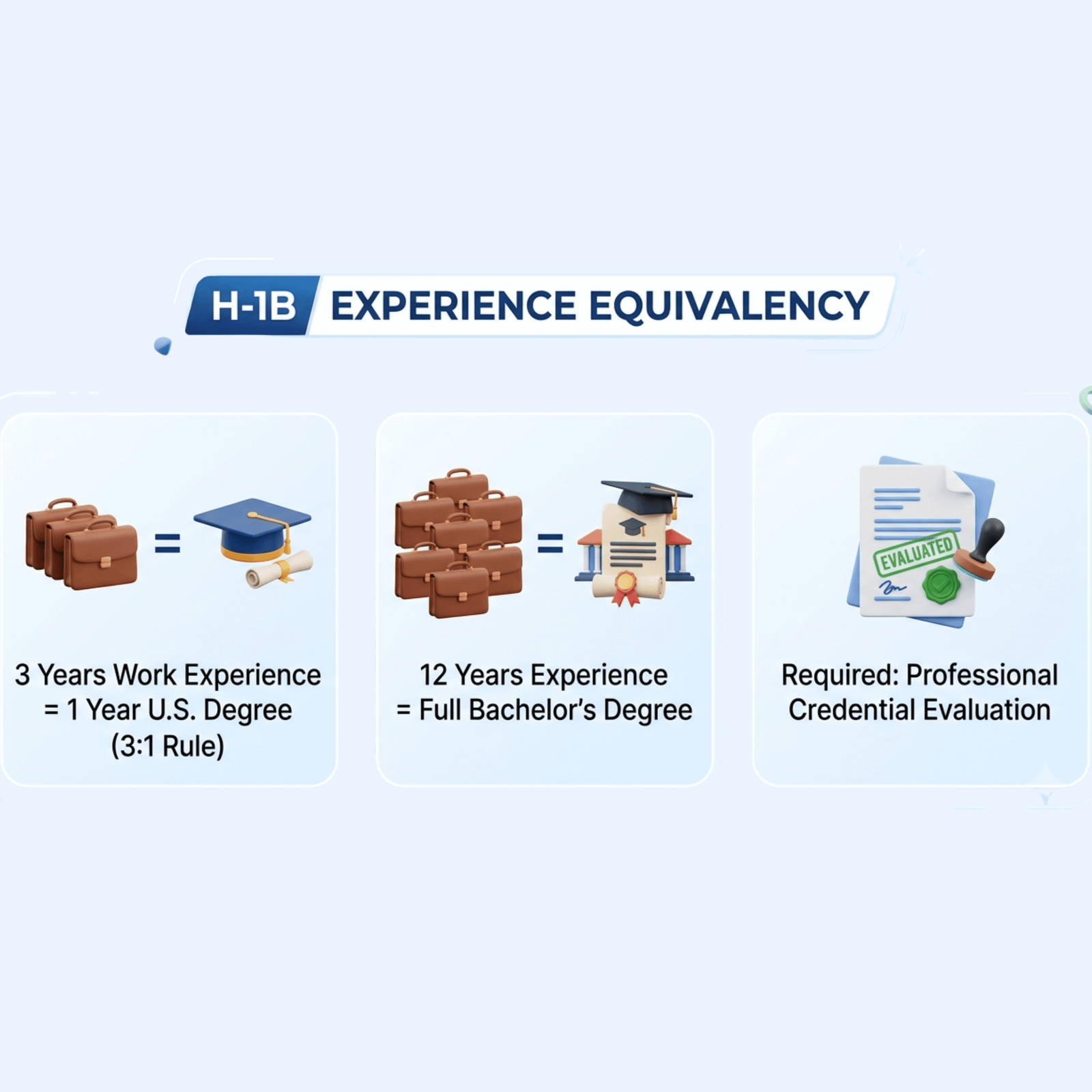
Three Years of Work Experience Equal One Year of Education
This principle is the most important rule to remember. The US immigration laws demand that work experience may replace education on a three-to-one basis.
Here is how it works:
- 3 years of relevant professional experience will replace 1 year of higher education
- This rule is often applied by people with a 3-year degree from abroad, as 3 years of experience can make up for the missing year of education.
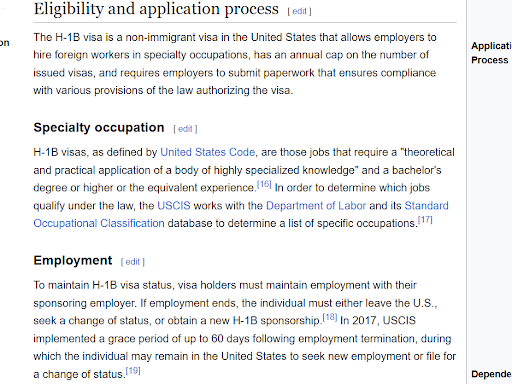
Image Credit – Wikipedia
Twelve Years of Experience Can Substitute a Full Degree
Where formal education is limited, there is an alternative route as well. In some cases, twelve years of progressively responsible experience are considered equal to the four years of a US bachelor’s degree.
This option is only valid under certain conditions, though. One should ensure that one has gained adequate knowledge from one’s experience that is equivalent to one’s degree studies.
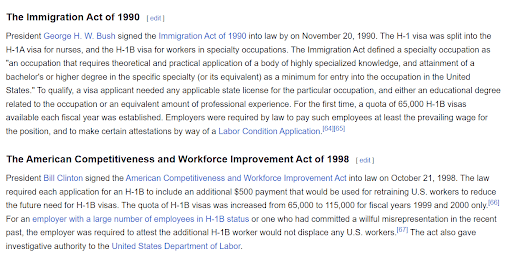
Image Credit – Wikipedia
The Experience Must Be Directly Related
Whether you have three or twelve years of experience, it must relate directly to the job you are applying for.
For example, if you are applying for an H-1B as a software engineer, your experience must be in software engineering or a closely related field. General management experience or experience in an unrelated field will not count.
How to Document Your Experience Properly
You cannot simply state your experience on your resume and expect it to be accepted. The documentation requirements are strict.
- Get a Professional Credential Evaluation: An accredited firm must evaluate your education and experience to formally document that it is equivalent to a US bachelor’s degree.
- Provide Detailed Experience Letters: Letters from former employers must describe your job titles, duties, dates of employment, and any promotions. The letters should show that your responsibilities grew over time, demonstrating progressive responsibility.
A resume alone is not considered sufficient evidence.
Frequently Asked Questions
No, there is no single number of years that applies to everyone. What matters is whether your education and experience together meet the bachelor’s degree or equivalent standard for the specific specialty occupation. USCIS may evaluate qualifying experience using the general three-years-of-progressive-experience-for-one-year-of-college-equivalency approach.
Yes, in some circumstances, an applicant without a bachelor’s degree may qualify through a combination of specialized, progressively responsible work experience and education. A commonly used equivalency approach is approximately three years of qualifying experience for each year of college-level education. The experience must be closely related to the specialty occupation and well documented. An expert opinion letter may also help explain the equivalency.
No, not all work experience automatically counts. USCIS generally focuses on progressively responsible and specialized experience that is relevant to the specialty occupation. Entry-level, repetitive, or non-professional-level work may receive less weight or may be questioned when determining degree equivalency.
A credential evaluation, expert opinion letter, or both may help establish that your education, training, and professional experience meet the knowledge and equivalency requirements for the position. The appropriate documentation depends on the specific facts of the case and the evidence available.
Yes. The employer’s job posting can be relevant because it helps establish the actual educational and experience requirements of the position. If the posting requires a specific degree and does not indicate that equivalent education or experience may be accepted, it may make an experience-based equivalency argument more difficult.
No. USCIS evaluates an expert opinion letter together with the other evidence in the petition, including experience letters, job duties, educational records, and the overall consistency of the case. A well-supported expert opinion letter can strengthen an equivalency argument, but its value depends on the quality of the analysis and supporting documentation.
Final Verdict
No fixed number of years guarantees H-1B approval. What matters is whether an applicant’s degree and experience, taken together, genuinely meet the bachelor’s equivalency threshold under the three-for-one formula.
A formal credential evaluation is what converts this calculation into a finding that USCIS can rely on, rather than one that an officer is left to interpret independently.
Applicants who are uncertain about their standing should obtain a credential evaluation before filing their petition.

Expand Your Knowledge with These H-1B Resources:
- Complete H-1B Visa Guide: Eligibility, USCIS Requirements, RFEs & Petition Process
Understand the H-1B visa process from start to finish, including eligibility requirements, specialty occupation criteria, filing procedures, common USCIS Requests for Evidence (RFEs), required documentation, and practical guidance for employers and foreign professionals preparing successful petitions. - H-1B Visa: Eligibility, Process & RFEs
Learn the H-1B visa eligibility requirements, application process, common USCIS RFEs, filing steps, and how credential evaluations and expert support can strengthen your petition. - Document Evaluation vs. Morningside for H-1B
Compare Document Evaluation and Morningside Evaluations for H-1B work experience evaluations, processing times, pricing, expert services, and USCIS documentation support.
Akash Pundir is the Chief Operating Officer at Document Evaluation LLC, bringing over 5 years of international business operations and legal support experience across the United States, Australia, and India. He has overseen the strategic positioning and analysis of over 1,000+ complex USCIS cases, specializing in guiding expert evaluation teams to draft high-stakes Expert Opinion Letters (EOL), Academic Equivalencies, and defense packets for H-1B, EB-2 NIW, RFEs, and NOIDs. Driven by digital transformation, Akash ensures every evaluation adheres strictly to the latest USCIS legal frameworks and compliance benchmarks.
