

 |
|
Best Evidence for O-1 Visa: What Actually Works and What Doesn’t?

If your O-1 visa petition feels almost there but still ends in RFEs or denials, you’re not alone. Many skilled professionals have strong profiles yet fall short, not due to a lack of successes, but because they present the incorrect kind of evidence. At Document Evaluation, we’ve seen that success isn’t about more documents but the right ones.
You’ve likely heard the O-1 visa is for “extraordinary individuals” but most successful applicants aren’t celebrities. They are professionals who know how to present their work usefully. Under USCIS guidelines, it’s not just what you have done, it’s how well you prove it.
To substantiate your achievements and clear USCIS scrutiny, you can hire our specialized agency to secure an authoritative O-1 visa expert opinion letter.
Why does your O-1 evidence often fail?
Before diving into what works, it helps to understand why so many O‑1 visa petitions get questioned or denied. Based on USCIS guidance and recent judgment trends, the main problem is hardly weak accomplishments, it’s weak proof packaging.
USCIS wants unbiased, third‑party proof that you stand at the top of your field. That means:
- Documents that a reviewer can verify, not just your resume or self‑description.
- Context that shows impact, not just a list of titles or projects.
- Evidence that aligns with specific O‑1 criteria, not a random collection of awards & certificates.
For example, a generic LinkedIn recommendation or vague “best employee” certificate often fails, even if the person is genuinely exceptional.
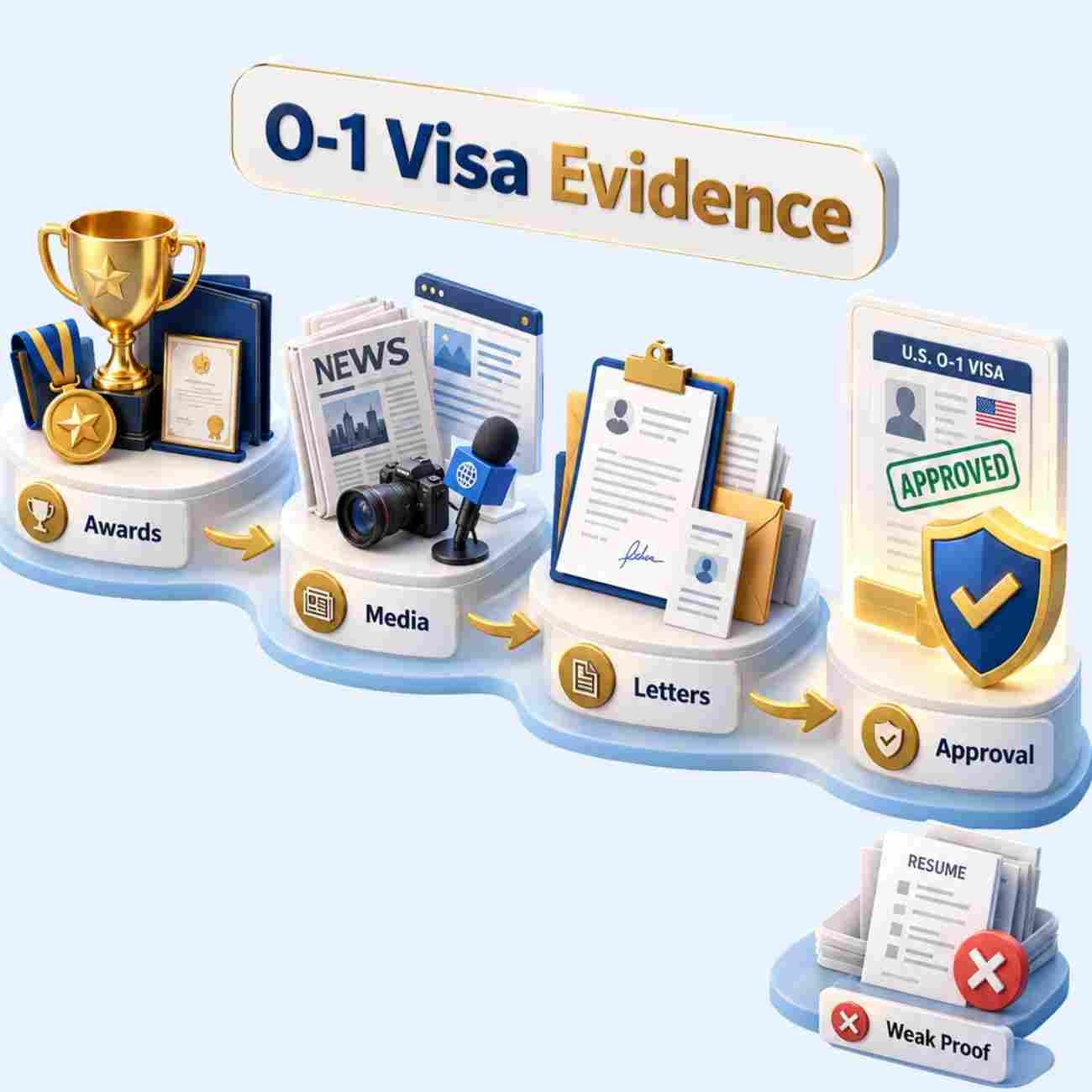
The O-1 evidence framework: 3 things USCIS cares about
To build a strong O‑1 case, you should think in three layers:
1. You meet at least three O-1 criteria
USCIS looks for documented evidence that you meet at least three of the standard criteria for extraordinary ability (for O‑1A) or achievement (for O‑1B). These include things like:
- Nationally or internationally recognized awards
- Membership in associations that need outstanding achievements
- Published material about you in major media or professional outlets
- Original contributions of great significance
- High salary relative to others in your field
- Critical or leading role for famous organizations
- Participation in judging others’ work
- Scholarly publications or important creative output
You don’t need to cover all of them, but the evidence for each selected measure must be clear, dated, and third‑party.
2. The evidence is credible and verifiable
USCIS regularly highlights that it will “reasonably” evaluate the evidence, which means it expects the following:
- Real organizations and publications, not vanity awards or self‑published platforms.
- Documents that can be cross‑checked, such as official award letters, jury letters, press clippings, or contracts.
- Objective proof of impact, such as references, downloads, user numbers, or revenue tied to your work.
For example, a small tech blog post that mentions your name in passing is far less convincing than a feature article in a major industry outlet that explains why your work is important and how it’s being used by others.
3. The overall narrative shows sustained acclaim
Even if you hit three criteria, USCIS evaluates the totality of the evidence. A one‑time award from a low‑profile organization is different from a pattern of recognition over multiple years, including awards, media coverage, peer recognition, and leadership roles.
This is where many strong professionals slip up. They may have excellent achievements, but they present them as isolated facts instead of a clear story of “rising to the top of your field.”
What actually counts as strong evidence (by category)?
Now let’s get specific. Below are the types of evidence that always work for O‑1 petitions, organized by common standard categories and subtle mistakes that weaken them.
Awards and honors
Strong evidence:
- Formal award certificates or plaques with the name of the organization, year, and reason for the award.
- Award announcements on the official website or in a credible publication.
- Jury or judging panel information that shows the award is competitive and meaningful.
Weak evidence:
- Internal “employee of the month” certificates without context.
- Awards where the criteria are unclear or the organization is not much recognized.
Tip – Always include a brief description of the award’s competitiveness, such as how many people applied, how many were selected & what the selection criteria were. This turns a simple certificate into a meaningful data point.
Membership in elite associations
Strong evidence:
Membership letters or IDs that state the association restricts membership to people with outstanding achievements or high skill standards.
Association bylaws or screener pages that explain the membership requirements.
Weak evidence:
- Generic professional memberships that anyone can join with a fee.
- Memberships where the criteria are not clearly tied to “outstanding achievement.”
For example, being part of a national engineering honor society that involves top‑percentile grades or research contributions. Being a general member of a broad professional association is usually not enough on its own.
Published material about you
Media coverage can be powerful. USCIS expects
- Articles, interviews, or features that focus on you personally, not just your company or project.
- Valid outlets in your field (e.g., major tech, business, or arts publications).
- Date, publication name, and URL or page number where possible.
Strong evidence:
- Feature articles that explain your work, its impact, and why it’s notable.
- Interviews where you are quoted as an expert or thought leader.
- Press coverage tied to a major product launch, research breakthrough, or artistic achievement.
Weak evidence:
- Mentions in small newsletters or social‑media‑style posts.
- Coverage that only says “company X launched Y” without mentioning your role.
Tip: Screenshot the article, highlight where you are mentioned, and add a short annotation explaining why this piece matters (e.g., “This article highlights my role as lead architect of the system used by 10,000+ customers”).
Evidence of original contributions and impact
This is one of the most powerful O‑1 criteria, mainly for researchers, engineers, founders, and artists. The key is proving two things: originality & impact.
For researchers and academics
Strong evidence:
- Peer‑reviewed publications in respected journals.
- Citation counts or references showing others are building on your work.
- Letters from independent experts who explain how your research has influenced the field.
Weak evidence:
- Low‑impact or predatory journals.
- Self‑citations or small numbers of citations without explanation.
USCIS now looks at both the quality of the journal & the context of the citations. A small number of highly suitable citations in major journals can be more convincing than a long list of minor ones.
For engineers and tech professionals
Strong evidence:
- Patents or patent applications where you are listed as an inventor.
- Technical documentation or product specs showing your role in designing key systems.
- Metrics that show the impact of your work, such as user growth, performance improvements, or acceptance by major clients.
Example: A software engineer who optimized a core algorithm that reduced server costs by 30% for a company serving millions of users can tie together a patent, internal performance reports & a testimonial letter to show real‑world impact.
For founders and entrepreneurs
Strong evidence:
- Funding rounds, investor term sheets, or cap‑table summaries.
- Accelerator or incubator acceptance letters.
- Press coverage of the company’s growth or your leadership role.
- Revenue or user‑growth data, if you can share it safely.
Weak evidence:
- Generic “startup founder” status without traction or recognition.
- Social‑media metrics presented in isolation.
USCIS wants to see that your company is recognized as significant or that your role as a founder is tied to clear, measurable outcomes.
For artists and creatives
Strong evidence:
- Juried exhibitions, galleries, or festivals that selected your work from many applicants.
- Reviews in reputable arts or cultural publications.
- Awards or prizes from well‑known arts organizations.
- Performance or exhibition contracts that show you are being paid at a high level.
Weak evidence:
- Participation in open‑submission events with no selection criteria.
- Self‑published or very low‑profile reviews.
For O‑1B artists, it’s important to show that your work has been presented to a significant audience and that reviewers or curators view it as exceptional.
Salary and compensation evidence
High salary can be one of the O‑1 criteria, but it only works if it’s meaningfully higher than what’s common for your role, location, and industry.
What to include:
- Recent pay stubs or employment contracts.
- Bonus or equity statements that show total compensation.
- Salary‑comparison data (from reliable sources) showing that your compensation is in the top tier for similar positions.
Common pitfalls:
- Presenting a single number without context.
- Ignoring that USCIS may compare your salary to US standards, not only to salaries in your home country.
For international professionals, it can help to include a brief explanation of how your salary compares to US market rates for similar roles, mainly if you’re working remotely or joining a US-based company.
How to structure your O‑1 evidence (a practical checklist)
To avoid RFEs & make your case easy to approve, think of your evidence as a narrative file, not a random pile of documents. Here’s a simple structure that works well:
-
Cover memo or summary
- One‑page overview of your field, your main achievements, and which O‑1 criteria you are meeting.
- Short timeline showing your rise in the field.
-
Core documents
- Passport, visa history, and basic identification.
- Resume or CV, customized to non‑legal readers (avoid jargon when possible).
- Current employment contract or offer letter, clearly describing your role and expected duties.
-
Detailed evidence by criterion
- Group all documents under each criterion (e.g., “Awards,” “Published Material,” “Original Contributions”).
- Include short captions or brief explanations for each item.
-
Supporting letters and third-party materials
- Expert opinion letters.
- Letters from past employers, collaborators, or clients that confirm special projects or roles.
- Any advisory opinions or opinions from recognized professional bodies, if applicable.
-
Impact and context materials
- Metrics, statistics, or references that show the real‑world effect of your work.
- Screenshots or links to online proof, with dates and source info.
Organizing your file this way makes it easy for USCIS to follow your story and reduces the chances of an RFE asking, “Can you prove this?”
Expert insights: What makes evidence approval‑ready?
Based on our experience handling O‑1‑near cases & document evaluations, there are a few insider points that consistently separate strong petitions from weaker ones.
1. Frame your evidence around USCIS’s two-step test
USCIS typically uses a two‑step analysis:
- Does the evidence show you meet at least three of the O‑1 criteria?
- Even if you meet the minimum, does the totality of the evidence show you are truly at the top of your field?
Most denials happen at step two, when the evidence is real but not clearly tied together. That’s why it’s important to
- Label each criterion.
- Cross‑reference items (e.g., “This award is discussed in Article X”).
- Add brief analytical comments that connect the dots for the adjudicator.
2. Replace vanity metrics with real-world proof
Many applicants focus on “impressive” numbers that don’t mean much to USCIS:
- “I have 10,000 followers.”
- “I speak at 20 conferences.”
Instead, focus on:
- “I was invited to speak at X international conference because my paper was selected from 300+ submissions.”
- “My framework is used by Y companies serving Z customers.”
Real-world impact beats raw numbers every time.
3. Use document evaluation to strengthen weak points
Sometimes the strongest professional evidence is buried in PDFs, slides, or internal reports that aren’t formatted for immigration review. That’s where a document evaluation can help:
- Translate technical documents into clear, USCIS‑friendly explanations.
- Highlight exactly which parts of your CV, awards, or projects meet which O‑1 criteria.
- Suggest additional evidence‑gathering strategies (e.g., reaching out to past collaborators for letters).
This is helpful for international professionals whose achievements are genuine but less familiar to US adjudicators.
Frequently Asked Questions
Can I apply for an O-1 visa without a college degree?
Yes. The O-1 visa focuses on extraordinary ability. While a degree can help, you may still qualify through strong professional achievements, awards, and significant industry contributions.
How many criteria do I need to meet for an O-1 visa?
You must satisfy at least three of the eight O-1A eligibility criteria (or the applicable O-1B criteria). However, stronger petitions often demonstrate four or more criteria with substantial supporting evidence.
Does my extraordinary ability need international recognition?
No. National recognition may be sufficient if you can clearly demonstrate that your achievements are significant and well-recognized within your professional field.
What is a consultation letter for an O-1 visa?
A consultation letter is an advisory opinion issued by a relevant peer group, labor organization, or professional association that supports your O-1 petition. It is required in many O-1 cases unless an exemption applies.
How long does the O-1 visa last?
The O-1 visa is initially granted for up to three years and may be extended in one-year increments as long as you continue qualifying for O-1 employment.
Can I switch employers on an O-1 visa?
Yes. However, your new employer must file a new O-1 petition unless you are already working under an approved agent-based petition that covers the new employment.
Is a document evaluation required for the O-1 visa?
No. A document evaluation is not always mandatory, but it is highly recommended when your education or professional qualifications are based on non-US standards to help strengthen your petition.
Up Next in Our O-1 Visa Guide:
- O-1 visa qualifications and requirements:
Learn the key qualifications and USCIS requirements for the O-1 visa, including evidence of extraordinary ability, major achievements, awards, publications, and professional recognition in your field. This guide explains who qualifies and what documents help strengthen an O-1 petition. - Complete guide to O-1A and O-1B visa requirements:
Understand the differences between O-1A and O-1B visas, eligibility criteria, required evidence, petition process, and USCIS standards for extraordinary ability in science, business, education, athletics, arts, film, and television industries. - Best O-1 Visa Services in the USA:
Discover what to look for in the best O-1 visa service providers in the USA, including expert guidance, document preparation, expert opinion letters, petition support, and strategies that help applicants build stronger O-1 cases and reduce RFEs.
Akash Pundir is the Chief Operating Officer at Document Evaluation LLC, bringing over 5 years of international business operations and legal support experience across the United States, Australia, and India. He has overseen the strategic positioning and analysis of over 1,000+ complex USCIS cases, specializing in guiding expert evaluation teams to draft high-stakes Expert Opinion Letters (EOL), Academic Equivalencies, and defense packets for H-1B, EB-2 NIW, RFEs, and NOIDs. Driven by digital transformation, Akash ensures every evaluation adheres strictly to the latest USCIS legal frameworks and compliance benchmarks.
