

 |
|
How to Translate Documents for a Green Card Application (USCIS Guide 2026)

Applying for a green card? through family, employment, the diversity visa lottery, or another pathway, you’ve spent months or maybe years preparing your green card application. The forms are filled out. The fees are paid. Then USCIS issues a request for additional evidence due to a translation problem in one of your documents.
Document translation for immigration purposes isn’t as simple as running a paragraph through Google Translate and moving on. USCIS has specific, non-negotiable requirements about how foreign-language documents must be handled, and if your translations don’t meet those standards, your entire application could be delayed or denied.
To protect your timeline from avoidable federal scrutiny, you can secure professional assistance with an accurate Document Translation for USA.
Why Does Translation Accuracy Matter So Much For Green Card Applications?
If you are applying for a green card, then check the documents carefully. A wrong date or a misspelled name are the mistakes in your translation that can lead to big problems. USCIS relies on the English translation submitted with your documents when reviewing your application. A small problem can make them question your whole application. That often leads to delays, extra paperwork, denials, and months of waiting.
What USCIS Requires: The Official Translation Standard
Any document containing a foreign language that is submitted to USCIS must be accompanied by a full English language translation that the translator has certified as complete and accurate, as well as by the translator’s certification of their ability to translate from the foreign language into English.
Two things are important here: full translation and certified translator ability.
What “Full Translation” Actually Means
A full translation means you must translate every single word in the document, no exceptions.
This process includes:
- The main writing
- Words at the top and bottom of each page
- Any official stamps or seals
- Any extra notes written in the margins
- Anything handwritten, even if it’s just a date or a signature
What “Certified” Actually Means
Something that confuses many applicants: USCIS does not need a notarized translation or a translation by a licensed professional. They need a certification statement from the translator.
The certification statement includes:
- Translator’s name
- Contact information
- Ability in both languages
- Translation is complete and accurate to the best of their knowledge
- Date and signature
Which Documents Need to Be Translated?
You’re applying for a green card either through Form I-485 in the US or through consular processing. Either way, you’re going to need certified translations for quite a few papers.
Birth certificate: They need to see your full name, date of birth, and your parent’s name, all clearly translated into English.
Marriage certificate: If your green card is based on your marriage then the document is a must. They will want the whole document translated, not just parts of it.
Divorce decree: If you or your spouse were married before, you must show proof that those marriages ended. That means translating every divorce paper you have.
Passport pages: In case you provide passport stamps or pages to support your immigration case and these documents have foreign-language content, they must be translated to English.
Police clearance certificates: According to your immigration procedure and particular needs of a country you are applying to, you might need police certificates, and these certificates should be translated to English.
Military records: If you served in the military back home or anywhere else, you may need to translate those records. It really depends on your specific case, but it is better to be ready.
Court records: If you’ve ever been involved in any criminal case or court proceeding, every single document related to that has to be translated.
Academic records: In case you are applying for the green card from a job, there is a chance that they may ask you for your degrees, transcripts, or other academic documentation. If the above documentation is in a language other than English, you will need to get it translated.
Financial records: If you are filling out the form I-864 which is also known as the Affidavit of Support, you may be asked for your bank statements and tax returns. In case these documents are not in English, then they too will need to be translated.
Medical records: In certain instances, the physician performing the immigration medical examination may ask for your translated medical documents.
Step-by-Step: How to Get Your Documents Translated Correctly
Step 1: Go Through Your Application and Find Every Non-English Document
To start, take your entire application checklist and go through it page by page. Pull out every single document that isn’t in English. And don’t forget about those tricky ones that have both languages on the same page, like some European birth records that show the original language next to an English version. Even if there’s already an English column, you might still need a translator’s certification to go with it, so don’t assume you’re off the hook.
Step 2: Pick Someone Reliable
You’ve got a few choices here, and it really depends on your budget and how comfortable you feel.
If you want the safest option, choose a professional translation agency that specializes in legal or immigration papers. The best ones are usually members of the American Translators Association (ATA) or at least stress that their translations are USCIS-compliant.
Step 3: Send Your Translator Clean, Clear Copies
When you send your documents to the translator, make sure they’re high-quality scans or photos. If there’s a stamp or seal that’s hard to read even on the original paper, tell your translator to add a note like “[Stamp: illegible]” right in the translation.
Step 4: Double-Check the Translation Yourself
Once you get the translation back, carefully read it. You don’t need to be fluent in the other language to catch the basics. Just check that every piece of text got translated, names and dates are exactly the same as what’s on the original, and the layout makes sense and follows the same order as the original document.
Step 5: Attach the Translator’s Certification Statement
Every single translated document needs to have a cover page or a statement attached that includes the translator’s credentials and the official certification wording. Keep the translation and the original paper clipped together as one packet so nothing gets mixed up when you submit.
Step 6: Send Both the Original and the Translation Together
USCIS generally requires a copy of the foreign-language document along with its complete English translation. Never send just the translation by itself. If certified copies are required for your case, make sure they are issued or validated by the appropriate authority.
Digital vs. Physical Translations: What USCIS Accepts
If You’re Filing Online
Ensure you have a clear scan of both your original documents and their translation before uploading them. Remember to include the certificate as well. There is no need for you to post copies of the originals when filing electronically.
If You’re Filing by Mail
You will need to submit physical copies of the original and the translated documents. But one thing to remember here is that you should not submit your original document unless specifically requested to do so by USCIS.
Pro Tip: Always scan everything before you put it in the mail. Keep digital backups of all your documents. If something gets lost in the mail, you can save yourself months of stress and these problems by keeping a copy on your computer.
Country-Specific Translation
Different countries issue documents in different formats. Here are common challenges by region:
| Country/Region | Common Issue | What to Do |
|---|---|---|
| India | Birth certificates often contain handwritten entries in regional languages. | Ensure the translator can accurately read handwritten text, and request a certified copy from the municipal authority if needed. |
| China | Notarial certificates include official red seals. | Translate all text appearing on the seal, not just the main document content. |
| Mexico | Acta de Nacimiento documents contain multiple sections, stamps, and marginal notes. | Translate every section, stamp, signature, and marginal annotation without omissions. |
| Philippines | PSA-issued documents contain security features and watermarks. | Include a translator’s note describing any visible security features or watermarks. |
| Middle East | Official documents may use Hijri calendar dates. | Convert Hijri dates to the Gregorian calendar and clearly note the conversion in the translation. |
| Europe | Some countries issue bilingual documents (e.g., French/English). | You may still need a certified translator’s certification even if the document already contains English text. |
Important: If your document is from a country with a non-Roman script (e.g., Arabic, Chinese, Hindi, Russian), ensure your translator is specifically experienced with that script.
How Much Does Certified Translation Cost: Document Evaluation
Pricing varies based on language pair, document complexity, and turnaround time.
| Service | Economy | Standard | Express |
|---|---|---|---|
| Translation | $30 (2–3 Days) |
$50 (Next Day) |
$70 (Same Day) |
Can You Reuse a Translation from a Previous Visa Application?
If you have applied for a US visa before, you might already have translated documents. You can sometimes reuse them. But not always.
You are safe to reuse a translation if nothing has changed in the document; it was done by a certified translator, the certification statement still meets current USCIS rules, and the document itself is still valid, like a birth certificate.
However, you will need a fresh translation if the document has been updated, the original translator cannot be verified, the certification is incomplete or outdated, USCIS requirements have shifted, or you are now applying under a different immigration category.
Review older translations carefully before reusing them and make sure the certification statement still meets current USCIS requirements.
Frequently Asked Questions
Do You Need a Notarized Translation to Submit to USCIS?
When submitting translation documents to USCIS, an appropriate certified translation signed by the translator is required, but notarization is generally not required.
Can I Translate My Document?
USCIS does not specifically prohibit self-translation, but using an independent qualified translator is strongly recommended. The translator must certify that the translation is complete and accurate.
Which Languages Are Commonly Used for Green Card Translations?
Spanish, Mandarin, Hindi, Tagalog, Vietnamese, Korean, and Arabic are among the most commonly used languages for Green Card translations. Translation requirements remain the same regardless of the language used.
What if an Original Document Is Damaged or Partially Illegible?
A competent translator should translate the original document while marking unreadable sections with notes such as “[text illegible].” If the document is severely damaged, you may need to obtain a duplicate from the issuing agency.
Do I Need New Translations for Previously Processed Visas?
Previously translated documents can often be reused if the original document has not changed and the certification statement remains complete and accurate.
What Will Happen if My Translated Documents Contain Translation Errors?
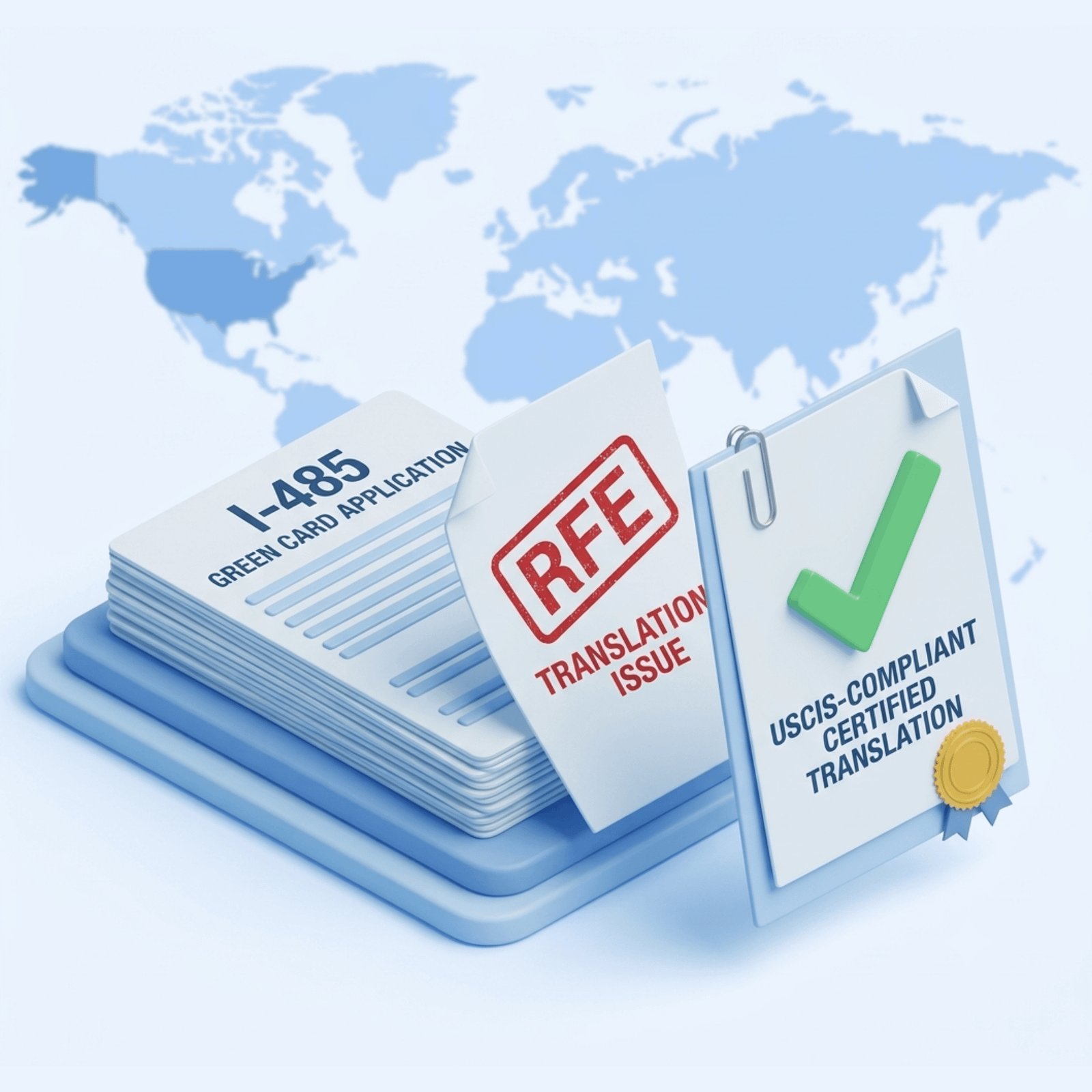
In most cases, USCIS may issue a Request for Evidence (RFE) asking for corrected translations or additional clarification.

Explore certified translation guidance and USCIS-compliant immigration document preparation resources:
- Complete Guide to Translating Documents for U.S. Visa and Immigration Applications
Understand how to properly translate passports, birth certificates, marriage records, financial documents, and supporting evidence for U.S. visa applications. This guide explains certified translation requirements, formatting standards, translator certifications, and document submission best practices. - How Certified Translation Services Help Avoid USCIS RFEs and Processing Delays
Explore how translation inaccuracies, incomplete certifications, and formatting issues can trigger Requests for Evidence (RFEs) during immigration processing. Learn how professionally prepared certified translations improve document accuracy, compliance, and USCIS review efficiency. - Why Translated Documents Get Rejected and How to Avoid It
Learn why USCIS rejects translated documents and how to avoid common translation errors. Follow key requirements to ensure accurate, complete, and properly certified documents.
Akash Pundir is the Chief Operating Officer at Document Evaluation LLC, bringing over 5 years of international business operations and legal support experience across the United States, Australia, and India. He has overseen the strategic positioning and analysis of over 1,000+ complex USCIS cases, specializing in guiding expert evaluation teams to draft high-stakes Expert Opinion Letters (EOL), Academic Equivalencies, and defense packets for H-1B, EB-2 NIW, RFEs, and NOIDs. Driven by digital transformation, Akash ensures every evaluation adheres strictly to the latest USCIS legal frameworks and compliance benchmarks.
