

 |
|
EB-1A Approval Rate 2026: Real Numbers and Why Self-Petitions Fail

- EB-1A approvals are tougher in 2026 due to stricter USCIS review.
- Meeting 3 criteria alone isn’t enough because final merits review is important.
- Strong, well-organized evidence is essential for approval.
- Self-petitions usually fail due to poor documentation and lack of impact.
- Customized expert support can strengthen an EB-1A petition.
The rate of EB-1A approval in 2026 remains a point of interest for elite individuals wishing to settle permanently in the USA. While the category caters to people of extraordinary talent, recent statistics reveal that assessing the requests has become more thorough and complex. The USCIS is paying more attention to the authenticity, relevance, and validity of evidence provided in support of the application.
Therefore, the EB-1A approval figure for 2026 can be considered an important factor to evaluate the level of scrutiny applied to the appeals. Those aware of the changes in the interpretation of the standards have a better chance of having their cases accepted.
To validate your extraordinary achievements and satisfy strict adjudication guidelines, you can hire our specialized agency to secure a comprehensive EB-1A visa expert opinion letter.
What Is the EB-1A Approval Rate in 2026?
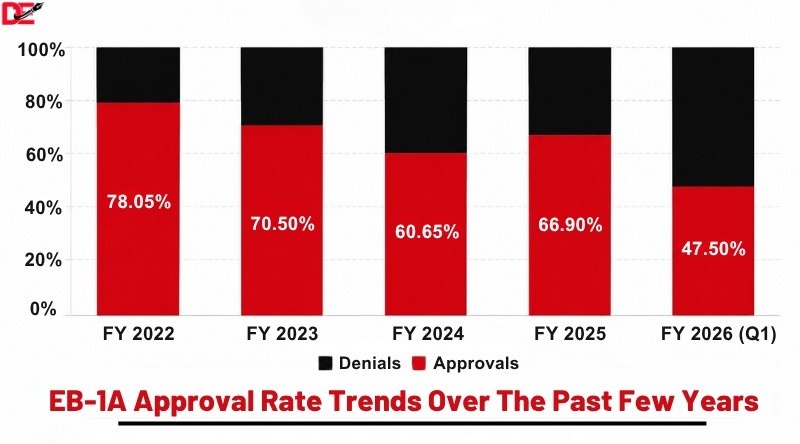
The EB-1A visa approval rate indicates the ratio of Form I-140 applications submitted under the category of exceptional ability that USCIS has processed within a certain period. The experts studying immigration have determined with reference to the publicly available USCIS adjudication statistics that the nation’s EB-1A approval rate for the fiscal year 2025 is about 66.90%, which is the equivalent of two out of every three applications filed being approved.
In the early months of FY block 2026, statistics indicate even lower figures around 47.50% because of the rigorous criteria that must be met during the application process, especially during the merit stage. Importantly, approval rates are not constant and will not remain unchanged in the future.
EB-1A Approval Rate Trends Over The Past Few Years
| Fiscal Year | Approx. Approval Rate |
| FY 2022 | 78.05% |
| FY 2023 | 70.50% |
| FY 2024 | 60.65% |
| FY 2025 | 66.90% |
| FY 2026 (Q1) | 47.50% |
Now filing an EB-1A petition is a different process than it was a few years ago. Now USCIS looks at all your evidence together, not just whether you meet 3 or 4 criteria.
Why Is the EB-1A Approval Rate Declining?
The falling rate of EB-1A approvals can be considered a consequence of a USCIS evolution. The decision-makers no longer limit their work to confirming the mere existence of an accomplishment; they also focus on understanding the essence of the accomplishment. Now it is clear that only those cases that include adequate arguments, proper documentation, and well-grounded arguments will not raise any questions.
In addition to that, the number of applications has increased recently, which has naturally made the process of selecting applications unreasonably selective. Therefore, the low EB-1A approval rate in 2026 must be understood as far as a different approach is established.
Does a Lower Approval Rate Mean EB-1A Has Become Impossible?
NO, The approval rate indicates how successful the past petitions were without distinguishing between those that were well-prepared and those without sufficient documentary evidence.
Those applications that are prepared correctly get approved. USCIS has not introduced any new criteria concerning EB-1A eligibility. Rather, the focus has been on enforcing the existing regulations and examining the authenticity of the submitted proof.
Why Are EB-1A Petitions Facing More Scrutiny in 2026?
EB-1A petitions are facing increased scrutiny in 2026, making it more important than ever for applicants to present strong, well-documented cases. Here are some of the key reasons:
1. USCIS Is Reviewing Evidence More Thoroughly
Officers are no longer simply verifying that you’ve technically satisfied 3 out of 10 criteria. “They’re looking at it more closely as to whether you can actually prove sustained acclaim at a national or international level and whether you actually belong to top people in your field.
2. More Petitions Are Being Denied At The Final Merits Determination
Meeting three criteria doesn’t automatically mean approval. USCIS assesses all evidence collectively during the final merits determination. If the evidence altogether doesn’t feel convincing enough, the petition gets denied.
3. More Self-Petitions Are Being Filed Without a Strong Strategy
EB-1A doesn’t need an employer to sponsor you; more people are choosing to self-petition. But many of these filings lack sufficient evidence or a clear strategy, which can significantly delay your chances.
What Makes an EB-1A Petition Strong?
The USCIS has a strong preference for documentation that others can verify, like
- Awards, National or International
- Published work
- Citation reports
- Patents
- Conference invitations
- Judge or peer reviews
- Memberships that require performance
- Evidence of high responsibilities
The stronger and less subjective the proofs are, the more easily the specialists will be able to assess the performance.
Do RFEs Affect the EB-1A Approval Rate?
Yes! An RFE, also known as a Request for Evidence, will not lead to an automatic rejection of your petition. Rather, it means that USCIS needs more confirmation prior to reaching a conclusion.
Possible RFE triggers comprise the following:
- Necessary evidence is missing to prove a requirement
- Proof of the significance of the contribution is absent
- Insufficient information provided about the contribution made by an applicant.
- No translation/proofs provided.
- Evidence of continuous acknowledgement is lacking.
Despite these challenges, replying to an RFE the right way can return a favorable outcome.
However, even well-qualified applicants can get an RFE if their documentation is not clear enough or does not show continuous recognition either nationally or internationally. Before submitting your application, visit EB-1A RFE Common Reasons and How to Respond to learn about the typical issues raised by USCIS and how to handle them.
How Can Document Evaluation Support Your EB-1A Petition?
An effective EB-1A filing needs good evidence that meets USCIS requirements. Document evaluation will help to make your petition more successful through evaluation & documentation services, such as
- Expert opinions from professors & industry experts
- Foreign credential evaluation
- Document translation
- Support for RFE responses
- Petition evaluation for clarity and organization
Whatever the case is, Document Evaluation will assist you with creating a stronger EB-1A petition.
Frequently Asked Questions
Where does the EB-1A approval rate actually stand in 2026?
The EB-1A Q1 FY 2026 approval rate is around 47.5%. Quite a drop from 66.9% in FY 2025. Basically, roughly one out of every two petitions being filed right now is getting denied.
Is it possible to self-petition for EB-1A without hiring a lawyer?
Yes, EB-1A doesn’t need an employer to sponsor you, so self-petitioning is totally allowed. But with approval under 47.5% right now, getting professional guidance is a good idea. It helps you organize your evidence properly, build a narrative that actually holds together, and avoid the mistakes that usually lead to denials.
Why do so many self-petitions end up failing?
The same issues keep showing up weak proof of extraordinary ability, generic recommendation letters, skipping the final merits determination, messy or disorganized evidence, and not meeting at least three of the ten regulatory criteria.
How many criteria actually need to be met?
At least 3 out of the 10 regulatory criteria, or proof of a major internationally recognized award like a Nobel Prize. But meeting the criteria is just step one, and after that USCIS still runs a separate final merits review.
What does “final merits determination” actually mean?
It’s the second stage of USCIS. Even after clearing 3+ criteria, USCIS still steps back and looks at your evidence as a whole, checking whether you genuinely show sustained national or international acclaim and actually belong among that small top percentage in your field.
Conclusion
EB-1A approval in 2026 is more difficult than in previous years. USCIS has stricter rules. But it doesn’t mean you can’t still succeed. Petitions that are well-prepared and genuinely evidence-driven are still getting approved. The real question is whether you understand what USCIS is actually looking for: sustained acclaim, measurable impact, and a narrative that ties everything together instead of reading like a list of disconnected facts.
Avoid the common mistakes that turn up self-petitioners; add real effort into strong expert letters and well-organized documentation, and don’t hesitate to bring in professional support if it strengthens your case. With the right strategy and enough preparation, this environment is still navigable, and approval is still very much within reach.

Learn More About EB-1A Petitions & USCIS Requirements
- Understanding EB-1A Eligibility, Requirements & the Green Card Process:
Learn the complete EB-1A eligibility requirements, qualifying criteria, filing process, required evidence, and practical tips to strengthen your Extraordinary Ability green card petition. - Common EB-1 RFEs and How to Build a Strong Response:
Explore why USCIS issues EB-1 RFEs, how to identify weak areas in your petition, and the best strategies for preparing a well-supported response that improves your approval chances. - Using Expert Opinion Letters to Strengthen EB-1 Petitions:
Explore how professionally prepared Expert Opinion Letters help prove extraordinary ability, explain original contributions, and reinforce key EB-1A eligibility criteria before USCIS.
Akash Pundir is the Chief Operating Officer at Document Evaluation LLC, bringing over 5 years of international business operations and legal support experience across the United States, Australia, and India. He has overseen the strategic positioning and analysis of over 1,000+ complex USCIS cases, specializing in guiding expert evaluation teams to draft high-stakes Expert Opinion Letters (EOL), Academic Equivalencies, and defense packets for H-1B, EB-2 NIW, RFEs, and NOIDs. Driven by digital transformation, Akash ensures every evaluation adheres strictly to the latest USCIS legal frameworks and compliance benchmarks.
