

 |
|
Dhanasar Prong 3 RFE: How To Address The Balancing Test And Labor Waiver


- Address each concern raised in the Prong 3 RFE.
- Explain why waiving labor certification benefits the United States.
- Support your claims with relevant documents and evidence.
- Show why your contributions matter, even if qualified U.S. workers are available.
- Make sure your response follows the RFE deadline and submission instructions.
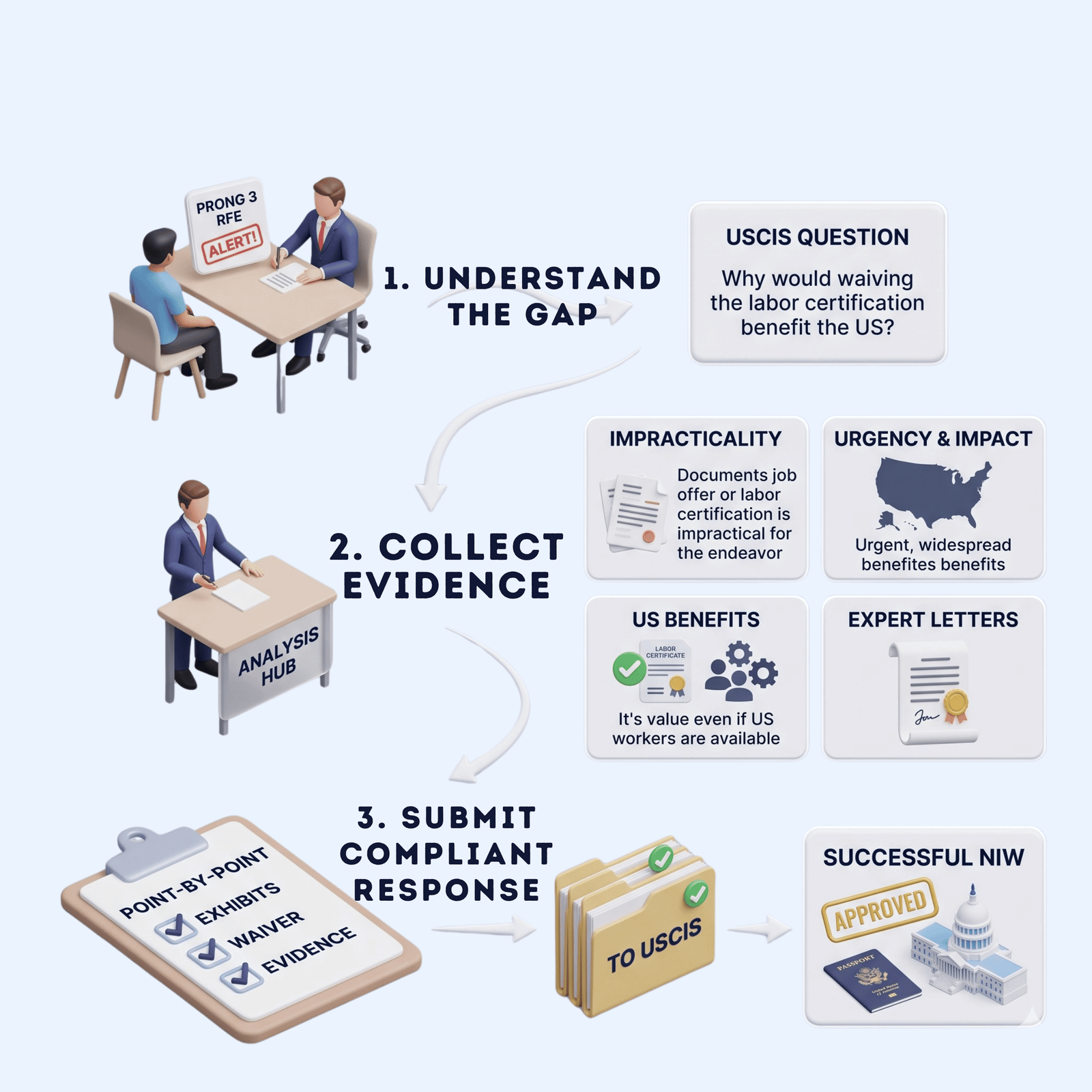
- An Expert Opinion Letter may help explain complex issues, but it cannot guarantee approval.
If you received a Prong 3 RFE, USCIS has not yet accepted that waiving the job offer and permanent labor certification requirements would benefit the United States in your case. The officer may agree that your endeavor is important and that you are well positioned to advance it but still find that your petition never explains why a waiver is justified.
Prong 3 asks whether, on balance, it would be beneficial to the United States to waive the job offer requirement and, with it, the labor certification requirement. Your response should start with the exact concern stated in the notice, tie your circumstances to that balancing analysis, and show how your documents support the argument. Extra publications, degrees, or recommendation letters help only if they speak to that concern.
💡 Next Step: To strengthen your EB-2 NIW RFE response, consider our EB-2 NIW RFE Response Solutions for support in addressing USCIS concerns and organizing relevant supporting evidence. We also offer express delivery within 1–3 days at competitive prices, helping you meet tight deadlines with a solution tailored to your notice.
What Is A Dhanasar Prong 3 RFE?
A Dhanasar Prong 3 RFE is USCIS asking for more evidence or an explanation on the third part of the Matter of Dhanasar test.
Matter of Dhanasar, 26 I&N Dec. 884 (AAO 2016), is the precedent decision that sets out how NIW petitions get judged. It has three prongs. The third asks whether, on balance, the US would benefit from waiving the job offer and labor certification requirements.
Some background on why that matters: labor certification exists to protect US workers. The employer has to show that hiring the foreign worker won’t hurt the wages or working conditions of similar US workers. An NIW lets USCIS skip the job offer, and with it the labor certification, when the national interest justifies it. So Prong 3 is really a comparison between what the US gains from the waiver and what the normal process is meant to protect.
In most of these RFEs, the officer is saying the endeavor sounds worthwhile, but you haven’t explained why the waiver itself is justified. What exactly bothers them differs from notice to notice. Some question whether labor certification even makes sense for your situation. Others want more information on the benefits your work will bring or on how you reached your balancing conclusion.
So before anything else, read the notice carefully and pin down what USCIS says is missing. Don’t assume every Prong 3 RFE asks for the same evidence.
Why USCIS May Question The Prong 3 Balancing Test
Most weak Prong 3 arguments have the same problem: the evidence is decent, but it never gets tied back to the waiver. The petition might have solid information about the industry, the applicant’s background, and the value of the work, but it still might not explain why the waiver should be granted.
-
It Explains National Importance But Not Why A Waiver Is Needed
Showing that your work could improve healthcare, strengthen cybersecurity, or push research forward is mostly Prong 1 material. Prong 3 asks something different: why would the US be better off letting you do this work without a job offer and labor certification? Saying the industry matters doesn’t answer that. You need to show how your contributions and your situation make a waiver more likely.
-
It Leans Too Strong On Qualifications
Degrees, publications, awards and years of experience show you’re accomplished. They don’t show that the national interest favors skipping labor certification. What helps is connecting them to the endeavor. If you’ve spent years building a particular technology, say what that means for the work you plan to do and the benefit it would bring. Then explain why that, along with everything else in the record, supports a waiver.
-
The Claimed Benefits Aren’t Backed Up
Statements like “this will create jobs” or “this will make the US more competitive” don’t count for much if the record doesn’t show how the endeavor would get there. Keep what’s already happened separate from what you expect to happen. Contracts, project milestones, research partnerships & letters showing real stakeholder interest can support specific claims. If a benefit is still in the future, explain why you expect it instead of presenting it as certain.
-
The Labor Certification Argument Is Generic
“I want to work independently” or “I plan to start a company” or “I don’t want to depend on one employer” doesn’t prove the normal process is impractical, and it doesn’t prove a waiver helps the US. The argument has to fit your actual endeavor. A research program with several collaborators raises different practical issues than a regular job with a single employer. Whether those issues justify a waiver depends on the evidence and the overall balance.
-
It Makes Unsupported Claims About US Workers
The USCIS Policy Manual says directly that a shortage of workers in an occupation doesn’t satisfy Prong 3 on its own. Focus instead on the specific contribution you’d make and why the national interest in that contribution supports the waiver, even if qualified US workers exist.
What USCIS Considers Under The Third Prong Of Matter Of Dhanasar
Matter of Dhanasar lists these factors: (1) whether, in light of the nature of the petitioner’s qualifications or the proposed endeavor, it would be impractical either for the petitioner to secure a job offer or to obtain a labor certification; (2) whether, even assuming that other qualified US workers are available, the United States would still benefit from the petitioner’s contributions; and (3) whether the national interest in the petitioner’s contributions is sufficiently urgent to warrant forgoing the labor certification process.
-
Whether A Job Offer Or Labor Certification Would Be Impractical
The endeavor and your qualifications may show why the usual employment-based route doesn’t fit. Say you’re an entrepreneur building a business that serves several clients, rather than taking a permanent job with one employer. Your business model, planned activities and actual arrangements can help explain that. Just calling yourself an entrepreneur won’t get you there.
Researchers, consultants, engineers and other professionals are in the same position. Name the specific practical problem and back it with facts. You don’t have to prove that labor certification is legally impossible in every situation.
-
Whether The United States Would Benefit Even If Qualified US Workers Were Available
Here USCIS asks whether your contributions are valuable enough to justify a waiver, assuming qualified US workers exist.
The difference is easy to miss. You can show that a field needs skilled people and still not explain why your particular work justifies skipping the normal process. Specialized work, a track record of contributions, or a credible plan for wider benefits can make that link. Don’t put down US workers or claim no American could do what you do. Explain what your contribution is worth in the circumstances of your case.
-
Whether The National Interest Warrants Forgoing The Labor Certification Process
Urgency can matter too. A time-sensitive public health effort, a documented safety concern, or research on a pressing technical problem can show why delay is costly. But you don’t need to prove a national emergency or point to a fixed deadline. Urgency is one factor among several. If you rely on it, describe the need and explain why timing matters for what you plan to do.
-
How The Factors Work Together
Prong 3 is a balancing test. You don’t win or lose by producing a separate document for each factor.
One petition might make a strong case that labor certification is impractical and also shows real benefit even if US workers are available. Another might lean mostly on the nature and expected impact of the endeavor. USCIS weighs everything together.
What you’re really trying to show is that the facts support one conclusion: granting the waiver would benefit the US more than keeping the usual job offer and labor certification requirements.
What Evidence Can Help Address A Prong 3 RFE?
The right evidence depends on what USCIS says is missing. A document is worth adding only if it backs up a specific factual claim and helps answer the question in the notice.
| Evidence Category | How It May Support Prong 3 | Important Limitation |
| Proposed endeavor statement or detailed plan | Spell out the work, the contributions you intend to make, and why a waiver would benefit the US | Listing general goals doesn’t show the waiver is worth granting. |
| Project records, contracts, or research documentation | Backs up claims about ongoing work, commitments, or expected contributions. | The documents have to tie to your actual endeavor and the point you’re arguing. |
| Business records, funding, or customer interest | Can show an entrepreneurial endeavor is feasible and support claims about economic benefit or job creation. | Business plans and projections aren’t guaranteed outcomes, so don’t present them that way. |
| Evidence of previous contributions | Shows what kind of work you’ve done and how significant it was, especially if you plan to continue or expand it. | Past achievements alone don’t prove the waiver is beneficial. |
| Independent expert opinion letter | Can explain technical issues and why your documented contributions matter. | An expert can’t fill in missing facts or decide the legal outcome. |
| Evidence of time-sensitive needs | Can support an argument that delay could hurt an important national interest. | Don’t exaggerate urgency or claim it without facts. |
| Documentation about the employment arrangement | Can explain why a standard job offer or labor certification doesn’t fit your situation well. | Being independent or self-employed isn’t enough to establish eligibility. |
Connect each document to a specific concern
Say the RFE questions whether you’ve explained the benefit of the waiver beyond the importance of your field. Piling on more general industry reports probably won’t fix that. A better response says what those reports show, how your documented work relates to the need they describe, and why your circumstances support a waiver.
An exhibit list or evidence index helps you stay organized, but it isn’t analysis. Every important factual claim needs a record behind it, and your written explanation should make the link obvious.
No single category is required in every case. What matters is closing the actual gap in the evidence without adding material that has nothing to do with it.
How To Respond To A Dhanasar Prong 3 RFE
An EB-2 NIW RFE response should be built around what the notice asks. Resubmitting the original petition with additional pages does not address the officer’s concerns.
- Read the exact RFE language: The notice states why USCIS questions the third prong, and sometimes it gives more than one reason. If several concerns are raised, each one needs a reply.
- Separate the prongs: Some notices deal only with Prong 3. Others also question national importance, the petitioner’s ability to advance the endeavor, or basic EB-2 eligibility. Each is measured against its own legal standard, so the response should take them one at a time.
- Review the original submission: Go through the arguments that were made and the evidence behind each, and mark any place where the connection to the waiver was unclear or incomplete.
- Build a case-specific balancing argument: It should rely on the considerations that apply to this petitioner’s circumstances and explain why the waiver is beneficial. A general statement that the work is valuable is insufficient.
- Match claims with supporting evidence: Every important assertion should point to a specific document. A claim about future benefits needs an explanation of how the projection was reached, and it should be presented as a projection, not as an established result.
- Check consistency across the record: The endeavor statement, expert letters, business or research plans, and employment information should describe the same work. Any conflicting description or unsupported change should be found and corrected before filing.
- Follow the notice’s submission requirements: The RFE sets a response deadline and delivery instructions, and both have to be observed. What the response should contain depends on the actual notice and the existing record.
The aim is to resolve the concern USCIS raised. A longer petition won’t do that, and no structure or set of exhibits guarantees approval.
EB-2 NIW RFE Reasons And How To Respond depend on the concerns USCIS raises in a petition. These may relate to the proposed endeavor’s national importance, the applicant’s qualifications, or the evidence supporting a waiver of the job offer requirement. The response should address the specific issues mentioned in the RFE and include relevant supporting documents.
Why Choose Document Evaluation LLC For Your Dhanasar Prong 3 RFE?
Prong 3 is where USCIS decides whether the United States is better off waiving the job offer and labor certification for you. If your RFE questions that, your response has to explain why your work and your proposed endeavor justify the waiver. We prepare expert opinion letters and supporting documentation that speak to this argument using your own professional record.
Here is what you can expect from us:
- An expert opinion letter written by an independent expert after reviewing your background, achievements, endeavor, and evidence, never a template with your name filled in
- Access to 140+ professors and top field experts across 50+ fields, with profiles to review so you can choose the expert you want
- Supporting documentation tailored to the concerns USCIS raised in your RFE
- Unlimited revisions until you’re satisfied with the final version
- 24/7 support whenever you have a question during the process.
- Express delivery is available within 1–3 business days if you need your RFE documentation on an expedited timeline.
A good letter explains the technical or professional importance of what you have done and ties it to your endeavor, especially in areas where a non-specialist officer may need context.
When To Seek Professional Help With A Prong 3 RFE
Reviewing an RFE with qualified immigration counsel makes sense when the notice raises several legal issues, disputes how the proposed endeavor was understood, or points to problems that cut across all three Dhanasar prongs.
A lawyer can work out the legal strategy for the response and explain how the notice applies to this particular petition. Documentary support and expert evaluation are a different kind of help. They come in when the evidence needs organizing or when a specialized issue needs explaining.
Before paying for a new letter or evaluation, look again at what was filed the first time and at what the RFE says is missing. Sometimes more expert analysis would fill a real gap. Other times the actual problem sits somewhere else, and a new letter wouldn’t touch it.
Official sources:
- Matter of Dhanasar, 26 I&N Dec. 884 (AAO 2016). The foundational precedent establishing the three-prong NIW framework and explaining the balancing test. Read the official decision from the US. Department of Justice.
- USCIS Policy Manual, Volume 6, Part F, Chapter 5. The principal USCIS policy source for NIW eligibility, the three prongs, and relevant evidentiary considerations. Read the USCIS Policy Manual.
- USCIS, Employment-Based Immigration: Second Preference EB-2. Official information about the EB-2 classification and its eligibility framework. Read the USCIS EB-2 page.
- US Department of Justice, Executive Office for Immigration Review, DHS/AAO/INS Decisions. Official index for published immigration precedent decisions. Use this resource to verify a decision’s status before citing it as binding authority. Browse the official decisions index.
*Legal note: This article provides general educational information, not legal advice for an individual immigration petition.
Frequently Asked Questions
What does a Dhanasar Prong 3 RFE mean?
USCIS wants more evidence or a clearer explanation of why waiving the job offer and permanent labor certification requirements would benefit the United States on balance. Exactly what it is asking for depends on how your notice is worded, so read that language before anything else.
What is the balancing test in an EB-2 NIW petition?
USCIS compares what the United States gains from waiving the job offer and labor certification against the interests those requirements normally serve. In your case it may look at whether labor certification is practical for the work you propose, whether your contributions would still be valuable if qualified U.S. workers were available, and whether the national interest is urgent.
Do I have to prove that no qualified U.S. workers are available?
You don’t. Prong 3 has no blanket requirement like that. What you do have to show is why the waiver benefits the United States given the facts of your own case.
Does a Prong 3 RFE mean my EB-2 NIW petition will be denied?
No, an RFE is a request for more information and a denial hasn’t been issued. You get the chance to answer USCIS’s concerns, and the outcome will depend on your response, the evidence in the record, and the legal standard. Approval can’t be promised either way.
Can an Expert Opinion Letter help respond to a Prong 3 RFE?
Sometimes. If a qualified, independent expert can explain why your documented contributions matter, or clarify a technical point connected to your waiver argument, the letter may add something useful. It won’t make up for evidence missing from your record, and it won’t guarantee the result.
Is a business plan required to satisfy the third prong?
Prong 3 doesn’t require one. If your endeavor is entrepreneurial, a business plan may be relevant, but it depends on what you propose to do. Choose evidence that fits your endeavor and speaks to the concern stated in your notice.
Can strong evidence for Prong 1 and Prong 2 automatically satisfy Prong 3?
It can’t. Whether your work is nationally important and whether you can advance it are different questions from whether the waiver itself benefits the United States. Some of your evidence may count toward more than one prong, but your Prong 3 argument still needs to deal with the balancing test directly.

Explore Dhanasar Prong 1 & 2 RFE defense strategies and complete EB-2 NIW filing rules below:
- Dhanasar Prong 1 RFE: How to Prove National Importance
Learn how to address a Dhanasar Prong 1 RFE by showing the substantial merit and national importance of your proposed endeavor with clear evidence and supporting documents. - Dhanasar Prong 2 RFE: How to Prove You Are Qualified
Learn how to respond to a Dhanasar Prong 2 RFE by highlighting your qualifications, experience, skills, and achievements to show you are well positioned to advance your proposed endeavor. - What Is the EB-2 NIW Visa: Complete Guide
Serves as a comprehensive roadmap for the National Interest Waiver green card pathway, covering advanced degree thresholds, the three Matter of Dhanasar prongs, and step-by-step self-petitioning procedures without PERM certification.
Akash Pundir is the Chief Operating Officer at Document Evaluation LLC, bringing over 5 years of international business operations and legal support experience across the United States, Australia, and India. He has overseen the strategic positioning and analysis of over 1,000+ complex USCIS cases, specializing in guiding expert evaluation teams to draft high-stakes Expert Opinion Letters (EOL), Academic Equivalencies, and defense packets for H-1B, EB-2 NIW, RFEs, and NOIDs. Driven by digital transformation, Akash ensures every evaluation adheres strictly to the latest USCIS legal frameworks and compliance benchmarks.
