

 |
Can You Get EB-2 NIW Without Publications?

- Publications are not required for EB-2 NIW.
- You must meet the EB-2 eligibility criteria.
- Your evidence must support all three Dhanasar prongs.
- Work experience and proven results can strengthen your case.
- USCIS reviews your entire petition, not just your publications.
You’ve got the degree, a few solid years in your field, and a clear idea of what you want to do in the US What you don’t have is a single published paper. So is an EB-2 NIW still possible?
Yes, it is possible. Publications are not a formal requirement for an EB-2 NIW petition. However, you must qualify for EB-2 and demonstrate that your proposed endeavor satisfies all three requirements under the Matter of Dhanasar framework.
That means your file has to explain three things: what you plan to do, why it matters to the country, and why you’re the right person to pull it off. Your work history, projects, and results can carry that argument. A missing byline on a journal article doesn’t decide the outcome. The overall strength of your record does matter.
💡 Next Step: Without publications to rely on, securing independent validation through professional assistance becomes critical to strengthening your case. Hire our specialized agency to Get Professional EB-2 NIW Expert Letter Service and ensure your industry achievements are authoritatively documented for USCIS.
Can You Get An EB-2 NIW Without Research Papers?
Yes, USCIS has no rule saying every NIW applicant must have published papers or journal articles. Your case rests on two things: meeting the basic EB-2 requirements and passing the three-part test from Matter of Dhanasar, the precedent decision officers use for national interest waivers.
Publications are only one kind of proof. Say you’re an engineer. Your finished projects, patents or technical reports can show what your work actually delivered. If you work in business, growth numbers, industry contributions or projects that move the wider economy, you can do the same job. Researchers usually have papers to point to, but if you don’t, that alone won’t make you ineligible.
The thing to remember is that every claim in your petition needs evidence behind it. A degree or many years on the job won’t carry the case by itself. You still have to show why your proposed endeavor deserves the waiver.
What Are The EB-2 NIW Requirements Without Publications?
Before USCIS looks at your national interest waiver request, you first have to qualify for EB-2 itself. There are two ways to do that.
1. Qualify Through An Advanced Degree
If you hold a US advanced degree or a foreign equivalent, you’re covered. There’s also a second path: a US bachelor’s degree (or foreign equivalent) plus at least five years of progressive experience in your specialty after graduating can count as the equivalent of a master’s.
Either way, you’ll need paperwork to back it up. That usually means degree certificates and transcripts, a credential evaluation if one is appropriate for your degree, and letters from employers that describe what you did in each role. Publications won’t stand in for any of these requirements.
2. Qualify Through Exceptional Ability
The other route is exceptional ability in the sciences, arts, or business, which means expertise well above what’s normally seen in your field.
The regulations generally ask for evidence that meets at least three of six criteria. If those criteria don’t fit your occupation, comparable evidence can work instead. But hitting three doesn’t guarantee approval, because USCIS weighs the evidence as a whole.
The six criteria are:
- An academic record related to your area of exceptional ability
- Letters showing at least ten years of full-time experience in your occupation
- A license or certification to practice your profession, where one applies
- Proof that your salary or other pay reflects exceptional ability
- Membership in professional associations
- Recognition for your achievements and contributions from peers, government bodies, or professional or business organizations
You don’t have to meet all six, and publications aren’t a required criterion on this list. Keep in mind that qualifying for EB-2 is only half the job. You still have to prove separately that you deserve the national interest waiver.
For an EB-2 NIW petition, meeting the degree or exceptional ability requirement is only the first step. The Matter Of Dhanasar EB-2 NIW Criteria explain the three tests. USCIS is used to assess your proposed work, your ability to carry it forward, and whether waiving the job offer and labor certification requirements would benefit the United States.
What If You Have No Publications, Citations, or Research Experience?
You don’t need published papers or a research background. What you do need is to qualify for EB-2 (through an advanced degree or exceptional ability) and show proof that backs up your plan for work in the US
If you work in industry, run a business, or practice as an engineer or doctor, you can use the work you’ve already done in your career. Some useful examples:
- Project reports that show what you did and what results came out of it
- Employment records that prove your experience and skills
- Business results, like contracts, happy clients, or ways you made operations better
- Patents or technical documents that show your ideas or inventions
- Recommendation letters from experts who can explain what you did and why it matters
What counts as strong proof depends on your field and your plan. Just make sure your documents show you can actually do the work you say you will.
EB-2 NIW Without Publications: Examples By Profession
| Profession | What You Can Use |
| Software engineers | Technical projects, how many people use your product, system improvements, patents |
| Business professionals | Client contracts, business results, records of projects you carried out |
| Healthcare professionals | Quality improvement projects, records of your work |
| Entrepreneurs | Business plan, customer growth, contracts, results |
| Educators | Courses you designed, proof that students did better |
| Engineers | Technical reports, design records, successful projects |
These documents help show your skills and the impact of your work. But they only matter if you explain how they connect to your plan and to the NIW requirements.
How To Build A Strong EB-2 NIW Petition Without Publications
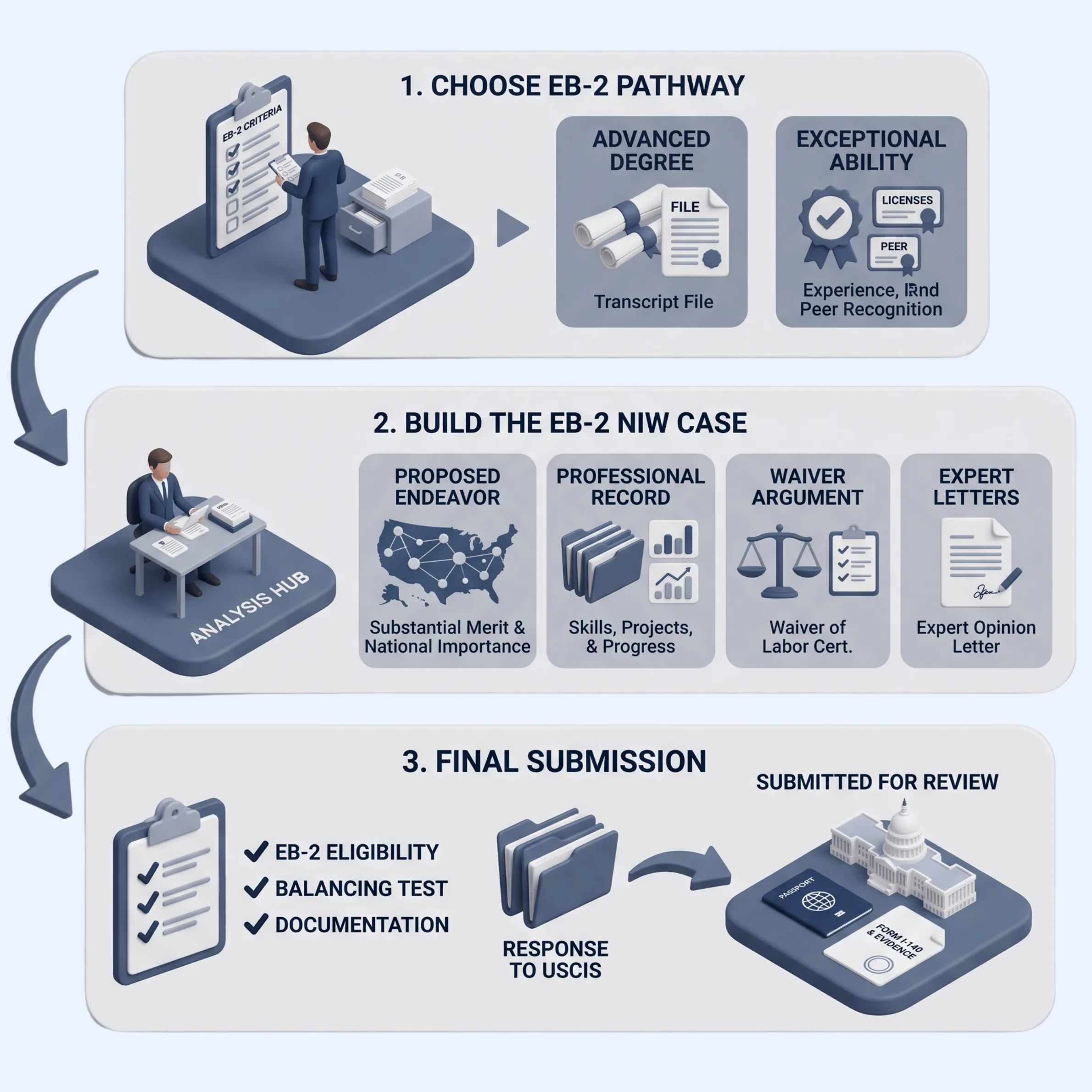
- Check that you qualify for EB-2: You need an advanced degree or exceptional ability.
- Explain your proposed endeavor: Say clearly what you plan to do in the US and why it’s important.
- Collect proof of your work: Gather project records, letters from employers, contracts, and anything that shows real results.
- Link your background to your plan: Show how your education, skills, and past work prepare you to succeed.
- Cover all three Dhanasar prongs: Show that your work has national importance, that you’re well positioned to move it forward, and that it makes sense for the US to waive the job offer and labor certification.
Every major claim in your petition should be backed by a document. A clear, well-organized petition makes your case easier to understand. That said, no petition is guaranteed approval, so it’s worth taking your time with it.
How USCIS Evaluates An EB-2 NIW Petition
Under Matter of Dhanasar, USCIS evaluates three requirements when deciding an EB-2 NIW petition. You must provide evidence supporting each requirement, whether or not you have publications.
1. Your Proposed Endeavor Must Have Substantial Merit And National Importance
Start by explaining what you actually plan to do in the United States, then show why it has substantial merit and national importance. The work can sit in business, science, technology, healthcare, education or any other field where it has real merit.
A job title won’t do this for you. Saying “I’ll work as a software engineer” tells USCIS nothing about why the work matters. Describe the problem you want to solve, the work you’ll do, and the impact it could have beyond your job or employer.
If you have no publications, you can back your application up with project documentation, business plans, technical proposals, industry reports, or records that show how far your work could reach. Whatever you submit should speak to your specific endeavor, not just praise your profession in general.
2. You Must Be Well Positioned To Advance Your Proposed Endeavor
Here, USCIS considers whether your education, skills, knowledge, experience, track record, and plans position you to advance your proposed endeavor. His proof matters even more when you don’t have publications or citations.
Evidence can include successful projects, leadership roles, specialized expertise, patents, contracts, client results, or improvements you introduced and can document. Letters from employers, clients, collaborators or qualified experts can help explain what you did and what came of it.
Tie your past work to your future plans. If you want to build healthcare technology, say what you’ve already built, tested, managed or improved, and how that prepares you for the next step. An unclear recommendation letter carries less weight than one that points to specific examples and is backed by records.
3. Waiving The Job Offer And Labor Certification Requirements Must Benefit The United States
You also have to show that, on balance, it would benefit the United States to waive the job offer and labor certification requirements. The NIW lets eligible applicants ask for that waiver, and in most cases you can file the petition yourself without relying on an employer.
Explain why your proposed endeavor and your ability to carry it out justify waiving the job offer and labor certification requirements. Your plan might involve starting a business, doing important research, offering specialized services, or advancing work that benefits others beyond your circle.
Saying your work is valuable or that you have a lot of experience doesn’t get you there. You need to explain why granting the waiver makes sense given the circumstances of your endeavor. Publications can help, but this prong doesn’t require them.
What Evidence Can You Use For EB-2 NIW Without Publications?
If you haven’t published research papers, build your case around documents that show your qualifications, past results, proposed work, and ability to carry it forward. What works best depends on your occupation and what you plan to do.
| Evidence | What it does for your petition |
| Degree certificates and transcripts | Prove your education and support the EB-2 route you’re using |
| Employment verification letters | Record your roles, duties, experience, and specialized skills |
| Project reports and technical records | Show what you worked on, what problems you tackled, and what came out of it |
| Patents or IP records | Document inventions or original work tied to your proposed endeavor |
| Performance reviews and promotion records | Point to your growth, added responsibility, and how your work was received |
| Contracts, client records, or business results | Back up claims about finished projects, commercial activity, or measurable outcomes |
| Expert recommendation letters | Explain why your work matters and why your background prepares you for the endeavor |
| Business or implementation plans | Lay out what you intend to do, the resources you’ll need, and the outcomes you expect |
| Awards or professional recognition | Show recognition, where it’s relevant to the eligibility requirements |
| Evidence of adoption or practical use | Show whether others have used your work, method, product, or service, or whether it produced documented results |
*You don’t need every item above. Pick the documents that speak to the legal requirements and support what your petition claims. Whenever you can, use independent records to verify your key achievements rather than leaning only on your statements or recommendation letters.
Mistakes To Avoid When Applying For EB-2 NIW Without Publications
Applicants seeking EB-2 NIW approval without publications should avoid mistakes that weaken their supporting evidence.
- Relying only on work experience: Professional experience does not automatically establish EB-2 eligibility or satisfy the NIW criteria.
- Using an unclear proposed endeavor: Clearly explain your planned work and its potential national importance.
- Submitting generic recommendation letters: Provide specific examples of achievements and contributions.
- Making unsupported claims: Back up professional accomplishments with credible documentation wherever possible.
- Ignoring a Dhanasar prong: Address all three NIW requirements rather than focusing only on your qualifications or the value of your work.
Remember, publications are not mandatory for an EB-2 NIW. The overall strength, relevance, and consistency of your evidence remain important to your petition.
How Document Evaluation Can Support Your EB-2 NIW Preparation
Not having publications doesn’t rule you out of an EB-2 NIW. What counts is how well your education, work history, proposed endeavor, and supporting documents show that you meet the requirements. At Document Evaluation LLC, we help professionals organize their cases around their background and the evidence they actually have.
Here is what we offer:
- Expert opinion letters written by independent experts based on your background, achievements, and proposed endeavor.
- Access to 140+ professors and top field experts across 50+ fields, so you can review options in your area and choose the one you prefer.
- Unlimited revisions until the final letter
- 24/7 assistance available, so your questions never have to wait
- Experience with professionals in research, technology, healthcare, engineering, and business
An expert opinion letter can help explain why your work matters and how it connects to your proposed endeavor. It doesn’t replace the EB-2 eligibility requirements or guarantee approval.
Frequently Asked Questions
Are publications mandatory for EB-2 NIW approval?
No! Publications aren’t required for an EB-2 NIW. You do need to qualify for EB-2 and show, with real evidence, that your proposed endeavor meets all three Dhanasar prongs.
Can I apply for EB-2 NIW with a master’s degree and no publications?
Yes! The master’s takes care of the EB-2 education requirement. The waiver is a separate question, though. You will need to show that your endeavor has substantial merit and national importance, that you are well positioned to advance it, and that the US benefits from waiving the job offer requirement.
Can I get EB-2 NIW with a bachelor’s degree and no publications?
It’s possible. A bachelor’s degree plus five years of progressive experience in your field after graduation counts as equal to a master’s. Once you clear that, the NIW requirements are the same as for any other applicant.
Can I qualify for EB-2 NIW based on work experience alone?
Usually not. Experience helps show you can deliver on your plans, but it doesn’t replace the EB-2 requirement itself. You need an advanced degree, its equivalent, or exceptional ability first. The NIW case sits on top of that.
Do I need recommendation letters if I have no publications?
They aren’t required. They do help when they’re specific about what you did and why it mattered. Generic praise adds very little. Letters carry more weight when contracts, project records, or performance data back them up.
Can a business professional apply for EB-2 NIW without publications?
Yes. Publications are rare in business careers, and USCIS knows that. You still have to meet the EB-2 requirement through a degree or equivalent experience. After that, the focus is on your endeavor: a clear business plan, proof of past results, contracts or projects you’ve handled, and the jobs, revenue, or community benefit you expect to create.
Does having publications guarantee EB-2 NIW approval?
No. An officer reads the whole file, not just the publication count. Papers unrelated to your proposed endeavor carry little weight. If the national importance of the endeavor or your ability to advance it isn’t clearly shown, even a long publication list can end in an RFE or a denial.
Can I self-petition for EB-2 NIW without a US employer?
Yes, and that is one of the main advantages of the NIW. You file Form I-140 yourself, with no employer sponsor and no labor certification. You still have to prove EB-2 eligibility and meet the NIW requirements.
Can patents replace publications in an EB-2 NIW petition?
A patent shows you made something original, but it won’t replace publications by itself. It only helps if it ties back to what you plan to do in the U.S., so back it up with other proof like project results or letters from people who know your work.
How can I prove my impact if I have no citations or academic recognition?
You can use whatever shows the results of your work, like project records, contracts, how many people adopted what you built, or numbers showing something got better. Just don’t dump the documents in and leave it there. Say in the petition how each one backs up your plan.
Conclusion
You can file an EB-2 NIW without publications. What matters is that you meet the EB-2 requirement and can back up each of the three Dhanasar prongs with real documents. Missing papers won’t sink a petition by themselves. Weak evidence will. So build the file around what you’ve actually done: your work history, the endeavor you plan to pursue in the US, and why it matters there. Go through every exhibit before you file.

Explore EB-2 NIW expert letters and Dhanasar RFE guides below:
- What is an EB-2 NIW Expert Letter?
Explains the role of independent advisory letters in corroborating the three Dhanasar prongs, establishing petitioner credibility, and substantiating the national importance of the proposed endeavor for USCIS adjudicators. - Who Can Write an EB-2 NIW Expert Letter?
Breaks down USCIS qualifications for EB-2 NIW expert evaluators, detailing why independent tenured professors, recognized industry authorities, and unbiased peer reviewers carry the evidentiary weight needed to substantiate your petition. - Cost of EB-2 NIW Expert Opinion Letter: A Complete Pricing Guide
Details current 2026 market rates and fee structures for EB-2 NIW expert evaluations. Explains key cost drivers—such as expedited turnaround times, endeavor complexity, and expert credentials—to help self-petitioners budget effectively for independent supporting evidence.
Akash Pundir is the Chief Operating Officer at Document Evaluation LLC, bringing over 5 years of international business operations and legal support experience across the United States, Australia, and India. He has overseen the strategic positioning and analysis of over 1,000+ complex USCIS cases, specializing in guiding expert evaluation teams to draft high-stakes Expert Opinion Letters (EOL), Academic Equivalencies, and defense packets for H-1B, EB-2 NIW, RFEs, and NOIDs. Driven by digital transformation, Akash ensures every evaluation adheres strictly to the latest USCIS legal frameworks and compliance benchmarks.
