

 |
How To Choose An Expert Opinion Letter Provider: 9 Questions To Ask Before You Pay

Nine questions will tell you more about an expert opinion letter provider than anything written on their website. All nine come back to one thing: who actually writes the letter, and whether that letter will reason from your documents or simply assert a conclusion. Officers can tell the difference. The letters that get set aside are almost always the ones that read as though they could have been written about anybody.
Before you pay anyone, it is worth knowing what a serious expert opinion letter service will tell you up front, and what it will not.
💡 Next Step: Once you know which standards separate credible evaluations from generic templates, working with a transparent, specialized agency guarantees your petition is backed by a qualified authority. Secure professional assistance to Order Your Expert Opinion Letter for USCIS and submit a thorough, case-specific analysis that withstands adjudicator scrutiny.
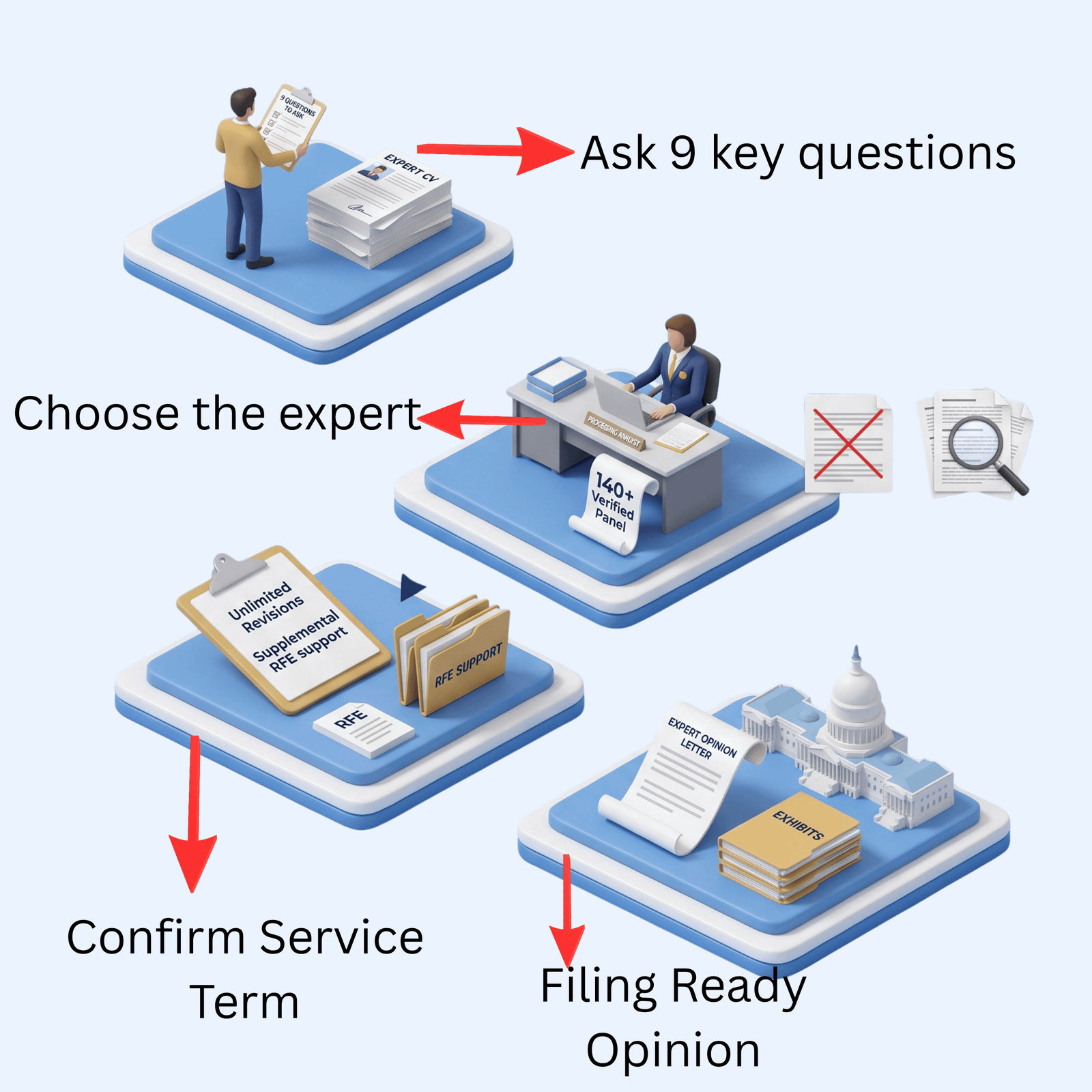
9 Questions To Ask Before Hiring An Expert Opinion Letter Provider
If you read nothing else, put these in an email and send it to every provider on your shortlist.
- Who will actually write my letter, and what are their credentials in my specific field?
- Can I see the expert’s CV before I pay?
- Do I choose the expert, or are they assigned to me?
- Has this expert written letters for my visa type before?
- What happens if USCIS issues a request for evidence that questions the letter?
- How many revisions are included, and what counts as a revision?
- What is the standard turnaround, and what does a rush actually cost?
- Will the letter be built from my evidence, or is it a template with my name in it?
- What happens if the expert concludes my case does not support a letter?
1. Who Will Write Your Expert Opinion Letter And What Are Their Qualifications?
This is the question everything else rests on, and it is the one most providers answer with a category instead of a person.
The standard an officer applies is whether the writer is qualified in the subject area your case turns on. Fame in a neighboring field does not transfer. A distinguished professor of mechanical engineering writing about a machine learning role produces a weaker letter than a less celebrated data scientist writing about the same role, because the second one can explain the specialty and the first one is reaching. There is more on who is qualified to write an expert opinion letter in our guide.
2. Can You Review the Expert’s CV Before Paying?
The expert’s CV is not marketing material. It goes into the filing as an exhibit, and the officer reads it alongside the letter to decide whether the opinion is worth anything.
So if you cannot see the CV before paying, you are buying an exhibit you have not read. That is a strange thing to agree to. The request is entirely reasonable, and a CV with the contact details redacted is fine.
When you get it, read it for one thing specifically: does the subject area on the CV match the subject area of your case? Not the job title, the subject area. A professor of “management” might be an expert in operations research or in organizational psychology, and only one of those helps a petition about supply chain analytics.
3. Can You Choose Your Own Expert Opinion Letter Writer?
This question does two jobs. It tells you whether you get a say, and it tells you whether the provider genuinely has a panel.
A provider with a real panel can show you two or three people in your field and let you pick. A provider with two in-house writers cannot, which is why the answer arrives as “we assign the best available expert.” The word doing the work in that sentence is “available”.
There is also a practical follow-up worth asking: how many experts do you have in my field specifically? A provider can have hundreds of experts and none in yours. The number that matters is the second one.
4. Does The Expert Have Experience With Your Visa Category?
This is the question people skip, and it is the one that most often produces a well-written letter that answers the wrong question.
The technical question changes completely between categories:
| Your Category | What The Letter Has To Establish |
| H-1B specialty occupation | That the role itself normally requires a degree in a specific specialty, and that the applicant’s degree is in it. The four prongs are set out at 8 CFR 214.2(h)(4)(iii)(A) |
| Degree equivalency | That a foreign qualification, or a mix of study and work experience, equates to a US degree, see the three-for-one rule |
| EB-1A or O-1 | That the applicant’s work sits at the level the category demands, judged by the standards of their field. The ten EB-1A criteria are at 8 CFR 204.5(h)(3) |
| EB-2 NIW | That the proposed endeavour has substantial merit and national importance, and that this applicant is well positioned to advance it |
An expert who has written forty degree-equivalency letters may write with real authority and still produce something unusable for an EB-1A petition, because the second one is not a question about transcripts at all.
It is worth knowing that H-1B requests for evidence routinely separate the role from the person. Those are two different grounds, and they need two different kinds of expert reasoning. A provider who treats them as one thing has not done many of these.
5. Does The Provider Offer Support For USCIS Requests For Evidence (RFEs)?
Ask this before you pay, because this is where the cost quietly doubles.
If an officer challenges the letter, whether on the expert’s qualifications, the depth of the analysis, or the independence of the opinion, you will usually need a supplemental letter from the same expert addressing the specific point raised. Two things determine whether this is manageable or painful.
The first is money: is a supplemental letter included, or billed again, and at what price? Get a figure, in writing, before you pay the first invoice.
The second is rarely asked and matters just as much: will that expert still be available in four months? Requests for evidence arrive long after the letter was signed. An expert who has moved institutions, gone on sabbatical, or simply stopped doing this work leaves you starting over under a deadline. If the provider cannot commit to availability, ask what happens then.
There is now a third thing, and it is recent enough that most guides have not caught up with it. Requests for evidence are issued under 8 CFR 103.2(b)(8), and in August 2026, USCIS updated its Policy Manual on how those windows are applied. The regulatory maximum is twelve weeks for a request for evidence and thirty days for a notice of intent to deny; officers are not obliged to grant the maximum; and the former practice of adding fourteen days for notices mailed outside the United States has been dropped. If you are abroad, you have less time than older advice assumes, which makes the question of how fast a provider can actually move a practical one rather than a theoretical one.
If you are already holding a request for evidence, two things will help more than reading further:
- Our RFE response service handles the whole response, not only the expert letter and evaluation side of it.
- If the petition is an H-1B, our guide to responding to an H-1B request for evidence sets out what the response itself needs to contain.
6. How Many Revisions Are Included In The Expert Opinion Letter Service?
The second half of that question is the one that matters, and hardly anybody asks it.
“Unlimited revisions” is a common promise and it means nothing on its own, because the fight is never about how many it is about what counts. If you send a document you had forgotten about and the expert’s analysis has to change, is that a revision or a new letter? If your attorney asks for a different emphasis, is that a revision or a rewrite? Providers who bill for rewrites will describe both as new work.
So ask it in those words, with an example. The answer tells you whether “unlimited” is a policy or a line of copy.
Our own position: revisions are unlimited until you are satisfied, with no extra fee. A change in analysis due to new evidence is considered a revision, not a new letter. That distinction is the whole value of the promise.
7. How Long Does It Take To Get An Expert Opinion Letter?
Before you ask, it’s important to understand what the constraint actually is. It is not the company’s workload. It is the professional’s calendar.
That is why a promise of twenty-four hours should make you curious rather than relieved. Either the provider has an in-house writer producing letters at volume, or nobody has asked the expert whether they are free. A real rush means an expert has agreed to clear time for your file.
Ours is one to three business days on the premium rush service, and standard turnaround is longer. Both are real numbers and the premium one costs more, which is the honest version of this conversation. For what the figures look like by category:
8. Will Your Expert Opinion Letter Be Customized to Your Evidence?
This is the single biggest reason expert letters get little weight, and you can usually detect it before paying.
A letter doing real work refers to your material specifically. It names the courses on your transcript and what they covered. It quotes the job description and explains which duties require which knowledge. It cites your publications or projects by name. An officer reading it can see that somebody examined these documents and could not have written the same paragraphs about anyone else.
A template does the opposite. It recites the legal standard, asserts that the applicant meets it, and attaches a CV. It is often well written. It changes nothing, because it contains no information the officer did not already have.
There are two ways to check before you pay. The first is to ask how many of your documents the expert will cite by name. A provider who has thought about this will give you a real answer, usually with a document list attached.
The second is to ask to see the structure they work on. Ours is set out in our guide to the format of an expert opinion letter, and you can look at a sample report to see what finished work looks like.
9. What Happens If the Expert Finds Your Case Does Not Support A Letter?
This is the most revealing question on the list, yet almost nobody asks it.
Here is why it matters. A weak expert letter is worse than no expert letter. It does not sit quietly in the file. It is filed, it is read, and it can draw attention to the exact weakness you were hoping to cover.
A thin letter arguing that a three-year degree is equivalent to a four-year US degree invites an officer to examine that question closely.
So a provider who will write whatever you pay for is not doing you a favor. The provider you want is the one who reviews your documents first and is willing to tell you that a letter will not help, or that it will only help if you can supply something you have not yet supplied.
Ask what happens to your money in that situation.
How USCIS Policy Changes Make The Initial Evidence More Important
Until recently, a filing that was missing something would usually draw a request for evidence first. That gave you a second chance. It is no longer the default.
In an August 2026 update to its Policy Manual, USCIS restored officers’ discretion to deny a benefit request outright without first issuing a request for evidence or a notice of intent to deny where required initial evidence is missing. The agency’s position is that the regulations always permitted this and the previous policy encouraged incomplete filings.
Two consequences for the decision you are making right now.
The initial filing matters more than it did. A thin or templated expert letter is no longer just a wasted expense. It can be part of a record that is refused without any further conversation.
And the provider you choose matters more than it did. Where there may be no request for evidence to put things right, the quality of the first letter carries the whole weight.
3 Red Flags to Watch for When Choosing An Expert Opinion Letter Provider
-
An Approval Guarantee
Nobody can guarantee a USCIS outcome, and no honest provider will try. An expert opinion letter is advisory; it is evidence an officer weighs, not an instruction they follow.
This issue has been settled for a long time. In Matter of Caron International, Inc., 19 I&N Dec. 791 (Comm. 1988), it was held that the agency may use advisory opinion statements from universities, professional organizations, and other sources as expert testimony, but that where an opinion is not in accord with other information in the record or is in any way questionable, USCIS is not required to accept it and may give it less weight.
That is the whole reason questions 1, 4, and 8 above matter more than the expert’s prestige. A provider promising you a result is either misunderstanding their product or hoping that you do.
-
The Expert Is Not Named Before Payment
This is covered above, and it is the clearest signal of all. A provider confident in their panel introduces you to it.
-
One Flat Price For Every Visa Type
Different categories require different analyses and different amounts of work. A single price across all of them usually means a single template for all of them.
How To Compare Expert Opinion Letter Providers Before Making A Decision
Put all nine questions in one email and send the same email to every provider on your shortlist. Then compare three things, in this order.
First, who answered in writing at all. Providers who answer only on a call are often avoiding a record.
Second, who named a person. Everything in a letter points back to one named professional, and a provider who will not name them before payment is asking you to buy a signature without seeing it first.
Third, who told you something you did not want to hear. A provider who mentions a weakness in your evidence or says a rush is not realistic on your timeline is showing you how they will behave when something goes wrong. That is worth more than a lower price.
Why Choose Document Evaluation For Your Expert Opinion Letter?
We write expert opinion letters, and we handle USCIS RFE responses end to end. We also provide credential and work-experience evaluations and certified translations. What we are not is an immigration law firm. Where you have an attorney, they argue the case and file the petition, and we produce the technical evidence that sits inside it. Where you do not, we handle the response from start to finish and tell you plainly if the case needs counsel. The full scope is on our expert opinion letter service and what it covers page.
What we will tell you about ourselves: a panel of 140+ experts, filtered to your field, with the choice of expert yours; unlimited revisions until you are satisfied; a premium rush option of one to three business days; and and a 4.9 rating from 42 Google reviews.
What we will not tell you is an approval rate, because we cannot evidence one honestly. We write the letter. The petition is filed by your attorney, decided by an officer, and shaped by evidence that existed before we were involved. Any firm quoting you a percentage on that chain is quoting you a number they made up.
Frequently Asked Questions
How much should an expert opinion letter cost?
Price tracks the analysis, not the page count. A degree-equivalency opinion is a narrower job than an EB-1A letter assessing a body of work against the standards of a field, and the two should not cost the same. What should worry you is a single flat price across every category.
Can my own professor write it instead?
Sometimes. It depends on two things. The professor needs genuine standing in the specific field your case depends on, and they need to be independent of you. A former supervisor who taught you reads closer to a recommendation letter, and officers do weigh the relationship between the writer and the applicant. For EB-1 petitions the standard applied to these letters sits in the USCIS Policy Manual, Volume 6, Part F, Chapter 2: a letter should describe the contribution, explain its significance to the field, and establish the writer’s own qualifications to judge it, rather than restate the regulatory language. A professor can certainly meet that standard. Most are simply not used to writing to that standard.
Does USCIS have to accept an expert opinion letter?
No. The opinion is evidence an officer weighs alongside everything else. Under Matter of Caron International, Inc., 19 I&N Dec. 791 (Comm. 1988), USCIS may treat an advisory opinion as expert testimony but where the opinion does not accord with other information in the record or is in any way questionable, the agency is not required to accept it and may give it less weight. In practice, letters get discounted when they assert conclusions without reasoning from the record or when the writer’s expertise does not match the question being asked. That is why questions 1, 4, and 8 above matter more than the expert’s prestige.
How long does an expert opinion letter take?
The constraint is the expert’s availability, not the provider’s capacity. Standard turnaround runs longer than most people expect; our premium rush option is one to three business days. Whatever timeframe you are quoted, ask what the provider needs from you on day one; most delays are documents arriving late, not experts writing slowly.
Can the same letter be reused if I get a request for evidence later?
The original letter stays in the record, but a request for evidence usually needs a supplemental letter from the same expert addressing the specific point raised. That is why question 5 above asks about both the price of a supplemental letter and whether that expert will still be available months later. If you are already holding a request for evidence, our RFE response service handles this. If you are already holding a request for evidence, our RFE response service handles this.
What if the expert says my case does not support a letter?
A good provider tells you before taking the work, and that is the answer you want. A weak letter in the file can draw an officer’s attention to the very point you were trying to strengthen. Ask each provider what happens to your payment in that situation, and get it in writing.

Akash Pundir is the Chief Operating Officer at Document Evaluation LLC, bringing over 5 years of international business operations and legal support experience across the United States, Australia, and India. He has overseen the strategic positioning and analysis of over 1,000+ complex USCIS cases, specializing in guiding expert evaluation teams to draft high-stakes Expert Opinion Letters (EOL), Academic Equivalencies, and defense packets for H-1B, EB-2 NIW, RFEs, and NOIDs. Driven by digital transformation, Akash ensures every evaluation adheres strictly to the latest USCIS legal frameworks and compliance benchmarks.