

 |
How to Respond To A Form I-485 Adjustment of Status RFE

- An RFE means USCIS wants more evidence or clarification before making a final decision.
- Read the RFE carefully and note exactly what USCIS is asking for as a document.
- Address each request directly, backing it up with accurate, relevant evidence.
- Keep your documents organized and follow the RFE’s instructions and deadline.
- Talk to an immigration attorney when the issue involves inadmissibility, immigration violations, fraud, or other eligibility concerns.
A Request for Evidence (RFE) following an I-485 filing often raises concern, particularly for applicants who have been waiting on a green card decision. This reaction is natural, but it is worth noting that an RFE is not, in itself, a sign that the case will be denied.
USCIS issues an RFE when the record before it does not yet support a decision. The notice sets out what USCIS considers missing or insufficient, along with instructions on how and when to respond. In most cases, this simply means the existing evidence has not fully established eligibility, not that eligibility is in question altogether.
A rushed or incomplete response tends to create more problems than it solves. The notice deserves a careful read from start to finish, a clear understanding of what is actually being asked, and a response that addresses each issue raised before the deadline passes.
To ensure every point is thoroughly addressed with complete documentation, many applicants choose to partner with specialized legal experts for professional USCIS RFE Response Services to safeguard their green card approval.
What Is a Form I-485 RFE?
An I-485 Request for Evidence (RFE) is issued by the USCIS. When existing documentation or information is insufficient for the officer to make a decision in the pending adjustment of status application.
The letter must be reviewed carefully since it contains specific guidelines for the particular case. It should generally specify:
- What documents or evidence is needed in addition to those already presented?
- What information or eligibility criterion needs to be clarified further?
- How the answer should be submitted
- Where the answer must be sent, if the address for mailing is stated
- The deadline by which the answer should reach USCIS
Why Did USCIS Send An RFE For An I-485 Application?
The reason for an I-485 RFE depends on the facts of your case and the category under which you are applying for adjustment of status.
Some of the most common issues involve missing documents/incomplete evidence/inconsistencies in the record or questions about eligibility.
-
Missing Civil Documents
USCIS asks for documents you hadn’t submitted, or your initial application may simply not have met the required standards.
There’s a possibility that these lists will be relevant:
- Birth certificates
- Marriage certificates
- Divorce decrees
- Death certificates
- Passport records
- Proof of lawful admission or parole
- Official English translations
-
Problems With Form I-864
Those applying for certain family-based adjustments of status could be asked for more evidence after they submit Form I-864 Affidavit of Support.
USCIS could reach out for further evidence if it finds any of what comes next:
- No tax documents submitted
- Income level too low
- Household size wrongly stated
- Employment evidence not presented
- Uncertainty about sponsor’s ability to support financially
- Requirement of a qualifying joint sponsor
-
Medical Examination Issues
USCIS may request a properly completed Form I-693 Report of Immigration Medical Examination and Vaccination Record or additional information related to the medical examination.
-
Inconsistencies in Your Documents
An officer might have to ask questions if the data does not correspond in several documents.
As an instance:- You have several versions of your name
- Your dates of birth are wrong or inconsistent
- Your marital status details don’t match
- Your employment or immigration history is at variance
-
Questions About Your Eligibility
The RFEs may bring up significant concerns on the eligibility of the applicant for adjustment of status.
Potential reasons for such concerns may include the applicant’s prior immigration history, previous entries into the United States, inadmissibility, unauthorized work, status-related matters, or other factors specific to the case.
How Do You Respond to a Form I-485 RFE?
The best course of action is to reply to the RFE point by point
Do not use the response as a means of sending all documents in your possession. On the contrary, you need to supply the exact documents requested and anything else needed to clarify them.
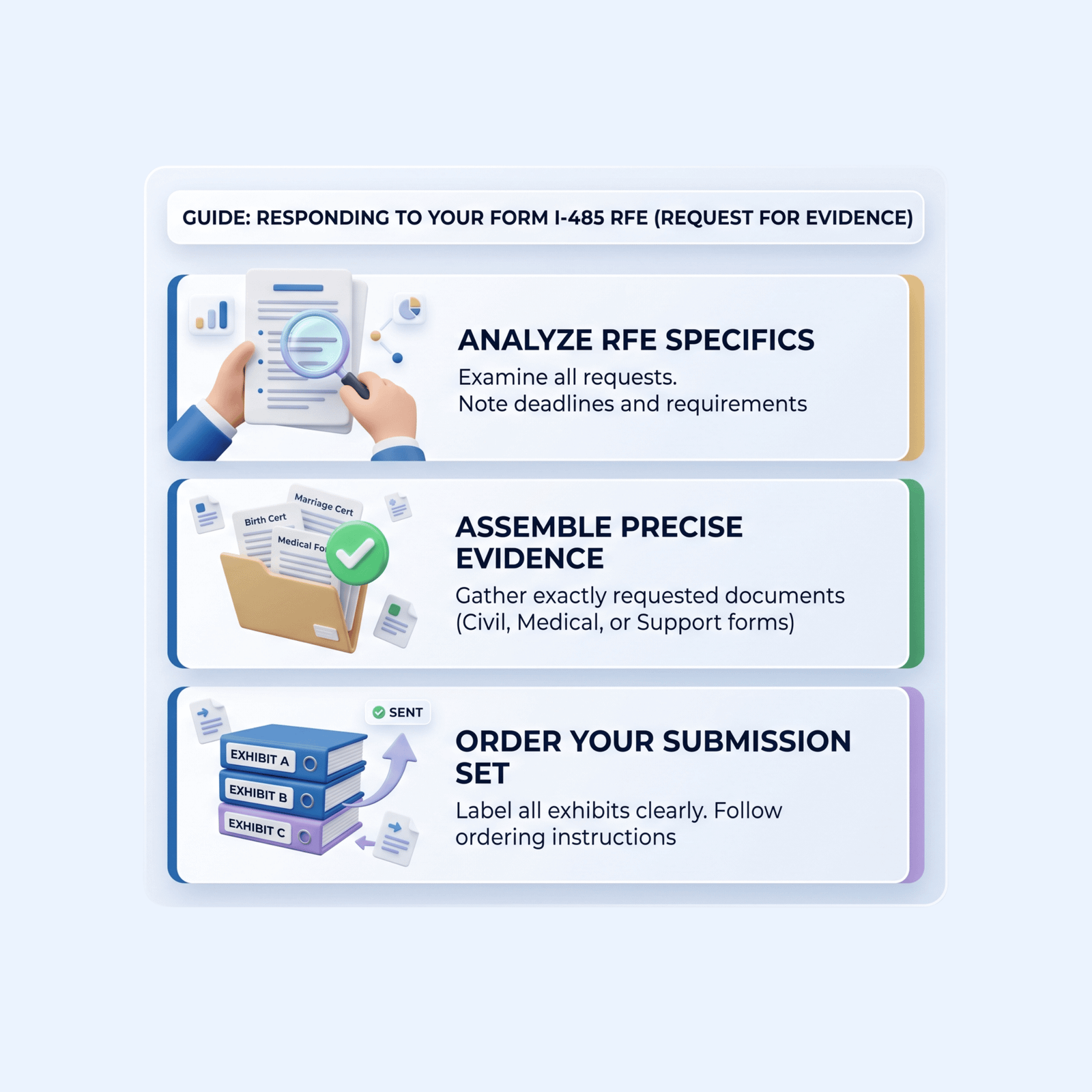
Step 1: Read the Entire RFE Carefully
First of all, read the entire notice carefully. Besides focusing only on the initial form USCIS requests, some RFEs contain several queries or different evidence requests.
Underline:
- Each and every document that is being requested.
- Any explanations that USCIS expects.
- Particular submission guidelines.
- Timeframe for response.
- The physical address or way of sending the response.
Your reply must be consistent with the directions given in your specific RFE even if you see different recommendations on the Internet or know someone who got a similar notice.
Step 2: Break the RFE Into Individual Requests
Write down all the things USCIS wants you to submit. For example,
- Request 1: Send one full birth certificate.
- Request 2: Upload a certified English translation.
- Request 3: Clarify the discrepancy between the name on the birth certificate and the name used on Form I-485.
This will make sure you do not miss any aspect of the RFE.
Step 3: Gather the Correct Supporting Evidence
Your first focus should be on the direct evidence USCIS is asking for.
When USCIS needs a particular document, don’t substitute it with different types of evidence unless the document is truly unavailable and alternative evidence suits your case.
Suppose USCIS wants evidence of a name discrepancy; just sending an extra passport copy may not fix the problem. You will likely need documents that clarify the link between the different names or explain the discrepancy.
The most effective answer is the one that responds to the exact question USCIS raised.
Step 4: Prepare a Clear RFE Response Letter
Although a cover letter may not always be needed. It can make a complicated response easier to review.
An organized response letter may include:
- Your full name
- Your A-Number, if applicable
- Your Form I-485 receipt number
- The date of the RFE
- A short description of the evidence being submitted
- A list of exhibits
Then respond to each issue separately. For example:
- USCIS Request: Please provide any further evidence to show that you entered the US legally.
- Response: Enclose a copy of my Form I-94 and appropriate pages from my passport as Evidence A.
- USCIS Request: Please provide any evidence explaining the name difference.
- Response: The applicant submits the marriage certificate & supporting identification documents as Exhibit B to explain the change in name.
This format makes it easier for the USCIS officer to see how each piece of evidence relates to the RFE.
Step 5: Organize Your Evidence in the Same Order as the RFE
A clear response file may look like this:
- RFE response notice or coversheet, if instructed
- Response cover letter
- Copy of the RFE
- Exhibit list
- Evidence responding to Request 1
- Evidence responding to Request 2
- Evidence responding to Request 3
- Additional supporting documents, if relevant
Use clear labels such as the following:
Exhibit A: Evidence of Lawful Admission
Exhibit B: Birth Certificate and Certified English Translation
Exhibit C: Evidence Supporting Form I-864
The goal is simple: USCIS should not have to guess which document answers which question.
Do You Need An Attorney To Respond To An I-485 RFE?
Most immigration attorneys likely aren’t needed for every I-485 RFE.
For example, responding to an RFE asking for a civil document that is clearly missing might be a straightforward matter.
A lawyer’s expertise might come in useful, even seriously, if the RFE is related to
- Possible inadmissibility
- Immigration violations
- Unauthorized employment
- Unlawful presence
- Criminal record
- Fraud or misrepresentation
- Far-ended family-based eligibility problems
- Employment-based adjustment problem
- Large differences in your immigration record
Frequently Asked Questions About Form I-485 RFEs
Does an I-485 RFE mean my Green Card application will be denied?
No, USCIS needs more information before making a decision. They want a complete and supported response that allows USCIS to continue your application.
Can I submit additional evidence with my RFE response?
Yes, you can include evidence in your response that is mentioned in the RFE issued by USCIS. Your response should be focused on your specific question that was raised by the USCIS.
How long does USCIS take after receiving an I-485 RFE response?
Processing times following an RFE response differ significantly from case to case. This variability is due to factors such as case complexity and the current workload at the processing center.
Can USCIS send another RFE after I respond?
Yes, USCIS requested additional evidence to determine eligibility. An RFE asks for the specific evidence USCIS needs to continue reviewing and decide your application.
What happens if I never receive my RFE notice?
Firstly check your USCIS case status and online account. If USCIS issued a notice but you did not receive it. You are able to submit a non-delivery inquiry through USCIS.
Can You Respond to an I-485 RFE After the Deadline?
Don’t count on USCIS accepting a late response. Once your deadline passes. They can go ahead and decide your case using whatever evidence is already on file, so it’s risky to wait until the last minute.
Conclusion
Receiving a Form I-485 RFE must not necessarily lead to denial of your application for the adjustment of status.
The most efficient way of responding to such a notice would be a concise & coherent response where all issues highlighted by USCIS would be addressed. Make sure that you thoroughly read the notice & gather all the required documents, explaining the discrepancies in case there are any. Be exact in the manner of your submission as well as in your timing.
In case the RFE raises complex questions about your eligibility, inadmissibility & immigration background, you might want to consult a reputable immigration lawyer. Securing professional assistance early can make all the difference, which is why working with an expert legal team for dedicated USCIS RFE Help ensures your response meets every federal standard.

USCIS RFE Guide: Sample Letter, Missed Deadline Steps & Best Response Services
- USCIS RFE Demystified: Official Samples, Response Strategy & Approval Tips
Demystifies the USCIS Request for Evidence (RFE) process. It walks applicants through understanding their official letter, organizing an evidence packet, avoiding common response pitfalls, and applying practical submission strategies to maximize approval chances. - Missed Your USCIS RFE Deadline? Instant Next Steps & Recovery Guide
Provides an emergency step-by-step action plan for applicants facing a missed or approaching RFE deadline. It covers how USCIS handles late submissions, available legal options (like Motions to Reopen), and practical ways to salvage an immigration application before a final denial decision is made. - Top RFE Response Services in USA for Education & Specialty Occupation Cases
Compares top-rated legal services and credential evaluation experts specializing in complex employment-based RFEs. Tailored for H-1B applicants and employers, it focuses on resolving specialty occupation disputes, foreign degree equivalency issues, and position-qualification gaps.
Akash Pundir is the Chief Operating Officer at Document Evaluation LLC, bringing over 5 years of international business operations and legal support experience across the United States, Australia, and India. He has overseen the strategic positioning and analysis of over 1,000+ complex USCIS cases, specializing in guiding expert evaluation teams to draft high-stakes Expert Opinion Letters (EOL), Academic Equivalencies, and defense packets for H-1B, EB-2 NIW, RFEs, and NOIDs. Driven by digital transformation, Akash ensures every evaluation adheres strictly to the latest USCIS legal frameworks and compliance benchmarks.
