




No doubt – LORs are important in separating accepts vs declines, especially in a competitive area (Masters/PhD).
LORs (Letter of recommendation) are not just “nice to have.”
Admissions Committees value LORs as an IMPORTANT part of their evaluations.
Unfortunately, many recommenders do not understand how to write an effective LOR & most applicants do not know how best to help recommenders write an impactful letter.
This blog will guide you through the basics of writing a successful LOR!
Quick Stat – According to a survey by the Council of Graduate Schools, 85% of admissions officers rank Letters of Recommendation among the top 3 most influential factors in graduate admissions decisions.
What Exactly Is a Letter of Recommendation?
A letter of recommendation (LOR) is a document that is written by an employer, a mentor or a professor to encourage someone to apply for a certain institution. A LOR talks about the person’s skills & achievements as well as their personality & character. In addition to being used when applying to universities or scholarships, they are sometimes used when applying for jobs.
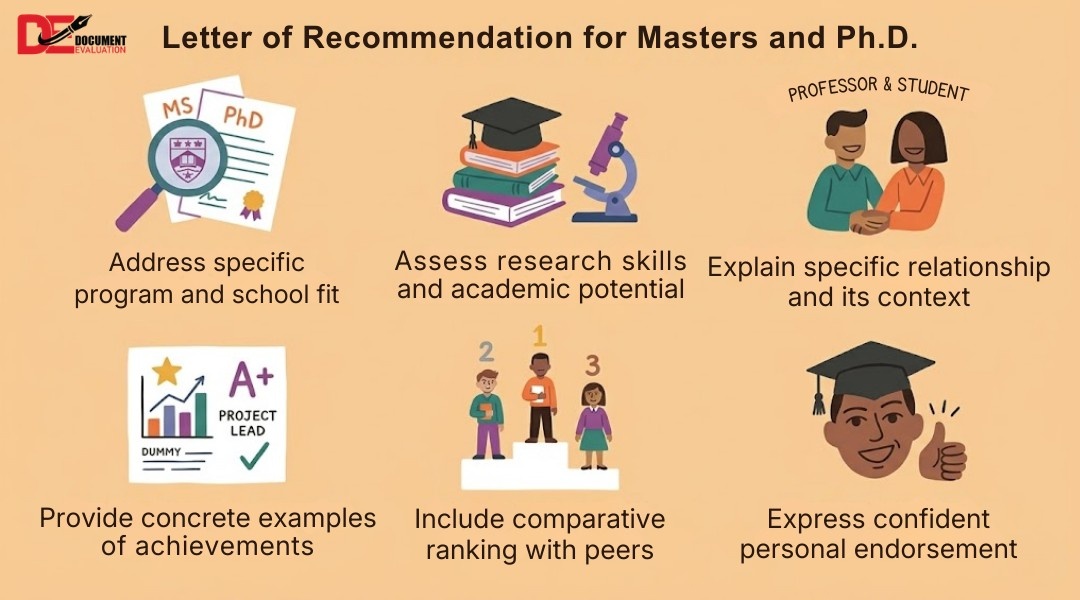
In immigration petitions such as EB-1A or EB-2 NIW, applicants often submit letters of recommendation from experts in their field. In some cases, petitions may also require an expert opinion letter prepared by a qualified evaluator to further strengthen the petition.
Who Should Write your Letter of Recommendation?
Choosing the right recommender is half the battle.
| Program Type | Best Recommender | Why do they work best? |
|---|---|---|
| Masters (Research) | University Professor / Research Supervisor | Speaks to academic severity & research capability |
| Masters (Professional) | Employer / Senior Manager | Confirms real-world skills & work ethic |
| PhD | PhD Supervisor / Research Mentor | Can assess research potential directly |
| MBA | Direct Manager + Senior Colleague | Highlights leadership & impact |
| Interdisciplinary Program | One Academic + One Industry Expert | Covers both theory & application |
Tip – Avoid getting LORs from family friends, politicians or celebrities, unless they directly supervised your academic or professional work. A strong letter from your lab supervisor defeats a showy letter from a minister every time.
How Many Letter of Recommendation Do You Need?
Most programs will require either 2 or 3 letters, however that can vary based on a few factors.
The following provides guidance on what the normal range is:
- 2-3 letters needed for the majority of Master's programs.
- 3 recommendations needed for Ph.D programs, at least two must be from an academic referee.
- Some top-tier universities such as MIT, Stanford, or other Ivy League schools may require as many as 4 references.
Important – Always check each university has specific requirements. Some schools require that you have all academic referents; others accept referents from various sources (to include professionals).
What are the Types of Letters of Recommendation?
Graduate programs typically request 2 to 3 recommendation letters.These letters may come from different sources depending on your background.
| Type | Written By | Focus |
|---|---|---|
| Academic LOR | Professor or Lecturer | Academic performance |
| Research LOR | Research supervisor | Research potential |
| Professional LOR | Employer or Manager | Work Experience and Skills |
What Does a Great Letter of Recommendation Actually Include?
This is where most people get it wrong. A great LOR is not just compliments on a page. It needs to be specific, evidence-based, and compelling.
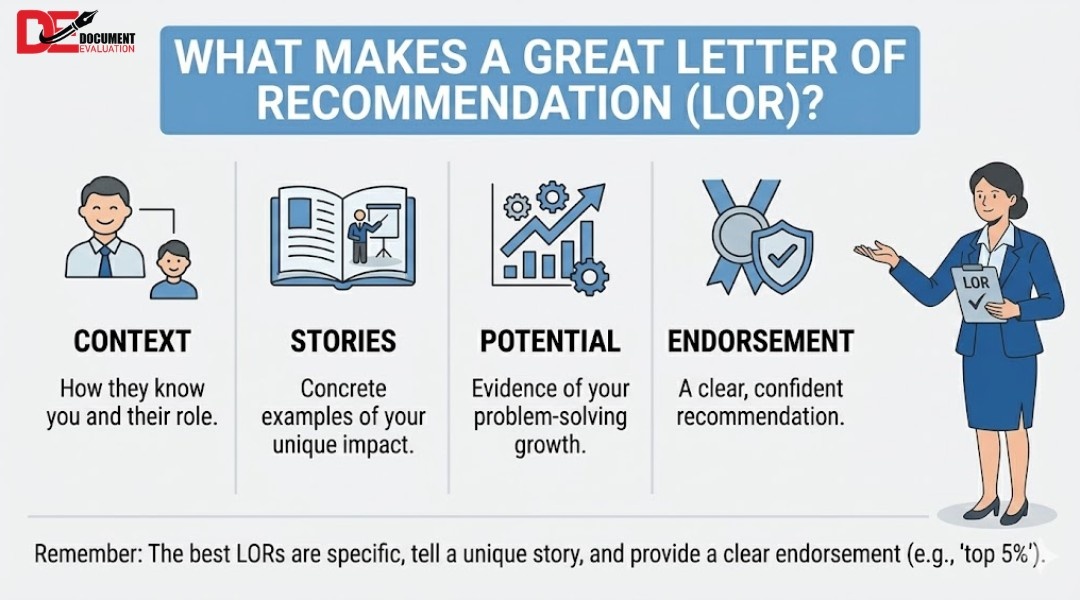
Here are the 6 key elements every strong LOR should have:
- Introductory Paragraph - Who you are, how many years they have known you.
- Concrete Evidence - Stories/examples that illustrate the individual's accomplishments, not just phrases such as, “she works hard.”
- Academic/Professional Skills/Abilities - Proof of the skills you possess that relate directly to the program you are applying to.
- Research/Problem Solving Skills - In graduate school, it is crucial to demonstrate that you possess the ability to conduct research independently.
- Personal Traits/Characteristics - Intellectual curiosity, resilience, ability to work with others (collaboration) are things you should demonstrate as having strong examples of in your recommendation.
- Final Statement of Endorsement - An clear & confident statement indicating that you are being recommended, perfectly placing you among his/her best partners.
Tip – The best LORs tell a story. They don’t just list qualities, they show the admissions committee who you are through memorable, real examples.
The Perfect Letter of Recommendation (LOR) Structure!
A well-structured LOR typically has 1 to 1.5 pages, roughly 400 to 600 words. Below is a clean structure to follow:
| Section | What to Cover ? | Approx. Length |
|---|---|---|
| Opening Paragraph | Who you are, your role, how you know the applicant & for how long | 3 to 4 Sentences |
| Body Para 1 | Academic or technical skills, backed by specific project/result examples | 5 to 7 Sentences |
| Body Para 2 | Research ability, critical thinking or professional achievements | 5 to 7 Sentences |
| Body Para 3 | Personal qualities, communication, leadership, curiosity, perseverance | 4 to 5 Sentences |
| Closing Paragraph | Strong, unambiguous endorsement. Ranking the student | 3 to 4 Sentences |
7 Common Letter of Recommendation Mistakes That you Should Avoid!
Watch out for these red flags that admissions committees notice immediately:
- Using generic phrases such as "great student" gives little to no value to the application without supporting evidence.
- The LOR should provide helpful background information, not just be a re-statement of what can be found on the applicant's CV.
- The letter is not helpful when it consists of a lukewarm recommendation.
- If a recommender submits a letter with less than 300 words, it provides an indication that they do not know you well enough to write a sufficient recommendation.
- Recommendation letters should not focus just on GPAs; what is equally or more important is your character, determination, and willingness to achieve goals.
- If your recommender submits a letter that has poor grammar or is poorly formatted, it reflects negatively on both the recommender and the applicant.
- Always provide your recommender with the due date to submit their letter and ensure that they are aware of the logistical importance of the deadline.
Applicant's Checklist - How to Help Your Recommender?
Here’s something people don’t talk about enough, the applicant plays a major role in the quality of their own LOR. Here’s what you should do:
- Ask Early - Give your recommender at least 4 to 6 weeks notice before the deadline.
- Provide a Brag Sheet - Give them access to your resume, SOP, achievements etc.
- Remind them what you did together - Give them a refresher on your work or times you spent together.
- Be Clear about your Goals - Explain your goals for this application & how you'd like them to approach it.
- Polite Reminders - A reminder 2 weeks before the deadline and one 3 days before is perfectly reasonable.
- Always Say Thank You - A handwritten thank you or a personal email goes a long way.
Tip – Draft a short email template for your recommender summarizing key highlights they could mention. You’re not writing the letter, you’re giving them ammunition to write a great one.
Phrases to Make your Letter of Recommendation Strong!
Not sure how to word things? Here are some strong phrases that work well in front of admissions committees:
- "Among the top 5% of students I have mentored in over 15 years of teaching..."
- "Her ability to independently solve (specific problem) demonstrated rare analytical maturity..."
- "I have no hesitation in recommending him for the most competitive doctoral programs..."
- "She consistently demonstrated the intellectual curiosity that separates good researchers from great ones..."
- "His leadership during (specific project) directly resulted in (measurable outcome)..."
Online Submission - What to Expect?
Most universities today have online portals for LORs, such as ApplyYourself, Slate, etc. This is how the process currently goes:
- Student types in the recommender's email address.
- Automatic email is sent to the recommender with a secure upload link.
- Recommender writes and submits the LOR directly to the university.
- Students can monitor the status of the LOR from their own application dashboard.
Note – Applicants generally waive their right to read the LOR when submitting & admissions committees know this. Waiving that right makes your LOR more credible in the eyes of reviewers.
To Sum Up!
A great Letter of Recommendation is, at its heart, a dialogue between your recommender and the admissions committee. It is your recommender telling them, “Hey, I know this person, and I am willing to put my professional reputation behind this person.”
That kind of personal, detailed, and enthusiastic endorsement is going to get noticed. It is going to make you stand out in a sea of thousands of applications. It is going to make you more likely to get in.
Whether you’re the one writing it or the one asking for it, it is worth it. It really is!!
GOOD LUCK with your applications!!!!
Frequently Asked Question!
Sometimes professors ask students to draft it first and then professor reviews, edits & officially submits the final version.
Yes some universities may verify Letter of recommendation by contacting the recommender to confirm the authenticity.
Yes but it works better if the letter is little customized for every program.
Some universities may allow late submission but it is advised to submit before the deadline.
It is not always compulsory but using an institutional letterhead makes the letter more trustworthy.
Far far away, behind the word mountains, far from the countries Vokalia and Consonantia, there live the blind texts. Separated they live in Bookmarksgrove right at the coast
Yes most universities accept digitally signed recommendation letters.
It is best to request it 4 to 6 weeks before the application deadline.