

 |
|
US University Admission Documents Checklist for International Students

Applying to a university in the US is probably the most exciting & paperwork-congested journey you will attempt.
The good news is that once you know exactly what you need to do, it’s no longer discouraging , it becomes manageable.
In this post, we will let you know all the important DOCUMENTS you’ll need to apply to universities, what universities look for in each document, and how to get ready with a complete academic evaluation for USA.
We have covered both undergraduate and graduate studies!
To ensure your foreign transcripts are precisely converted to meet official standards, you can hire our specialized agency to secure an accurate Academic Evaluation for USA.
The Core Documents You’ll Always Need!
Regardless of the university or the program you are planning to apply for, the following is the list of non-negotiables, the documents that every application needs.
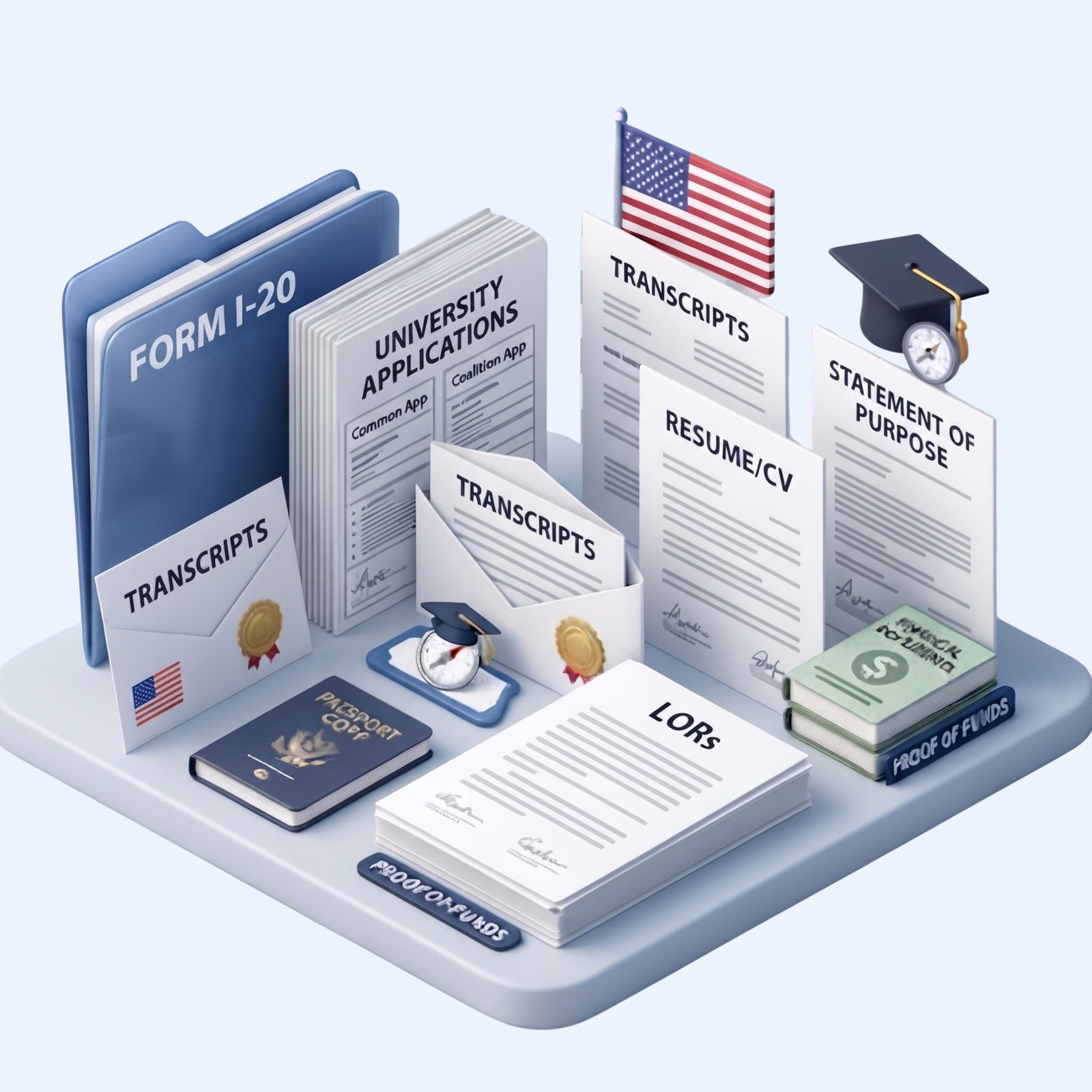
- Academic Transcripts – Official records containing all the courses and grades you’ve completed at every university you have attended. Universities need these documents sent directly from the university or in a sealed envelope.
- Valid Passport – A copy of your passport, containing the photo and information pages. This document needs to confirm your identity and nationality. Also, it needs to have a validity period of at least 6 months beyond the intended enrollment date.
- Completed Application Form – Most US universities will need the Common App, Coalition App, or the university’s own portal. Incomplete forms will raise a red flag immediately.
- Application Fee Payment – This fee generally needs to be paid per university and will range from $50 to $90. Some universities offer fee waivers if the applicant needs it. Always check this first.
- Updated CV / Résume – This is a must for graduate applications. This document needs to highlight all your academic achievements, research, internships, publications, and extracurricular activities. This document needs to be a maximum of 1 to 2 pages.
Standardized Test Scores
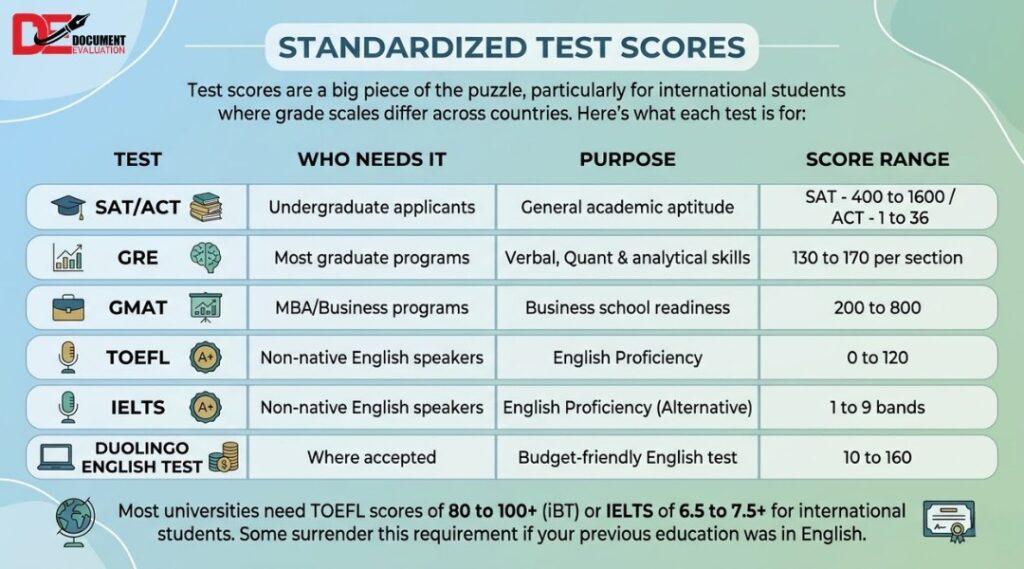
Test scores are a big piece of the puzzle, particularly for international students where grade scales differ across countries. Here’s what each test is for:
| Test | Who Needs it | Purpose | Score Range |
|---|---|---|---|
| SAT/ACT | Undergraduate applicants | General academic aptitude | SAT – 400 to 1600 / ACT – 1 to 36 |
| GRE | Most graduate programs | Verbal, Quant & analytical skills | 130 to 170 per section |
| GMAT | MBA/Business programs | Business school readiness | 200 to 800 |
| TOEFL | Non-native English speakers | English Proficiency | 0 to 120 |
| IELTS | Non-native English speakers | English Proficiency (Alternative) | 1 to 9 bands |
| Duolingo English Test | Where accepted | Budget-friendly English test | 10 to 160 |
Most universities need TOEFL scores of 80 to 100+ (iBT) or IELTS of 6.5 t0 7.5+ for international students. Some surrender this requirement if your previous education was in English. Apart from these test scores, most graduate programs will also require a course-by-course evaluation to properly calculate your GPA.
Financial Documents & Proof of Funds!
The government also wants to know if you have enough money to live & study in the country. This is a main part of the visa application process, moreover the actual application itself. Before you arrange your funds, it is wise to convert international GPA to US GPA to ensure you meet the university’s academic cutoff.
What You’ll Need?
- Bank statements for the last 6 months
- Affidavit of Support if you are being funded by a family member or a particular organization
- Scholarship or Fellowship award letter if applicable
- Financial aid award letter from the university
- Loan sanction letter if you are serving an education loan
- Income tax returns or salary slips of the sponsor
How Much is Enough? – The general rule is that you need to have enough money to cover a year’s worth of living & studying costs. This will vary from $30,000 to $80,000 depending on the university & state. This will be mentioned on your I-20.
Statement of Purpose (SOP) & Personal Essays
This is where your application takes life! Your transcripts tell you what you have done, but your SOP tells them who you are and why you want it.
What Makes a Strong SOP?
- A “Why this program?” section, not just generic flattery
- A narrative of your academic and professional history
- A description of your research interests (for PhD/Master’s), matching what the faculty is working on
- A description of your goals, showing why this degree makes reason as a next step
- Details, not abbreviations: “I am hardworking” is not good, but “I have spent the last two years working as a software engineer” is good
SOP Vs. Personal Statement – What’s the difference? An SOP is career and academic focused, while a personal statement is more focused on who you are as a person.
Word count – 500-1000 words for undergraduate essays, 500-1500 words for graduate SOPs – it’s essential to stick within the word count, as going over it is a bad judgment call.
Academic Evaluation Support
Make your international academic credentials easier for
U.S. universities to evaluate.
Professional foreign credential academic evaluations that help convert international transcripts into U.S. educational equivalencies for university admissions.
Hire Experts for Foreign Credential Academic Evaluation
Trusted evaluations · Fast turnaround for U.S. admissions
Letters of Recommendation (LORs)
Think of your LORs as character witnesses, people who can vouch for your abilities from a position of authority and personal knowledge.
| Application Level | No. of LORs | Ideal Sources |
|---|---|---|
| Undergraduate | 2 to 3 | Teachers, School Counselor, Extracurricular Mentor |
| Master’s/MBA | 2 to 3 | Professor + Current Employer |
| PhD | 3 | Research Supervisor, Professors (Research-Focused) |
Who to ask and who not to? – Select recommenders who know you well & can give clear examples of your work. A general letter from a professor who hardly knows you is much weaker beside a detailed letter from a teaching attendant who educated your project thoroughly.
Give your recommenders at least 4 to 6 weeks of notice. Share your CV, SOP draft & the clear program details so they can customize the letter well.
The Complete Admission Document Checklist
| Document | UG | Master’s | PhD | Notes |
|---|---|---|---|---|
| Academic Transcripts | ✅ | ✅ | ✅ | Official, Sealed if Mailed |
| Passport Copy | ✅ | ✅ | ✅ | Valid 6+ Months Post Enrollment |
| SAT/ACT | ✅ | – | – | Check if Test-Optional |
| GRE/GMAT | – | ✅ | ✅ | Some Schools Waive and Verify |
| TOEFL/IELTS | ✅ | ✅ | ✅ | Waived if Educated in English |
| SOP/Personal Statement | ✅ | ✅ | ✅ | Customized per School |
| Letters of Recommendation | ✅ | ✅ | ✅ | 2 to 3 Depending on Level |
| CV/Resume | Some | ✅ | ✅ | 1 to 2 Pages Max |
| Financial Proof / Bank Statements | ✅ | ✅ | ✅ | For Visa & Admission Both |
| Writing Samples/Portfolio | – | Some | Some | Required for Humanities/Arts PhDs |
| Research Proposal | – | Some | ✅ | Critical for PhD Applications |
| Interview (If Required) | Some | Some | Some | MBA Programs Almost Always Interview |
Your Application Timeline
Timing is everything. Below is a month-by-month application plan for Fall Intake, which is the most popular time to apply.
- Jan to Mar (Year Before) – University research, take necessary tests & shortlist 8-12 universities.
- April to Jun – Order your transcripts, start working on your SOP & identify your recommenders
- Jul to Sep – Complete your SOP drafts, arrange your financial documents, and take your tests.
- Oct to Nov – Submit your Early Decision applications. Most deadlines fall between 1st and 15th Nov.
- Dec to Jan – Submit your Regular Decision applications. Most deadlines fall between 1st & 15th Jan.
- Mar to Apr – Receive your admission offers. Apply for your F1 visa with your I-20 form.
- May – National Decision Day. Assign to your university by paying your tuition deposit.
Pro Tips Most Applicants Miss!
- Keep copies of all documents – It is always a good idea to keep both physical & digital copies. Universities often misplace documents, so having a duplicate would save time.
- Customize, rather than copying – While writing your SOP, make sure to reference specific professors, courses, labs, etc, for each university. The admission committee can easily tell if your SOP is a template.
- Apply 2-3 weeks before the deadlines – Technical issues, crashes & document issues can happen. The deadline is a hard deadline, not a suggestion. Apply before 11:00 PM.
- Credential evaluation – Some universities need a WES evaluation of your foreign transcripts. It can take 4 to 6 weeks, so start early.
- Don’t Forget the Visa Documents – Once your admission is through, your I-20 form from the university, your proof of SEVIS payment, your DS 160 form & your visa interview appointment at the US embassy are all important documents. Your financial documents will be important again.
Frequently Asked Questions
Are all documents required for every university?
No, requirements vary depending on the university and program.
Can I submit scanned copies of transcripts?
Yes, but they must be official or digitally verified.
Is SOP required for all courses?
Most graduate programs require it, especially MS programs.
Can I reuse the same SOP for all universities?
No, it is better to customize it for each application.
How many LORs are usually needed?
Generally two to three, depending on the university.
Are GRE scores compulsory?
Not always, as many universities are now test-optional.
When are financial documents required?
Often after admission, for visa and enrollment purposes.
What happens if I miss a document?
Your application may be considered incomplete or rejected.
In Conclusion!
US university applications are not rocket science, they are simply very methodical. The students who get in are not necessarily the brightest, they are simply the most prepared. So, start early, be familiar with all the documents, and be yourself while writing your statement of purpose.
Each document is a part of your overall case. Your transcripts are a reflection of your capabilities. Your SOP is a reflection of your aspirations. Your LORs are a reflection of your personality. Your financial documents are a reflection of your preparedness. All of them together are a reflection of a student who is ready to take on the American education system. To avoid mistakes in this methodical process, many students consult the best credential evaluation services to handle their international documents.
Start by checking all the documents, working backwards from the deadline, and remember, thousands of international students do it every year. You are ready!

Worried About Missing Deadlines & Rejections in Your US University Application?
Don’t let missing documents risk your study abroad dreams. Secure your admission with error-free credential evaluations and expert guidance to meet university requirements without interruption.
Explore More Resources for International Students
- 50+ Academic Writing Phrases for Essays & Research
Explore 50+ academic writing phrases with examples to improve essays, research papers, dissertations, and university assignments with clear, professional language. - Is a Distance Education Degree Valid in the USA?
Learn whether a distance education degree is recognized in the USA, how credential evaluations work, and what universities and employers consider. - US University Admission Checklist for International Students
Get a complete checklist of documents required for US university admission, including transcripts, SOP, LORs, test scores, financial proof, and F-1 visa paperwork.
Akash Pundir is the Chief Operating Officer at Document Evaluation LLC, bringing over 5 years of international business operations and legal support experience across the United States, Australia, and India. He has overseen the strategic positioning and analysis of over 1,000+ complex USCIS cases, specializing in guiding expert evaluation teams to draft high-stakes Expert Opinion Letters (EOL), Academic Equivalencies, and defense packets for H-1B, EB-2 NIW, RFEs, and NOIDs. Driven by digital transformation, Akash ensures every evaluation adheres strictly to the latest USCIS legal frameworks and compliance benchmarks.
