

 |
|
O-1 Visa Processing Time In October 2026: Current Timelines For Extraordinary Ability


How long does an O-1 visa take in October 2026? The answer depends on which stage of the process you are asking. USCIS petition processing, premium processing, visa interviews, and visa issuance each follow a different timeline. There is no single processing period that covers the entire O-1 process.
As of October 2026, USCIS processing-time information shows that standard Form I-129 petitions in the O category take about 14 months for 80% of completed cases. This figure applies to the USCIS petition stage. It does not include the time needed to prepare the petition or, for applicants outside the United States, complete the visa process at a US consulate.
Eligible O-1 petitions can use premium processing. Under this option, USCIS takes qualifying adjudicative action within 15 business days. That does not mean the applicant will receive an O-1 visa within 15 business days because visa processing is a separate step.
To prevent costly delays and satisfy extraordinary ability criteria regardless of your adjudication timeline, you can hire our specialized agency to Order Your O-1 Visa Expert Opinion Letter for authoritative evidentiary support.
O-1 Premium Processing Time In 2026
Premium processing remains the fastest USCIS option for an eligible O-1 petition.
For eligible Form I-129 O petitions, USCIS provides adjudicative action within 15 business days. The premium-processing fee for O-1 petitions is $2,965 for requests subject to the fee effective March 1, 2026.
The 15-business-day period does not mean that USCIS must approve the petition within that time frame. USCIS can take a qualifying action that includes an approval, denial, Request for Evidence (RFE), or another action permitted under the premium-processing rules.
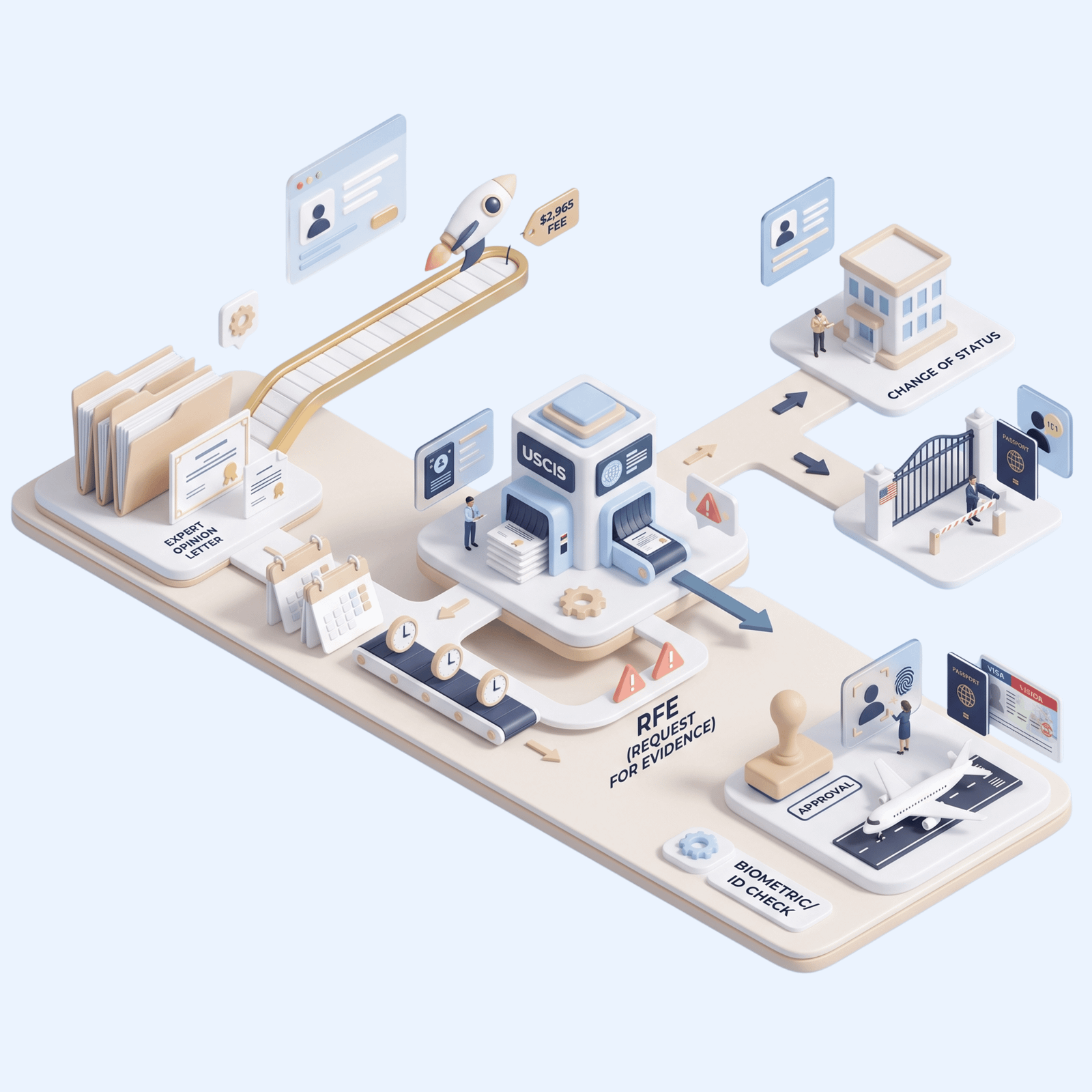
The process may look like this:
O-1 petition → Premium processing → USCIS decision → Visa application and interview, unless an applicable interview-waiver exception applies → Visa issuance → Travel
For someone outside the United States, the process can therefore continue after USCIS approves the petition.
Premium processing does not guarantee:
- O-1 approval
- Visa issuance
- A visa interview by a particular date
- Entry into the United States
- Completion of the entire O-1 process within 15 business days
To avoid costly evidentiary delays and ensure your case is positioned for a seamless approval, you can hire our specialized agency for professional assistance to navigate the USCIS Form I-129 O-1 processing timeline with confidence.
O-1 Visa Processing Time In October 2026
The current timeline can be broken down as follows:
| O-1 Processing Stage | What It Means | October 2026 Information | Important Point |
| Petition preparation | Gathering evidence and preparing Form I-129 | Depends on the case | Not included in USCIS processing time |
| Standard I-129 processing | USCIS reviews and decides the O petition | About 14.5 months for 80% of O-category cases | Not a guaranteed timeline |
| Premium processing | Faster USCIS adjudication | 15 business days | Covers USCIS action, not the complete visa process |
| Approval notice | USCIS issues its decision | After adjudication | Petition approval is different from visa issuance |
| Consular visa processing | Visa application outside the United States | Varies by location | Separate from USCIS processing |
| Change of status | Request to change status while in the United States | Separate USCIS process | Does not involve visa stamping |
The 14-month figure should therefore be viewed as a USCIS petition-processing figure, not as the amount of time an applicant will necessarily need to obtain an O-1 visa.
USCIS processing-time information is based on completed cases and can change as workloads and adjudication conditions change.
USCIS historical data also shows why older processing figures should not automatically be used as October 2026 estimates. The FY2026 historical table reports a 5.2-month median for non-premium Form I-129 petitions through July 31, 2026. And that figure covers Form I-129 cases more broadly and does not represent an O-1-specific October 2026 processing time.
How Long Does An O-1 Petition Take?
For a standard O-1 petition, the current October 2026 figure is about 14.5 months for 80% of O-category Form I-129 cases.
This is not a fixed waiting period for every applicant. USCIS may decide one petition sooner while another may take longer.
It helps to separate four dates that applicants often treat as the same:
- Receipt date: The date USCIS receives the petition.
- Processing time: The published timeframe for the applicable USCIS category.
- Case inquiry date: The date USCIS may allow an applicant to ask about a case that has gone beyond normal processing.
- Decision date: The date USCIS actually makes a decision on the individual petition.
For this reason, an O-1 petition filed in October 2026 should not be expected to receive a decision exactly 14 months later.
How Long Does It Take To Get An O-1 Visa After I-129 Approval?
An approved I-129 petition does not automatically give an applicant an O-1 visa.
If the applicant is outside the United States, the process generally continues as follows:
O-1 petition → USCIS approval → Visa application → Interview, if required → Visa issuance → Travel to the United States
The Department of State provides separate information about visa appointment availability. Its current wait-time system includes petition-based visa categories such as H, L, O, P & Q.
Appointment availability can vary significantly between US embassies and consulates. For example, the published figures for locations such as Mumbai and New Delhi can differ.
These appointment figures should not be presented as O-1-specific processing times because the Department of State groups several petition-based visa classifications together.
After the interview, an applicant may also need additional time for visa issuance or administrative processing.
This is why an applicant should not expect to receive an O-1 visa 15 business days after choosing premium processing. The 15-business-day period applies to the USCIS petition stage.
What Are The O-1 Change of Status And Consular Processing?
The next step depends in part on where the beneficiary is when the petition is filed.
-
Change of Status
A person already in the United States may request a change of status to O-1 through the USCIS petition, as long as they meet the applicable requirements.
In this situation, USCIS handles the petition and change-of-status request. The change-of-status request itself does not require a consular visa interview, although a visa may be needed later if the person leaves the United States and needs to return in O-1 status.
-
Consular Processing
If the applicant is outside the United States, they generally need to apply for an O-1 visa at a US embassy or consulate after USCIS approves the petition. The visa application adds another part to the overall timeline.
USCIS processing and the visa process at a US embassy or consulate are handled separately, so completing one does not mean the other is complete.
In July 2026, the Department of State also changed its guidance on nonimmigrant visa interviews. Applicants generally should schedule their interview in the country where they are a citizen or legal resident, unless a designated post or an applicable exception allows otherwise.
What Can Delay An O-1 Petition?
An O-1 case may take longer than expected for several reasons. Some common ones are
- A Request for Evidence (RFE)
- Missing or incomplete documents
- Evidence that is difficult to follow
- Questions about the beneficiary’s extraordinary ability
- Issues with the petitioner or proposed employment
- Problems related to the required consultation
- Inconsistencies in contracts or itineraries
- USCIS workload
- A request for more supporting evidence
- Consular processing after USCIS approves the petition
Receiving an RFE does not mean USCIS has decided to deny the case. It means the officer needs more information or evidence before reaching a final decision.
An RFE also does not add a fixed amount of time to every O-1 case. The additional time depends on what USCIS asks for, how soon the petitioner submits the response, and how long USCIS takes to review it.
Does An O-1 RFE Increase Processing Time?
Yes! An RFE can increase the total time required to complete an O-1 case because the petitioner needs to prepare a response & USCIS must review the additional evidence.
Premium processing does not remove the need to respond to an RFE. The expedited process requires USCIS to take qualifying action within the applicable timeframe; it does not require the agency to approve the petition.
The right way to view an RFE is as another step in the adjudication process. It does not, by itself, indicate that the petition will be approved or denied.
To prevent costly petition delays, petitioners often secure professional assistance to navigate the O-1 Visa RFE Response Processing Time with USCIS-ready expert opinion letters and objective peer reviews.
How Long Does It Take To Prepare An O-1 Petition?
The time needed to prepare an O-1 petition is separate from USCIS processing time.
Before filing Form I-129, the petitioner and beneficiary may need to collect and organize a significant amount of supporting evidence. The amount of preparation depends on the person’s background, the type of O-1 classification, and the evidence available.
Preparation may include:
- Awards
- Publications and media coverage
- Evidence of judging
- Memberships
- Original contributions
- Scholarly articles
- Evidence of critical or essential roles
- Compensation evidence
- Consultation documentation
- Contracts
- Itineraries
- Employer documentation
A petition with a large amount of evidence can take substantial time to prepare and organize.
Therefore, the total immigration timeline should not be calculated by looking only at the USCIS processing time.
Can An Expert Opinion Letter Help An O-1 Petition?
An expert opinion letter can help explain certain O-1 evidence. An independent expert can describe why the applicant’s specialized work, original contribution, or technical achievement matters in the field.
USCIS does not ask for an expert opinion letter in every O-1 case. A letter also does not guarantee approval or a faster decision. It should add support to the evidence in the petition, not replace it.
The usefulness of the letter depends on the case and what the expert can say about the applicant’s work. The letter can be helpful when the petition includes technical work, foreign qualifications, specialized achievements, or other evidence that may need further professional explanation.
If you decide a letter fits your petition, this guide to choosing expert opinion letter services explains what to check, such as the expert’s field, independence from your employer, and whether the letter is written for your case.
What Are The O-1 Processing Time And O-1 Visa Validity?
O-1 processing time and visa validity are not the same thing. Processing time means how long USCIS or another agency takes to review and decide a petition or application.
Visa validity refers to the period when the visa can be used to seek entry at a US port of entry. O-1 status, on the other hand, covers the period during which the beneficiary is allowed to stay in the United States under O-1 classification.
For this reason, these terms should not be used interchangeably. For example, premium processing may result in a quick decision on an O-1 petition, but the applicant may still need to complete the consular visa process before travelling to the United States.
How To Avoid O-1 Visa Processing Delays?
Before filing the petition, read through the complete case one more time. Check that the evidence supports the claims and that the details are consistent in all the documents.
Make sure:
- The evidence supports the claims in the petition.
- The documents are clear and easy to review.
- The contracts and itineraries contain the same information.
- Any required consultation has been completed.
- Employer and petitioner details are complete and correct.
- Foreign education or professional documents are explained when necessary.
- Expert letters, if included, give the expert’s own opinion about the applicant’s work instead of repeating the petition.
A careful review cannot guarantee a faster USCIS decision. It can help catch missing documents, errors, or gaps before filing. This may also lower the chance of receiving follow-up questions or a request for evidence.
Frequently Asked Questions
How long does an O-1 visa take in 2026?
As of October 2026, standard USCIS processing for O-category Form I-129 petitions is about 14.5 months for 80% of cases. Premium processing provides USCIS adjudicative action within 15 business days. If the applicant needs consular processing, the visa stage follows a separate timeline.
How long does O-1 consular processing take?
There is no single worldwide O-1 consular-processing timeline. Appointment availability varies by US embassy or consulate, and the Department of State publishes location-specific information for petition-based visa appointments.
How long does an O-1 change of status take?
The timeline depends on the applicable USCIS processing category and the circumstances of the filing. Change of status should not be treated as the same process as obtaining an O-1 visa through a US consulate.
Does O-1 processing time depend on the applicant’s nationality?
USCIS petition processing does not simply depend on nationality. However, an applicant outside the United States may face different consular appointment availability depending on the location of the visa application.
What is the fastest way to process an O-1 petition?
For an eligible petition, premium processing is the fastest USCIS adjudication option. It provides a 15-business-day timeframe for USCIS action. It does not remove the time required to prepare the petition or complete visa processing after approval.

O-1 Visa Guide: Requirements, Costs, Extraordinary Ability Criteria & Evidence Strategy
- O-1 Visa Guide: Requirements, Filing Costs, and Application Timeline
Navigate the complete O-1 visa roadmap. Learn the core eligibility standards, current USCIS fee structures, and the step-by-step petition process from consultation to final approval. - O-1A Evidence Strategy: How Many Publications and Letters Do You Actually Need?
Cut through the myths of evidence volume. Discover how USCIS weighs peer recommendation letters against published scholarly work, and how to focus on objective impact over sheer quantity. - Proving Extraordinary Ability: USCIS O-1 Visa Evidentiary Criteria Explained
Break down the regulatory criteria for O-1 status. Learn how to document your sustained national or international acclaim using verified industry evidence, awards, and authoritative expert evaluations.
Akash Pundir is the Chief Operating Officer at Document Evaluation LLC, bringing over 5 years of international business operations and legal support experience across the United States, Australia, and India. He has overseen the strategic positioning and analysis of over 1,000+ complex USCIS cases, specializing in guiding expert evaluation teams to draft high-stakes Expert Opinion Letters (EOL), Academic Equivalencies, and defense packets for H-1B, EB-2 NIW, RFEs, and NOIDs. Driven by digital transformation, Akash ensures every evaluation adheres strictly to the latest USCIS legal frameworks and compliance benchmarks.
