

 |
|
O-1 Visa Requirements for Individuals With Extraordinary Ability

- The O-1A visa covers individuals with extraordinary ability in science, education, business, or athletics.
- The O-1B visa is designated for those with extraordinary ability in the arts or extraordinary achievement in motion picture and television industries.
- No specific minimum college degree is formally required to qualify for an O-1 visa.
- Most standard cases require satisfying at least three regulatory criteria.
- The petition must be filed by a U.S. employer, agent, or sponsor rather than the individual directly.
- USCIS evaluates the overall quality and substantive strength of the evidence rather than the sheer volume of documents.
If you have a strong record of achievement in your field, the O-1 visa may allow you to continue your work in the United States. It is available to individuals who can show extraordinary ability in areas such as science, education, business, athletics, the arts, and motion picture or television.
You do not need a specific degree to qualify. Your accomplishments and the recognition you have received can support your case, as long as you can show that you plan to continue working in your area of expertise in the United States.
To substantiate your extraordinary ability with an authoritative, independent evaluation, you can hire our specialized agency to Order Your O-1 Visa Expert Opinion Letter tailored specifically to USCIS evidentiary standards.
What Are the O-1 Visa Requirements?
The requirements depend on whether the applicant applies for O-1A or O-1B classification. Understanding the distinction between the O-1A vs O-1B visa categories is essential for identifying the correct evidentiary standard for your field—whether you are aiming for science and business or the arts and entertainment.
What Are The O-1A Requirements?
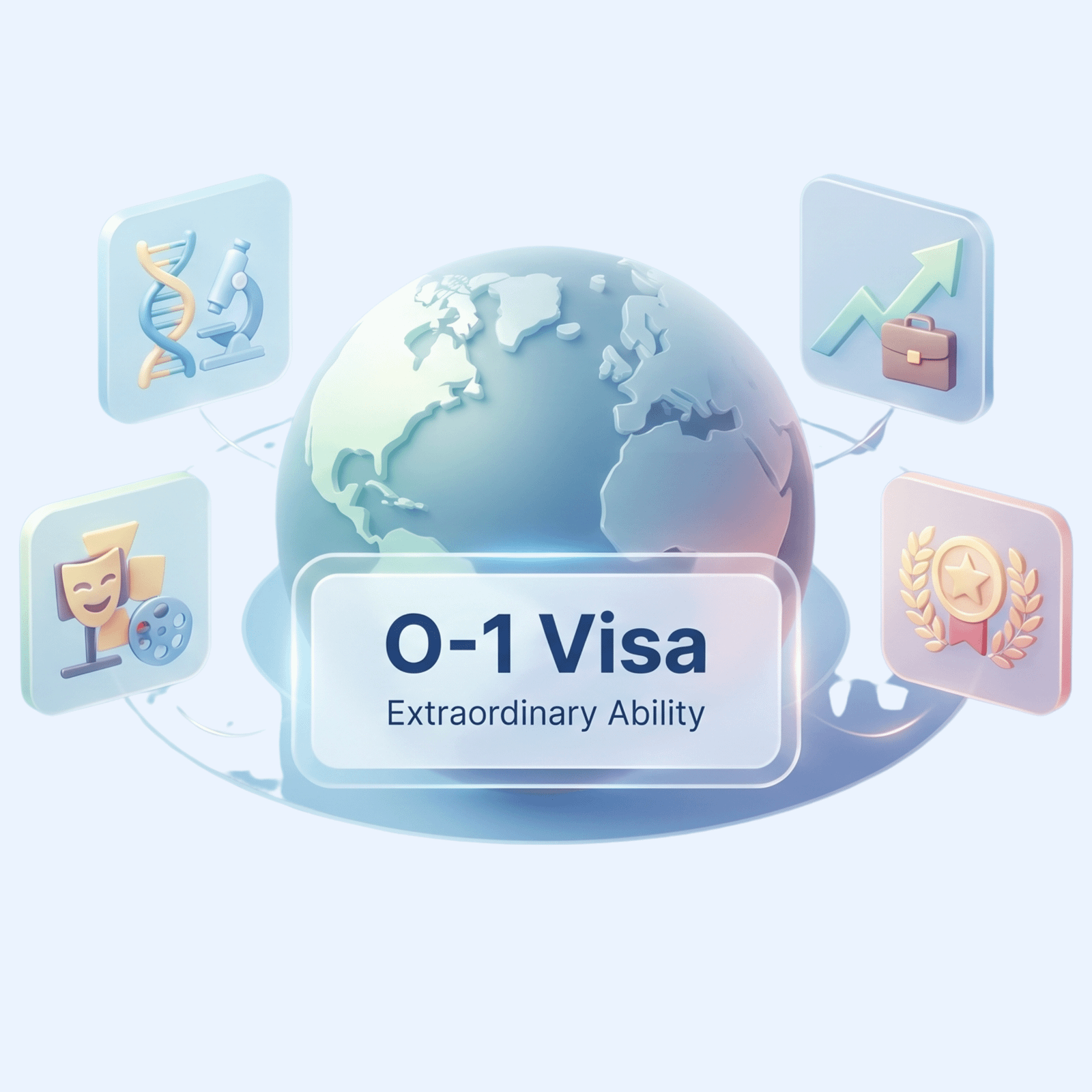
O-1A covers extraordinary ability in:
- Sciences
- Education
- Business
- Athletics
For O-1A, you need to show sustained national or international acclaim and expertise that puts you among the small percentage at the top of your field.
One way to qualify is through an internationally recognized award, such as a Nobel Prize. If you do not have one, you generally need to meet at least three of these eight criteria:
- Receiving a nationally or internationally recognized award for excellence in your field.
- Belonging to a professional association that admits members based on outstanding achievements.
- Having articles or other published material about you and your work in professional publications, major trade publications, or major media.
- Being invited to judge the work of other professionals in your field or a closely related area.
- Making original scientific, scholarly, or business contributions that have major significance in your field.
- Publishing scholarly work in professional journals or other major media.
- Holding an important position with an organization or establishment known for its distinguished reputation.
- Salary or other compensation that is significantly high compared with others working in the same field.
If these criteria do not fit your occupation, instead USCIS may consider comparable evidence.
Meeting three criteria is only part of the process. USCIS reviews the complete record to determine whether your achievements support O-1A classification.
What Are The O-1B Visa Requirements?
O-1B is intended for professionals in the arts whose work has received substantial recognition. Your petition should show that you have reached a level where you are regarded as prominent, leading, or well known in your area of work.
A major national or international award or nomination can help establish eligibility. If you do not have one, you generally need to satisfy at least three of the following six requirements:
- You have appeared in a prominent or starring capacity in productions or events that are well regarded in the industry.
- Your work has received national or international attention through professional reviews, articles, or other published coverage.
- You have held an important role in a production or worked in a significant position for an organization known for its standing in the industry.
- Your work has produced major commercial results or received substantial critical praise.
- Your achievements have been recognized by professional organizations, critics, government bodies, or established experts.
- Your compensation is substantially higher than what is normally paid to others working in a similar area.
If some of these requirements do not fit the nature of your occupation, USCIS may consider other forms of comparable evidence.
Meeting three of the requirements does not mean the petition will be approved. USCIS reviews all of the information submitted and decides whether it shows the level of achievement and recognition needed for O-1B status.
What Are The O-1B Requirements for Motion Picture Or Television?
O-1B also covers individuals with extraordinary achievement in motion picture or television productions.
Applicants must show a high level of achievement and recognition as outstanding, notable, or leading in the field.
The applicant may qualify through a significant national or international award or nomination. Otherwise, the petition generally must satisfy at least three applicable criteria involving areas such as
- Leading or presenting participation
- Published recognition
- Critical roles
- Commercial or critical success
- Significant recognition
- High compensation
What Does an O-1 Petition Need?
An O-1 beneficiary cannot file the petition directly. A US employer or qualifying US agent generally files Form I-129 with USCIS.
A foreign employer may also use a US agent to file in qualifying situations.
The petition must show that:
- The beneficiary qualifies for O-1 classification.
- The beneficiary will continue working in their area of extraordinary ability or achievement.
- The applicable evidentiary requirements have been met.
- The petition includes the required employment documents.
- The required consultation or advisory opinion is included, unless an exception applies.
Depending on the case, the petition must also include contracts or a summary of an oral agreement, details about the proposed activities, dates of employment or engagements, an itinerary when required, and the appropriate advisory opinion.
Does An O-1 Visa Require A Degree?
No, O-1 classification does not require a bachelor’s or master’s degree.
USCIS focuses on the applicant’s extraordinary ability or achievement and the evidence supporting that claim.
An advanced degree alone does not establish O-1 eligibility. Likewise, an applicant does not automatically lose eligibility because they do not have an advanced degree.
Does an O-1 Require An Employer Or Job?
Yes, An eligible petitioner must file the O-1 petition, and the proposed US work must relate to the beneficiary’s area of extraordinary ability or achievement.
A US agent may file for certain workers, including individuals who traditionally work for themselves, workers with short-term engagements involving multiple employers, and certain foreign-employer arrangements.
When an agent represents multiple employers, the petition must include the required documentation and an itinerary covering the relevant engagements.
Frequently Asked Questions
O-1A applicants generally need a major internationally recognized award or evidence that satisfies at least three of the eight regulatory criteria. O-1B applicants generally need a qualifying major award or at least three applicable criteria under the relevant O-1B standard. Meeting the required number of criteria does not guarantee approval.
No, you do not need a master’s degree or any other specific degree for an O-1 visa. What matters is whether your background and accomplishments support a claim of extraordinary ability or achievement.
Yes, a major internationally recognized award is one way to qualify, but it is not the only option. Applicants may also establish eligibility by meeting the applicable evidentiary criteria for their O-1 classification.
No, an O-1 beneficiary cannot file the petition directly with USCIS. The petition must be submitted by a qualifying US employer or a US agent on the beneficiary’s behalf.
Yes, business is one of the areas covered by the O-1A classification. Business professionals must show sustained national or international acclaim and provide evidence demonstrating the level of expertise required for O-1A classification.
Yes, scientists and researchers can qualify under the O-1A category because science is included within this classification. Depending on the case, supporting material may include original contributions, scholarly publications, judging activities, awards, and critical or essential roles.
O-1A is for people working in science, education, business, or athletics who can show extraordinary ability. O-1B is for those in the arts, as well as individuals with extraordinary achievement in motion picture or television. The type of supporting evidence you need will depend on the category that fits your work.
What Evidence Is Needed For An O-1 Visa?
The documents you submit will vary based on the type of O-1 classification and the work you do. Depending on the circumstances, a petition may include:
- Awards or prizes received for your work
- Memberships in professional associations
- Articles, interviews, or other media coverage
- Invitations to review or judge the work of others
- Scholarly articles and other publications
- Evidence of significant original work or contributions
- Proof of important roles with employers or organizations
- Material showing the standing of the organizations involved
- Salary or other compensation records
- Contracts, job offers, and employment-related documents
USCIS does not decide a case by looking at the number of documents submitted. The material should make it clear why the applicant has reached the level of achievement and recognition required for O-1 classification.
For O-1A cases, USCIS also has specific guidance for evaluating evidence in STEM-related occupations and certain areas of work connected to critical and emerging technologies.

Do You Have Extraordinary Ability? You Don’t Need a Degree to Qualify for an O-1 Visa!
From science and business to the arts and athletics, prove your impact with strong evidence not just a diploma. Let a U.S. employer or agent file a rock-solid petition.
Discover O-1 visa requirements, recommendation letter strategies, and 2026 USCIS approval trends in the guides below:
- How to Secure an O-1 Visa: Eligibility Criteria, True Costs & USCIS Filing Roadmap
Details core O-1 extraordinary ability criteria, required documentation, USCIS filing fees, and step-by-step application timelines for sustained national or international acclaim. - How Many Publications & Recommendation Letters Do You Need for an O-1A Visa?
Breaks down optimal quantities and selection strategies for O-1A peer recommendation letters, independent scholarly publications, and supporting evidence required to satisfy USCIS criteria. - What Are Your Odds of O-1 Visa Approval in 2026? Official USCIS Data & Trends
Analyzes recent USCIS data and approval trends for the O-1 visa category. Highlights common Request for Evidence (RFE) triggers, adjudication metrics, and key factors for petition success.
Akash Pundir is the Chief Operating Officer at Document Evaluation LLC, bringing over 5 years of international business operations and legal support experience across the United States, Australia, and India. He has overseen the strategic positioning and analysis of over 1,000+ complex USCIS cases, specializing in guiding expert evaluation teams to draft high-stakes Expert Opinion Letters (EOL), Academic Equivalencies, and defense packets for H-1B, EB-2 NIW, RFEs, and NOIDs. Driven by digital transformation, Akash ensures every evaluation adheres strictly to the latest USCIS legal frameworks and compliance benchmarks.
