

 |
|
What are the Translation Requirements for an EB-2 Visa? A Complete Filing Guide

If you’re filing an EB2 petition, USCIS won’t accept foreign-language documents on their own; every one of them needs a certified English translation attached. That covers diplomas, academic transcripts, employment letters, birth certificates, and even supporting materials like recommendation letters.
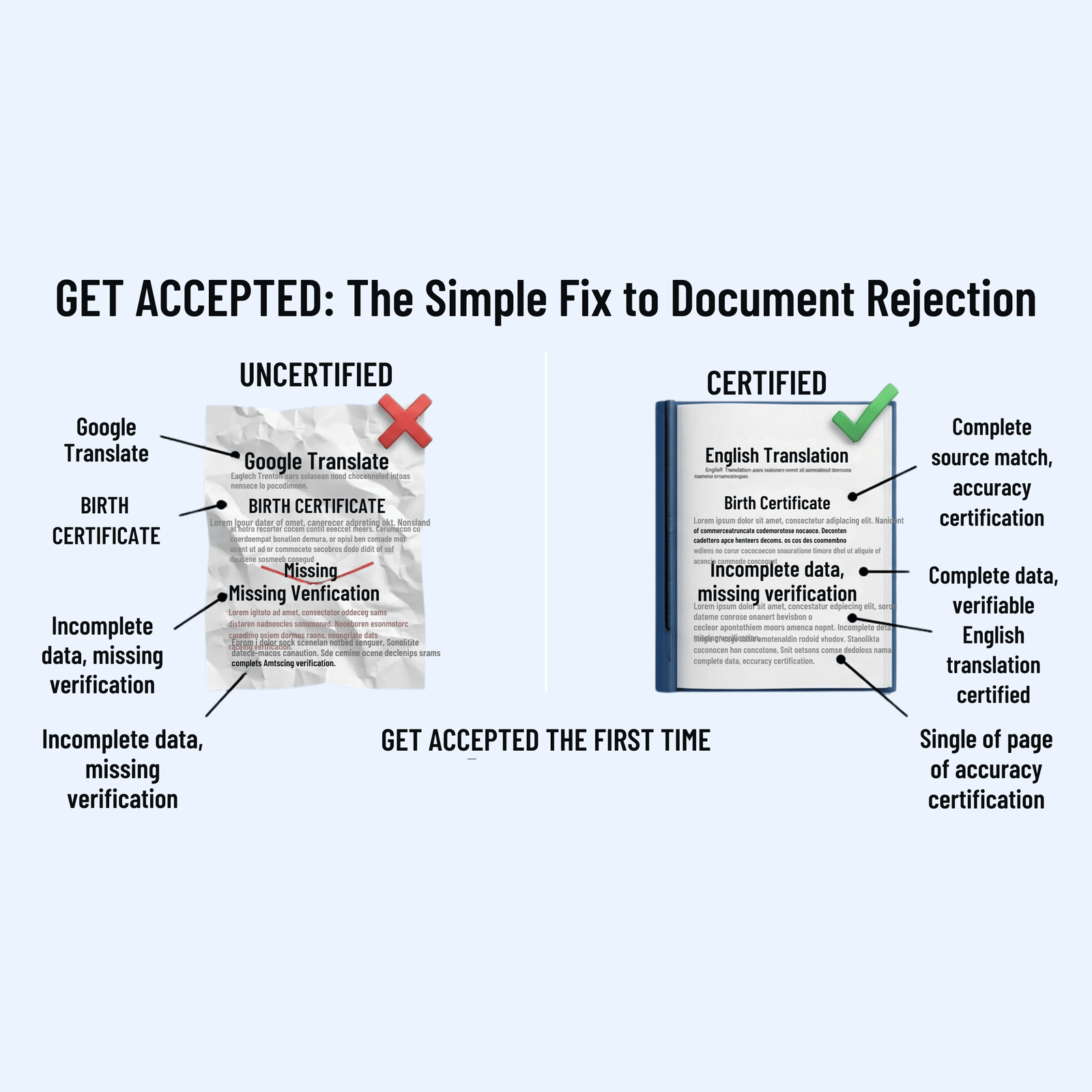
The rule itself isn’t complicated: the translation has to be complete and accurate, and it needs a signed certification from someone qualified to translate it. What actually causes problems isn’t the rule; it’s the execution. Petitioners often submit partial translations, forget the certification altogether, or use inconsistent spellings of names across different documents. Any of these can be enough for USCIS to issue a Request for Evidence, which pushes your case timeline back significantly.
To ensure your entire documentation package meets every technical requirement, you can hire our expert service to provide an accurate expert opinion letter for EB-2 visa.
What USCIS Actually Requires For EB-2
Every rule about foreign-language documents in an EB2 petition traces back to a single regulation: 8 CFR 103.2(b)(3). It states that any document containing a foreign language submitted to USCIS must be accompanied by a full English translation, and the translator must certify that the translation is both complete and accurate and that they are competent to translate from the foreign language into English.
Three requirements are the following:
- The translation must be complete: Every word, stamp, seal, and handwritten note on the original document needs to appear in English, not just the parts you think matter.
- The translator must certify accuracy and completeness: This is a written statement, signed and dated.
- The translator must certify their competency: In both the source language and English.
What the regulation notably does not require is notarization, a licensed or accredited translator, or membership in any professional translation body. This surprises many applicants. You don’t need an ATA-certified translator or a notary stamp for USCIS purposes, though some people add notarization anyway as extra reassurance. It doesn’t hurt, but it isn’t the thing that gets your translation accepted.
What Documents Typically Need Translation for an EB2 Petition
For EB2 cases, whether filed as a standard EB2 with a labor certification or as an EB2-NIW (National Interest Waiver), the foreign-language documents that most commonly need certified translation include the following:
- Foreign university diplomas and academic transcripts
- Foreign employment verification letters
- Birth and marriage certificates (for derivative family members)
- Reference letters or recommendation letters written in a language other than English
- Foreign patents, publications, or awards submitted as evidence of exceptional ability
- Any supporting affidavit originally drafted in a foreign language
Supporting evidence like recommendation letters and third-party affidavits also needs a certified translation if they weren’t originally written in English. We’ve seen strong NIW petitions get an RFE purely because a glowing recommendation letter from a foreign colleague was submitted only in the original language, with no translation attached at all.
Step-by-Step: Getting Your Translations Right
Step 1: Identify every foreign-language document in your filing
Go through the whole petition packet, page by page. Don’t just flag the obvious stuff like diplomas; many people miss foreign-language stamps, seals, or annotations sitting on pages that are otherwise in English.
Step 2: Choose a competent translator
It could be a professional translation service, or honestly, anyone fluent in both languages who’s willing to put their name on a certification. While USCIS regulations (8 CFR 103.2(b)(3)) do not clearly prohibit self-translation, most immigration attorneys strongly advise against it. An independent third-party translator is chosen because it removes any appearance of bias & carries more weight with adjudicators. You are hardly a neutral party when the document being translated is your diploma, and USCIS officers scrutinize self-translated documents more closely.
Step 3: Translate the Full Document
Not a summary, not the “relevant parts.” USCIS has said directly that a summary from the translator doesn’t count as a real translation.
Step 4: Attach a certification statement
Important note about the certification: Under 8 CFR 103.2(b)(3), the certification must include all of the following elements to be valid:
- The translator’s full printed name
- The translator’s signature
- The date of the translation
- The translator’s contact information (phone number, email address, or physical address)
- A clear statement that the translator is skilled in both the source language & English
- A clear statement that the translation is complete & accurate
Do not skip any of these elements. Missing contact information or a missing date is a common reason USCIS issues a Request for Evidence (RFE).
Step 5: Submit a copy of the original document with the translation
USCIS wants both together so an adjudicator can compare them directly if they need to.
Step 6: Keep certifications document-specific
Do not combine five documents under one certification; such an action confuses the paper trail and appears careless. Every document gets its own, even if it’s the same translator doing all of them.
Common Mistakes That Trigger RFEs
We’ve seen these come up again and again, and almost all of them are avoidable:
- Partial translations: This includes skipping margin notes, stamps, or back-page text. If it’s a foreign language, it must be translated.
- Missing certification language: A translation with no signed statement of accuracy and competency is treated as incomplete evidence.
- Using machine translation as the final product: Google Translate or AI-generated translations submitted without human review and certification are a real risk. USCIS has increasingly flagged these and, in some cases, treated them as grounds for concern regarding the integrity of the filing. Machine tools are fine for your comprehension; they’re not a substitute for certified human work.
- Inconsistent name translation: If your name is translated as “Mohammed” on one document and “Muhammad” on another, it raises questions about whether the documents even refer to the same person. A good translator keeps this consistent across your whole filing.
- Blurry or low-quality scans: If the translator cannot clearly read the original, the translation itself becomes unreliable, and that shows.
- Assuming English headers mean no translation is needed: Even if a document has English labels or headers, any foreign-language content underneath still requires full translation.
Translation Cost & Timeline: Document Evaluation
| Service | Economy | Standard | Express |
| Translation | $30 (2-3 Days) | $50 (Next Day) | $70 (Same Day) |
Frequently Asked Questions
No, USCIS doesn’t require any formal license or accreditation. The regulation just asks the translator to certify they’re competent in both languages and that the translation is complete and accurate. Still, using an experienced professional translator is a good idea; it reduces the chance of errors or an adjudicator raising questions later.
It’s not banned, but most immigration attorneys will tell you not to. USCIS tends to see self-translation as a conflict of interest; after all, you have a personal stake in how the document reads. An independent third-party translator is more credible and keeps things clear.
No, a signed certification from the translator confirming their competency and the accuracy of the translation is sufficient. Notarizing it isn’t going to hurt anything, but it doesn’t add any legal weight either; USCIS just doesn’t ask for it.
USCIS generally treats such cases as missing evidence, and that usually means an RFE. Once that happens, you’re looking at weeks, sometimes months, added to your processing timeline. It’s a lot easier to catch gaps before filing than to fix them after.
Yes, if a letter was originally written in another language, it needs a certified English translation attached. People miss this requirement more often than you’d think, especially since the focus usually goes to the “core” evidence. Worth going back through every supporting document, not just the obvious ones.
No, as your final submission. USCIS wants human-translated work with a proper certification statement behind it. Machine translation without that certification is a quick way to invite extra scrutiny or a rejection.
It varies by provider and how much you’re sending over, but most standard documents come back within a few business days from a professional service. Build this into your filing timeline early; it’s not something you want to be confused about at the last minute.
If your name is transliterated from non-Latin scripts. Flag it to your translator upfront so they keep spelling consistent, or if the variation already exists in your original records, make sure it’s clearly noted. Consistency here saves you headaches during review.
Conclusion
Translation requirements for an EB2 visa aren’t complicated once you understand the underlying logic: complete, accurate, certified, and consistent. The regulation itself is short, but the consequences of getting it wrong an RFE, a delay, sometimes a denial are not small. Treat your translations with the same care you’d give the rest of your petition. Get them done early, make sure every document is fully translated and properly certified, and keep your originals ready in case USCIS asks for them. It’s one of the more controllable parts of an otherwise complex process.

Explore our expert guides to prepare accurate, USCIS-compliant documents for your visa or Green Card application:
- How Translation Mistakes Can Affect Your Visa Application
Learn how translation mistakes can cause delays, RFEs, or visa issues and how to avoid them. - How to Translate Documents for Your Green Card Application
A simple guide to translating documents correctly for your Green Card application and meeting USCIS requirements. - A Simple Guide to Translating Documents for Visa Applications
Discover which documents need translation, certification requirements, and tips for submitting accurate visa documents.
Akash Pundir is the Chief Operating Officer at Document Evaluation LLC, bringing over 5 years of international business operations and legal support experience across the United States, Australia, and India. He has overseen the strategic positioning and analysis of over 1,000+ complex USCIS cases, specializing in guiding expert evaluation teams to draft high-stakes Expert Opinion Letters (EOL), Academic Equivalencies, and defense packets for H-1B, EB-2 NIW, RFEs, and NOIDs. Driven by digital transformation, Akash ensures every evaluation adheres strictly to the latest USCIS legal frameworks and compliance benchmarks.
