

 |
EB-2 Priority Date India: Avoid NIW RFEs Using A Targeted Expert Opinion Letter

Key Takeaways
- There is no set number of days for an EB-2 NIW decision after an RFE response.
- Regular processing is measured from USCIS receipt of the I-140 through case completion; an RFE response does not create a separate new processing-time period.
- With Premium Processing, the applicable timeframe stops when USCIS issues an RFE and begins again when USCIS receives the RFE response.
- Sending an RFE response does not mean the case will be approved.
- If the case stays pending, check the case status and current USCIS processing information to see whether an inquiry is possible.
If you are an Indian professional planning to file an EB-2 National Interest Waiver (NIW) petition, two things often require your attention: your priority date and the strength of your I-140 petition.
Your priority date shows your place in the EB-2 visa queue. It doesn’t mean that you qualify for the NIW. USCIS determines whether you meet the EB-2 eligibility requirements and satisfy the three NIW factors established in Matter of Dhanasar.
The evidence you submit with your I-140 petition has to support your eligibility and cover the NIW requirements. If USCIS thinks some claims aren’t explained well enough or aren’t backed by documents, it can issue a Request for Evidence (RFE). An expert opinion letter can help here by giving a professional’s view of your work and explaining the parts that reviewers might not fully follow on their own.
💡 Next Step: To bridge this gap between complex technical achievements and strict immigration standards, securing authoritative third-party validation is critical. Partner with our specialized agency to Get USCIS-Ready EB-2 NIW RFE Support Letters and fortify your petition against intense USCIS scrutiny.
What Does The EB-2 Priority Date Mean For Indian Applicants?
Your priority date is the date used to establish your place in the employment-based immigrant visa queue.
For an EB-2 NIW petition, the priority date is generally the date USCIS properly receives your Form I-140 because the NIW does not require a PERM labor certification.
The priority date becomes especially important for Indian applicants because EB-2 visa demand from India is high. Visa availability is controlled through the monthly Visa Bulletin issued by the US Department of State.
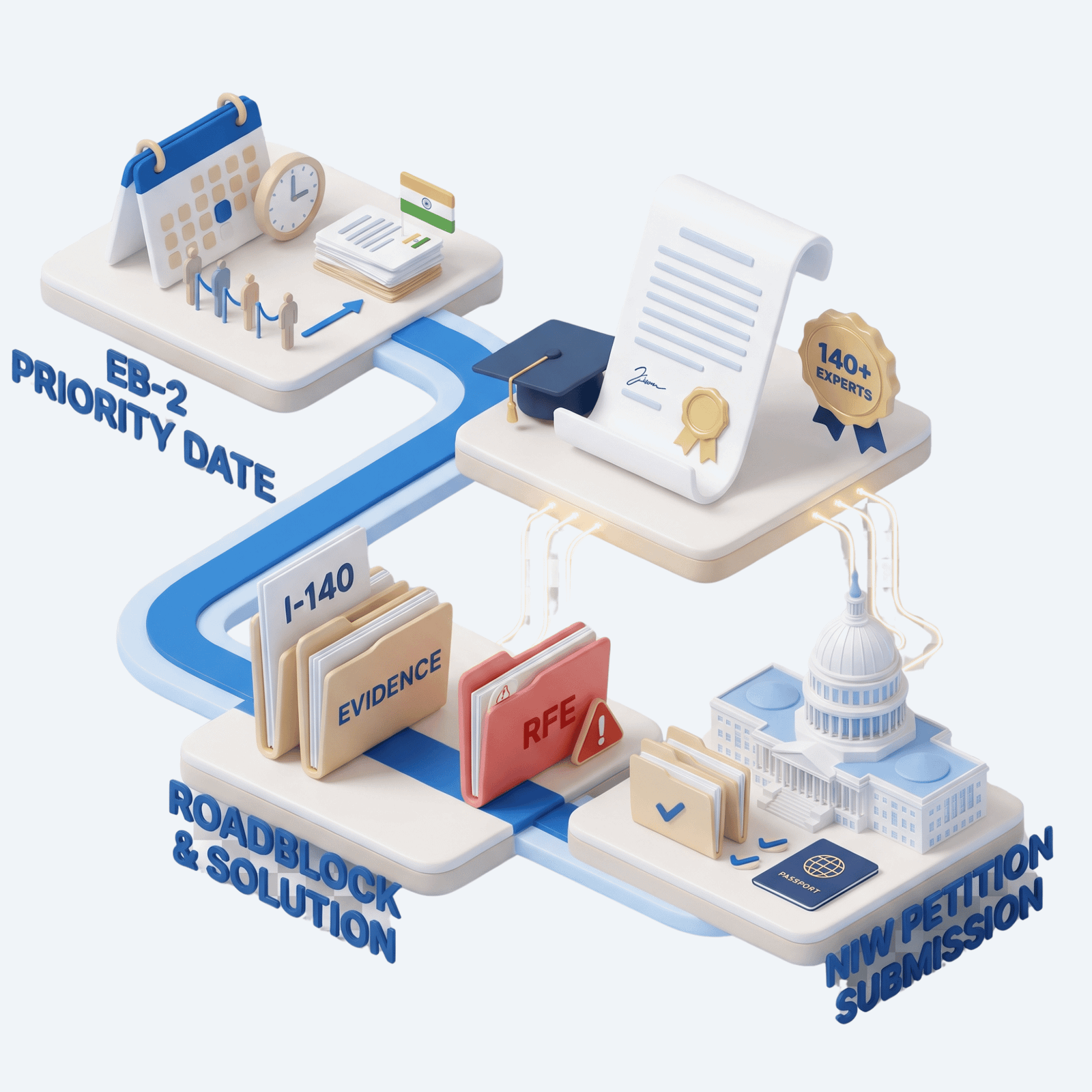
An EB-2 NIW case involves two separate decisions. First, USCIS decides whether your I-140 meets the EB-2 and NIW requirements. Whether a visa number is available is a different question, and that depends on your priority date and the Visa Bulletin cutoff dates.
Your priority date addresses the second question. It does not answer the first.
Can A Good Priority Date Protect You From An NIW RFE?
Your priority date has no say in how strong your NIW petition is. USCIS looks at the evidence you filed with your I-140 and decides whether you meet the requirements.
To qualify for an EB-2 NIW, you first need to meet the basic EB-2 requirement, which means holding an advanced degree or showing exceptional ability. After that, you have to satisfy all three NIW factors:
- Your proposed endeavor has substantial merit and national importance.
- You’re well positioned to advance that endeavor.
- On balance, the US benefits from waiving the job offer and labor certification requirements.
If your evidence falls short of proving eligibility, USCIS can send an RFE asking for more documents or explanations. Sometimes it skips the RFE and denies the petition outright.
If you’re an Indian applicant looking at a long EB-2 wait, it makes sense to file a complete I-140 the first time. An RFE means collecting more documents and sending a response within the deadline, which adds one more step before USCIS reaches a decision.
Why Do EB-2 NIW Petitions Receive RFEs?
An RFE doesn’t mean your NIW petition is weak. USCIS usually sends one when the record doesn’t provide enough information on a specific requirement or when the officer wants something in your evidence clarified.
For NIW cases, questions may arise about:
- The applicant’s EB-2 qualifications
- The proposed endeavor
- The national importance of the proposed work
- The applicant’s professional background
- Previous achievements and contributions
- Research, publications, or citations
- Technical or specialized work
- The applicant’s ability to advance the proposed endeavor
- The reasons supporting the waiver of the job offer and PERM requirements
One issue is that strong documents do not always explain themselves.
For example, a publication may show that you conducted research, but it may not explain why that research matters to your field. Your resume may show years of experience, but it may not establish how that experience prepares you to carry out your proposed endeavor.
How Does A Targeted Expert Letter Address The NIW Requirements?
-
Substantial Merit And National Importance
Your proposed endeavor must have substantial merit and national importance.
An independent expert can describe your proposed endeavor, its potential impact, and its connection to your wider field or industry. The letter should speak about the specific work you plan to do and not just repeat how important your profession is in general.
The expert’s assessment should focus on your actual proposed endeavor and be backed by relevant documentary evidence.
-
Well Positioned To Advance The Proposed Endeavor
Your previous experience can help show that you are prepared to advance your proposed endeavor.
An expert can review your education, professional experience, research, technical skills, previous projects, publications, patents, awards, and other accomplishments. The letter can then explain how that background relates to the work you plan to pursue.
For example, if you plan to continue research in a specialized area, the letter can connect your earlier research and professional experience with the work you intend to take up.
What you have done so far should have a clear connection to the work you plan to pursue.
-
Benefit Of Waiving The Job Offer And PERM Requirement
The third NIW factor considers whether it would benefit the United States to waive the normal job offer and labor certification requirements.
An expert can provide professional context about the nature of your work and explain why your proposed activities support the reasons presented for the waiver.
This part should focus on your individual case rather than broad statements about your profession’s value.
What Evidence Should Accompany An NIW Expert Opinion Letter?
An expert opinion letter should be supported by evidence from your petition.
Depending on your background, the evidence may include:
- Degree certificates and academic records
- Curriculum vitae or résumé
- Employment and experience documents
- Research publications
- Citation records
- Patents
- Project records
- Conference presentations
- Awards and recognitions
- Professional memberships
- Recommendation letters
- Business or industry records
- Evidence related to your proposed endeavor
The expert’s opinion and your documentary evidence should support each other.
If an expert discusses the significance of a research contribution, for example, the petition should include records that establish the research and its impact. The letter provides the professional explanation; the underlying documents provide the evidence.
Can An Expert Opinion Letter Prevent An NIW RFE?
There is no way to guarantee that USCIS will not issue an RFE.
An expert opinion letter is a part of your NIW petition; USCIS makes its decision based on your complete record. A professional explanation before filing can help make your evidence and proposed endeavor clearer to the adjudicating officer.
If your work is highly technical, an expert can explain its significance. If your proposed endeavor requires a connection between your previous experience and future plans, the expert can address that connection. If standard employment or academic records may not fully convey your achievements, the expert can provide additional professional context.
The objective is to submit a petition where the evidence and explanations already address the relevant NIW requirements as clearly as possible.
How Can Document Evaluation Help With An RFE And EB-2 NIW Expert Opinion Letter?
When USCIS sends an RFE, the response may need more detail about the proposed endeavor, why the work matters, or how the applicant’s background supports it. An expert opinion letter can address these points through the professional knowledge and experience of a qualified expert in the same field.
Document Evaluation works with 140+ professors and independent field experts across 50+ disciplines. The expert then writes an opinion specific to your background, your documents, and the NIW or RFE concerns in your case. There are no pre-written templates; each document is prepared for the individual case.
Clients can also reach the team 24/7 with questions and request unlimited revisions until they are satisfied with the final document.
Official Resources:
USCIS – Matter of Dhansar and NIW criteria
Frequently Asked Questions
What is the EB-2 NIW priority date for Indian applicants?
In an EB-2 NIW case, your priority date is usually the day USCIS receives your properly filed Form I-140. If you’re an Indian applicant, keep a close eye on it, since it sets your place in the EB-2 visa line.
Does a priority date mean my NIW petition is approved?
No. Your priority date holds your place in the employment-based visa queue. It has no bearing on whether you qualify for an NIW. Whether the I-140 gets approved is a separate decision, and USCIS will still check that your petition meets both the EB-2 and NIW requirements.
What can an NIW Expert Opinion Letter add to a petition?
An expert can give a professional view of work that may be difficult to understand from a résumé or other records alone. The letter can discuss the applicant’s experience, research, achievements, and proposed endeavor based on the facts of the case.
Can an Expert Opinion Letter guarantee NIW approval?
An Expert Opinion Letter is supporting evidence, not a guarantee of NIW approval. USCIS evaluates the complete petition, including the applicant’s qualifications, proposed endeavor, and supporting evidence against all applicable NIW requirements.
How does Document Evaluation LLC match an expert with an NIW case?
Document Evaluation LLC works with more than 140 professors and field experts across different areas. Clients can review suitable expert profiles and choose an expert whose background matches the subject of their work before the letter is prepared.
Are Document Evaluation LLC Expert Opinion Letters based on templates?
No. The letter is prepared around the client’s background, evidence, proposed endeavor, and the purpose of the document. The company does not use one standard letter for every NIW case.
Conclusion
For Indian EB-2 NIW applicants, tracking the priority date and preparing the I-140 are two different jobs. The priority date decides where you stand in the visa queue. Your qualifications and evidence decide whether USCIS approves the petition.
This is where an expert opinion letter from a qualified professional in your field can help. It gives reviewers added context about your achievements, your career so far, and what you plan to work on in the US The strongest letters are written around your specific petition and sit alongside your other supporting documents, addressing the exact NIW criteria your case needs to meet.

Explore EB-2 NIW foundational rules, low-citation RFE defenses, and startup founder strategies below:
- What Is the EB-2 NIW Visa? Complete Guide
Demystifies the National Interest Waiver pathway, detailing how advanced degree holders and individuals with exceptional ability can bypass employer sponsorship and PERM to self-petition for a U.S. Green Card. - How to Win a Low-Citation EB-2 NIW RFE
Outlines proven defense strategies for industry practitioners facing USCIS citation challenges, leveraging commercial impact, expert letters, and alternative evidence to secure petition approval. - How to Win a Startup Founder EB-2 NIW RFE
Explains how entrepreneurs can overcome USCIS scrutiny by documenting concrete business milestones, prototype development, and early-stage traction instead of relying solely on future financial projections.
Akash Pundir is the Chief Operating Officer at Document Evaluation LLC, bringing over 5 years of international business operations and legal support experience across the United States, Australia, and India. He has overseen the strategic positioning and analysis of over 1,000+ complex USCIS cases, specializing in guiding expert evaluation teams to draft high-stakes Expert Opinion Letters (EOL), Academic Equivalencies, and defense packets for H-1B, EB-2 NIW, RFEs, and NOIDs. Driven by digital transformation, Akash ensures every evaluation adheres strictly to the latest USCIS legal frameworks and compliance benchmarks.