

 |
|
Startup Founder And Entrepreneur EB-2 NIW RFE: How To Respond

- Answer each USCIS concern with relevant evidence.
- Show why your work matters beyond your startup.
- Link your experience and achievements to the proposed endeavor.
- Support business claims with reliable documents.
- Submit your response before the RFE deadline.
Even if a startup has a registered entity, a functioning prototype, initial customers, or even a comprehensive business expansion plan, US Citizenship and Immigration Services (USCIS) may still have questions about an EB-2 National Interest Waiver (NIW) petition. The challenge is often in articulating what the business aims to achieve, how that endeavor is of importance outside normal business pursuits, and why the entrepreneur is positioned to execute it.
Start-up founder and entrepreneur EB-2 NIW RFE: How should the start-up founder and entrepreneur EB-2 NIW RFE be answered? Business evidence may be useful, but it depends on what you can demonstrate and how it meets the legal standards.
A Narrative Plan of Future Activity Under Matter of Dhanasar, 26 I & N Dec. 884 (AAO 2016), an NIW petitioner must present the three prongs of the proposed activity, the ability of the applicant to forward it and the reason for waiver of job offer and labor certification requirements. Address USCIS’s concrete problem rather than the overall success of the business idea.
💡 Next Step: To directly address these adjudicator concerns with independent, authoritative analysis, founders can Hire Experts for EB-2 NIW RFE Opinion Letters through our specialized agency to secure professional assistance for their response.
Why USCIS May Issue An EB-2 NIW RFE To A Startup Founder
Getting an RFE doesn’t mean USCIS thinks your startup won’t work. It usually just means the adjudicator wasn’t convinced by the evidence on one or more requirements and wants to see more before deciding.
For entrepreneurs, these are the issues that tend to come up:
- Unclear proposed endeavor: The petition talks about the company and its products, but never says what specific work the founder plans to do in the US.
- National importance not shown: It points to a big market or an industry-wide problem, but doesn’t explain why this particular endeavor matters beyond the business itself.
- Projections with no backing: Revenue targets, hiring plans, expansion goals, or economic benefits rest on assumptions that aren’t supported by anything solid.
- Little proof of progress: The case leans on a business plan or pitch deck, with few real milestones such as product development, customer interest, or pilot results.
- Weak link to the founder’s background: The record doesn’t make it clear how the applicant’s skills, experience, and achievements put them in a position to actually deliver this work.
- Thin waiver argument: It doesn’t properly explain why skipping the job offer and labor certification would benefit the United States under the applicable standard.
These are only possible weak spots. No RFE raises all of them, and they won’t all apply to every founder. Start by reading the actual notice and working out exactly what USCIS is objecting to. Then respond to that.
Is Owning A Startup Enough To Qualify For An EB-2 NIW?
No! Owning a startup doesn’t qualify you for the EB-2 NIW.
You first have to meet the basic EB-2 category, either as a professional with an advanced degree or as a person of exceptional ability, whichever fits. On top of that, you personally have to meet the NIW criteria. Your business can supply documents about the proposed venture and what you’ve achieved as a founder, but forming a company on its own satisfies neither requirement.
It helps to see what each kind of evidence actually shows:
- Company registration: It proves a business entity exists. It says nothing about whether the work has national importance.
- Product or prototype: It shows technical development. Whether it matters depends on what it does, which problem it solves, and what your part in building it was.
- Customer contracts or pilot results: They point to demand, real-world use, or progress. That doesn’t automatically make the work nationally important.
- Your professional record: It can show relevant expertise and past results, especially when those results link directly to what you plan to do next.
There’s also no NIW rule that says a founder must have venture funding, a certain level of revenue, a team of employees, or an already established US company. An early-stage venture should be judged on the evidence it actually has, not on a made-up checklist of startup milestones.
How To Address A Prong 1 RFE As A Startup Founder
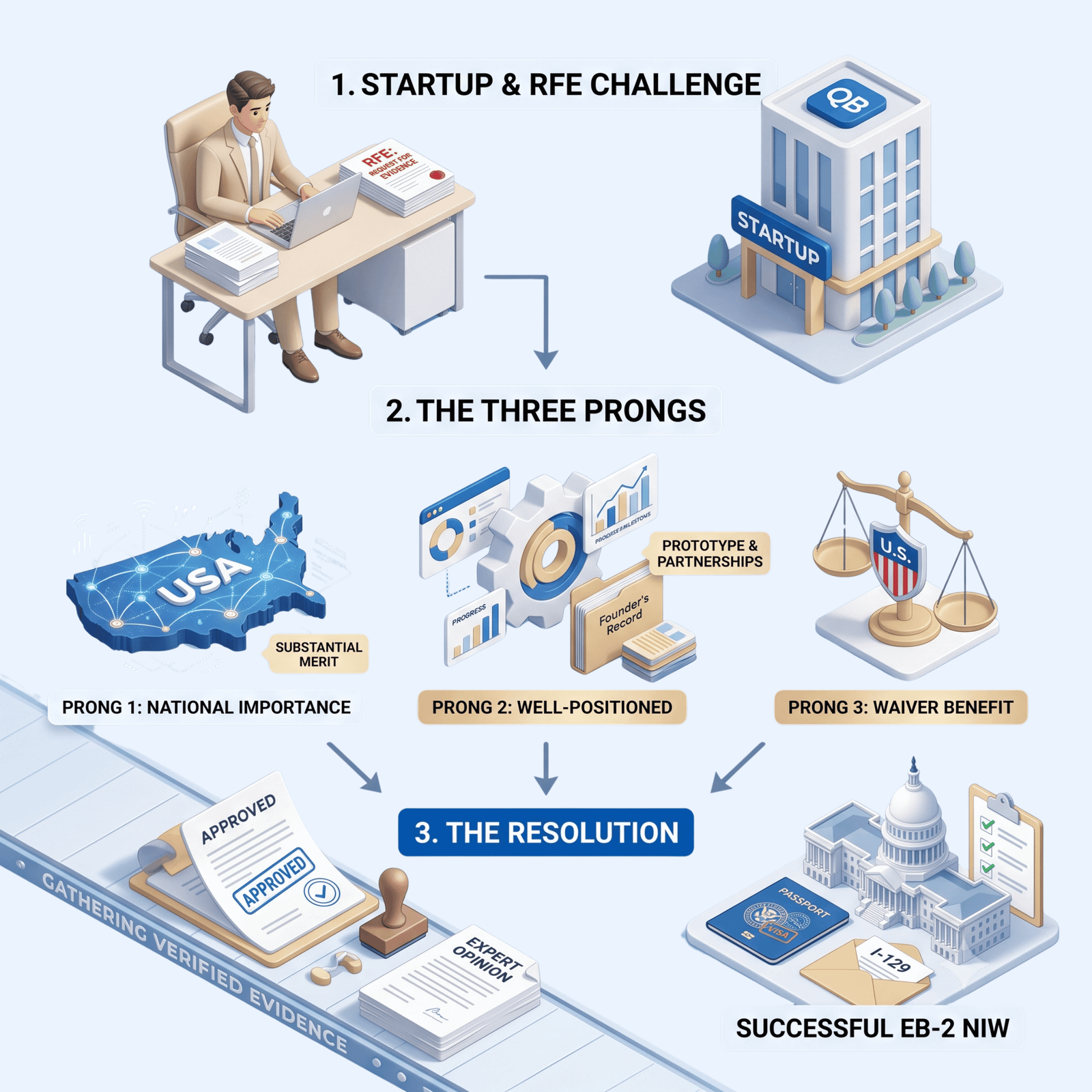
Prong 1 looks at two things: whether your proposed endeavor has substantial merit and whether it has national importance. A product can be commercially promising and still fall short here, because you also have to explain why the work matters beyond the company’s normal business goals.
-
Be More Specific About The Endeavor
Phrases like “building an AI company” or “growing a healthcare tech company” are too broad. They don’t tell USCIS what work you actually plan to do. Say what problem you’re solving, what you will do about it, and who benefits.
Take a hypothetical founder who builds software that predicts machine breakdowns in factories. She should explain what operational problem the software addresses, how it works, and why that’s valuable. If she claims it can cut downtime across the industry, she needs evidence for that. Saying the software exists isn’t enough.
-
Tie The Work To Its Wider Impact
The evidence should show how your endeavor connects to something larger, such as an industry, a technology, the economy, or public welfare. What matters is that the link between your work and its claimed importance is documented, not just asserted.
| Evidence | What It Can Help Show |
| Industry reports or government publications | The nature and size of the problem you’re addressing |
| Technical documentation or pilot results | How your solution works and what it has already done |
| Customer feedback, contracts, or letters of interest | Demand, real use, or likely adoption |
| Independent research or expert analysis | Why the work is significant and what it could mean more broadly |
| A well-supported implementation plan | How you intend to carry out your goals |
A report saying your industry is worth billions doesn’t prove that one company’s work is nationally important. Job creation claims work the same way. They need a credible plan and facts behind them, not just a forecast.
If your RFE raises Prong 1, respond to the exact concern the officer wrote down. Explain what each new piece of evidence shows, mention any limits it has, and spell out how it supports the importance of your endeavor.
How To Address A Prong 2 RFE As An Entrepreneur
Prong 2 asks whether you are well positioned to advance the proposed endeavor. It isn’t just about whether the startup could succeed. USCIS wants to see that your background, the progress you’ve made, your resources, and your plans support your ability to move this specific work forward.
1. Connect Your Experience To The Work
Many founders list years of management experience, technical degrees, or senior titles without saying how any of it relates to the new business. Don’t leave that gap. Explain how those credentials will actually help you build this venture.
Say a founder wants to commercialize a particular medical technology. She could point to engineering work, product development, research contributions or implementation projects she has been part of. The explanation should also make it clear that she was a key contributor, not just someone who was on the team.
2. Show Progress, Not Only Intentions
A business plan tells USCIS what you intend to do. Evidence of finished work shows what you have already done. Useful documents include:
- Prototype records, technical specifications, test results, or development milestones
- Customer agreements, pilot projects, or documented product adoption
- Partnerships, letters of interest, or commercial discussions backed by records
- Investment commitments or funding documents, if you have them
- Earlier ventures, professional achievements, or successful projects related to the endeavor
- A practical implementation plan that reflects your experience, your resources, and the development work still left
Each of these proves something different. Investment can show outside interest or give you resources to execute, but it doesn’t prove you can handle every part of the endeavor yourself. A letter of interest can show possible demand, but it doesn’t mean a contract will follow.
You can still have a strong case without investors or paying customers. Completed research, technical milestones, professional achievements, early testing, or credible partnerships can all count. What matters is that your response explains why the evidence you do have shows you can move the project ahead.
How To Address A Prong 3 RFE As A Startup Founder
Prong 3 asks a balancing question: on the whole, would the United States benefit from waiving the job offer and labor certification requirements? Under Matter of Dhanasar, USCIS looks at a few things:
- Whether getting a job offer or labor certification would be impractical, given your circumstances or the nature of your endeavor
- Whether the US would still benefit from your contributions even if qualified US workers are available
- Whether the national interest in your work is urgent enough, where that applies
If you’re a startup founder, your response should describe your real situation. Don’t fall back on the general claim that entrepreneurs need independence.
What to explain
Start with the facts of your case: what the work is, what your specific role is in moving it forward, and why the project depends on you in that role. Then show the benefits the work can bring, and back them up with documents. Where it fits, explain why the usual job offer and labor certification route would be impractical for you, or why the US would gain from your contributions even though qualified US workers exist.
What doesn’t work
Saying you own a company, plan to work for yourself, or would rather not have an employer doesn’t answer the question. None of that tells USCIS why waiving the requirements helps the country.
You also don’t have to prove a labor shortage. Not every entrepreneur needs to. What your argument does need is to follow the actual legal standard & rest on the evidence in your own case.
What Documents Can Support A Startup Founder EB-2 NIW RFE Response?
There’s no one document package that works for every entrepreneur. Start with the RFE and work out what each piece of evidence is supposed to prove.
1. Endeavor Statement And Business Plan
These can lay out the scope of your work, the outcomes you expect, how you’ll carry it out, and what resources you need. In your response, keep facts and forecasts separate, and back up the important assumptions with evidence. A business plan alone doesn’t prove all three NIW prongs.
2. Product Development And Project Records
Prototypes, test results, technical specs, pilot reports & milestone records can show real progress. Explain what you personally contributed and how this work connects to your proposed endeavor.
3. Commercial And Partnership Evidence
Contracts, customer records, letters of interest, and partnership documents can support claims about adoption, demand, or implementation. How much they count depends on their actual terms, who the parties are, and how far along the relationship is.
4. Education and professional records
Degrees, credential evaluations where needed, employment records, publications, patents, project results, and earlier ventures can show your qualifications and experience. Say clearly how those achievements relate to the work you plan to do.
5. Independent Expert Opinion
A properly qualified expert can explain your technical contributions, the industry context, or why your documented work is significant. The opinion should state what facts it relies on and explain the expert’s reasoning. A letter that just praises you doesn’t help.
Funding records, revenue statements, hiring plans, and other business documents can also be useful when they answer a specific concern in the RFE. Don’t add them just to make the response look bigger.
One document can support more than one argument, but you need to explain its relevance separately each time. A successful pilot, for example, can show progress under Prong 2 and give factual background for a Prong 1 argument. It doesn’t prove national importance on its own.
How To Prepare An Effective Startup Founder EB-2 NIW RFE Response
A good response is built around what USCIS is actually asking, not around how many documents you can pull together.
1. List Every Issue In The RFE
Sort them out. Questions about EB-2 eligibility are one thing; concerns about your endeavor, your positioning, and the waiver analysis are separate.
2. Go Back To Your Original Filing
Read the RFE next to your endeavor statement, business plan, personal statement, expert letters, and the evidence you already submitted.
3. Find The Exact Gap
Work out what’s wrong with each claim. It may be unclear, unsupported, inconsistent, or not tied closely enough to the legal standard.
4. Collect Evidence That Fills That Gap
If USCIS questions your technical progress, development records may be what you need. If the question is about broader significance, you’ll want credible industry evidence and a clearer explanation of what your endeavor could mean beyond your company.
5. Explain Each Document In Your Written Response
Say what it shows and why it matters. Don’t expect the officer to work out the connection from just one attachment.
6. Check That Everything Matches
Your endeavor statement, business plan, expert opinion, financial projections, and RFE response should all describe the same work. If something has changed since you filed, explain it. Don’t leave contradictions hanging.
7. Follow The Notice
Read the submission method, the deadline, and the document instructions carefully. For a complex case, an immigration attorney can help you decide on strategy.
Don’t treat an RFE as a reason to send in every company record you have. A short, focused response that answers the stated problems is usually more useful than a big stack of papers with no explanation.
Can an Expert Opinion Letter Help a Startup Founder With an EB-2 NIW RFE?
An expert opinion letter can help when USCIS needs a clearer picture of why your work matters, whether technically, commercially, or professionally. How useful it is depends on the expert’s qualifications, what evidence they reviewed, and which issue the letter is meant to address.
An independent expert with relevant industry experience can explain things like:
- Why a documented technical contribution carries weight in its field
- How your earlier experience relates to the endeavor you propose
- What a prototype, pilot result, or technical milestone actually shows
- How your work connects to a real problem in the industry
- Why certain achievements or project results matter for the claims in your petition
A good letter does more than call you talented or say your business looks promising. It names the relevant facts, explains the expert’s reasoning (and methodology, where that applies), and reaches conclusions the evidence can support.
You don’t need an expert opinion in every NIW case. It can’t make up for missing factual evidence, prove every legal requirement by itself, or guarantee approval. Your response still has to answer the RFE as a whole.
Document Evaluation LLC offers EB-2 NIW Expert Opinion Letters and RFE response support. If you need independent analysis or document support for a specific evidence problem, you can look into these services. What support makes sense depends on your case, and for legal questions you should talk to a qualified immigration attorney.
When to Seek Help as a Startup Founder With an EB-2 NIW RFE
It’s worth getting a case-specific review if your RFE questions the national importance of your work, doubts that you can carry out the endeavor, disputes how relevant your professional achievements are, or raises concerns about the waiver analysis.
An immigration attorney can read the notice, judge the legal arguments, and advise you on how to respond. An independent expert can help explain technical or industry-specific points. A documentary support provider can help put together evidence within the limits of what its service covers.
These are three different jobs. An expert’s opinion can add to your evidence, but it doesn’t replace legal advice, and it doesn’t take away your responsibility to prove you’re eligible. Pick your support based on what the RFE actually raises. Not every RFE needs a new expert letter.
Official Sources
- Matter of Dhanasar, 26 I&N Dec. 884 (AAO 2016)
- USCIS Policy Manual, Volume 6, Part F, Chapter 5
- USCIS: Employment-Based Immigration, Second Preference (EB-2)
Frequently Asked Questions
Can a startup founder qualify for an EB-2 NIW?
Yes, it’s possible. But being a founder isn’t what gets you there. You have to qualify for EB-2 itself first, and then meet all three NIW prongs. Your endeavor and your evidence decide the outcome, not the fact that you own a company.
Does a startup need revenue to support an NIW petition?
No, the NIW has no revenue minimum. If you do have revenue, it can show that the business is active and moving. If you don’t, you can lean on other evidence, as long as it speaks to the concern USCIS actually raised.
Can I respond to an NIW RFE without outside investors?
You can. Nothing in the NIW standard asks for investors. Many founders build their case on technical progress, their own experience, customer interest, or partnerships instead, depending on what they have.
How do I show national importance?
Start by describing your specific endeavor, then show why it matters beyond your own company. Industry research, technical results, credible reports, and independent analysis can all help, depending on your field. A big market or a good business model won’t get you there on its own.
What shows that I’m well positioned to advance the endeavor?
Your degrees and past achievements count, and so do the things you’ve already built or done: product work, milestones, partnerships, customer evidence, and a realistic plan. What makes the evidence strong is how directly it ties to this endeavor. A title or a business plan alone says very little.
Can an Expert Opinion Letter help with an entrepreneur-related RFE?
Sometimes. If the expert is qualified in your field, the letter can explain your technical contributions, the industry background, or why your documented work is significant. It needs to be based on real evidence and aimed at the specific concern in the RFE. It won’t replace your other documents, and it can’t promise an approval.
Does an RFE mean my petition will be denied?
No. It’s USCIS asking for more information or a clearer explanation. What happens next depends on your full record and how well your response answers their questions. An RFE is neither a sign of denial nor a sign that approval is coming.

Explore Dhanasar criteria, expert letters, and complete EB-2 NIW filing rules below:
- How to Structure an EB-2 NIW Expert Opinion Letter for USCIS Approval
Breaks down the exact structural blueprint required for an EB-2 NIW expert evaluation. Details how independent authorities should document petitioner credentials, map qualifications directly to the three Matter of Dhanasar prongs, and avoid generic boilerplate language that triggers USCIS scrutiny. - How Long Does USCIS Take to Process an EB-2 NIW RFE Response?
Details standard USCIS adjudication wait times once a National Interest Waiver RFE response is received. Compares standard service center queues against 45-day Premium Processing clock-reset timelines and outlines when petitioners can submit formal case inquiries. - Why EB-2 NIW RFEs Get Issued and How to Beat Them
Analyzes recent Form I-140 adjudication patterns following a Request for Evidence, breaking down common RFE triggers—such as national importance and proposed endeavor scope—and outlining strategic evidence frameworks to convert challenges into approvals.
Akash Pundir is the Chief Operating Officer at Document Evaluation LLC, bringing over 5 years of international business operations and legal support experience across the United States, Australia, and India. He has overseen the strategic positioning and analysis of over 1,000+ complex USCIS cases, specializing in guiding expert evaluation teams to draft high-stakes Expert Opinion Letters (EOL), Academic Equivalencies, and defense packets for H-1B, EB-2 NIW, RFEs, and NOIDs. Driven by digital transformation, Akash ensures every evaluation adheres strictly to the latest USCIS legal frameworks and compliance benchmarks.
