

 |
|
H-1B Specialty Occupation RFE Processing Time In October 2026


Key Takeaways
- No fixed wait time after an H-1B RFE response.
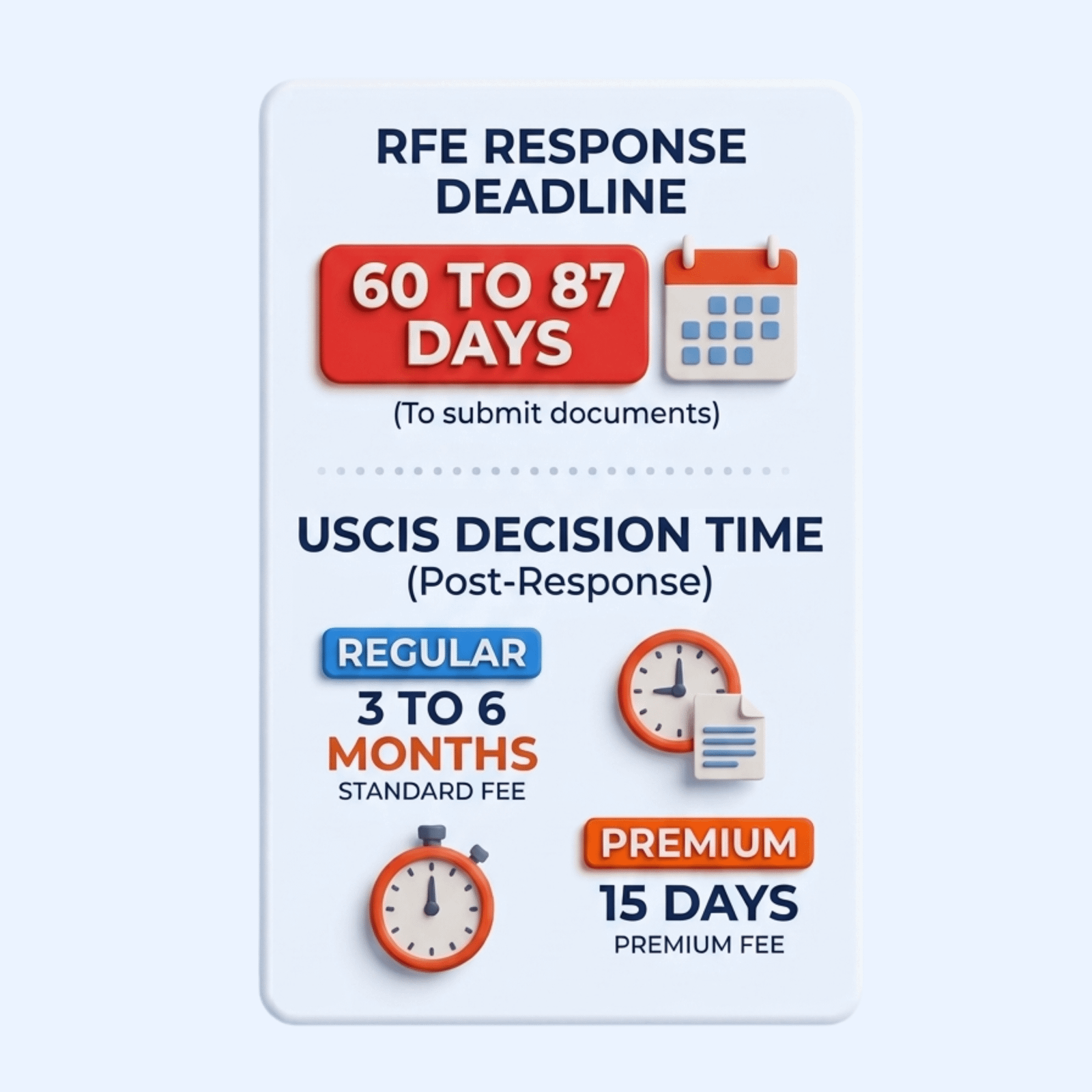
- An RFE response period can be up to 84 days, but the exact deadline is determined by the RFE notice.
- Regular processing depends on the case and USCIS workload.
- Premium Processing uses a 15-business-day timeframe.
- An RFE does not mean automatic denial.
An H-1B specialty occupation RFE does not have a single USCIS-published processing time after the petitioner submits a response. USCIS gives the petitioner a deadline to provide the requested evidence, but that response period is different from the time USCIS takes to adjudicate the petition afterward. For H-1B petitions, the RFE response deadline cannot exceed 12 weeks, although the exact deadline shown on the RFE notice controls.
After USCIS receives the response, the petition continues through adjudication. The decision may take different amounts of time depending on the applicable Form I-129 processing category, USCIS workload, the issues raised in the RFE, and the evidence submitted. Regular processing does not have a universal post-RFE decision deadline. Premium processing follows a separate USCIS timeframe, and an RFE can affect when that timeframe runs.
To ensure your response directly addresses all underlying concerns and avoids further adjudication delays, you can hire our specialized agency to Get Professional H-1B RFE Response Services tailored to your case.
What Is An H-1B Specialty Occupation RFE?
A Request for Evidence (RFE) is a notice from U.S. Citizenship and Immigration Services (USCIS) asking an H-1B petitioner to provide additional evidence or information needed to establish eligibility.
For an H-1B petition, one important question is whether the offered position qualifies as a specialty occupation. USCIS describes a specialty occupation as a position requiring the theoretical and practical application of highly specialized knowledge and normally requiring at least a bachelor’s degree or its equivalent in a specific specialty. The regulations provide several ways a position can meet the specialty occupation criteria.
USCIS may issue an RFE when the evidence submitted with the petition does not sufficiently establish eligibility. The agency has stated that H-1B RFEs commonly address specialty occupation evidence, among other issues.
Depending on the facts of the petition, an RFE may ask for evidence concerning:
- The actual duties of the offered position
- The degree normally required for the position
- The connection between the position and the required field of study
- The employer’s business operations
- The nature and complexity of the position
- Evidence concerning the worksite or third-party placement, where applicable
- Contracts, statements of work, or other project evidence, where relevant
- The beneficiary’s education, credentials, or experience
- Other evidence needed to establish H-1B eligibility
These are not requirements that appear in every specialty occupation RFE. The specific RFE notice determines what USCIS wants the petitioner to address.
How Long Does an H-1B Specialty Occupation RFE Take to Process?
There is no universal USCIS-published number of days for processing an H-1B specialty occupation RFE after the response is submitted.
This is the most important distinction for applicants and employers to understand.
An H-1B RFE creates two separate timelines:
- The time available to respond to the RFE
- The time USCIS takes to continue adjudicating the petition after receiving the response
USCIS says an RFE will specify a response deadline and that the maximum response time for an RFE is 12 weeks. The exact date printed on the notice controls the petitioner’s response deadline.
That 12-week maximum should not be described as an “H-1B RFE processing time.” It is the maximum response period USCIS generally allows for an RFE.
Once USCIS receives the response, the petition returns to the adjudication process. There is no separate universal rule requiring USCIS to approve or deny every H-1B specialty occupation petition within a particular number of days after the response.
The wait can vary based on the underlying Form I-129 processing category, USCIS workload, the complexity of the case, and the issues raised by the RFE.
How Long Do You Have to Respond to an H-1B RFE?
The RFE itself informs the petitioner the deadline for presenting evidence.
Based on USCIS, the period an RFE notice gives to the petitioner is the maximum response that they can take, which would be 12 weeks or 84 days. Yet, it shouldn’t be assumed that every H-1B petitioner gets the same 84 days.
In fact, the specific deadline mentioned on the actual RFE notice is the one that the petitioner should follow.
The petitioner is so advised to:
- To begin with, the petitioner should read the whole RFE thoroughly.
- Then the petitioner needs to pinpoint each issue raised by USCIS.
- Collect the requested documents
- In order for USCIS to receive, understand and consider the petitioner’s reply, it may be necessary to present the documents very clearly and logically.
- To make sure that USCIS receives the material, it is best to deliver and/or submit per their instructions.
Also, a copy or receipt is always good to have as a backup.
To be sure, the petitioner should also be aware of and comply with the deadline mentioned in the notice as failure to reply within the period specified may cause delay in adjudication or the RFE may be considered as not answered leading US-CIS not to consider evidence that was to be submitted in reply of theRFE.
What Happens After USCIS Receives An H-1B RFE Response?
The process generally follows these steps:
- The petitioner prepares the RFE response.
- The response is submitted according to USCIS instructions.
- USCIS receives the response.
- The submitted evidence becomes part of the petition record.
- The USCIS officer reviews the response together with the underlying petition and existing evidence.
- USCIS may approve the petition.
- USCIS may deny the petition if eligibility has not been established.
- USCIS may take another action permitted under the applicable rules.
An RFE response does not automatically result in approval.
USCIS has explained that an RFE means the petition has not been denied and that the petitioner is being given an opportunity to submit evidence supporting eligibility. The final decision is based on the complete record.
Does An H-1B RFE Restart The Processing Time?
An RFE should not automatically be described as creating a new standard processing period for a regular H-1B petition.
USCIS explains that its published processing times generally measure the time from receipt of a case through completion. Its processing-time methodology includes cases in which USCIS issues an RFE and includes the time taken by the petitioner to respond. Premium Processing cases are excluded from the regular processing-time calculations.
This means three concepts should be kept separate:
- Overall Form I-129 processing time: USCIS’s published processing information for the applicable case type.
- RFE response period: The time the petitioner has to answer the RFE.
- Post-RFE adjudication: The period after USCIS receives the response while the petition continues through adjudication.
USCIS does not publish a universal rule saying that every regular H-1B petition receives a new 30-, 60-, or 90-day decision period after an RFE response.
H-1B RFE Processing Time Under Regular Processing
Under regular processing, there is no guaranteed number of days for USCIS to issue a decision after receiving an H-1B RFE response.
Petitioners should use the current USCIS Case Processing Times page to check the processing information applicable to their Form I-129 case.
The basic process is:
- Open the USCIS processing-time page.
- Select Form I-129, Petition for a Nonimmigrant Worker.
- Select the appropriate case category or classification.
- Select the applicable processing location or operation when requested.
- Review the current processing information.
- Check whether the case falls outside the period in which USCIS permits a case inquiry.
USCIS updates its case processing times monthly using the latest available data. For certain forms, USCIS now reports processing information under Service Center Operations (SCOPS) rather than a specific service center. Processing times can also change because of workload, staffing, filing volume, operational changes, and case-specific complexity.
A processing-time figure should not be treated as a promised decision date.
Historical I-129 processing data
USCIS’s historical national median data provides useful context but should not be presented as the October 2026 H-1B RFE processing time.
For FY2026 data through July 31, 2026, USCIS reported a historical national median of 5.2 months for non-Premium Form I-129 cases and 0.6 months for Premium Processing I-129 cases. USCIS defines these historical figures as the median time it took to complete cases during that reporting period.
These figures are not:
- An October 2026 processing-time guarantee
- An H-1B specialty occupation RFE timeframe
- A post-RFE decision timeframe
- A prediction for an individual petition
They should be treated only as historical national data.
H-1B RFE Processing Time With Premium Processing
Premium Processing provides a separate adjudication timeframe for eligible Form I-129 petitions.
For H-1B petitions filed with Form I-907, USCIS currently provides a 15-business-day Premium Processing timeframe. The current USCIS Form I-907 materials list H-1B under Form I-129 with a 15-day Premium Processing period, while USCIS’s fee schedule lists the H-1B Premium Processing fee as $2,805.
Premium Processing does not guarantee H-1B approval.
The Premium Processing commitment concerns USCIS taking the applicable adjudicative action within the applicable timeframe. That action may include an approval, denial, RFE, or another action covered by the Premium Processing rules.
The petitioner should also understand that Premium Processing does not eliminate the possibility of an RFE.
What Happens to Premium Processing After an H-1B RFE?
The Premium Processing timeline may be much changed by the issuance of an RFE (Request for evidence).
When a Request for evidence is served during Premium Processing, the Premium Processing period doesn’t stop and continue counting down like before until the petitioner has finished preparing the reply. As the Premium Processing guidelines which are applicable in such a case, the deadline period actually stops and starts over when USCIS gets the reply to the RFE.
For an H-1B petition, the practical sequence can therefore look like this:
Form I-129 + Form I-907 filed → USCIS begins Premium Processing → USCIS issues RFE → Premium Processing timeframe is affected → petitioner responds → applicable Premium Processing timeframe resumes or resets under USCIS rules.
This is why it is inaccurate to tell an H-1B petitioner that Premium Processing guarantees a final approval exactly 15 business days after the original filing.
How to Respond To An H-1B Specialty Occupation RFE
A useful RFE response should directly address the issues raised in the notice rather than simply adding a large quantity of documents.
Depending on the RFE, the response may include:
- A detailed response to each USCIS question
- A clearer explanation of the position’s duties
- Evidence connecting the position to the required specialty
- Employer organizational information
- Relevant contracts or statements of work, when applicable
- Client or project documentation, when applicable
- Evidence supporting the employer’s need for the position
- Educational and professional documentation for the beneficiary
- Other evidence specifically requested by USCIS
The strongest response is not necessarily the longest one. Evidence should be relevant, credible, organized, and responsive to the questions USCIS actually raised.
For complex cases, an immigration attorney can help the petitioner evaluate the RFE and prepare an appropriate response.
What If USCIS Has Not Decided My H-1B Case After The RFE Response?
If the case remains pending after the RFE response, the petitioner can take several practical steps.
First, confirm that USCIS received the response. Then:
- Check the case status online.
- Keep the RFE response and delivery records.
- Check the current Form I-129 processing information.
- Determine whether the case is outside the applicable USCIS processing period.
- Check whether the case qualifies for a case inquiry.
- Consider professional legal advice if the case has unusual circumstances.
USCIS provides an online case inquiry tool for cases that may be taking longer than expected. Petitioners should check the current USCIS processing-time information and the case-inquiry criteria before submitting an inquiry. A case inquiry does not guarantee that USCIS will decide the petition within a specific number of days.
Can You Submit A Case Inquiry After An H-1B RFE?
USCIS provides an online case inquiry tool for eligible cases.
However, not every pending H-1B petition will qualify for an inquiry immediately after an RFE response. USCIS recommends checking the applicable processing-time information before submitting a case inquiry.
USCIS’s current case-inquiry system allows petitioners to submit an inquiry when a case appears to be taking longer than expected. Before submitting an inquiry, check the current processing-time information and USCIS eligibility criteria for the case. A case inquiry is not a guarantee of a decision within a specific timeframe.
Does An H-1B RFE Mean The Petition Will Be Denied?
No. An RFE is not a denial.
USCIS explains that an RFE gives the petitioner an opportunity to provide additional evidence when the original submission did not sufficiently establish eligibility. The agency evaluates H-1B petitions based on the evidence in the record and the applicable legal requirements.
An RFE also should not automatically be described as evidence that approval is likely or unlikely. The outcome depends on the petition, the issues raised, and the complete evidence submitted in response.
H-1B Specialty Occupation RFE Processing Timeline
| Stage | What happens |
| H-1B petition filed | USCIS receives Form I-129 |
| Initial review | USCIS evaluates the petition |
| RFE issued | USCIS requests additional evidence |
| RFE response prepared | Petitioner gathers requested evidence |
| RFE response submitted | Response is sent to USCIS |
| USCIS receives response | Evidence becomes part of the case record |
| Further adjudication | USCIS reviews the complete record |
| Decision | Petition may be approved or denied |
There is no fixed number of days that should be attached to each stage.
Frequently Asked Questions
1. How long does an H-1B specialty occupation RFE take to process?
USCIS does not publish one universal post-RFE processing period for H-1B specialty occupation petitions. After receiving the response, USCIS continues adjudicating the Form I-129. The timing can vary based on the applicable processing category, workload, case complexity, and evidence submitted.
2. How long does USCIS take after receiving an H-1B RFE response?
There is no standard number of days that applies to every H-1B petition after an RFE response. Petitioners should check the current USCIS Form I-129 processing information and monitor their individual case status rather than relying on an unofficial 30-, 60-, or 90-day estimate.
3. How many days do I have to respond to an H-1B RFE?
USCIS guidance states that an RFE response period cannot exceed 12 weeks, or 84 days. The exact deadline printed on the RFE notice controls. Not every RFE necessarily provides the full 12 weeks, so petitioners should follow the date stated in their notice.
4. Does an H-1B RFE restart the processing time?
Not as a universal new processing period for regular processing. USCIS’s published processing times measure case processing from receipt through completion and include cases involving RFEs. Premium Processing follows separate rules under which an RFE can affect and reset the applicable Premium Processing timeframe.

Discover H-1B visa eligibility rules, specialty occupation RFE approval trends, and third-party placement defense strategies through the guides below:
- H-1B Visa Blueprint: Qualification Criteria, Degree Rules & USCIS Filing Steps
Details fundamental H-1B eligibility rules, specialty occupation degree criteria, employer petition requirements, and step-by-step strategies for a compliant USCIS filing packet. - H-1B Specialty Occupation RFEs: Approval Trends, Adjudication Metrics & Success Factors
Analyzes recent USCIS adjudication data regarding specialty occupation challenges. Details key factors that resolve degree-mismatch inquiries and strategies to boost RFE response approval rates. - Overcoming H-1B Third-Party Placement RFEs: Control Rules & End-Client Evidence
Explains why USCIS targets off-site consulting and contracting arrangements, outlining how to document right-of-control, end-client Statements of Work (SOWs), and continuous specialty work availability.
Akash Pundir is the Chief Operating Officer at Document Evaluation LLC, bringing over 5 years of international business operations and legal support experience across the United States, Australia, and India. He has overseen the strategic positioning and analysis of over 1,000+ complex USCIS cases, specializing in guiding expert evaluation teams to draft high-stakes Expert Opinion Letters (EOL), Academic Equivalencies, and defense packets for H-1B, EB-2 NIW, RFEs, and NOIDs. Driven by digital transformation, Akash ensures every evaluation adheres strictly to the latest USCIS legal frameworks and compliance benchmarks.
