

 |
|
Why Did USCIS Issue a Third-Party Placement RFE for Your H-1B Petition?

If you or your employee works at a client site, you already know what the notice is about: H-1B third-party placement RFE.
Let’s be honest, navigating the visa approval process is stressful enough without USCIS questioning whether your job is real. Over the years in the visa and document evaluation industry, we’ve seen countless highly skilled professionals and legitimate IT consulting firms panic over these exact RFEs.
But getting an RFE is not a denial. In most cases, USCIS is asking for additional evidence to verify the details of the petition. They want actual proof that a real employer-employee relationship exists and that there is genuine, non-risky work waiting for you at the client site.
To successfully satisfy these strict evidentiary demands and establish right-to-control compliance, you can hire our specialized agency for a comprehensive H-1B RFE response service. Obtaining professional assistance ensures your contracts, SOWs, and client letters are expertly aligned with USCIS standards to protect your petition.
What Triggers A Third-Party Placement RFE?
In an H-1B scenario, the petitioner (employer) and the worksite are the same. A tech company hires a software engineer; that engineer works at the company’s own office.
Third-party placement is different. The H-1B petitioner, often an IT staffing firm or consulting company, places the beneficiary at a separate client’s location to perform work. The petitioner remains the employer of record, but the client often directly supervises the day-to-day work performed under the client’s roof.
When there are multiple parties involved in a third-party placement arrangement, generally speaking, there will be additional requests made by USCIS for additional evidence to substantiate who actually has the authority to direct the employee’s work and whether there is a specialty occupation position available for the employee during the entire requested period for H-1B classification.
This clarification stated that having the title of ’employer’ does not necessarily mean that you control all aspects of the employment relationship between you and the beneficiary. Therefore, the petitioner must have an actual and bona fide (i.e., real) level of control over the terms and conditions of the employment relationship for the day-to-day operations of the beneficiary.
The Core of the RFE: Proving “Right to Control”
This principle is the most important for a successful USCIS response. Even if you are sitting at a desk in an end-client’s building, using their laptop, and logging into their servers, your actual H-1B employer must retain the “right to control” your daily work.
If the end-client dictates your daily schedule, conducts your performance reviews, and manages your PTO, USCIS will argue that the end-client is your actual employer, making your H-1B petition invalid.
Your evidence must clearly show that the consulting firm is the boss and that the end client is simply the location where the specialized service is being delivered.
Essential Client Site Evidence Checklist
When responding to an H-1B third-party placement RFE, document verification is everything. You cannot just tell USCIS what is happening; you must show them. Here is a definitive checklist of the documents you should include in your RFE response package:
- Master Service Agreement (MSA): The master agreement between you and the contractor or supplier that created the initial terms of your employment with them.
- Statement of Work (SOW): This document is important; it specifies the particulars of the project and your job description and should also ideally list by name who will be receiving services under this contract. The SOW also must indicate when the visas will be needed.
- End Client Letter: A letter from the end client to the employer confirming the project they requested, with a description of the relationship under which the parties will work together (more on this topic in the following section).
- Detailed Itinerary: This document is the detailed itinerary for your trip, including the dates, locations, and the job you will be doing.
- Vendor Letters (if applicable): You must provide letters as evidence of the chains of contracts if there are intermediaries between the contractor or supplier and the end-client.
- Organizational Chart: A visual representation indicating who the employee will report to on-site at the company’s facility (the person who will provide oversight on-site) versus who will be the employer’s supervisor while on-site working for the employer.
- Performance Reviews: Copies of performance reviews the contractor/supplier has conducted.
- Internal Communications: Copies of emails/communications in which the contractor/vendor confirms the allocation of long-term contracts to employees.
The Anatomy Of A Perfect End-Client Letter
If there’s a goal of visa documentation for third-party placements, it’s the end-client letter. However, a poorly worded letter can actually trigger a denial.
A strong end-client letter must be on the client’s official letterhead and explicitly state:
- The name of the beneficiary.
- The physical location where the work will be performed.
- A detailed breakdown of the highly specialized duties the worker will perform.
- The educational requirement for the role is to prove that it is a specialty occupation.
The Golden Clause: A clear statement acknowledging that the beneficiary is an employee of the petitioner and that the petitioner retains all right to control, hire, fire, and directly supervise the employee.
Handling The “Middleman” (Vendor Layers)
In the tech industry, it’s incredibly common to have a chain: Petitioner → Prime Vendor → End-Client.
USCIS expects that all parties clearly document the contractual relationship. If a vendor is between your employer and the end client, you must provide the MSA and SOW for each link in that chain. If you provide an SOW between the employer and the vendor but fail to show the contract between the vendor and the end client, USCIS will claim you haven’t proven that the end client actually requested the work.
Real Client Experience | Strengthening an H-1B RFE Before It Becomes a Bigger Problem
USCIS generally considers the full employment relationship, not just one of the documents, when making RFE decisions. They assess the submitted documents for H-1B approval based on three criteria: the person’s eligibility for the position based on their education and experience, the fact that the position itself is a specialty occupation, and the appropriateness of the documents submitted by the employer in evidencing and supporting all of the previous information.
One of our clients, who has an H1B RFE, visited our office this year to obtain an educational equivalency evaluation. During this time, and after the Document Evaluation team reviewed her education and qualifications, our team recognized that providing only an educational equivalency evaluation of her education would not be enough to successfully improve her chance of receiving an H-1B visa.
After reviewing the document, our team took a global view toward this case, identifying additional areas of concern that may be problematic regarding USCIS as well as providing support only for her requested educational equivalency evaluation.
Aparna stated, “The Document Evaluation team far surpassed my expectations by providing a document review that searched far deeper than only my initial request.”
The Do’s And Don’ts Of RFE Responses
After evaluating thousands of documents, we’ve seen the same fatal errors repeated. Keep these Do’s and Don’ts in mind:
DO: Over-explain the technical duties. Don’t just say “Software Developer.” Say, “Will architect cloud-based microservices using Java and AWS to manage the client’s inventory database.”
DON’T: Let the end-client letter say they will “supervise” or “manage” the beneficiary. Use words like “collaborate with” or “deliver services to.”
DO: Redact sensitive pricing or confidential IP information from contracts. USCIS doesn’t need to know the billing rate; they just need to see the scope of work.
DON’T: Submit an SOW that expires in three months if you are asking for a three-year visa, unless you provide heavy evidence of a history of continuous extensions.
Pro Tips From Document Evaluation
What if the end client refuses to provide a letter?
Such situations constantly happen. Many Fortune 500 companies have strict HR policies that oppose signing vendor letters. If such a situation happens, don’t throw in the towel. You can substitute the end-client letter with a combination of robust vendor letters, email trails showing the client’s policy against providing documents, and heavily detailed SOWs. USCIS is legally required to weigh the “totality of the circumstances.”
Address the “Specialty Occupation” element
A third-party RFE will also question whether the job is a specialty occupation. Make sure your client site’s evidence clearly connects the daily duties to the beneficiary’s specific degree. If the client site requires a generic “programmer,” USCIS might deny it. You’re in much better shape if the client requires a “Data Engineer with a Master’s in Computer Science.”
What Happens After You Submit An H-1B Third-Party Placement RFE Response?
1. The System Updates & The Clock Resets
- Your online USCIS case status will update to “Response To USCIS’ Request For Evidence Was Received.”
- The review clock resets completely; USCIS does not pick up where they left off.
2. Decision Timelines
- Premium Processing: USCIS must issue a decision within 15 business days of receiving your response.
- Standard Processing: Typically takes 2 to 6 months, though USCIS generally aims to review RFE responses within 60 days.
3. What the Officer Is Checking
An adjudicator reviews your new contracts (MSAs, SOWs) and end-client letters to ensure the following:
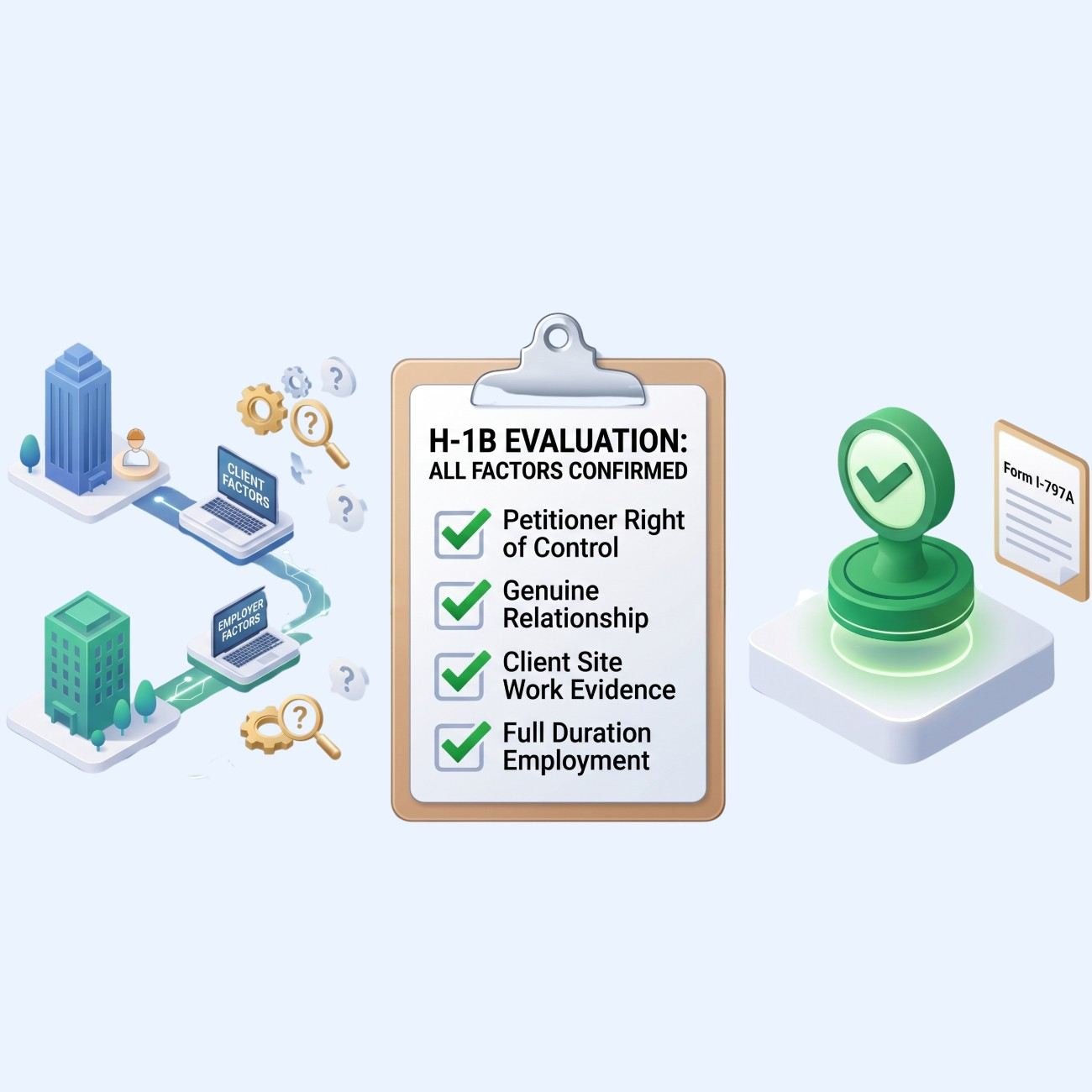
- Your petitioning employer retains the direct right to control your daily work.
- Legitimate, specialty occupation work actually exists at the client site for the full duration of the visa.
4. The Potential Outcomes
- Approval: You receive a Form I-797A Approval Notice, securing your legal status and work authorization.
- Denial: You receive a Notice of Decision explaining why the evidence was insufficient. Your employer must then choose to refile, appeal, or file a motion.
- Second RFE or NOID (Rare): If your response opens up an entirely new legal question, USCIS may give you one final window to respond before making a final decision.
Frequently Asked Questions
When do I need to reply to my H-1B RFE?
Generally, USCIS provides 87 to 89 days to reply to an RFE. The specific deadline will be mentioned on the top page of the RFE notice. Applicants should not wait until the last minute because obtaining supporting documents from clients or third parties can take additional time.
Is it possible to be approved for an H-1B without having an end-client letter?
Yes, an H-1B petition may still be approved without an end-client letter, but it can be more challenging. If a client cannot provide a letter, alternative evidence such as vendor letters, client emails, company policies, detailed statements of work, and other supporting documents may help establish the employment relationship.
In the context of an H-1B, what is the right to control?
Right to Control refers to the employer’s authority over the employee’s work. USCIS evaluates whether the petitioning employer controls hiring, firing, payment, performance evaluation, and other terms of employment for the H-1B beneficiary.
If the SOW is only for 6 months, will I have a shorter work visa?
Possibly. If the supporting Statement of Work (SOW) is limited to 6 months, USCIS may restrict the H-1B validity period based on the project documentation or the end date mentioned in the submitted SOW.
Can I change clients while my RFE is pending?
Changing clients, work locations, or job responsibilities while an H-1B RFE is pending may create complications and could affect the petition. In many situations, an H-1B amendment may be required when there are significant changes to the employment terms.
Conclusion
Getting an H-1B third-party placement RFE is an intimidating roadblock, but it is entirely achievable. The key is shifting your mindset: you aren’t just sending in paper; you are building a legal narrative. By providing contracts, precise end-client letters, and certain proof of the employer-employee relationship, you remove any uncertainty from the adjudicator’s decision-making process. Gather your evidence carefully and review every word of your client letters, and you’ll be in a strong position to get that approval notice.

Continue Reading About H-1B Petitions & RFEs:
- H1B Visa Requirements:
Learn about the H-1B visa process, including eligibility, USCIS requirements, filing steps, RFEs, and expert support services. This guide explains employer sponsorship, specialty occupation rules, required documents, and strategies to improve H-1B approval chances in the USA.
- How to Reduce the Chances of RFE in H1B?:
Learn why H-1B petitions get denied and how to avoid common rejection reasons. This guide explains USCIS concerns, specialty occupation issues, documentation mistakes, RFEs, and proven strategies to strengthen your petition and improve H-1B visa approval chances.
- Education Evaluation for H1B:
Learn about education evaluation for H1B visas and how it helps applicants meet USCIS specialty occupation requirements. This complete guide explains degree equivalency, credential evaluation process, required documents, and how evaluated qualifications support successful H1B visa approval in the USA.
Akash Pundir is the Chief Operating Officer at Document Evaluation LLC, bringing over 5 years of international business operations and legal support experience across the United States, Australia, and India. He has overseen the strategic positioning and analysis of over 1,000+ complex USCIS cases, specializing in guiding expert evaluation teams to draft high-stakes Expert Opinion Letters (EOL), Academic Equivalencies, and defense packets for H-1B, EB-2 NIW, RFEs, and NOIDs. Driven by digital transformation, Akash ensures every evaluation adheres strictly to the latest USCIS legal frameworks and compliance benchmarks.
