

 |
|
How to Prepare for an H-1B RFE: Key Documents and Evidence Checklist
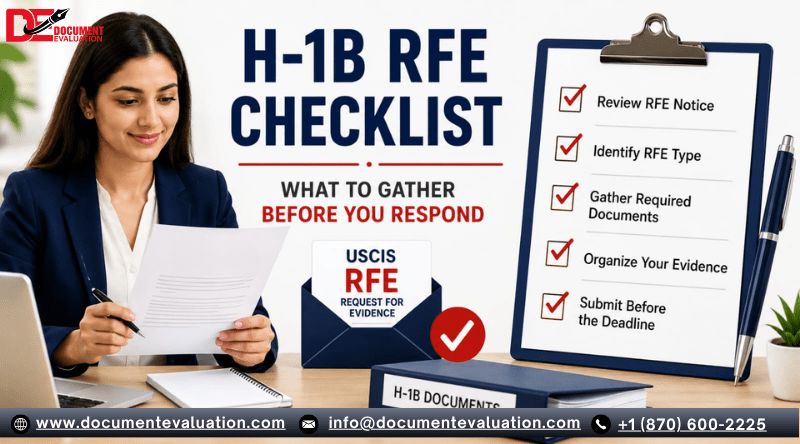

You open the mail. It is from USCIS. Your heart sinks.
It is a Request for Evidence, an RFE.
Stop right there. An RFE is not a denial. Under immigration law, it is simply USCIS saying, “We need more information before we can decide.”
According to USCIS data, the vast majority of H-1B RFEs get approved when the response is complete and correct. The difference between approval and denial? A checklist.
This is that checklist. While following a structured checklist is essential, you can also hire our specialized agency to effectively respond to H-1B specialty occupation RFE challenges. Securing expert service ensures your job duties, degree equivalency, and supporting arguments fully align with USCIS evidentiary standards.
Before You Do Anything Else
Step 1: Find the deadline. It is printed on the first page of your RFE notice. The notice triggers a standard response time of 84 days. Mark it on your calendar.
Step 2: Read the RFE twice. Underline every specific request. USCIS officers list exactly what they want. Give them exactly that.
Step 3: Identify your RFE type. Most H-1B RFEs fall into one of four categories. Find yours below.
Category 1: Specialty Occupation RFE Checklist
This is the most common H-1B RFE. USCIS is asking: Does this job really require a bachelor’s degree?
You need to gather:
- A clear explanation connecting each job duty to a specific academic field. Example: “Creating machine learning models requires a degree in computer science because ML algorithms are taught in CS 400-level courses.”
- A print-out from the Department of Labor’s Occupational Outlook Handbook for your job title, with the section highlighted that indicates that a bachelor’s degree is normal for this occupation.
- Job postings from at least three other companies. These postings must be for similar roles at similar companies. Each posting should list a bachelor’s degree as a requirement.
- Provide an expert opinion letter from either a college professor or a senior industry professional who can affirm that the position meets the legal definition of a specialty occupation as defined by §214(i)(1) of the INA.
- Your company’s organizational chart. Show where this role sits. Who does this person report to? Who reports to them? Complexity helps prove specialty occupations.
Tip: Generic job descriptions get denied. If the job involves “data analysis,” name the software. Name the methodology. Name the specific course that teaches that skill.
Category 2: Beneficiary Qualifications RFE Checklist
USCIS is asking: Does the employee’s education actually match this job?
You need to gather:
- Degree documents: Bachelor’s degree or some other advanced degree
- Academic records: If outside the USA, you must provide a verified English translation of the record.
- A credential evaluation from a recognized evaluation center (NACES): Non-negotiable for foreign degrees.
- Course analysis (not simply credential evaluation): This assessment relates to the courses taken and how they relate to the job duties. Example: Course CS401-Advanced Algorithms is directly related to job duty 3: Optimizing Database Queries.
- If you don’t have a bachelor’s degree, you need a work evaluation: USCIS uses the 3:1 rule: 3 years of applicable experience = 1 year of college education. The evaluation must come from a professor from an accredited university in the United States.
- Letters from employers stating job duties: These letters should describe specific duties performed for a specified employer. Example: “He was a good employee” will get you no credit; you need detailed technical content.
- Expert opinion letter regarding the beneficiary’s qualifications (from a proper professor in your area/field): The letter should verify that your education (or experience) relates to the offered H-1B position.
Tip: If your degree is in a slightly different field than the job, lean hard on the course-by-course analysis. Show that 80% of your coursework still applies.
Category 3: Employer-Employee Relationship RFE Checklist
This scenario is common for consulting firms, IT staffing companies, and remote workers. USCIS is asking: Does the petitioning employer actually control this worker?
You need to gather:
- The employment agreement or offer letter: Highlight every section that discusses supervision, control, firing, and daily direction.
- A detailed itinerary: List every client site, project name, start date, and end date for the entire requested H-1B period.
- Letters from end clients: Each client must write a letter confirming: (a) the beneficiary works there, (b) the petitioner (your company) supervises the work, and (c) the client does NOT control hiring, firing, or daily tasks.
- Timesheets or weekly reports: Show how the beneficiary reports their work back to the petitioner. Screenshots of reporting portals work well.
- Payroll records: W-2 forms. Pay stubs from the last six months. This document proves the petitioner pays the salary, not the client.
- An organizational chart of the petitioner company: Show where the beneficiary sits. Show their direct supervisor at the petitioner company. Provide that supervisor’s job description.
Tip: The legal test is “right to control.” Who can fire the beneficiary? Who sets their schedule? Who approves their time off? The answer must always be the petitioner.
Category 4: Wage Level / LCA RFE Checklist
USCIS is asking: Why is this complex job paired with a Level 1 or Level 2 wage?
You need to gather:
- A revised job description that accurately reflects the role’s complexity. If USCIS says the duties sound senior, do not fight it. Revise the description to match the wage level.
- DOL OEWS wage data for your specific SOC code and geographic location. Print the data from the FLAG system. Highlight the wage level you used.
- A written explanation of why you selected that wage level. For Level 1 roles, state that the position is entry-level with close supervision. For Level 2, indicate that while some independent judgment is present, complex tasks are still reviewed.
- If the role has grown more complex over time, include a letter from the employer explaining the change. Show when duties were added.
- An expert opinion letter on wage levels. Some professors specialize in labor market analysis. They can state that your wage level is appropriate for the actual duties.
Tip: Do not lie about duties to match a wage level. That is fraud. Revise honestly or upgrade the LCA.
General Checklist for Every H-1B RFE Response
Regardless of your RFE type, these items must go into every response package.
Cover page documents:
- The original RFE notice: A clear copy is acceptable if the original is lost.
- A cover letter: One page maximum. List your receipt number, the RFE date, and each issue you are addressing.
- A table of contents: Page numbers must match exactly.
Evidence organization:
- Label every exhibit “Exhibit A: Job Description.” “Exhibit B: Expert Opinion Letter.” Do not use unclear labels like “Supporting Documents.”
- Separate the evidence by RFE issues: If USCIS asked three questions, create three separate sections.
- Use page numbers: Every single page gets a number.
Foreign language documents:
- Every non-English document must have a certified English translation attached.
- The translator must sign a statement: “I certify that I am competent to translate from (language of your document) to English and that this translation is complete and accurate.”
Final checks before mailing:
- You have kept a complete copy of everything you are sending.
- You are submitting at least one week before the deadline. USCIS does not grant extensions.
- You have confirmed the correct mailing address. The RFE notice lists a specific service center. Do not mail to the wrong one.
Expert Opinion Letters: A Special Note
If you are responding to a Specialty Occupation RFE or a Beneficiary Qualifications RFE, an expert opinion letter is often the difference between approval and denial.
Your expert letter must include:
- The expert’s CV: Full academic or professional history.
- A statement of independence: The expert must say they have no financial or personal stake in your case.
- A sworn declaration: “I declare under penalty of perjury under the laws of the United States that the foregoing is true and correct.”
- A direct response to your specific RFE: Generic template letters get ignored. The letter must quote your RFE language.
Who qualifies as an expert?
- Tenured or associate professors at regionally accredited US universities
- Senior industry professionals with at least ten years of relevant experience
- Credential evaluators who are members of NACES
Who does not qualify?
- Your coworker
- Your former manager
- Anyone selling $99 template letters online
Timeline Checklist
Week 1:
- Read and decode your RFE
- Hire an attorney if you do not have one
- Order any expert opinion letters immediately (they take 7-14 days)
Weeks 2-6:
- Gather every document on your specific checklist
- Contact previous employers for letters
- Request transcripts and credential evaluations
Weeks 7-9:
- Draft your cover letter
- Organize exhibits with page numbers
- Have your attorney review everything
Week 10-11:
- Make complete copies for your records
- Submit online or via certified mail
Final week:
- Do not wait until the last day
- Confirm receipt with USCIS Case Status Online
Frequently Asked Questions
H-1B RFE response?
Continue Reading About H-1B Petitions, RFEs, Specialty Occupations & Expert Support:
- H-1B RFE Approval Timeline 2026 For USCIS Processing:
Learn what happens after submitting an H-1B RFE response, including current USCIS processing timelines, common causes of delays, approval expectations, and practical steps employers and beneficiaries can take to keep their petitions on track. - How to Strengthen an H-1B Specialty Occupation Case with an Expert Opinion Letter:
Discover how a professionally prepared expert opinion letter can help establish specialty occupation eligibility, address USCIS concerns, strengthen supporting evidence, and improve the overall credibility of an H-1B petition or RFE response. - H-1B Visa – Eligibility and Requirements:
Understand the key eligibility criteria, employer obligations, educational requirements, specialty occupation standards, filing procedures, and supporting documentation needed for a successful H-1B visa petition with USCIS.
Akash Pundir is the Chief Operating Officer at Document Evaluation LLC, bringing over 5 years of international business operations and legal support experience across the United States, Australia, and India. He has overseen the strategic positioning and analysis of over 1,000+ complex USCIS cases, specializing in guiding expert evaluation teams to draft high-stakes Expert Opinion Letters (EOL), Academic Equivalencies, and defense packets for H-1B, EB-2 NIW, RFEs, and NOIDs. Driven by digital transformation, Akash ensures every evaluation adheres strictly to the latest USCIS legal frameworks and compliance benchmarks.
