

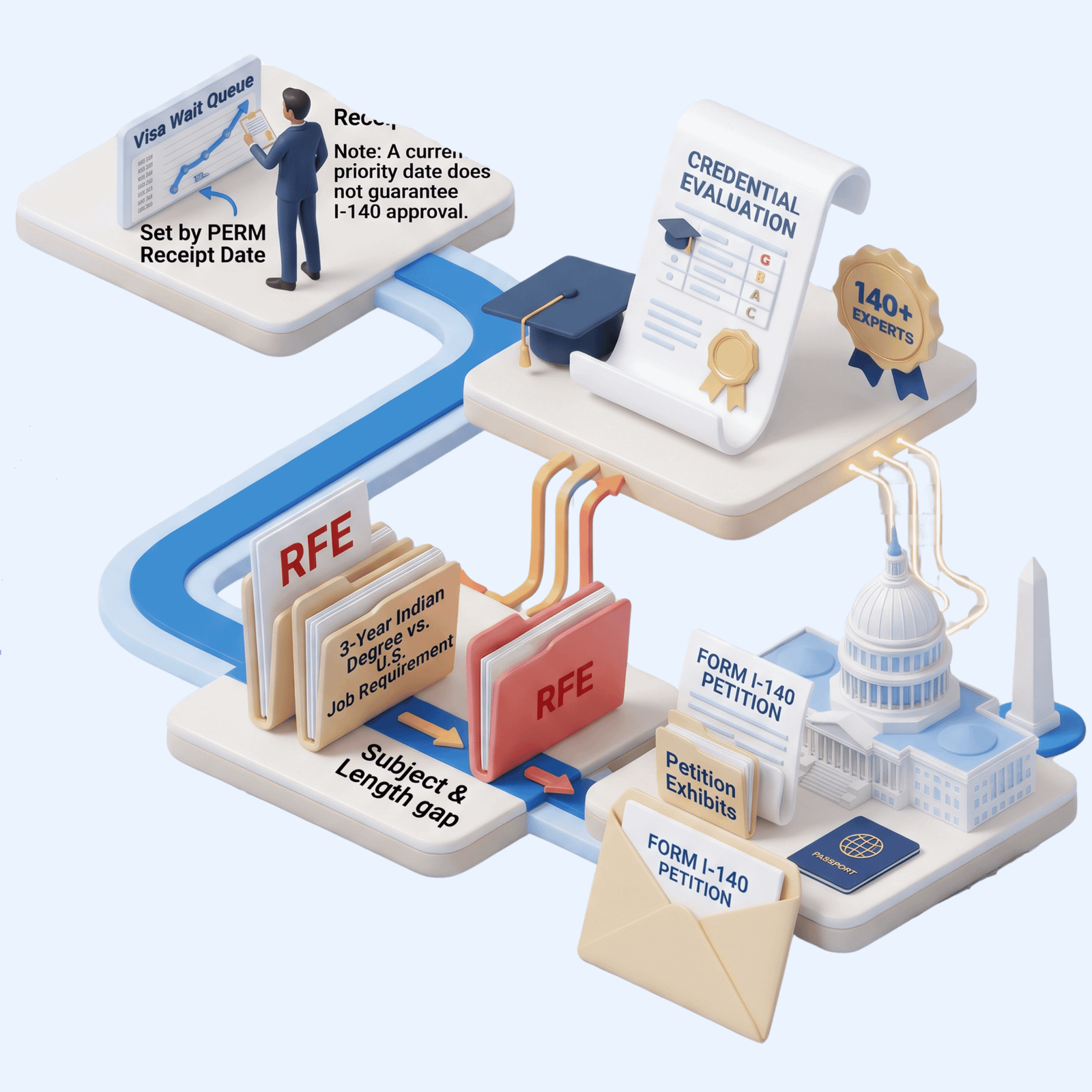
- A current priority date does not mean your I-140 will be approved.
- If your degree doesn’t match the PERM requirement, USCIS may send an RFE.
- Indian three-year bachelor’s degrees are not rejected automatically.
- A credential evaluation shows how your degree compares to a U.S. degree.
- An Expert Opinion Letter can back up your education claims.
If you’re applying for an EB-3 green card from India, you’ll be watching your priority date closely. But the date only tells you where you stand in the queue. Your education and work experience still have to match what the job requires.
Problems tend to come up when your degree’s title, subject, or length is different from what the PERM labor certification asks for. Indian bachelor’s degrees, especially three-year programs, see such issues often. Your degree certificates, transcripts, and credential evaluation are the documents that show how your education lines up with the job requirement.
💡 Next Step: When standard transcripts alone fail to resolve these equivalency discrepancies, securing authoritative professional assistance is essential to prevent an RFE or denial. Hire our specialized agency to Get Professional EB-3 NIW Expert Letter Service and ensure your academic credentials are clearly validated for USCIS review.
What Is The EB-3 Priority Date For India?
When your EB-3 case needs a PERM labor certification, the priority date is usually the day the Department of Labor receives your labor certification application. Once the labor certification is approved, your employer can file Form I-140 with USCIS.
The priority date marks your place in line for an employment-based immigrant visa. Each month, the Department of State publishes a Visa Bulletin listing a separate date for every employment-based category and country of chargeability. By comparing your date with the bulletin, you get a rough idea of when you can move to the next step.
EB-3 India Visa Bulletin, September 2026
| Eb-3 India | EB-3 India |
| Final Action Date | January 22, 2014 |
| Date for Filing | January 15, 2015 |
These dates change, so look at the latest Visa Bulletin to see whether your priority date is current.
Keep in mind that the priority date only decides whether a visa number is available. Whether your I-140 meets the EB-3 requirements is a separate decision made by USCIS.
Does A Priority Date Protect Your I-140 From An RFE?
No! Even if your date is current or earlier than the bulletin date, approval isn’t guaranteed. USCIS looks at your education, work experience, and other documents on their own to see if you qualify for the position.
Someone with a very early priority date can still get questions from USCIS about their degree or other evidence filed with the I-140. Since the wait for a visa number from India can be long, it helps to keep your documents consistent and make sure your education and experience clearly fit the job requirements.
Why Does A Degree Mismatch Lead To An RFE?
The education requirement for the position comes from the PERM labor certification, and the degree in your I-140 has to fit that requirement.
Say the PERM asks for a bachelor’s degree in computer science, but your degree is in information technology or carries a different title. USCIS may ask for more evidence before it accepts that your education meets the requirement.
A three-year bachelor’s degree from India is not automatically ruled out for EB-3. USCIS looks at your academic records, the structure of your degree, and the education the position requires. It’s up to you to provide evidence that your education satisfies the specific PERM requirement. A credential evaluation can explain the US academic equivalency of your degree, though USCIS has the final say on eligibility.
How Document Evaluation LLC Can Help?
Occasionally a foreign degree causes trouble in an EB-3 case because its title, field, or level doesn’t line up with the job requirement. In those situations, Document Evaluation LLC can review your education documents and prepare supporting evidence for your case.
- Credential evaluation: Our team goes through your degree certificates, transcripts, and academic records to assess their US equivalency. You get a detailed report on your qualifications that you can file with your EB-3 petition or attach to an RFE response.
- If USCIS issues an RFE: When USCIS asks for more information about your degree or the education listed for the job, we can prepare the evaluation and, if needed, an Expert Opinion Letter to include in your response.
- Access to experts: We work with a network of more than 140 professors and experts across different fields. We identify the field related to your degree and send you suitable expert profiles. You go through them and pick the expert you want for your letter.
- Expert Opinion Letter: An independent expert reviews your academic background, your supporting documents, and the exact concerns raised in your RFE. The letter is written around your qualifications and case details, not from a standard template. We offer 24/7 support and unlimited revisions.
Frequently Asked Questions
What is the EB-3 priority date for India?
If your EB-3 case requires PERM, the priority date is generally the day DOL receives your labor certification application. Your place in the visa queue depends on this date.
Does a current priority date mean my EB-3 I-140 will be approved?
No. Visa availability and I-140 eligibility are two different things. USCIS still has to decide whether you meet the requirements of the EB-3 position.
Is a three-year bachelor’s degree from India accepted for EB-3?
It isn’t automatically disqualified. What matters is whether your education meets the specific requirement listed for the position and whether you can document that properly.
What does a credential evaluation show in an EB-3 case?
It reviews your degree certificates, transcripts, and academic records and explains how they compare to U.S. education. If your degree title, program length, or structure differs from the PERM requirement, the report helps explain that gap to USCIS when it reviews your petition.
Can Document Evaluation LLC prepare an EB-3 RFE response?
We can prepare a credential evaluation and, where the case needs it, an Expert Opinion Letter. We work with 140+ professors and field experts, and you can review their profiles and choose the one you want for your letter.
Conclusion
Your EB-3 priority date sets your position in the visa queue, but your education still has to meet the requirements of the job you’re sponsored for. If USCIS questions your foreign degree, a credential evaluation along with an independent Expert Opinion Letter can help explain your qualifications and respond to the concerns in your case.
Official Resources:
US Department of State – Visa Bulletin
USCIS – Employment-Based Immigration: Third Preference (EB-3)
USCIS – Form I-140, Immigrant Petition for Alien Workers
US Department of Labor – Permanent Labor Certification (PERM)
Electronic Code of Federal Regulations – 20 CFR § 656.17
USCIS Policy Manual – Employment-Based Classifications
USCIS – Requests for Evidence and Notices of Intent to Deny

Looking for EB visa guidance? Find the key details below.
- EB-2 Priority Date India: Prevent NIW RFEs with an Expert Opinion Letter
Learn why priority dates only hold your place in the visa queue—and how a tailored, independent Expert Opinion Letter strengthens your I-140 record across all Dhanasar requirements to help you avoid RFEs. - EB-2 NIW Processing Time Current Updates: Timelines & Delay Prevention
Breaks down November 2026 USCIS standard and premium I-140 processing timelines, Visa Bulletin movement, and key strategies to avoid RFE delays.