

 |
|
L-1 Visa Approval Rate 2026: Latest Statistics, Trends & Success Rates

- The overall L-1 visa approval rate currently hovers around 92%.
- L-1A petitions for managers and executives generally maintain higher approval rates than L-1B specialized knowledge petitions.
- The majority of denials stem from insufficient documentation or eligibility discrepancies.
- Providing accurate and comprehensive evidence directly strengthens overall approval odds.
- Certified translations and formal credential evaluations play a key role in preventing Requests for Evidence (RFEs).
The success ratio of L-1 visa applications in 2026 will play a critical role in the decision-making process of the multinationals and professionals who plan on transferring to the US through the L-1 visa program. Although the L-1 visa will remain as a favorite choice among executives, managers, and specialized knowledge employees, approval ratios may change depending on the nature of the application, quality of documentation, and current USCIS policies.
Knowledge of the recent L-1 visa approval statistics, trends in approvals, denial reasons, and other related information will help you increase your chances of approval. This article provides information on the L-1 visa success ratio for 2026, approval trends, denial reasons, and helpful tips to improve approval chances.
To substantiate your managerial or specialized knowledge qualifications under strict adjudication standards, you can hire our specialized agency to provide an authoritative expert opinion letter for L-1 visa.
What Is the L-1 Visa?
The L-1 visa lets multinational companies move employees from a foreign office into a US office of the same organization. It’s built for intracompany transfers, not general hiring.
There are two categories of the visa, and which one applies to you depends on your job function:
- L-1A: for executives and managers who direct the organization, a major function, or a team of professionals.
- L-1B: for employees with specialized knowledge of the company’s products, services, systems, or proprietary processes that isn’t readily available in the general labor market.
To qualify for either category, the applicant must generally have worked for the overseas company on a full-time basis, for at least one continuous year, within the three years immediately preceding the transfer. Part-time work, gaps in employment, or duties that fall outside the qualifying criteria can affect eligibility for the L-1 visa.
What Is the L-1 Visa Approval Rate in 2026?
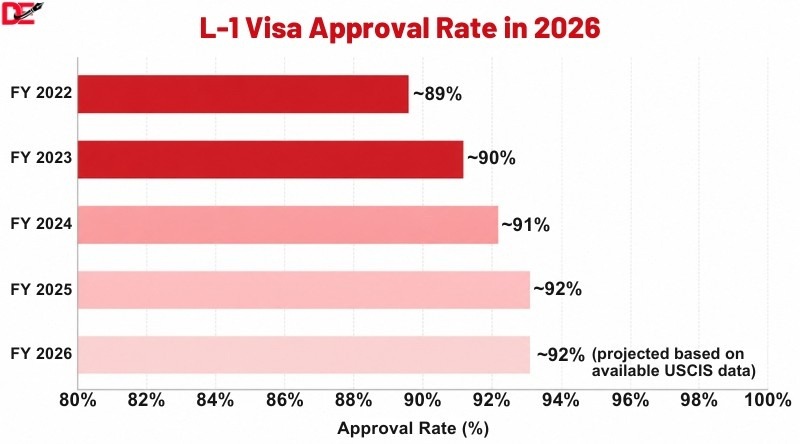
| Fiscal Year | Estimated Overall L-1 Approval Rate |
|---|---|
| FY 2022 | ~89% |
| FY 2023 | ~90% |
| FY 2024 | ~91% |
| FY 2025 | ~92% |
| FY 2026* | ~92% (projected based on available USCIS data) |
The course here matters as much as the raw number. Approval rates have climbed steadily over the past several years, likely some combination of stronger petition preparation across the industry and more predictable adjudication standards.
That said, a high aggregate rate describes the population of applicants, not any single case. USCIS reviews every petition on its merits, and an industry-wide trend won’t save a petition that’s missing key evidence.
What Do These Numbers Actually Mean for You?
A 92% approval rate sounds reassuring, but it’s easy to misread. It does not mean 92% of people who want an L-1 automatically qualify; it means 92% of petitions that were actually filed were approved, and most of those were filed by employers who already reviewed the case carefully before submitting it.
Your chances of being among that successful 92% improve significantly if you meet the following criteria:
- You’ve completed at least one full year of qualifying employment abroad.
- The proposed US role closely to the overseas position in terms of scope and responsibility
- The employer is able to clearly document the corporate relationship between the foreign and US entities, whether that’s a parent, subsidiary, affiliate, or branch
- Your job duties clearly meet the requirements for either the L-1A or L-1B visa.
- Your petition includes complete, well-organized supporting evidence from day one, not documentation assembled quickly after a Request for Evidence (RFE) arrives.
Even employees at large, well-known multinational companies can receive RFEs if key documentation is missing, inconsistent, or unclear. Company size and reputation help, but they don’t substitute for a well-built individual case.
What Are The L-1A vs. L-1B Approval Rates?
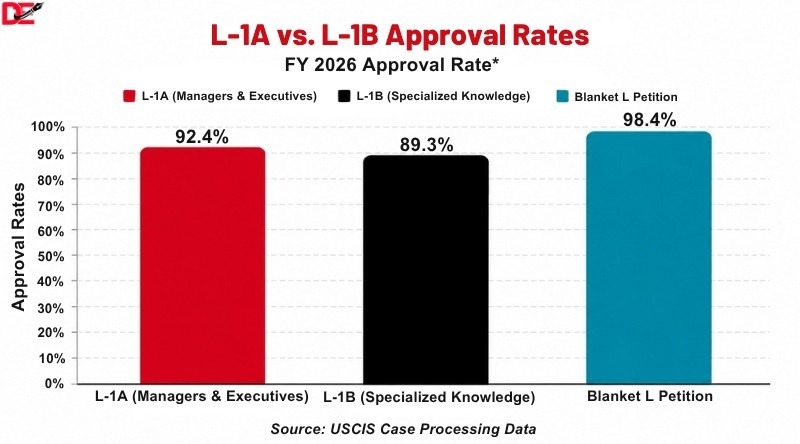
| Petition Type | FY 2026 Approval Rate* |
|---|---|
| L-1A (Managers & Executives) | 92.4% |
| L-1B (Specialized Knowledge) | 89.3% |
| Blanket L Petition | 98.4% |
Why is there a gap between L-1A and L-1B?
Managerial and executive responsibilities are just easier for USCIS officers to verify. Org charts, reporting lines, budget authority, and headcount all provide fairly objective evidence. Specialized knowledge is difficult to prove. Officers have to be convinced the employee’s knowledge is genuinely uncommon, not just solid industry expertise, and that subjectivity is what makes L-1B cases more prone to RFEs and denials.
Blanket L petitions see the highest approval rates of all, and it’s for a simple reason: they’re only available to large, established multinationals that USCIS has already pre-approved as qualifying organizations, so the company-level question is settled before the employee’s petition is even filed.
Why Do Some Employee Transfers Get Denied?
Most L-1 denials aren’t about fraud. They occur because USCIS wasn’t convinced either of the employee’s qualifications or of the employer’s structure. The most common failure points
1. The L-1B Specialized Knowledge Claim Doesn’t Hold Up
“Specialized knowledge” is a legal term with a specific bar to clear, and general industry experience usually doesn’t clear it. USCIS can agree the employee is valuable and still conclude that value isn’t unique or advanced enough to justify a transfer over an ordinary hire.
2. The Managerial Or Executive Role Isn’t Backed Up
Your title alone won’t do the work. USCIS wants to see who you supervise, what decisions you make, and where you sit in the org chart, not just what’s on your business card.
3. The One-Year Employment Requirement Falls Short
Many applicants have at least one continuous year with the foreign entity, and it must fall within the three years immediately prior to the transfer. USCIS can deny your application when miss that window, work part-time, or have mismatched dates
4. The Corporate Relationship Isn’t Clearly Proven
USCIS wants to see a real, documented relationship between the US and foreign office: parent, subsidiary, affiliate, branch, or whatever the case may be. This requirement is especially true when the ownership structure is complicated or has recently changed. In those situations, you really need to make sure the paperwork is correct, or you can expect extra examination.
5. The Petition Is Missing Or Inconsistent Documents
This one’s the most avoidable. Missing pay stubs, unclear job descriptions, or dates that contradict each other across documents are precisely what triggers an RFE even when the underlying case is strong.
How Can Transfer Employees Improve Their Approval Chances?
Your employer files the petition, but you’re not a passive participant in the process. The employee’s own records and responsiveness play a real role in how strong the case turns out to be. Before filing, make sure:
- Your resume accurately reflects your experience, with no inflated titles or duties that don’t match your real day-to-day work.
- Your job duties are clear and consistent with every document in the petition itself.
- Your payroll and HR records match exactly to the employment dates. Even small errors can trigger unnecessary scrutiny.
- Your educational documents are complete and relevant and properly evaluated for US equivalency.
- Any non-English documents are professionally translated, with certified translations rather than informal ones.
- You respond promptly to any information requests from your employer’s HR or legal team; delays in gathering documentation are one of the most common causes of filing delays.
Taking ownership of these details before your employer submits the petition can reduce your risk of an RFE, which, even when ultimately successful, can add months to your timeline.
Frequently Asked Questions
What’s the difference between L-1A and L-1B visas?
L-1A covers executives and managers, as well as people who direct a function or supervise professional staff. L-1B is for employees whose knowledge of the company’s products, processes, or services is specialized enough that it’s not something you’d easily find in the general labor market.
How long do I need to work abroad before applying?
The rule is that you need to work continuously for one year with the overseas employer, at any point in the three years before your transfer, and it must be full-time in a qualifying role. Part-time work or gaps during that stretch can make things harder to prove.
Why is the L-1B approval rate lower than L-1A?
Because “specialized knowledge” is a harder thing to prove. It’s subjective by nature, and USCIS officers need to be convinced your knowledge is genuinely uncommon, not just solid industry experience. That’s what makes L-1B cases more likely to draw an RFE or denial.
What are the most common reasons for L-1 visa denials?
A weak specialized knowledge claim, poorly documented managerial duties, or gaps that break the one-year employment requirement are the usual culprits. Missing or contradictory paperwork trips up plenty of cases too.
How can I improve my chances of L-1 approval?
Small things matter more than people expect: your resume needs to match your experience, your job duties should read the same way across every document, and your employment dates need to line up exactly with your payroll records. Getting these details right before filing can help you avoid an RFE.
Conclusion
A 92% approval rate is encouraging, but it’s not a guarantee. Most denials aren’t about fraud; they happen because USCIS wasn’t convinced, whether that’s about your specialized knowledge, your managerial duties, or the relationship between the two companies. All of that is preventable.
Consistent employment dates, job duties described the same way across every document, and complete, well-prepared paperwork are key to closing that gap. The approval rate shows that you have a decent chance of getting approved. What you do with your documentation is what actually determines your case.

Tracking L-1 Visa Approval Rates in 2026? Latest Statistics & Trends
Explore FY 2026 approval rates for L-1A, L-1B, and Blanket L petitions, common denial triggers, and tips to safeguard your transfer.

Explore More L-1 Visa Approval & USCIS RFE Guides
- Common L-1, O-1 & TN Visa RFE Reasons and Response Guide:
Learn the most common reasons USCIS issues RFEs for L-1, O-1, and TN visa petitions, along with practical strategies and documentation tips to prepare a strong, timely response. - Complete Guide to USCIS Requests for Evidence and Strong Response Strategies
Understand what a USCIS Request for Evidence (RFE) means, review an official sample notice, and learn how to respond effectively to avoid unnecessary delays or petition denials. - Step-by-Step Guide to Responding to a USCIS RFE:
Follow a step-by-step guide to organizing supporting documents, addressing every USCIS concern, and submitting a complete RFE response that strengthens your immigration case.
Akash Pundir is the Chief Operating Officer at Document Evaluation LLC, bringing over 5 years of international business operations and legal support experience across the United States, Australia, and India. He has overseen the strategic positioning and analysis of over 1,000+ complex USCIS cases, specializing in guiding expert evaluation teams to draft high-stakes Expert Opinion Letters (EOL), Academic Equivalencies, and defense packets for H-1B, EB-2 NIW, RFEs, and NOIDs. Driven by digital transformation, Akash ensures every evaluation adheres strictly to the latest USCIS legal frameworks and compliance benchmarks.
