

 |
|
How to Strengthen Your USCIS Case with Expert Opinion Letters and Supporting Evidence: A Guide


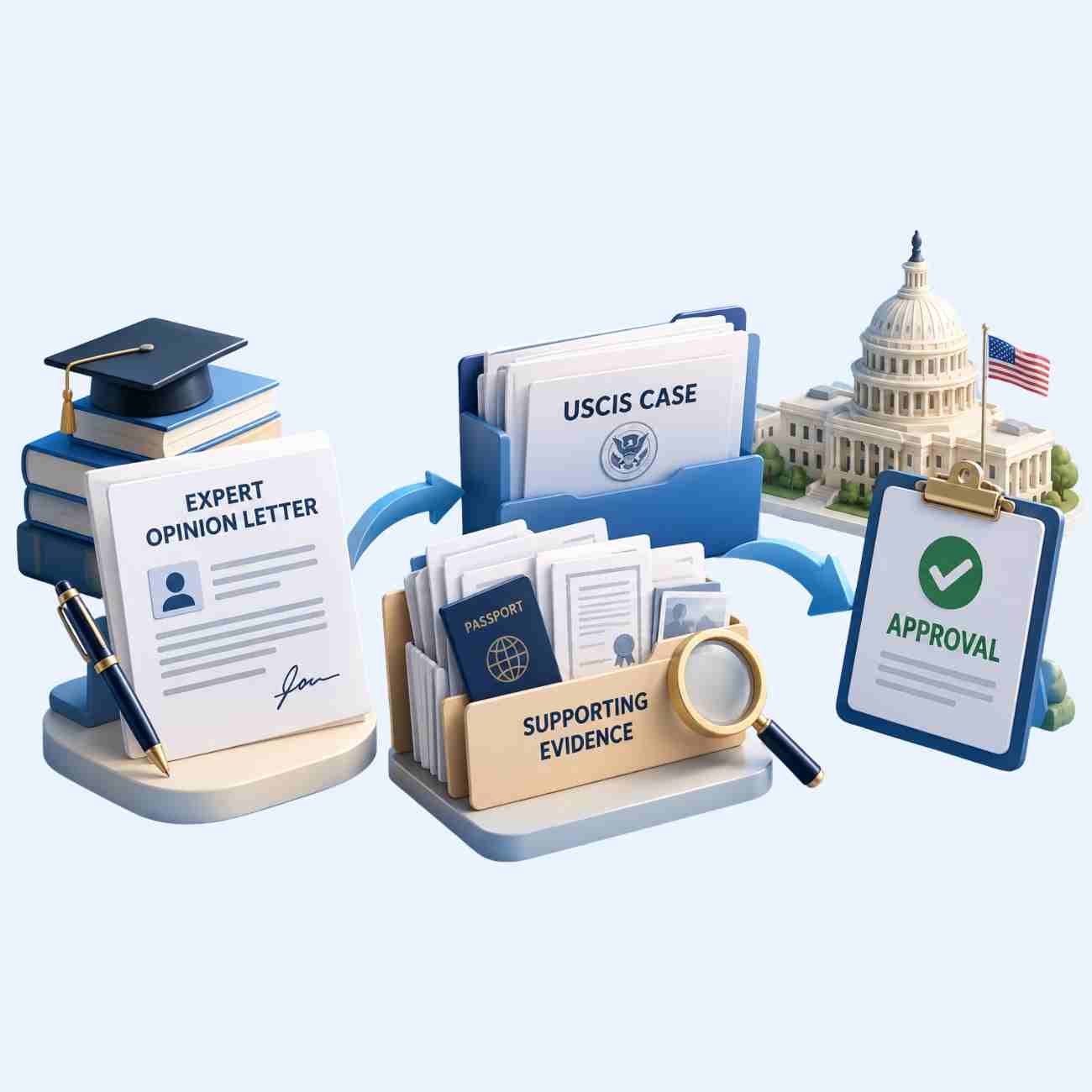
Getting a US visa is not straightforward. You have to prove that your degree, work, and skills meet the rules. That’s why a letter from an expert helps a lot. But many people don’t realize that the letter by itself is usually not enough.
USCIS officers don’t just read the letter. They check the proof that goes with it. If you provide a detailed letter and support it with strong documents, you will help your case a lot. If you don’t back it up with evidence, it can cause delays, RFEs, or even a denial.
Let’s read what USCIS looks for, common mistakes to avoid, and how to make your case stronger.
To ensure your petition stands up to strict scrutiny, you can hire our specialized agency for a comprehensive Expert Opinion Letter for USA.
What is an Expert Opinion Letter?
An expert opinion letter is a written review from a qualified expert in your field, such as a professor or industry leader. (Note: For degree-equivalence questions in H-1B cases, a separate credential evaluation from an academic evaluator is typically required.) It explains why you meet the rules for immigration or a professional job.
You’ll often see these letters for the following:
- H-1B specialty jobs
- Checking if a foreign degree is equal to a US degree
- EB-2 National Interest Waiver petitions
- O-1 visas for extraordinary ability
- EB-1 visas for extraordinary ability
- PERM labor certification
- Work experience checks
The expert looks at your education, experience, achievements, and work history before writing their opinion.
Here’s the key part – An expert’s strong opinion doesn’t mean much unless you back it up with solid evidence.
What Evidence Does Each Visa Require for an Expert Opinion Letter?
| Visa Type | Expert Opinion Letter Supports | Common Supporting Evidence |
|---|---|---|
| H-1B | Specialty occupation or degree equivalency | Degree, transcripts, credential evaluation, and work experience. |
| EB-2 NIW | National importance and professional expertise | Publications, citations, patents, awards, and recommendation letters. |
| EB-1A | Extraordinary ability claims | Major awards, media coverage, judging experience, memberships, and citations. |
| O-1 | Extraordinary ability in the field | Awards, press coverage, contracts, speaking engagements, and expert letters. |
| PERM | Education and job qualification verification | Academic records, employment letters, and credential evaluation. |
| Work Experience Evaluation | Experience-based qualification | Employer letters, job duties, and employment history. |
*Note: This is a general evidence list. Your specific case may need additional evidence.
What Supporting Evidence Should You Include in Your Expert Opinion Letter?
Here’s what you can submit with your letter to strengthen it. Pick the ones that fit your field and visa type.
- School and degree records – Degrees, transcripts, and diplomas. If they’re from another country, get a credential evaluation from a reputable agency (for H-1B, use a NACES-member evaluator). The evaluation tells USCIS whether your degree equals the required US degree (bachelor’s, master’s, or doctorate).
- Your published work and how often it’s cited – PDFs of your papers, Google Scholar page, h-index, and citation counts. Letters from experts sound more convincing when they mention your impact factors or citation numbers.
- Awards and recognition – certificates, newspaper clippings, and award letters. For O-1, major national or international prizes are the most important. If your award is from another country, include a brief explanation of the award’s national or international significance.
- Work and job proof – Letters from employers on company letterhead, job descriptions, and pay stubs. This shows that your experience matches the specific job you are claiming.
- Patents and inventions – USPTO filings, invention disclosures. Use numbers that show real results such as how many people supported or how much money they earned.
- Memberships and judging roles – Invitations to peer-review panels & membership in elite societies. It shows other people in your field respect you.
- News coverage and impact numbers – News articles, project results & stats. Example: “My algorithm cut processing time by 40%.” Numbers make your story real.
- The expert’s own qualifications – Include the expert’s current CV, a signed statement that they have no conflict of interest & an explanation of how they know your field. Without this, USCIS may give the letter less or no weight.
- Certified translations – Every non-English document must come with a full English translation and a signed translator’s certification. This requirement is not optional.
- 10. An index or cover note – List each document and briefly explain what it proves. Do not assume the USCIS officer understands your industry’s norms.
How Many Documents Should You Submit For your EOL?
There’s no magic number, but here’s a practical rule of thumb:
| Number of Documents | Recommendation |
|---|---|
| 5–10 Strong Documents | Ideal for most expert opinion letter cases. Focus on your strongest and most relevant evidence. |
| Too Few Documents | May not provide enough supporting evidence for the expert to prepare a strong and credible opinion. |
| Too Many Documents | Can make the petition harder to review if it contains unnecessary, repetitive, or less relevant evidence. |
Quality matters more than quantity. One properly explained patent with revenue data is better than 20 generic certificates. Focus on your 5 to 10 strongest pieces of evidence, not on everything you’ve ever done.
What Type of Evidence Mistakes Often Lead to RFEs or Visa Denials?
In my experience, even well-prepared applicants fall into these traps:
- Submitting hollow evidence – A certificate without context. A job title without an org chart. This document is a publication without citation data. Evidence needs to tell a story, not just exist.
- Letting the letter do all the heavy lifting – An expert opinion letter says what the expert believes. Your evidence proves it. These are two distinct functions.
- Ignoring the “distinguished” threshold – Immigration law doesn’t just ask whether the applicant has achievements; it asks whether those achievements meet a high standard. Your evidence must establish that standard and show the applicant meets or exceeds it.
- Including irrelevant materials – A big folder doesn’t always mean you have a strong case. Adjudicators are not impressed by volume, they look for relevance & quality. Burying strong evidence in filler material can actually damage your case.
- Using outdated evidence – For most visas, focus on achievements from the last 3 to 5 years. However, for EB-1A and O-1, older achievements that established your original reputation are also valuable. The key is to show sustained acclaim over time, not just recent work.
Frequently Asked Questions
How many expert letters do I need?
The law does not specify a required number of expert letters. Most strong cases include one primary expert opinion letter along with several additional letters from independent experts. A few well-supported, credible letters are generally more effective than many weak ones.
Can I include awards or recognition from other countries?
Yes. USCIS gives greater weight to awards that are nationally or internationally recognized. Local awards may still be helpful if you provide evidence explaining their prestige, significance, and impact within your profession.
What’s the main reason expert letter cases get denied?
The most common reason is insufficient supporting evidence. Even a well-written expert opinion letter cannot overcome a lack of documentation that verifies the claims made in the petition.
Should I send everything now or wait for USCIS to ask for more?
It is generally best to submit the strongest possible evidence with the initial filing. A complete petition can reduce the likelihood of receiving a Request for Evidence (RFE) and help avoid unnecessary delays.
How recent should my proof be?
Although there is no official requirement, evidence from the past three to five years is generally the most persuasive because it demonstrates ongoing professional achievements. Earlier accomplishments may also be valuable if they established your reputation.
Do I need to explain each document I send?
Yes. Including a clear index or brief explanation for each document helps USCIS understand its purpose and relevance, making your petition easier to review.
To Sum Up
An expert opinion letter is one of the most valuable tools in an immigration petition. But it’s a tool, not a solution on its own. The evidence you build around that letter is what makes it credible, persuasive, and approvable.
And never forget: USCIS requires certified translations for every non-English document. Missing translations are an automatic RFE or denial.
Every purpose should be linked back to a legal criterion. And every claim the expert makes should be backed by something the adjudicator can see, read, and verify.
Get that right, and you give your petition the strongest possible foundation.

Continue Reading About Expert Opinion Letter Requirements:
- Expert Opinion Letter for USCIS:
An expert opinion letter for USCIS helps demonstrate that your education, work experience, and professional background meet immigration requirements for petitions such as H-1B, EB-2 NIW, and O-1 visas. Learn about eligibility, supporting evidence, evaluation standards, and how a well-prepared expert opinion letter can strengthen your case and reduce the risk of RFEs. - Best expert opinion letter service for EB-2 NIW:
Finding the best expert opinion letter service for EB-2 NIW is essential for building a strong National Interest Waiver petition. This guide explains what makes an expert opinion letter credible, the documents required, approval strategies, processing timelines, and how professional evaluation services can help support your USCIS case effectively.
- EB-2 NIW Expert Opinion Letter for Data Scientists:
Data scientists and AI professionals often qualify for EB-2 NIW petitions when their work demonstrates national importance and substantial merit. This guide explains how an expert opinion letter can support data science, machine learning, and AI-related immigration cases by validating technical expertise, professional achievements, and industry contributions for USCIS review.
Akash Pundir is the Chief Operating Officer at Document Evaluation LLC, bringing over 5 years of international business operations and legal support experience across the United States, Australia, and India. He has overseen the strategic positioning and analysis of over 1,000+ complex USCIS cases, specializing in guiding expert evaluation teams to draft high-stakes Expert Opinion Letters (EOL), Academic Equivalencies, and defense packets for H-1B, EB-2 NIW, RFEs, and NOIDs. Driven by digital transformation, Akash ensures every evaluation adheres strictly to the latest USCIS legal frameworks and compliance benchmarks.
